

Анализ технико-технологического комплекса исследований подледниковых озер Антарктиды
- 1 — аспирант Санкт-Петербургский горный университет императрицы Екатерины II ▪ Orcid
- 2 — канд. техн. наук ассистент Санкт-Петербургский горный университет императрицы Екатерины II ▪ Orcid
- 3 — канд. техн. наук научный руководитель лаборатории Санкт-Петербургский горный университет императрицы Екатерины II ▪ Orcid
- 4 — инженер-конструктор Санкт-Петербургский горный университет императрицы Екатерины II ▪ Orcid
Аннотация
Подледниковая гидрологическая система Антарктиды является уникальным и наименее изученным источником геологической, палеоклиматической и биологической информации, доступ к которой возможен только при проведении прямых исследований с отбором проб воды, взвеси и донных отложений. Наибольшую научную ценность представляют изолированные на протяжении многих сотен тысяч лет участки последовательного осадконакопления с мощными слоями древних донных отложений, не нарушенных ледниковой базальной эрозией. Такие участки располагаются в подледниковых озерах – ключевых элементах подледниковой гидрологической системы Антарктиды. Тема планирования и реализации прямых исследований подледниковых озер Антарктиды, находящихся как под относительно небольшой толщей ледника, так и на глубинах более 2500 м, до сих пор является дискуссионной из-за малого опыта решения подобных задач, а также разногласий в области соблюдения и контроля экологических требований при получении доступа к подледниковым объектам. В статье обобщены результаты междисциплинарных исследований подледниковых озер Антарктиды, включая их локализацию, глубину залегания, морфометрические и гидродинамические параметры, а также состав донных отложений. Особое внимание уделено описанию технико-технологического комплекса исследования подледниковых озер, включающего геофизические работы, бурение скважины доступа, вскрытие озера, определение физических и химических параметров водного объекта, отбор проб воды, донных отложений и взвеси. Анализируются и обсуждаются сложности и ограничения при исследовании «стабильных» подледниковых озер, представлены ключевые направления развития используемых в этой сфере технологий и технических средств.
Исследование выполнено в рамках Государственного задания в сфере научной деятельности на 2024 г. № FSRW-2024-0003.
Введение
В настоящее время изучение подледниковых гидрологических систем Антарктиды остается одной из самых актуальных и приоритетных задач в сфере наук о Земле (геофизика, гидрология, геология, палеоклиматология) и биологических наук (микробиология, молекулярная биология, экология и экзобиология). Элементы подледниковой гидрологической системы в Антарктиде представлены шельфовыми океаническими участками, потоками и озерами, покрытыми толщей ледника, затрудняющей их прямое исследование. Одними из основных объектов исследований являются подледниковые озера, разделяемые на «стабильные» и «активные», в зависимости от постоянства объема воды и наличия гидравлической связи с другими элементами подледниковой гидрологической системы. В настоящее время в Антарктиде насчитывается 766 подледниковых озер [1], 70 % которых на протяжении многих сотен тысяч лет изолированы от внешней среды, что обуславливает их научную ценность благодаря значительному возрасту донных отложений [2], а также возможному наличию неизвестных форм жизни [3, 4].
Значительный вклад в современное представление о подледниковых озерах обеспечен геофизическими методами исследования (авиационные и наземные радиолокационные зондирования, сейсмические зондирования методом отраженных волн (МОВ), спутниковая радарная альтиметрия [5-7], гравиметрия и магнитометрия [8], электроразведка методом переходных процессов [9]) и прогностическими расчетными методами (моделями базального таяния ледника [10, 11]), геостатическим моделированием [12]. Несмотря на достоинства указанных методов, богатый опыт их использования и большую значимость результатов, они позволяют получить лишь косвенные данные о параметрах подледниковой среды, но не могут предоставить исчерпывающую информацию о структуре, минералогическом, биологическом составе воды и донных отложений, а также гидрологическом режиме озера. Задача получения такой информации лежит в основе будущих исследований подледниковых озер [13] и может быть решена методами прямого опробования, наиболее информативными из которых является отбор кернов донных отложений, проб воды, минеральной и биологической взвеси.
История прямых исследований подледниковых озер охватывает уже более двух десятков лет, в этом направлении разработано и испытано множество технологий и технических средств. Разнообразие морфометрических и гидродинамических параметров озер, литологические особенности их донных отложений, значительный диапазон мощностей ледника и удаленность исследуемых объектов от научных станций обуславливают применение уникального подхода при изучении каждого озера.
В настоящее время формально не проведено полное описание наиболее проработанных технологий и технических средств, разработанных множеством научных коллективов и используемых на разных этапах исследования озер. В статье приведены анализ основных параметров подледниковых озер Антарктиды и обзор опробованных и перспективных составляющих технико-технологического комплекса исследований, включающего этапы предварительных геофизических работ, бурения скважины доступа, вскрытия озера и его исследования с отбором проб воды, донных отложений и взвеси. Также анализируются и обсуждаются ограничения и основные направления развития исследований «стабильных» подледниковых озер, как наименее изученных и наиболее ценных с научной точки зрения составляющих подледниковой гидрологической системы Антарктиды.
Особенности подледниковых озер Антарктиды
Изолированные от атмосферы толщей льда подледниковые озера Антарктиды значительно отличаются от озер на других континентах условиями формирования, гидрологическим режимом, биоразнообразием, химическим составом воды, а также минералогическим составом и возрастом донных отложений.
Известно, что подледниковые озера Антарктиды в основном образуются в результате таяния нижней части ледяного покрова от воздействия геотермального тепла, а также в результате фрикционного нагрева при течении ледника. Большинство «активных» озер находится под быстротекущими ледяными потоками в прибрежной части Антарктиды, что обуславливает их небольшие глубины и размеры, а также сравнительно малый возраст донных отложений (порядка нескольких сотен тысяч лет), зачастую с нарушенной структурой [14].
«Стабильные» озера встречаются там, где скорость базального таяния низка или равна нулю [15] при малой скорости течения вышележащего ледника. В отличие от «активных» озер они обладают бо́льшими размерами и глубинами, а также участками ненарушенного естественного осадконакопления. Среди «стабильных» озер существуют уникальные объекты, образованные посредством тектонических [16-18] и гидрологических процессов еще до оледенения Антарктиды, поэтому в них возможно обнаружение биологических, геологических и гидрологических реликтовых компонентов длительного доледникового периода [19]. В котловине некоторых из таких озер водная толща может быть сильно стратифицирована по плотности, солености и температуре, а их придонную часть могут занимать горячие и сильно минерализованные геотермальные воды [20].
Морфометрические и гидродинамические параметры подледниковых озер
Основными морфометрическими параметрами подледниковых озер являются объем водного тела и глубина, зависящие от геоморфологических особенностей котловины. Глубины подледниковых озер разнятся от нескольких метров для «активных» прибрежных озер до 1300 м для «стабильных» озер (например, озеро Восток [5, 21]), а объемы водного тела изменяются в диапазоне от 0,2 км3 до 5400 км3 (табл.1). Дополнительными параметрами являются скорость и направление течений, определяющих наличие перемешивания объема воды и взвеси, что в совокупности с донным рельефом влияет на интенсивность осадконакопления и, как следствие, на возраст и структуру донных отложений [22].
Таблица 1
Морфометрические и гидрологические параметры наиболее изученных подледниковых озер Антарктиды и их донных отложений
|
Озеро |
Средняя мощность покрывающего льда, м [15] |
Глубина, м [15] |
Объем водного тела, км3 [15] |
Тип озера |
Структура донных отложений |
Мощность отложений, м |
Скорость циркуляции воды, мм/с [23] |
|
Whillans* [24] |
798 |
6 |
0,155 |
Активное |
Илистый диамиктон, состоящий из 8 % гранул и гальки, 33 % песка, 26 % ила и 33 % глины (D50 ≈ 0,078 мкм) |
н/д |
н/д |
|
South Pole [25] |
2857 |
32 |
н/д*** |
Стабильное |
Плотность 1800 кг/м3 |
150 |
0,1 |
|
Concordia [15] |
4055 |
126 |
31 |
Стабильное |
н/д |
н/д |
0,83 |
|
Ellsworth [2] |
3400 |
156 |
1,37 |
Активное |
Мелкозернистые илы (< 0,06 мм) пористостью 77 % (глина-ил-песок 80-18-1,6 %) |
6 |
0,69 |
|
Восток** [26-28] |
3945 |
Средняя 400 м; максимальная 1200 м |
6100 |
Стабильное |
Тонкодисперсная (глинисто-алевритовая) фракция глинисто-слюдистых минералов и зерен кварца микрометровых размеров с включениями зерен (алевролитов и песчаников) размером от 0,3 до 8 мм. Средний размер включений 0,5-2,0 мм |
300 |
3,8 |
|
90Е [29] |
4074 |
900 |
1800 |
Стабильное |
н/д |
н/д |
н/д |
|
Mercer** [30] |
1149 |
15 |
0,43 |
Активное |
Мелкозернистые илы или глины D60 < 0,063 мм (пористость 77 %, глина-ил-песок 80-18-1,6 %) |
н/д |
н/д |
|
СECs [22] |
2653 |
310 |
2,5 |
Активное |
Мелкозернистые отложения с преобладанием ила и глины пористостью 77 % (глина 80 %, ил 18 %) |
15 |
0,97 |
|
Snow Eagle (LSE, PEL) [31] |
3600 |
115 |
21 |
Активное |
Неконсолидированные насыщенные водой отложения плотностью 1700 кг/м3 |
200 |
н/д |
|
Hodgson* [32] |
4 |
90 |
н/д |
Бывшее подледниковое |
Серая илисто-песчаная грязь с множественными прослойками более крупных отложений от песка до гравия |
3,8 |
н/д |
|
Untersee* [33] |
3 |
64 |
0,7 |
Поверхностное |
Терригенные черные илы (илисто-глинистые, глинисто-илистые и илисто-глинистые с примесью песка), богатые органическим веществом |
н/д |
н/д |
* Был получен доступ к озеру с последующим отбором проб донных отложений, во всех остальных озерах представлена предполагаемая структура донных отложений.
** Был получен доступ к озеру без отбора донных отложений.
*** Нет данных.
Локализация и глубина залегания подледниковых озер
Реализация технико-технологического комплекса работ по исследованию подледниковых озер осложняется экстремальной изоляцией изучаемых объектов (рис.1, а) – значительной мощностью ледника и удаленностью озер от полярных станций. Залегание озер относительно поверхности ледника изменяется в широком диапазоне от нескольких десятков метров на побережье до 4661 м (LVS-12) [15] в континентальной части Антарктиды, удаленность от полярных станций может быть от 0 км (Восток) до 791 км (Recovery9) [15].
Как правило, «стабильные» озера покрыты большей толщей ледника по сравнению с «активными» – 90 % из них покрыты ледником мощностью более 2500 м против 26 % у «активных» (рис.1, б).
«Активные» озера отличаются большей удаленностью от полярных станций, 73 % располагается на расстоянии, превышающем 200 км, против 44 % у «стабильных» озер (рис.1, в).
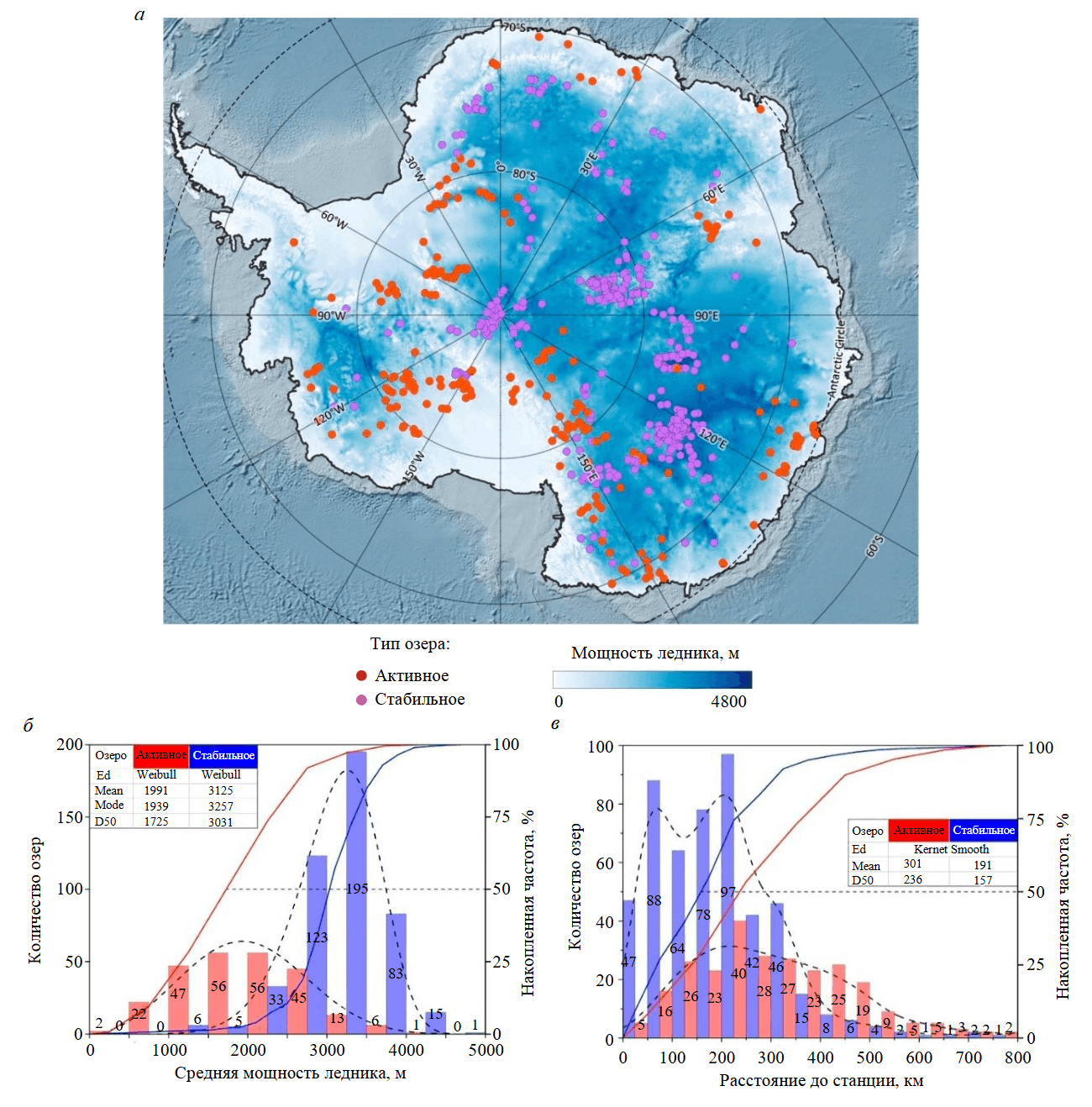
Рис.1. Параметры локализации и доступности подледниковых озер Антарктиды: а – мощность ледника на карте Антарктиды с расположением подледниковых озер (на основе данных [34]); б – распределение значений мощности ледника над подледниковыми озерами (на основе данных [15]); в – распределение расстояния от озер до ближайших полярных станций (на основе данных [15])
Литологические особенности донных отложений
Ввиду малого опыта отбора проб из подледниковых озер Антарктиды, современное представление об их донных отложениях складывается из результатов геофизических работ и последующей интерпретации полученных данных, а также результатов обработки кернов отложений из-под шельфовых ледников, подледниковых потоков, двух «активных» озер, а также озер, ранее покрытых ледником. Донные отложения подледниковых озер могут быть как значительно стратифицированными, с прослойками, отличающимися своими физико-механическими характеристиками, так и гомогенными. Структура отложений зависит от генезиса и эволюции озера, а также динамики вышележащего ледника. Результаты обработки кернов из подледниковых водоемов, в том числе из двух «активных» подледниковых озер, показывают, что донные отложения подледниковых водоемов Антарктиды менее однородны по сравнению с отложениями в не покрытых льдом озерах умеренных широт, могут обладать высокой прочностью на сдвиг (более 70 кПа на глубине 2 м [35]) и представлены неконсолидированными водонасыщенными диамиктонами, илами или песками с промежуточными крупнозернистыми обломочными слоями (4-64 мм) неорганического терригенного происхождения [36] (табл.1). Наличие прослоек крупнозернистых обломочных пород зависит от отдаленности участка осаждения от линии стока ледника на береговой линии. По мере удаления от нее осадок становится более мелкозернистым и характеризуется снижением скорости осаждения [37]. Крутые борта и высокая гидродинамическая активность озер способствуют формированию валов отложений, стекающих под силами гравитации со склонов у дна озера и нарушающих естественную последовательность осадконакопления, что также влияет на выбор участков отбора проб.
Следовательно, локализация и глубины залегания подледниковых озер, их морфометрические и гидродинамические параметры, а также литологические особенности донных отложений не только оказывают существенное влияние на спектр и масштаб решаемых научных задач, но и определяют используемые технологии и технические средства реализации проекта.
Технико-технологический комплекс исследований подледниковых озер
Комплексное исследование подледниковых озер включает в себя:
- Изучение водной толщи методами вертикального зондирования, сканирования, дискретного по глубине отбора проб воды и фильтрации взвеси от раздела «лед – вода» до дна, что дает информацию о физических, химических и биологических характеристиках подледниковых озер [15, 19].
- Анализ донных отложений после отбора кернового материала, а также минеральных включений в конжеляционном льду, который позволяет получить важнейшую информацию о геологических, тектонических, гидрологических и палеоклиматических процессах Антарктиды, а также о живых организмах, возможно обитавших в водной толще озер до начала процессов оледенения континента [4, 35]. Например, в результате изучения кернов льда, полученных из ледника, покрывающего озеро Восток, была выдвинута теория о наличии в его котловине геотермальных источников, как у озер тектонического происхождения [26].
Комплекс прямых исследований подледниковых озер состоит из нескольких основных этапов:
- Геофизические исследования.
- Бурение скважины доступа к подледниковому озеру.
- Вскрытие подледникового озера.
- Отбор проб воды, донных отложений, взвеси и измерение параметров подледникового озера.
Геофизические исследования
Перед прямыми исследованиями подледниковых озер необходимо определить их физические характеристики и топографические условия [38-40]. Использование прогностических моделей базального таяния ледников [41] в совокупности со средствами дистанционного изучения Антарктиды, представленных спутниковой альтиметрией и поверхностной геофизикой (рис.2, в), является единственным возможным способом идентификации подледниковых водных объектов, позволяющим не только определить их местоположение и размер, но и оценить изменения их объема, а в некоторых случаях и соленость вод [38]. Сейсмические исследования дают наиболее подробное представление о структуре и мощности донных отложений, а также позволяют определить глубину озера [5, 20, 22]. Основным изме-ряемым параметром является акустический импеданс, посредством которого формируется представление о примерной степени консолидации отложений, их гранулометрическом составе и стратиграфии (табл.1).
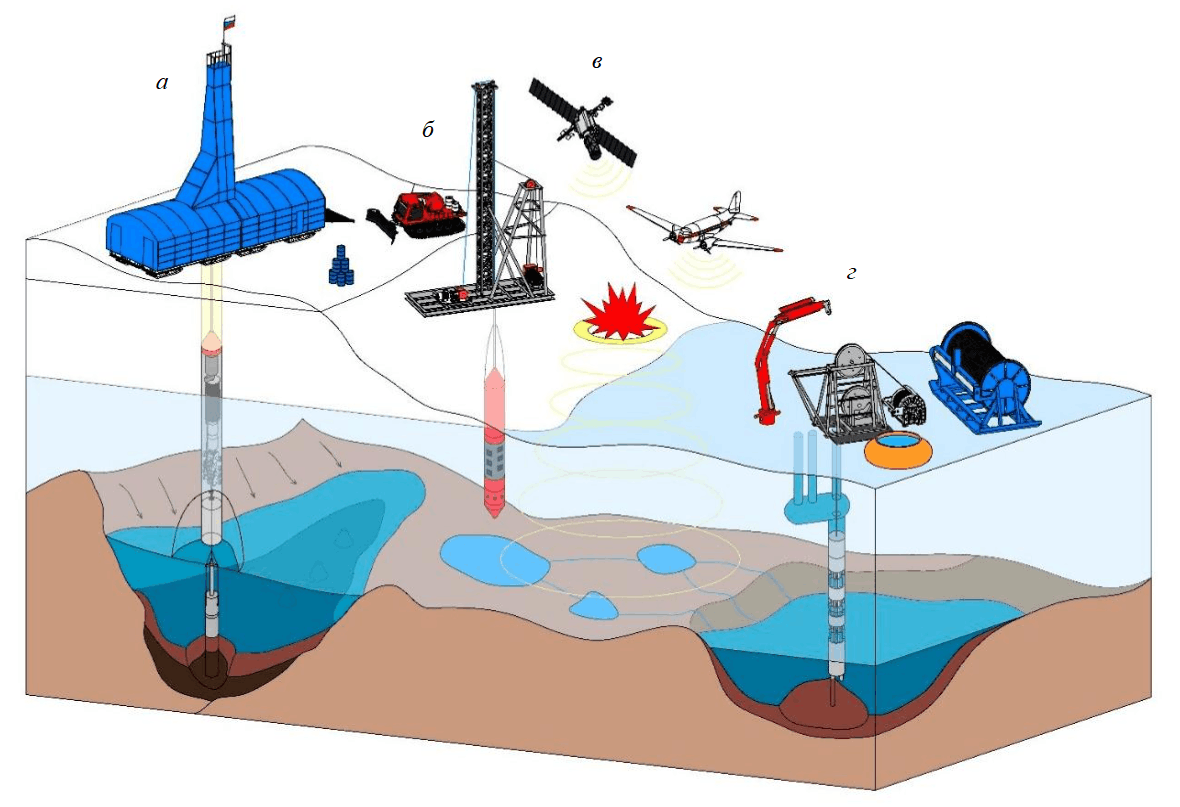
Рис.2. Технико-технологический комплекс исследований подледниковых озер Антарктиды: а – отбор проб донных отложений с применением составного устройства через скважину, пробуренную электромеханическим снарядом и заполненную экологически безопасной заливочной жидкостью; б – бурение тепловым зондом; в – геофизическая идентификация озер и определение их параметров; г – отбор проб донных отложений и воды одиночным устройством через скважину, пробуренную горячей водой
Результаты геофизических исследований и средства математического аппарата позволяют прогнозировать возраст донных отложений, построить модели осадконакопления и, как следствие, обоснованно выбрать точку отбора проб на дне озера и бурения на поверхности ледника [22].
Бурение скважины доступа
Бурение скважины доступа является наиболее трудоемкой и энергозатратной частью работ. Ввиду уникальности условий эксплуатации каждая из используемых в настоящее время технологий бурения скважин во льду включает оригинальные технические решения с присущими им преимуществами и недостатками. Главные параметры используемых технологий – максимальная глубина бурения, время ведения буровых работ, диаметр скважины, срок службы скважины, масса рабочего оборудования, количество потребляемого топлива за время ведения работ и соответствие требованиям экологической безопасности. Наиболее проработаны в настоящее время следующие технологии бурения скважин во льду:
Бурение электромеханическими снарядами на грузонесущем кабеле (рис.2, а) отличается низким энергопотреблением, возможностью получения долговременной исследовательской скважины в случае использования незамерзающей заливочной жидкости, а также низкой рейсовой скоростью бурения, вызванной большими затратами времени на спускоподъемные операции. Создание долговременной скважины позволяет периодически проводить отбор проб в течение длительного времени с получением информации о динамике гидрологической системы, стабильности микробных сообществ и темпах изменения экосистем [15].
Бурение горячей водой (рис.2, г) характеризуется высокими механической и рейсовой скоростями бурения скважины, высоким энергопотреблением, экологической безопасностью работ, малым сроком службы скважины, которая замерзает в течение 4-23 ч при температуре льда –25 °C и начальном диаметре 100-240 мм [13]. Проведение исследовательских работ в течение нескольких дней значительно сокращает затраты на снабжение временной станции.
Бурение тепловыми зондами (рис.2, б)отличается автономностью процесса бурения, мобильностью оборудования, значительной продолжительностью ведения работ в озере, возникновением технических проблем при больших глубинах бурения, зависимостью процесса бурения от содержания минеральных частиц во льду.
Основные параметры существующих комплексов бурения скважин доступа представлены в табл.2.
Таблица 2
Основные параметры существующих и разрабатываемых технологий бурения скважин доступа к подледниковым озерам
|
Технология |
Система |
Диаметр скважины, мм |
Достигнутая/ ожидаемая глубина бурения, м |
Скорость бурения, м/сут |
Масса оборудования (масса топлива), т |
Мощность бурения1, кВт |
Технология вскрытия озера |
|
Бурение электромеханическими снарядами на грузонесущем кабеле |
IBED |
136 |
541/1400 |
20 |
25 (н/д) |
3 + 11 |
Закрытая, ступенчатая, изолирующая |
|
КЭМС-135 |
138 |
3765/4500 |
30 |
35 (н/д) |
2,2 + 18,2 |
||
|
Foro 3000 |
129,6 |
– /2800 |
17 |
18 (31,93) |
1,79 + 8,7 |
||
|
Бурение горячей водой |
EHWD |
600 |
2500/ – |
2160 |
566 (н/д) |
4700 + 300 |
Прямая |
|
WISSARD |
300 |
1092/ – |
720-1480 |
230 (40) |
1000 |
||
|
SLCECCHWD [42] |
300 |
2154/2700 |
макс. 2880 |
88 (н/д) |
1000 + 120 |
||
|
Ellsworth |
360 |
– /3400 |
н/д |
111 (51) |
1500 |
||
|
DeepRAD2 |
н/д |
3413/3800 |
480 |
н/д |
н/д |
||
|
Бурение тепловым зондом |
RECAS [43] |
180 |
200/3800 |
36 |
330 кг (н/д) |
9,7 |
Изолирующая |
|
TRIPLE [44] |
200 |
52/4000 |
84 |
320 кг (н/д) |
25 |
Примечания:
1 Для установок бурения горячей водой приведена тепловая и электрическая мощность; для электромеханических буровых снарядов – мощность электродвигателя снаряда и буровой лебедки.
2 На основании доклада Wu Xiong «Progress in polar scientific drilling research of CUGB» (09.04.2026).
Вскрытие подледникового озера
Применяемая технология бурения скважины доступа к подледниковому озеру с учетом среды в скважине определяет возможные технологии вскрытия (рис.3):
- Закрытая, с применением недокомпенсации давления в скважине доступа и заполнения ее части в последствие замерзающей озерной водой. Этой технологией были получены первые образцы воды из озера Восток в замороженном виде [45]. Разновидностью технологии является применение термобурового снаряда для вскрытия подледникового озера опережающим долотом [46].
- Прямая, с получением непосредственного доступа к озеру, когда скважина заполнена талой водой или другой экологически безопасной жидкостью [47, 48].
- Ступенчатая, с буферной экологически безопасной незамерзающей жидкостью либо талой водой, когда остальная часть скважины заполнена токсичной заливочной жидкостью [46, 49].
- Изолирующая, с изоляцией озерной среды от скважинной слоем льда [43].
Параметры данного этапа технико-технологического комплекса оказывают прямое влияние на выбор технологии отбора проб воды, донных отложений, взвеси и измерения параметров подледникового озера.
Отбор проб воды, донных отложений, взвеси и измерение параметров подледникового озера
Для условий подледниковых озер реализуются следующие технологии отбора проб (рис.3):
- одиночным устройством, с непосредственным спуском исследовательского оборудования через скважину в среду озера [50];
- составным устройством, с применением промежуточного звена – доставочного модуля [51, 52], изолирующего исследовательское оборудование от скважинной среды.
Отбор проб воды из подледниковых озер может быть осуществлен как стандартным набором гидрологического оборудования (различные вариации батометров), адаптированным под условия скважины, так и уникальными средствами (RECAS [43], устройство исследования озера Ellsworth [53]).
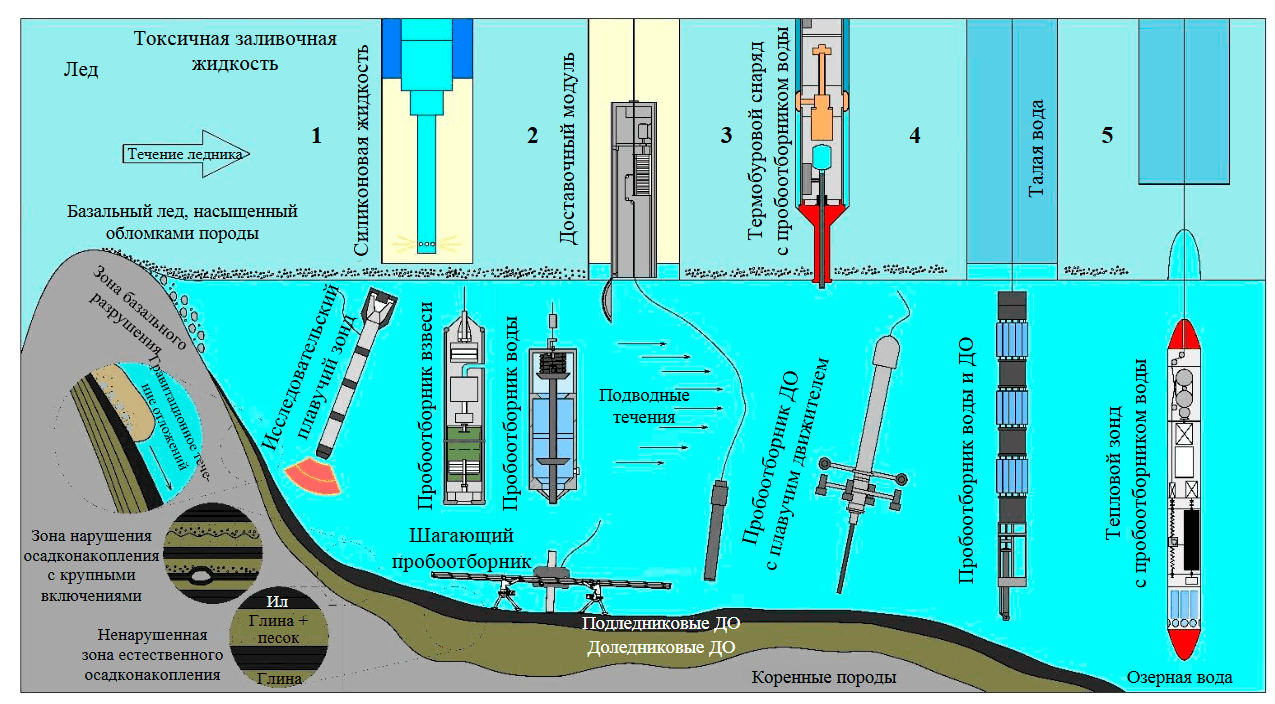
Рис.3. Технические средства прямых исследований подледниковых озер Антарктиды и технологии вскрытия подледникового озера: 1 – ступенчатая; 2 – прямая с последующим использованием составного исследовательского устройства; 3 – закрытая; 4 – прямая с последующим использованием одиночного исследовательского устройства; 5 – изолирующая; ДО – донные отложения
Как правило, при исследовании водных объектов для определения геологического разреза донных отложений, позволяющего сформировать полноценное представление об эволюции водоема, применятся колонковый способ отбора проб. На основании результатов сейсмических исследований дна подледникового озера с предварительным определением типа донных отложений подбираются основные параметры пробоотборника.
По способу отбора проб донных отложений пробоотборники классифицируются:
- гравитационные (применение – мягкие отложения) [54];
- поршневые (мягкие отложения) [55];
- ударные (от мягких отложений до песка) [56];
- вибрационные (от мягких отложений до песка) [57];
- вдавливаемые (мягкие отложения) [53];
- возвратно-вращательного действия (любые типы отложений, в том числе коренные породы) [26].
Для отбора взвешенных в воде озера биологических и минеральных частиц используются сетчатые фильтры [58], в основе принципа работы которых лежит прокачка воды через сетчатые картриджи с различным размером ячеек. Устройство подобного рода, изначально разработанное для океанологических исследований и впоследствии адаптированное для работы в подледниковых озерах, было использовано при исследовании подледникового озера Mercer [30].
Для повышения информативности проводимых прямых исследований, а также для выбора участков отбора проб, применяются устройства, позволяющие оценить следующие параметры озера в режиме реального времени: гидростатическое давление, температура, содержание газов, pH среды, окислительно-восстановительный потенциал воды, удельная электрическая проводимость, геометрия подледникового объекта средствами эхолокации, лазерного излучения.
При выполнении исследований важно осуществлять контроль работы исследовательского оборудования не только по аналоговым показаниям, передаваемым на поверхность, но и за счет средств видеорегистрации. Данное оборудование имеет малые габариты и устанавливается в общее многофункциональное исследовательское устройство, обладающее малой маневренностью [59], или отдельное управляемое плавучее средство [44, 60].
Проблемы и ограничения исследования подледниковых озер Антарктиды
С момента первого вскрытия подледникового озера Восток технологии и технические средства для исследования озер не перестают совершенствовать, но, несмотря на множество проведенных научно-исследовательских работ, позволивших достигнуть значимых результатов при исследовании подледниковых озер (Восток, Mercer, Whillans, Ellsworth), в настоящее время не было прямого отбора проб донных отложений из глубокозалегающих «стабильных» подледниковых озер. Это связано со следующими отличительными особенностями «стабильных» подледниковых озер.
Мощность ледника, покрывающего 90 % данного типа озер, составляет более 2500 м. Увеличение конечной глубины бурения значительно усложняет конструкцию применяемого бурового оборудования, что выражается в увеличении его общей массы и, как следствие, удорожании логистических операций.
Сравнительно большие глубины озер – более 50 м, которые в совокупности с подводными течениями увеличивают площадь участка пробоотбора. Глубина залегания и мощность водной прослойки озера, обуславливающие величину гидростатического давления, будут определять конструкцию герметизирующих блоков для электронных компонентов и движителей, некоторые из которых неспособны работать в водной среде. Также гидростатическое давление влияет на степень сжатия газовых включений в донных отложениях, декомпрессия которых может привести к разрушению структуры керна [61]. При достижении значительной глубины озера может происходить отклонение кабеля или грузонесущего троса пробоотборника от вертикали, что может привести к проблемам внедрения в донные отложения.
Широкий диапазон перепадов температур от –57 до 0 °С от поверхности ледника и до поверхности озера, что определяет мощность водонагревательной системы при бурении горячей водой, а также дополнительных нагревателей для предупреждения замерзания скважины в процессе исследования озер.
Геологическая неопределенность и различие физико-механических свойств слоев стратиграфически разнообразных донных отложений. Степень консолидации, пористость и водонасыщенность донных отложений в совокупности с их гранулометрическим составом в значительной степени влияют на сопротивление внедрению колонковой трубы пробоотборника, что сказывается на размере отобранной пробы [62]. Совокупность данных параметров также определяет реологические свойства массива, влияющие на усилие отрыва керна, эффективность работы динамических систем пробоотборника и вероятные нарушения структуры керна в процессе отбора проб.
Логистические трудности обеспечения работ при исследовании озер, удаленных от полярных станций, приводящие к удорожанию транспортировки 1 кг груза и, как следствие, предъявляющие повышенные требования к массогабаритным параметрам используемого оборудования и количеству топлива.
Технологические трудности соблюдения массогабаритных ограничений спускаемого в озеро оборудования, что вызвано стесненными условиями скважины доступа, сужающейся с течением времени.
Экологические требования по сохранению реликтовой экологической системы подледниковых озер, значительно усложняющие технологию исследования и конструкцию применяемых устройств и увеличивающие стоимость проведения работ.
Явления и условия, не выявленные ввиду отсутствия или малого опыта прямых исследований подледниковых озер. Например, как показал анализ кернов донных отложений «активных» подледниковых озер Mercer (глубина залегания 1087 м) и Whillans (глубина залегания 800 м), их осадки не отражали естественного озерного осадконакопления и складывались из частиц, сносимых подледниковыми потоками, в связи с чем керн из данных подледниковых озер по составу не отличался от отобранных под ледниковыми потоками и на шельфе в той же исследуемой области материка [22].
Предстоящие направления модернизации
С учетом изложенных отличительных особенностей «стабильных» подледниковых озер можно выделить основные направления создания и совершенствования технологий и технических средств их исследования:
- Обеспечение экологической безопасности вскрытия подледниковых озер при бурении снарядами на грузонесущем кабеле, реализуемое за счет использования силиконовой заливочной жидкости (например, полиметилсилоксановой жидкости ПМС-3), композитного полимерного кабеля и средств очистки стенок скважины [47].
- Увеличение диаметра скважин, механической и технической скоростей глубокого бурения снарядами на грузонесущем кабеле за счет применения модернизированных систем очистки, породоразрушающего инструмента и спускоподъемного оборудования.
- Увеличение глубин бурения горячей водой и времени существования скважины, в частности при бурении в восточной части Антарктиды с преобладающими мощностями ледника более 3000м.
- Увеличение глубин бурения тепловыми зондами путем модернизации встроенной лебедки и исключения ограничений при бурении льда с минеральными включениями установкой систем направленного бурения [13, 43].
- Увеличение длины извлекаемых кернов донных отложений с одновременным снижением энерговооруженности устройства [56].
- Увеличение области отбора проб донных отложений за счет применения движителей пробоотборника.
- Сохранение целостности отобранных кернов донных отложений, подвергающихся нарушению на этапах бурения, извлечения и транспортировки, что искажает результаты анализа физического, геохимического и биологического состояния пробы отложений [61].
- Обеспечение работоспособности электронных устройств в условиях высоких давлений и низких температур.
Заключение
Исследование подледниковых озер Антарктиды представляет собой сложную междисциплинарную задачу, решение которой связано с применением инновационных методов геофизических исследований, технологий бурения, экологически безопасных технологий вскрытия, комплексного изучения водных объектов, а также способов анализа полученных данных. Рассмотрены уникальные географические и горно-геологические условия подледниковых озер, реализованные и перспективные технологии и технические средства их исследования.
В течение множества десятилетий развития дистанционных и прямых исследований подледниковых озер используемые технологии и технические средства постоянно совершенствуются благодаря усилиям инженеров и ученых всего мира. Однако, несмотря на достигнутые результаты, в частности в идентификации подледниковых озер геофизическими методами, остается еще множество нерешенных задач, главной из которых является отбор проб из «стабильных» подледниковых озер с соблюдением мер экологической безопасности. Решение этой задачи требует комплексного подхода, включающего планирование и определение связей между научными целями, логистическими и инфраструктурными возможностями, технологиями бурения скважины доступа, вскрытием подледникового водоема и отбором проб. На всех этапах, предшествующих будущим работам на объекте, необходимо проведение экспериментальных исследований в условиях, приближенных к реальным и направленных на оценку надежности, энергоэффективности и экологической безопасности планируемых к использованию технологий. Прямые исследования подледниковых озер на современном научно-технологическом уровне сопряжены с комплексом трудноразрешимых задач, однако успешная реализация подобных проектов должна привести к революционным открытиям, которые кардинально расширят наше представление о климатической истории Земли, прошлых и современных биогеохимических процессах в изолированных экосистемах и будущей динамике криосферы планеты.
Литература
- Wilson S.F., Hogg A.E., Rigby R. et al. Detection of 85 new active subglacial lakes in Antarctica from a decade of CryoSat-2 data. Nature Communications. 2025. Vol. 16. N 8311. DOI: 10.1038/s41467-025-63773-9
- Smith A.M., Woodward J., Ross N. et al. Evidence for the long-term sedimentary environment in an Antarctic subglacial lake. Earth and Planetary Science Letters. 2018. Vol. 504, p. 139-151. DOI: 10.1016/j.epsl.2018.10.011
- Siegert M.J., Priscu J.C., Alekhina I.A. et al. Antarctic subglacial lake exploration: first results and future plans. Philosophical Transactions of the Royal Society A. Mathematical, physical and engineering sciences. 2016. Vol. 374. Iss. 2059. N 20140466. DOI: 10.1098/rsta.2014.0466
- Bulat S., Petit J.-R. Vostok, Subglacial Lake. Encyclopedia of Astrobiology. Springer, 2023, p. 3206-3212. DOI: 10.1007/978-3-662-65093-6_1765
- Masolov V.N., Popov S.V., Lukin V.V., Popkov A.M. The Bottom Topography and Subglacial Lake Vostok Water Body, East Antarctica. Doklady Earth Sciences. 2010. Vol. 433. Part 2, p. 1092-1097. DOI: 10.1134/S1028334X10080222
- Siegert M. A 60-year international history of Antarctic subglacial lake exploration. Geological Society, London, Special Publications. 2018. Vol. 461, p. 7-21. DOI: 10.1144/SP461.5
- Gorelik G.D., Egorov A.S., Shuklin I.A., Ushakov D.E. Substantiation of optimal range of geophysical surveys to study deep structure of the Lake Vostok area. Gornyi zhurnal. 2024. N 9, p. 56-61 (in Russian). DOI: 10.17580/gzh.2024.09.09
- Studinger M, Bell R.E., Karner G.D. et al. Ice cover, landscape setting, and geological framework of Lake Vostok, East Antarctica. Earth and Planetary Science Letters. 2003. Vol. 205. Iss. 3-4, p. 195-210. DOI: 10.1016/S0012-821X(02)01041-5
- Killingbeck S.F., Dow C.F., Unsworth M.J. A quantitative method for deriving salinity of subglacial water using ground-based transient electromagnetics. Journal of Glaciology. 2022. Vol. 68. Iss. 268, p. 319-336. DOI: 10.1017/jog.2021.94
- Pattyn F. Antarctic subglacial conditions inferred from a hybrid ice sheet/ice stream model. Earth and Planetary Science Letters. 2010. Vol. 295. Iss. 3-4, p. 451-461. DOI: 10.1016/j.epsl.2010.04.025
- Zotikov I.A. Bottom melting in the central zone of the ice shield on the Antarctic continent and its influence upon the present balance of the ice mass. International Association of Scientific Hydrology. Bulletin. 1963. Vol. 8. Iss. 1, p. 36-44. DOI: 10.1080/02626666309493295
- MacKie E.J., Schroeder D.M., Caers J. et al. Antarctic Topographic Realizations and Geostatistical Modeling Used to Map Subglacial Lakes. Journal of Geophysical Research: Earth Surface. 2020. Vol. 125. Iss. 3. N e2019JF005420. DOI: 10.1029/2019JF005420
- Talalay P.G., Xiaopeng Fan. Alternative clean approaches to accessing subglacial Lake Vostok. Arctic and Antarctic Research. 2024. Vol. 70. N 4, p. 499-513. DOI: 10.30758/0555-2648-2024-70-4-499-513
- Siegfried M.R., Venturelli R.A., Patterson M.O. et al. The life and death of a subglacial lake in West Antarctica. Geology. 2023. Vol. 51. N 5, p. 434-438. DOI: 10.1130/G50995.1
- Livingstone S.J., Yan Li, Rutishauser A. et al. Subglacial lakes and their changing role in a warming climate. Nature Reviews Earth & Environment. 2022. Vol. 3. Iss. 2, p. 106-124. DOI: 10.1038/s43017-021-00246-9
- Egorov A.S., Ageev A.S., Shuklin I.A. et al. On the similarity of deep structure of the basement and genesis of depressions on the eastern flank of East Antarctic and in Lake Baikal area. Journal of Mining Institute. 2025. Vol. 273, p. 26-41.
- Studinger M., Karner G.D., Bell R.E. Geophysical models for the tectonic framework of the Lake Vostok region, East Antarctica. Earth and Planetary Science Letters. 2003. Vol. 216. Iss. 4, p. 663-677. DOI: 10.1016/S0012-821X(03)00548-X
- Tabacco I.E., Cianfarra P., Forieri A. et al. Physiography and tectonic setting of the subglacial lake district between Vostok and Belgica subglacial highlands (Antarctica). Geophysical Journal International. 2006. Vol. 165. Iss. 3, p. 1029-1040. DOI: 10.1111/j.1365-246X.2006.02954.x
- Lukin V.V., Markov A.N. Hypothesis of Tectonic Preglacial Genesis of the Basin and Water Body of Antarctica’s Lake Vostok. Geography and Natural Resources. 2024. Vol. 45. N 2, p. 192-201. DOI: 10.1134/S1875372824700264
- Popov S.V., Boronina A.S., Ekaykin A.A. et al. Remote sensing and mathematical modelling of Lake Vostok, East Antarctica: past, present and future research. Arctic and Antarctic Research. 2024. Vol. 70. N 4, p. 460-476. DOI: 10.30758/0555-2648-2024-70-4-460-476
- Litvinenko V. Foreword: Sixty-year Russian history of Antarctic sub-glacial lake exploration and Arctic natural resource development. Geochemistry. 2020. Vol. 80. Iss. 3. N 125652. DOI: 10.1016/j.chemer.2020.125652
- Brisbourne A.M., Smith A.M., Rivera A. et al. Bathymetry and bed conditions of Lago Subglacial CECs, West Antarctica. Journal of Glaciology. 2023. Vol. 69. Iss. 278, p. 1546-1555. DOI: 10.1017/jog.2023.38
- Couston L.-A., Siegert M. Dynamic flows create potentially habitable conditions in Antarctic subglacial lakes. Science Advances. 2021. Vol. 7. Iss. 8. N eabc3972. DOI: 10.1126/sciadv.abc3972
- Hodson T.O., Powell R.D., Brachfeld S.A. et al. Physical processes in Subglacial Lake Whillans, West Antarctica: Inferences from sediment cores. Earth and Planetary Science Letters. 2016. Vol. 444, p. 56-63. DOI: 10.1016/j.epsl.2016.03.036
- Peters L.E., Anandakrishnan S., Holland C.W. et al. Seismic detection of a subglacial lake near the South Pole, Antarctica. Geophysical Research Letters. 2008. Vol. 35. Iss. 23. N L23501. DOI: 10.1029/2008GL035704
- Vasilyev N.I., Leychenkov G.L., Zagrivny E.A. Prospects of Obtaining Samples of Bottom Sediments from Subglacial Lake Vostok. Journal of Mining Institute. 2017. Vol. 224, p. 199-208. DOI: 10.18454/PMI.2017.2.199
- Popov S.V. Six decades of radar and seismic research in Antarctica. Ice and Snow. 2021. Vol. 61. N 4, p. 587-619 (in Russian). DOI: 10.31857/S2076673421040110
- Leitchenkov G.L., Antonov A.V., Luneov P.I., Lipenkov V.Ya. Geology and environments of subglacial Lake Vostok. Philosophical Transactions of the Royal Society A. Mathematical, physical and engineering sciences. 2016. Vol. 374. Iss. 2059. N 20140302. DOI: 10.1098/rsta.2014.0302
- Bell R.E., Studinger M., Fahnestock M.A., Shuman C.A. Tectonically controlled subglacial lakes on the flanks of the Gamburtsev Subglacial Mountains, East Antarctica. Geophysical Research Letters. 2006. Vol. 33. Iss. 2. N L02504.DOI: 10.1029/2005GL025207
- Priscu J.C., Kalin J., Winans J. et al. Scientific access into Mercer Subglacial Lake: scientific objectives, drilling operations and initial observations. Annals of Glaciology. 2021. Vol. 62. Iss. 85-86, p. 340-352. DOI: 10.1017/aog.2021.10
- Shuai Yan, Blankenship D.D., Greenbaum J.S. et al. A newly discovered subglacial lake in East Antarctica likely hosts a valuable sedimentary record of ice and climate change. Geology. 2022. Vol. 50. N 8, p. 949-953. DOI: 10.1130/G50009.1
- Hodgson D.A., Roberts S.J., Bentley M.J. et al. Exploring former subglacial Hodgson Lake, Antarctica. Paper II: palaeolimnology. Quaternary Science Reviews. 2009. Vol. 28. Iss. 23-24, p. 2310-2325. DOI: 10.1016/j.quascirev.2009.04.014
- Levitan M.A., Girin Yu.P., Luksha V.L. et al. Modern Sedimentation System of Lake Untersee, East Antarctica. Geochemistry International. 2011. Vol. 49. Iss. 5. P. 459-481. DOI: 10.1134/S0016702911050077
- Pritchard H.D., Fretwell P.T., Fremand A.C. et al. Bedmap3 updated ice bed, surface and thickness gridded datasets for Antarctica. Scientific Data. 2025. Vol. 12. N 414. DOI: 10.1038/s41597-025-04672-y
- Dunbar G., Niessen F., Vogel S. Late Pleistocene to Holocene Strata from Soft-Sediment Coring at the AND-1B Site, ANDRILL McMurdo Ice Shelf Project, Antarctica. Terra Antartica. 2007. Vol. 14. N 3, p. 141-154.
- Bentley M.J., Christoffersen P., Hodgson D. A. et al. Subglacial Lake Sediments and Sedimentary Processes: Potential Archives of Ice Sheet Evolution, Past Environmental Change, and the Presence of Life. Antarctic Subglacial Aquatic Environments. American Geophysical Union, 2011. Vol. 192, p. 83-110.
- Campbell T.D., Skidmore M.L., Patterson M.O. et al. Dynamic subglacial meltwater history archived in Antarctic subglacial lake sediments. Geological Society of America Bulletin. 2025. Vol. 137. N 7-8, p. 3055-3068. DOI: 10.1130/B37731.1
- Yan Zhou, Xiangbin Cui, Zhenxue Dai et al. The Antarctic Subglacial Hydrological Environment and International Drilling Projects: A Review. Water. 2024. Vol. 16. Iss. 7. N 1111. DOI: 10.3390/w16081111
- Talovina I.V., Babenko I.A., Ilalova R.K., Duryagina A.M. Olivine-spinel geothermometry – Indicator of formation identity of rocks and a basis for geodynamic reconstructions in Antarctica. Gornyi zhurnal. 2024. N 9, p. 77-82 (in Russian). DOI: 10.17580/gzh.2024.09.12
- Abdrakhmanov I.A., Gulbin Y.L., Skublov S.G., Galankina O.L. Mineralogical Constraints on the Pressure–Temperature Evolution of Granulites in the Bunger Hills, East Antarctica. Minerals. 2024. Vol. 14. Iss. 5. N 488. DOI: 10.3390/min14050488
- Litvinenko V., Trushko V. Modelling of geomechanical processes of interaction of the ice cover with subglacial Lake Vostok in Antarctica. Antarctic Science. 2025. Vol. 37. Iss. 1, p. 39-48. DOI: 10.1017/S0954102024000506
- Makinson K., Anker P.G.D., Garcés J. et al. Development of a clean hot water drill to access Subglacial Lake CECs, West Antarctica. Annals of Glaciology. 2021. Vol. 62. Iss. 85-86, p. 250-262. DOI: 10.1017/aog.2020.88
- Youhong Sun, Bing Li, Xiaopeng Fan et al. Brief communication: New sonde to unravel the mystery of polar subglacial lakes. The Cryosphere. 2023. Vol. 17. Iss. 3, p. 1089-1095. DOI: 10.5194/tc-17-1089-2023
- Audehm J., Bachmayer R., Bande M. et al. TRIPLE – Technologies for Rapid Ice Penetration and Subglacial Lake Exploration: Whitepaper by the TRIPLE Project within the German Space Agency Explorer Initiative at DLR. German Space Agency at DLR, 2025, p. 36. DOI: 10.22541/essoar.175371779.92742499/v2
- Lipenkov V.Ya., Turkeev A.V., Ekaykin A.A. et al. Unsealing Subglacial Lake Vostok: Lessons and implications for future full-scale exploration. Arctic and Antarctic Research. 2024. Vol. 70. N 4, p. 477-498. DOI: 10.30758/0555-2648-2024-70-4-477-498
- Vasiliev N.I., Talalay P.G., Bobin N.E. et al. Deep drilling at Vostok station, Antarctica: history and recent events. Annals of Glaciology. 2007. Vol. 47, p. 10-23. DOI: 10.3189/172756407786857776
- Serbin D.V., Buslaev G.V., Lavrik A.Yu. et al. Study of the interaction between the drilling fluid and lake water during the opening of the subglacial Lake Vostok in Antarctica. Journal of Mining Institute. 2025. Vol. 273, p. 136-146.
- Alemany O., Talalay P., Boissonneau P. et al. The SUBGLACIOR drilling probe: hydraulic considerations. Annals of Glaciology. 2021. Vol. 62. Iss. 84, p. 131-142. DOI: 10.1017/aog.2020.79
- Serbin D.V. Prevention of emulsion formation during opening subglasial reservoirs. News of the Ural State Mining University. 2021. Iss. 3 (63), p. 80-88 (in Russian). DOI: 10.21440/2307-2091-2021-3-80-88
- Da Gong, Xiaopeng Fan, Yazhou Li et al. Coring of Antarctic Subglacial Sediments. Journal of Marine Science and Engineering. 2019. Vol. 7. Iss. 6. N 194. DOI: 10.3390/jmse7060194
- Litvinenko V.S., Leitchenkov G.L., Vasiliev N.I. Anticipated sub-bottom geology of Lake Vostok and technological approaches considered for sampling. Geochemistry. 2020. Vol. 80. Iss. 3. N 125556. DOI: 10.1016/j.chemer.2019.125556
- Vasilev N.I., Bolshunov A.V., Dmitriev A.N., Podoliak A.V. Round-trip assembly for investigations of subglacial lake Vostok. International Journal of Applied Engineering Research. 2016. Vol. 11. N 9, p. 6376-6380.
- Keen P., Saw K., Rundle N. et al. A mini-corer for precision sampling of the water-sediment interface in subglacial lakes and other remote aqueous environments. Limnology and Oceanography: Methods. 2018. Vol. 16. Iss. 12, p. 856-867. DOI: 10.1002/lom3.10288
- Rosenheim B.E., Michaud A.B., Broda J. et al. A method for successful collection of multicores and gravity cores from Antarctic subglacial lakes. Limnology and Oceanography: Methods. 2023. Vol. 21. Iss. 5, p. 279-294. DOI: 10.1002/lom3.10545
- Hodgson D.A., Bentley M.J., Smith J.A. et al. Technologies for retrieving sediment cores in Antarctic subglacial settings. Philosophical Transactions of the Royal Society A. Mathematical, physical and engineering sciences. 2016. Vol. 374. Iss. 2059. N 20150056. DOI: 10.1098/rsta.2015.0056
- Makinson K., Ashurst D., Anker P.G.D. et al. A new percussion hammer mechanism for a borehole deployable subglacial sediment corer. Annals of Glaciology. 2020. Vol. 62. Iss. 85-86, p. 385-389. DOI: 10.1017/aog.2020.83
- Da Gong, Nan Zhang, Yunchen Liu et al. Small-diameter vibrocorer for sediment coring beneath Antarctic ice shelves: General concept and testing. Ocean Engineering. 2016. Vol. 126, p. 232-239. DOI: 10.1016/j.oceaneng.2016.09.023
- Bobin N.E., Talatai P.G., Yankilevich S.V. Technical means for the study of subglacial reservoirs in the example of Lake Vostok in Antarctica. Journal of Mining Institute. 2004. Vol. 157, p. 147-149 (in Russian).
- Mowlem M., Saw K., Brown R. et al. Probe technologies for clean sampling and measurement of subglacial lakes. Philosophical Transactions of the Royal Society A. Mathematical, physical and engineering sciences. 2016. Vol. 374. Iss. 2059. N 20150267. DOI: 10.1098/rsta.2015.0267
- Behar A.E., Chen D.D., Ho C. et al. MSLED: The Micro Subglacial Lake Exploration Device. Underwater Technology. 2015. Vol. 33. N 1, p. 3-17. DOI: 10.3723/ut.33.003
- Dück Y., Lorke A., Jokiel C., Gierse J. Laboratory and field investigations on freeze and gravity core sampling and assessment of coring disturbances with implications on gas bubble characterization. Limnology and Oceanography: Methods. 2019. Vol. 17. Iss. 11, p. 585-606. DOI: 10.1002/lom3.10335
- Jun Han Bae, Wonse Jo, Jee Hwan Park et al. Evaluation of Sampling Methods for Robotic Sediment Sampling Systems. IEEE Journal of Oceanic Engineering. 2020. Vol. 46. Iss. 2, p. 542-554. DOI: 10.1109/JOE.2020.3005576