

Analysis of technologies and equipment for Antarctic subglacial lake research
- 1 — Postgraduate Student Empress Catherine ΙΙ Saint Petersburg Mining University ▪ Orcid
- 2 — Ph.D. Assistant Lecturer Empress Catherine ΙΙ Saint Petersburg Mining University ▪ Orcid
- 3 — Ph.D. Scientific Supervisor of the Laboratory Empress Catherine ΙΙ Saint Petersburg Mining University ▪ Orcid
- 4 — Design Engineer Empress Catherine ΙΙ Saint Petersburg Mining University ▪ Orcid
Abstract
Antarctica's subglacial hydrological system is a unique and still largely unexplored source of geological, paleoclimatic, and biological information that can be accessed only through direct investigation involving the sampling of water, suspended particulate matter, and bottom sediments. Of greatest scientific value are sites that have remained isolated for hundreds of thousands of years and preserve continuous sedimentary sequences containing thick deposits of ancient bottom sediments unaffected by basal glacial erosion. Such sites occur in subglacial lakes, which are key components of Antarctica’s subglacial hydrological system. The planning and implementation of direct investigations of Antarctic subglacial lakes beneath both relatively thin ice and more than 2500 m of ice remain subjects of debate because experience with such operations is limited and there is no consensus on how compliance with environmental requirements should be ensured and monitored when subglacial environments are accessed. This article synthesizes the results of interdisciplinary studies of Antarctic subglacial lakes, including their locations, depths below the ice surface, morphometric and hydrodynamic parameters, and bottom-sediment composition. Particular attention is given to the technologies and equipment used to investigate subglacial lakes, including geophysical surveys, access-borehole drilling, lake access, measurement of the water body's physical and chemical parameters, and sampling of water, bottom sediments, and suspended particulate matter. The challenges and constraints associated with investigating “stable” subglacial lakes are analyzed and discussed, and key priorities for advancing the relevant technologies and equipment are identified.
This study was conducted under the 2024 State assignment for scientific research N FSRW-2024-0003.
Introduction
Research into Antarctic subglacial hydrological systems remains a major priority in the Earth sciences (geophysics, hydrology, geology, and paleoclimatology) and biological sciences (microbiology, molecular biology, ecology, and exobiology). Antarctica’s subglacial hydrological system comprises marine environments beneath ice shelves, subglacial watercourses, and lakes, all overlain by ice that impedes direct investigation. Subglacial lakes are among the principal objects of study and are classified as “stable” or “active” according to the constancy of their water volume and the presence of hydraulic connections to other components of the subglacial hydrological system. Antarctica currently contains 766 known subglacial lakes [1], 70 % of which have remained isolated from the external environment for hundreds of thousands of years. Their scientific value stems from the considerable age of their bottom sediments [2] and the possible presence of unknown forms of life [3, 4].
Current understanding of subglacial lakes has been advanced substantially by geophysical methods (airborne and ground-based radar sounding, reflection seismic surveys, satellite radar altimetry [5-7], gravimetry and magnetometry [8], and transient electromagnetic sounding [9]), predictive computational methods (models of basal ice-sheet melting [10, 11]), and geostatistical modeling [12]. Despite the advantages of these methods, the extensive experience gained in their application, and the importance of the resulting data, they provide only indirect information about the subglacial environment and cannot fully characterize its structure, the mineralogical and biological composition of its water and bottom sediments, or the lake's hydrological regime. Such information is central to future subglacial lake research [13] and can be obtained only by direct sampling, primarily through the recovery of sediment cores and the collection of water, and suspended mineral and biological particles.
Direct investigations of subglacial lakes now span more than two decades, during which numerous technologies and items of equipment have been developed and tested. The diversity of lake morphometry and hydrodynamics, the lithological characteristics of bottom sediments, the broad range of overlying ice thicknesses, and the remoteness of study sites from research stations require a tailored approach to each lake.
No comprehensive account has yet been published of the most mature technologies and equipment developed by different research teams and used at successive stages of lake investigation. This article analyzes the principal parameters of Antarctic subglacial lakes and reviews both established and emerging technologies and equipment used in preliminary geophysical surveys, access-borehole drilling, lake access, and the collection of water, bottom-sediment, and suspended-particulate-matter samples. It also examines the limitations of research into “stable” subglacial lakes – the least studied and scientifically most valuable components of Antarctica's subglacial hydrological system, and identifies the main priorities for further research.
Characteristics of Antarctic subglacial lakes
Shielded from the atmosphere by thick ice, Antarctic subglacial lakes differ markedly from lakes on other continents in their formation conditions, hydrological regimes, biodiversity, water chemistry, and the mineralogical composition and age of their bottom sediments.
Antarctic subglacial lakes are thought to form primarily through basal melting of the ice sheet caused by geothermal heat or frictional heating associated with ice flow. Most “active” lakes lie beneath fast-flowing ice streams in coastal Antarctica. Consequently, they are relatively shallow and small, and their bottom sediments are comparatively young (about several hundred thousand years) and often structurally disturbed [14].
“Stable” lakes occur where basal melting is slow or absent [15] and the overlying ice flows slowly. Compared with “active” lakes, they are larger and deeper and contain areas of undisturbed natural sediment accumulation. Some “stable” lakes are unique features formed by tectonic [16-18] and hydrological processes before Antarctic glaciation; they may therefore preserve relict biological material and geological and hydrological records from an extended preglacial period [19]. In the basin of some of these lakes, the water column may be strongly stratified by density, salinity, and temperature, while hot, highly mineralized geothermal water may occupy the deepest layers [20].
Morphometric and hydrodynamic parameters of subglacial lakes
The principal morphometric parameters of subglacial lakes are water volume and depth, both of which depend on basin geomorphology. Subglacial lake depths range from a few meters for coastal “active” lakes to 1300 m for “stable” lakes (e.g., Lake Vostok [5, 21]), while water volumes range from 0.2 km3 to 5400 km3 (Table 1). Other parameters include current velocity and direction, which govern the mixing of water and suspended particulate matter and, together with bottom topography, affect sedimentation rates and hence the age and structure of bottom sediments [22].
Table 1
Morphometric and hydrological parameters of the best-studied Antarctic subglacial lakes and their bottom sediments
|
Name |
Average ice thickness, m [15] |
Depth, m [15] |
Volume, km3 [15] |
Lakes type |
Sediments type |
Sediments thickness, m |
Velocity of water circulation, mm/s [23] |
|
Whillans* [24] |
798 |
6 |
0.155 |
Active |
Silty diamicton comprising 8 % granules and pebbles, 33 % sand, 26 % silt, and 33 % clay (D50 ≈ 0.078 μm) |
N/A |
N/A |
|
South Pole [25] |
2857 |
32 |
N/A*** |
Stable |
Density 1800 kg/m3 |
150 |
0.1 |
|
Concordia [15] |
4055 |
126 |
31 |
Stable |
N/A |
N/A |
0.83 |
|
Ellsworth [2] |
3400 |
156 |
1.37 |
Active |
Fine-grained silts (< 0.6 mm) with a porosity of 77 % (clay-silt-sand 80-18-1.6 %) |
6 |
0.69 |
|
Vostok** [26-28] |
3945 |
Average 400 m; max 1200 m |
6100 |
Stable |
Fine-grained (clay-silt) fraction of clay-mica minerals and micrometer-sized quartz grains, with siltstone and sandstone inclusions measuring 0.3 to 8 mm. Mean inclusion size 0.5-2.0 mm |
300 |
3.8 |
|
90Е [29] |
4074 |
900 |
1800 |
Stable |
N/A |
N/A |
N/A |
|
Mercer** [30] |
1149 |
15 |
0.43 |
Active |
Fine-grained silts or clays, D60 < 0.063 mm (porosity 77 %; clay-silt-sand 80-18-1.6 %) |
N/A |
N/A |
|
СECs [22] |
2653 |
310 |
2.5 |
Active |
Fine-grained sediments dominated by silt and clay, with a porosity of 77 % (clay 80 %; silt 18 %) |
15 |
0.97 |
|
Snow Eagle (LSE, PEL) [31] |
3600 |
115 |
21 |
Active |
Unconsolidated water-saturated sediments with a density of 1700 kg/m3 |
200 |
N/A |
|
Hodgson* [32] |
4 |
90 |
N/A |
Former subglacial |
Gray sandy silt with numerous interbeds of coarser sediment ranging from sand to gravel |
3.8 |
N/A |
|
Untersee* [33] |
3 |
64 |
0.7 |
Surface lake |
Organic-rich terrigenous black silts (silty clay, clayey silt, and sandy silty clay) |
N/A |
N/A |
* The lake was accessed and bottom sediments were subsequently sampled; for all other lakes, the inferred bottom-sediment structure is shown.
** The lake was accessed, but bottom sediments were not sampled.
*** Not available.
Locations and overlying ice thicknesses of subglacial lakes
Subglacial lake research is complicated by the extreme isolation of the study sites (Fig.1, a), particularly the considerable thickness of the overlying ice and the lakes’ distance from polar stations. The thickness of ice overlying the lakes varies widely, from several tens of meters near the coast to 4661 m above LVS-12 [15] in the Antarctic interior, while distances from polar stations range from 0 km for Lake Vostok to 791 km for Recovery9 [15].
As a rule, “stable” lakes have thicker overlying ice than “active” lakes: 90 % are covered by more than 2500 m of ice, compared with 26 % of “active” lakes (Fig.1, b).
“Active” lakes tend to be farther from polar stations: 73 % are located more than 200 km away, compared with 44 % of “stable” lakes (Fig.1, c).
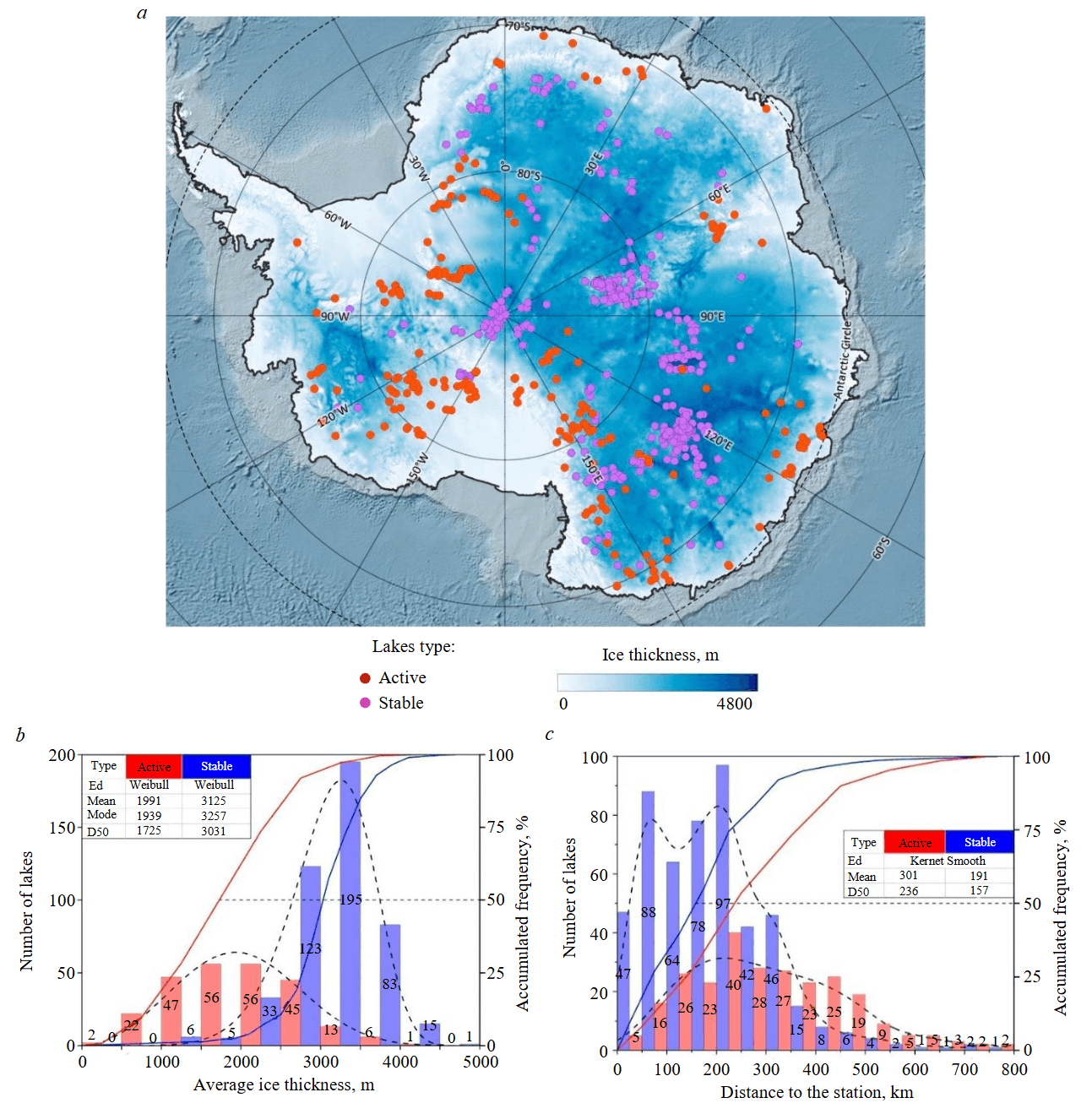
Fig.1. Location and accessibility parameters of Antarctic subglacial lakes: a – Antarctic ice-thickness map showing the locations of subglacial lakes (based on data from [34]); b – distribution of ice thickness above subglacial lakes (based on data from [15]); c – distribution of distances from lakes to the nearest polar stations (based on data from [15])
Lithological characteristics of bottom sediments
Because direct sampling of Antarctic subglacial lakes remains limited, current understanding of their bottom sediments is based on geophysical surveys and interpretation of the resulting data, together with analyses of sediment cores recovered from beneath ice shelves, from subglacial streams, from two “active” lakes, and from lakes formerly covered by ice. Subglacial lake sediments may be either strongly stratified, with interbeds that differ in their physical and mechanical properties, or homogeneous. Sediment structure depends on the origin and evolution of the lake and on the dynamics of the overlying ice. Analyses of cores from subglacial water bodies, including two “active” subglacial lakes, indicate that Antarctic subglacial sediments are less homogeneous than sediments in ice-free temperate lakes and may have high shear strength (more than 70 kPa at a depth of 2 m [35]), and comprise unconsolidated water-saturated diamictons, silts, or sands containing interbedded coarse clastic layers (4-64 mm) of inorganic terrigenous origin [36] (Table 1). The occurrence of coarse clastic interbeds depends on the distance from the depositional site to the glacier outlet at the coast. With increasing distance from the outlet, the sediment becomes finer grained and the sedimentation rate decreases [37]. Steep basin slopes and vigorous circulation promote gravity-driven downslope transport and the formation of sediment accumulations near the lake bed; these processes disrupt the natural depositional sequence and must therefore be considered when selecting sampling sites.
Thus, lake location, overlying ice thickness, morphometric and hydrodynamic parameters, and sediment lithology not only determine the scope and scale of the scientific questions that can be addressed but also dictate the technologies and equipment required for a project.
Technologies and equipment for subglacial lake research
A comprehensive investigation of a subglacial lake includes:
- Characterization of the water column by vertical profiling, scanning, depth-discrete water sampling, and filtration of water to collect suspended particulate matter from the “ice – water” interface to the lake bed, providing information on the physical, chemical, and biological characteristics of subglacial lakes [15, 19].
- Analysis of bottom-sediment cores and mineral inclusions in congelation ice, providing essential information on geological, tectonic, hydrological, and paleoclimatic processes in Antarctica and on organisms that may have inhabited the lakes’ water columns before continental glaciation began [4, 35]. For example, studies of ice cores recovered from the ice sheet overlying Lake Vostok led to the hypothesis that geothermal springs occur within its basin, as they do in lakes of tectonic origin [26].
A direct investigation of a subglacial lake consists of several main stages:
- Geophysical surveys.
- Access-borehole drilling.
- Subglacial lake access.
- Sampling of water, bottom sediments, and suspended particulate matter, and measurement of subglacial lake parameters.
Geophysical surveys
Before a subglacial lake is investigated directly, its physical characteristics and topographic setting must be determined [38-40]. Predictive models of basal ice-sheet melting [41], combined with satellite altimetry and surface-based geophysical surveys (Fig.2, c), provide the only practical means of identifying subglacial water bodies. Together, these methods can determine lake location and size, track volume changes, and, in some cases, estimate water salinity [38]. Seismic surveys provide the most detailed information on sediment structure and thickness and can also constrain lake depth [5, 20, 22]. Acoustic impedance inferred from the seismic data is used to estimate sediment consolidation, grain-size distribution, and stratigraphy (Table 1).
Geophysical data and mathematical modeling can be used to estimate sediment age, construct depositional models, and thereby provide a sound basis for selecting both the lake bed sampling site and the drilling location on the ice surface [22].
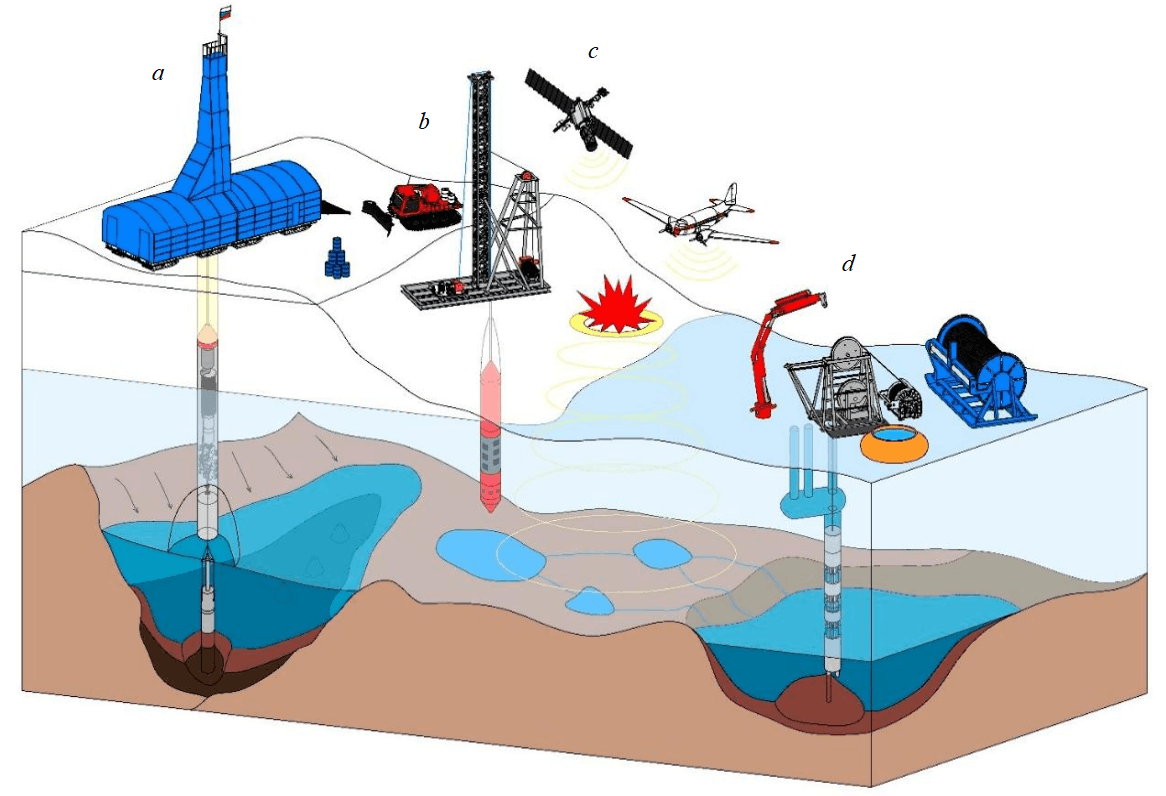
Fig.2. Technologies and equipment for Antarctic subglacial lake research: a – bottom-sediment sampling with a modular device through a borehole drilled using an electromechanical drill and filled with an environmentally safe borehole fluid; b – thermal-probe drilling; c – geophysical identification of lakes and determination of their parameters; d – bottom-sediment and water sampling with a single-unit device through a hot-water-drilled borehole
Access-borehole drilling
Access-borehole drilling is the most labor- and energy-intensive stage of the work. Because the operating conditions are unique, every ice-drilling technology currently in use incorporates purpose-built engineering solutions, each with its own advantages and disadvantages. The key parameters are maximum drilling depth, drilling time, borehole dia-meter, borehole lifetime, equipment mass, total fuel consumption during drilling, and compliance with environmental requirements. The following ice-drilling technologies are currently the most mature:
Cable-suspended electromechanical drilling (Fig.2, a) has low energy consumption and can create a long-lived research borehole when a nonfreezing borehole fluid is used. Its principal disadvantage is a low overall drilling rate because tripping operations are time-consuming. A long-lived borehole permits periodic sampling over an extended period, yielding information on hydrological-system dynamics, the stability of microbial communities, and rates of ecosystem change [15].
Hot-water drilling (Fig.2, d) provides high penetration and overall drilling rates and is environmentally safe, but it has high energy demand and a short borehole lifetime. At an ice temperature of –25 °C and an initial borehole diameter of 100-240 mm, the borehole refreezes within 4-23 h [13]. Completing the investigation within several days substantially reduces the cost of supplying a temporary station.
Thermal-probe drilling (Fig.2, b) offers autonomous drilling, portable equipment, and extended in-lake operating time. Its limitations include technical difficulties at great drilling depths and sensitivity to the mineral-particle content of the ice.
The main parameters of existing access-borehole drilling systems are presented in Table 2.
Table 2
Key parameters of existing and emerging access-borehole drilling technologies for subglacial lakes
|
Technology |
System |
Borehole diameter, mm |
Reached/ expected drilling depth, m |
Drilling speed, m/day |
Equipment weight (fuel weight), t |
Drilling power1, kW |
Lake access technology |
|
Cable-suspended electromechanical drilling |
IBED |
136 |
541/1400 |
20 |
25 (N/A) |
3 + 11 |
Closed, staged, isolated |
|
KEMS-135 |
138 |
3765/4500 |
30 |
35 (N/A) |
2.2 + 18.2 |
||
|
Foro 3000 |
129.6 |
– /2800 |
17 |
18 (31,93) |
1.79 + 8.7 |
||
|
Hot-water drilling |
EHWD |
600 |
2500/ – |
2160 |
566 (N/A) |
4700 + 300 |
Direct |
|
WISSARD |
300 |
1092/ – |
720-1480 |
230 (40) |
1000 |
||
|
SLCEC CHWD [42] |
300 |
2154/2700 |
max 2880 |
88 (N/A) |
1000 + 120 |
||
|
Ellsworth |
360 |
– /3400 |
N/A |
111 (51) |
1500 |
||
|
DeepRAD2 |
N/A |
3413/3800 |
480 |
N/A |
N/A |
||
|
Thermal-probe drilling |
RECAS [43] |
180 |
200/3800 |
36 |
330 kg (N/A) |
9.7 |
Isolated |
|
TRIPLE [44] |
200 |
52/4000 |
84 |
320 kg (N/A) |
25 |
Notes:
1 For hot-water drilling systems, thermal and electrical power are reported; for electromechanical drills, the power ratings of the drill motor and drilling winch are reported.
2 Based on the presentation by Wu Xiong, “Progress in polar scientific drilling research of CUGB” (09.04.2026).
Subglacial lake access
The access-borehole drilling method and the borehole fluid determine which lake-access methods can be used (Fig.3):
- Closed access, in which the pressure in the access borehole is maintained below the lake pressure so that lake water rises into part of the borehole and subsequently freezes. This method yielded the first frozen water samples from Lake Vostok [45]. A variant uses a thermal drill with a pilot bit to penetrate the subglacial lake [46].
- Direct access, providing immediate access to the lake when the borehole is filled with meltwater or another environmentally safe fluid [47, 48].
- Staged access, using a buffer of environmentally safe nonfreezing fluid or meltwater while the remainder of the borehole contains a toxic borehole fluid [46, 49].
- Isolated access, in which a layer of ice isolates the lake environment from the borehole environment [43].
The parameters of this stage directly affect the choice of methods for sampling water, bottom sediments, and suspended particulate matter, as well as for measuring subglacial lake parameters.
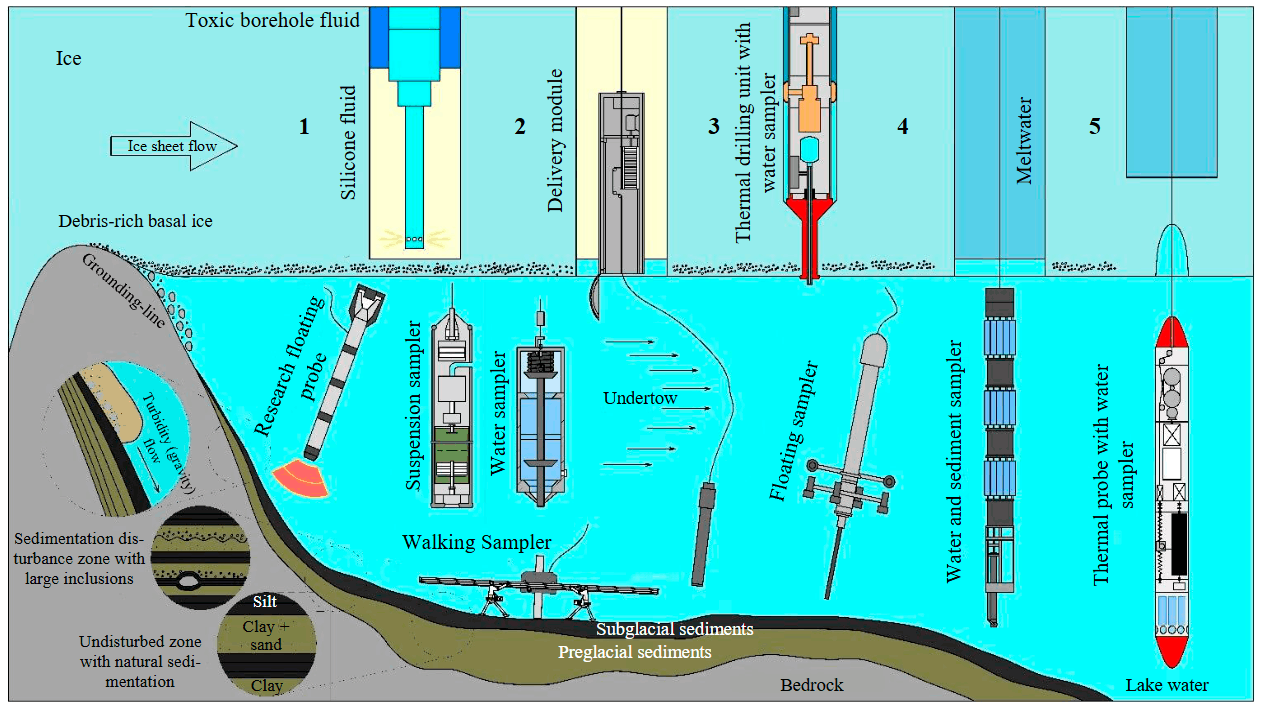
Fig.3. Equipment for direct investigation of Antarctic subglacial lakes and subglacial lake-access methods: 1 – staged; 2 – direct, followed by use of a modular research device; 3 – closed; 4 – direct, followed by use of a single-unit research device; 5 – isolated
Sampling water, bottom sediments, and suspended particulate matter and measuring subglacial lake parameters
The following sampling configurations are used in subglacial lakes (Fig.3):
- a single-unit device, in which the research equipment is lowered directly through the borehole into the lake [50];
- a modular device incorporating an intermediate component – a delivery module [51, 52] that isolates the research equipment from the borehole environment.
Water can be sampled from subglacial lakes using either a standard suite of hydrological instruments adapted to borehole conditions or purpose-built systems such as RECAS [43] and the Lake Ellsworth exploration system [53].
In studies of aquatic systems, sediment coring is generally used to characterize the sedimentary succession and thereby reconstruct the evolution of the water body. The principal sampler parameters are selected based on seismic surveys of the subglacial lake bed that provide a preliminary identification of sediment type.
Sediment samplers are classified by sampling method as follows:
- gravity corers (for soft sediments) [54];
- piston corers (for soft sediments) [55];
- percussion corers (from soft sediment to sand) [56];
- vibratory corers (from soft sediment to sand) [57];
- push corers (for soft sediments) [53];
- reciprocating rotary corers (for all sediment types, including bedrock) [26].
Mesh filters [58] are used to collect biological and mineral particles suspended in lake water; their operating principle involves pumping water through mesh cartridges with different aperture sizes. One such device, originally developed for oceanographic research and subsequently adapted for use in subglacial lakes, was deployed during the investigation of Mercer Subglacial Lake [30].
To maximize the information obtained from direct investigations and guide sampling-site selection, instruments are used to measure the following lake parameters in real time: hydrostatic pressure, temperature, dissolved-gas concentrations, pH, redox potential, electrical conductivity, and subglacial-water-body geometry using acoustic and laser ranging.
During an investigation, equipment operation should be monitored using both analog readings transmitted to the surface and video recordings. Compact video systems can be integrated into a multifunctional research platform with limited maneuverability [59] or mounted on a separate remotely operated floating vehicle [44, 60].
Challenges and limitations of Antarctic subglacial lake research
Technologies and equipment for lake research have continued to advance since the first access to Lake Vostok. Nevertheless, despite numerous studies that yielded important results at Lake Vostok, Mercer Subglacial Lake, Subglacial Lake Whillans, and Lake Ellsworth, bottom sediments have yet to be sampled directly from deep “stable” subglacial lakes. This is attributable to the following distinguishing characteristics of “stable” subglacial lakes.
The ice thickness covering 90 % of this type of lakes is more than 2500 m. Increasing the target drilling depth substantially complicates drilling-system design, increases total equipment mass, and consequently raises logistical costs.
Relatively large lake depths – more than 50 m, together with underwater currents increase the area over which a suspended sampler may drift. Overlying ice thickness and water-column depth determine the hydrostatic pressure and therefore the design of pressure housings for electronic and propulsion components that cannot operate unprotected in water. Hydrostatic pressure also compresses gas inclusions in the sediment; their expansion during decompression may disrupt the core structure [61]. In deep lakes, the sampler cable or load-bearing tether may deviate from the vertical, hindering penetration into the bottom sediments.
A wide range of temperature differences, from –57 to 0 °C, from the surface of the glacier to the surface of the lake, determines the power of the hot water heating system during drilling, as well as additional heaters to prevent the well from freezing during lake exploration.
Geological uncertainty and variations in the physical and mechanical properties of stratigraphically diverse sediment layers present further challenges. Sediment consolidation, porosity, water saturation, and grain-size distribution strongly influence resistance to penetration by the sampler’s core barrel and therefore affect the size of the recovered sample [62]. Together, these parameters also determine the rheological properties of the sediment mass, which affect the force required to detach the core, the performance of dynamic sampler systems, and the likelihood of disturbing the core structure during sampling.
Logistical difficulties in conducting research on lakes that are remote from polar stations, which leads to higher transportation costs per kilogram of cargo and, as a result, increased requirements for the weight and size of the equipment used and the amount of fuel.
Technological difficulties in complying with the mass and size restrictions of the equipment that is lowered into the lake, which is caused by the cramped conditions of the access well, which narrows over time.
Environmental requirements for preserving the relic ecological system of subglacial lakes, which significantly complicate the research technology and design of the devices used, and increase the cost of the work.
Some phenomena and conditions may remain unidentified because few subglacial lakes have been investigated directly and experience remains limited. For example, analyses of bottom-sediment cores from the “active” Mercer Subglacial Lake (1087 m of overlying ice) and Subglacial Lake Whillans (800 m of overlying ice) showed that their sediments did not preserve a record of natural lacustrine sedimentation but consisted instead of particles transported by subglacial flows. Their composition therefore did not differ from that of cores collected beneath ice streams and on the continental shelf in the same region of Antarctica [22].
Future priorities for technological development
Given these distinguishing characteristics of “stable” subglacial lakes, the following priorities can be identified for developing and improving the technologies and equipment used to investigate them:
- Ensuring environmentally safe access to subglacial lakes during cable-suspended electromechanical drilling by using a silicone borehole fluid (e.g., polymethylsiloxane fluid PMS-3), a composite polymer cable, and systems for cleaning the borehole walls [47].
- Increasing borehole diameter and both penetration and overall drilling rates during deep cable-suspended electromechanical drilling by using improved cleaning systems, cutting tools, and tripping equipment.
- Increasing hot-water drilling depths and borehole lifetime, particularly in East Antarctica, where ice thickness commonly exceeds 3000 m.
- Increasing thermal-probe drilling depths by upgrading the built-in winch and overcoming constraints imposed by mineral inclusions in the ice using directional-drilling systems [13, 43].
- Increasing the length of recovered bottom-sediment cores while reducing the sampler’s power demand [56].
- Expanding the area accessible for bottom-sediment sampling by fitting the sampler with propulsion units.
- Preserving the integrity of recovered bottom-sediment cores during drilling, recovery, and transport, as disturbance at these stages biases analyses of the sample’s physical, geochemical, and biological properties [61].
- Ensuring reliable operation of electronic devices under high pressure and at low temperatures.
Conclusion
The investigation of Antarctic subglacial lakes is a complex interdisciplinary undertaking that requires advanced geophysical methods, drilling technologies, environmentally safe lake-access techniques, integrated characterization of water bodies, and methods for analyzing the resulting data. This article has examined the distinctive geographic and geotechnical settings of subglacial lakes and the established and emerging technologies and equipment used to investigate them.
Over decades of remote and direct subglacial lake research, the technologies and equipment employed have steadily advanced through the efforts of engineers and scientists worldwide. Despite substantial progress, particularly in identifying subglacial lakes by geophysical methods, many questions remain unresolved. Foremost among them is the challenge of obtaining samples from “stable” subglacial lakes while meeting environmental-protection requirements. Addressing this challenge requires integrated planning that explicitly aligns scientific objectives, logistical and infrastructure capabilities, access-borehole drilling, lake-access procedures, and sampling technologies. Before field deployment, experimental studies should be conducted under conditions representative of actual operations to assess the reliability, energy efficiency, and environmental safety of the proposed technologies. At the current level of scientific and technological development, direct investigations of subglacial lakes present a set of formidable challenges. Successful implementation of such projects, however, could produce discoveries that fundamentally reshape our understanding of Earth’s climate history, past and present biogeochemical processes in isolated ecosystems, and the future dynamics of Earth’s cryosphere.
References
- Wilson S.F., Hogg A.E., Rigby R. et al. Detection of 85 new active subglacial lakes in Antarctica from a decade of CryoSat-2 data. Nature Communications. 2025. Vol. 16. N 8311. DOI: 10.1038/s41467-025-63773-9
- Smith A.M., Woodward J., Ross N. et al. Evidence for the long-term sedimentary environment in an Antarctic subglacial lake. Earth and Planetary Science Letters. 2018. Vol. 504, p. 139-151. DOI: 10.1016/j.epsl.2018.10.011
- Siegert M.J., Priscu J.C., Alekhina I.A. et al. Antarctic subglacial lake exploration: first results and future plans. Philosophical Transactions of the Royal Society A. Mathematical, physical and engineering sciences. 2016. Vol. 374. Iss. 2059. N 20140466. DOI: 10.1098/rsta.2014.0466
- Bulat S., Petit J.-R. Vostok, Subglacial Lake. Encyclopedia of Astrobiology. Springer, 2023, p. 3206-3212. DOI: 10.1007/978-3-662-65093-6_1765
- Masolov V.N., Popov S.V., Lukin V.V., Popkov A.M. The Bottom Topography and Subglacial Lake Vostok Water Body, East Antarctica. Doklady Earth Sciences. 2010. Vol. 433. Part 2, p. 1092-1097. DOI: 10.1134/S1028334X10080222
- Siegert M. A 60-year international history of Antarctic subglacial lake exploration. Geological Society, London, Special Publications. 2018. Vol. 461, p. 7-21. DOI: 10.1144/SP461.5
- Gorelik G.D., Egorov A.S., Shuklin I.A., Ushakov D.E. Substantiation of optimal range of geophysical surveys to study deep structure of the Lake Vostok area. Gornyi zhurnal. 2024. N 9, p. 56-61 (in Russian). DOI: 10.17580/gzh.2024.09.09
- Studinger M, Bell R.E., Karner G.D. et al. Ice cover, landscape setting, and geological framework of Lake Vostok, East Antarctica. Earth and Planetary Science Letters. 2003. Vol. 205. Iss. 3-4, p. 195-210. DOI: 10.1016/S0012-821X(02)01041-5
- Killingbeck S.F., Dow C.F., Unsworth M.J. A quantitative method for deriving salinity of subglacial water using ground-based transient electromagnetics. Journal of Glaciology. 2022. Vol. 68. Iss. 268, p. 319-336. DOI: 10.1017/jog.2021.94
- Pattyn F. Antarctic subglacial conditions inferred from a hybrid ice sheet/ice stream model. Earth and Planetary Science Letters. 2010. Vol. 295. Iss. 3-4, p. 451-461. DOI: 10.1016/j.epsl.2010.04.025
- Zotikov I.A. Bottom melting in the central zone of the ice shield on the Antarctic continent and its influence upon the present balance of the ice mass. International Association of Scientific Hydrology. Bulletin. 1963. Vol. 8. Iss. 1, p. 36-44. DOI: 10.1080/02626666309493295
- MacKie E.J., Schroeder D.M., Caers J. et al. Antarctic Topographic Realizations and Geostatistical Modeling Used to Map Subglacial Lakes. Journal of Geophysical Research: Earth Surface. 2020. Vol. 125. Iss. 3. N e2019JF005420. DOI: 10.1029/2019JF005420
- Talalay P.G., Xiaopeng Fan. Alternative clean approaches to accessing subglacial Lake Vostok. Arctic and Antarctic Research. 2024. Vol. 70. N 4, p. 499-513. DOI: 10.30758/0555-2648-2024-70-4-499-513
- Siegfried M.R., Venturelli R.A., Patterson M.O. et al. The life and death of a subglacial lake in West Antarctica. Geology. 2023. Vol. 51. N 5, p. 434-438. DOI: 10.1130/G50995.1
- Livingstone S.J., Yan Li, Rutishauser A. et al. Subglacial lakes and their changing role in a warming climate. Nature Reviews Earth & Environment. 2022. Vol. 3. Iss. 2, p. 106-124. DOI: 10.1038/s43017-021-00246-9
- Egorov A.S., Ageev A.S., Shuklin I.A. et al. On the similarity of deep structure of the basement and genesis of depressions on the eastern flank of East Antarctic and in Lake Baikal area. Journal of Mining Institute. 2025. Vol. 273, p. 26-41.
- Studinger M., Karner G.D., Bell R.E. Geophysical models for the tectonic framework of the Lake Vostok region, East Antarctica. Earth and Planetary Science Letters. 2003. Vol. 216. Iss. 4, p. 663-677. DOI: 10.1016/S0012-821X(03)00548-X
- Tabacco I.E., Cianfarra P., Forieri A. et al. Physiography and tectonic setting of the subglacial lake district between Vostok and Belgica subglacial highlands (Antarctica). Geophysical Journal International. 2006. Vol. 165. Iss. 3, p. 1029-1040. DOI: 10.1111/j.1365-246X.2006.02954.x
- Lukin V.V., Markov A.N. Hypothesis of Tectonic Preglacial Genesis of the Basin and Water Body of Antarctica’s Lake Vostok. Geography and Natural Resources. 2024. Vol. 45. N 2, p. 192-201. DOI: 10.1134/S1875372824700264
- Popov S.V., Boronina A.S., Ekaykin A.A. et al. Remote sensing and mathematical modelling of Lake Vostok, East Antarctica: past, present and future research. Arctic and Antarctic Research. 2024. Vol. 70. N 4, p. 460-476. DOI: 10.30758/0555-2648-2024-70-4-460-476
- Litvinenko V. Foreword: Sixty-year Russian history of Antarctic sub-glacial lake exploration and Arctic natural resource development. Geochemistry. 2020. Vol. 80. Iss. 3. N 125652. DOI: 10.1016/j.chemer.2020.125652
- Brisbourne A.M., Smith A.M., Rivera A. et al. Bathymetry and bed conditions of Lago Subglacial CECs, West Antarctica. Journal of Glaciology. 2023. Vol. 69. Iss. 278, p. 1546-1555. DOI: 10.1017/jog.2023.38
- Couston L.-A., Siegert M. Dynamic flows create potentially habitable conditions in Antarctic subglacial lakes. Science Advances. 2021. Vol. 7. Iss. 8. N eabc3972. DOI: 10.1126/sciadv.abc3972
- Hodson T.O., Powell R.D., Brachfeld S.A. et al. Physical processes in Subglacial Lake Whillans, West Antarctica: Inferences from sediment cores. Earth and Planetary Science Letters. 2016. Vol. 444, p. 56-63. DOI: 10.1016/j.epsl.2016.03.036
- Peters L.E., Anandakrishnan S., Holland C.W. et al. Seismic detection of a subglacial lake near the South Pole, Antarctica. Geophysical Research Letters. 2008. Vol. 35. Iss. 23. N L23501. DOI: 10.1029/2008GL035704
- Vasilyev N.I., Leychenkov G.L., Zagrivny E.A. Prospects of Obtaining Samples of Bottom Sediments from Subglacial Lake Vostok. Journal of Mining Institute. 2017. Vol. 224, p. 199-208. DOI: 10.18454/PMI.2017.2.199
- Popov S.V. Six decades of radar and seismic research in Antarctica. Ice and Snow. 2021. Vol. 61. N 4, p. 587-619 (in Russian). DOI: 10.31857/S2076673421040110
- Leitchenkov G.L., Antonov A.V., Luneov P.I., Lipenkov V.Ya. Geology and environments of subglacial Lake Vostok. Philosophical Transactions of the Royal Society A. Mathematical, physical and engineering sciences. 2016. Vol. 374. Iss. 2059. N 20140302. DOI: 10.1098/rsta.2014.0302
- Bell R.E., Studinger M., Fahnestock M.A., Shuman C.A. Tectonically controlled subglacial lakes on the flanks of the Gamburtsev Subglacial Mountains, East Antarctica. Geophysical Research Letters. 2006. Vol. 33. Iss. 2. N L02504.DOI: 10.1029/2005GL025207
- Priscu J.C., Kalin J., Winans J. et al. Scientific access into Mercer Subglacial Lake: scientific objectives, drilling operations and initial observations. Annals of Glaciology. 2021. Vol. 62. Iss. 85-86, p. 340-352. DOI: 10.1017/aog.2021.10
- Shuai Yan, Blankenship D.D., Greenbaum J.S. et al. A newly discovered subglacial lake in East Antarctica likely hosts a valuable sedimentary record of ice and climate change. Geology. 2022. Vol. 50. N 8, p. 949-953. DOI: 10.1130/G50009.1
- Hodgson D.A., Roberts S.J., Bentley M.J. et al. Exploring former subglacial Hodgson Lake, Antarctica. Paper II: palaeolimnology. Quaternary Science Reviews. 2009. Vol. 28. Iss. 23-24, p. 2310-2325. DOI: 10.1016/j.quascirev.2009.04.014
- Levitan M.A., Girin Yu.P., Luksha V.L. et al. Modern Sedimentation System of Lake Untersee, East Antarctica. Geochemistry International. 2011. Vol. 49. Iss. 5. P. 459-481. DOI: 10.1134/S0016702911050077
- Pritchard H.D., Fretwell P.T., Fremand A.C. et al. Bedmap3 updated ice bed, surface and thickness gridded datasets for Antarctica. Scientific Data. 2025. Vol. 12. N 414. DOI: 10.1038/s41597-025-04672-y
- Dunbar G., Niessen F., Vogel S. Late Pleistocene to Holocene Strata from Soft-Sediment Coring at the AND-1B Site, ANDRILL McMurdo Ice Shelf Project, Antarctica. Terra Antartica. 2007. Vol. 14. N 3, p. 141-154.
- Bentley M.J., Christoffersen P., Hodgson D. A. et al. Subglacial Lake Sediments and Sedimentary Processes: Potential Archives of Ice Sheet Evolution, Past Environmental Change, and the Presence of Life. Antarctic Subglacial Aquatic Environments. American Geophysical Union, 2011. Vol. 192, p. 83-110.
- Campbell T.D., Skidmore M.L., Patterson M.O. et al. Dynamic subglacial meltwater history archived in Antarctic subglacial lake sediments. Geological Society of America Bulletin. 2025. Vol. 137. N 7-8, p. 3055-3068. DOI: 10.1130/B37731.1
- Yan Zhou, Xiangbin Cui, Zhenxue Dai et al. The Antarctic Subglacial Hydrological Environment and International Drilling Projects: A Review. Water. 2024. Vol. 16. Iss. 7. N 1111. DOI: 10.3390/w16081111
- Talovina I.V., Babenko I.A., Ilalova R.K., Duryagina A.M. Olivine-spinel geothermometry – Indicator of formation identity of rocks and a basis for geodynamic reconstructions in Antarctica. Gornyi zhurnal. 2024. N 9, p. 77-82 (in Russian). DOI: 10.17580/gzh.2024.09.12
- Abdrakhmanov I.A., Gulbin Y.L., Skublov S.G., Galankina O.L. Mineralogical Constraints on the Pressure–Temperature Evolution of Granulites in the Bunger Hills, East Antarctica. Minerals. 2024. Vol. 14. Iss. 5. N 488. DOI: 10.3390/min14050488
- Litvinenko V., Trushko V. Modelling of geomechanical processes of interaction of the ice cover with subglacial Lake Vostok in Antarctica. Antarctic Science. 2025. Vol. 37. Iss. 1, p. 39-48. DOI: 10.1017/S0954102024000506
- Makinson K., Anker P.G.D., Garcés J. et al. Development of a clean hot water drill to access Subglacial Lake CECs, West Antarctica. Annals of Glaciology. 2021. Vol. 62. Iss. 85-86, p. 250-262. DOI: 10.1017/aog.2020.88
- Youhong Sun, Bing Li, Xiaopeng Fan et al. Brief communication: New sonde to unravel the mystery of polar subglacial lakes. The Cryosphere. 2023. Vol. 17. Iss. 3, p. 1089-1095. DOI: 10.5194/tc-17-1089-2023
- Audehm J., Bachmayer R., Bande M. et al. TRIPLE – Technologies for Rapid Ice Penetration and Subglacial Lake Exploration: Whitepaper by the TRIPLE Project within the German Space Agency Explorer Initiative at DLR. German Space Agency at DLR, 2025, p. 36. DOI: 10.22541/essoar.175371779.92742499/v2
- Lipenkov V.Ya., Turkeev A.V., Ekaykin A.A. et al. Unsealing Subglacial Lake Vostok: Lessons and implications for future full-scale exploration. Arctic and Antarctic Research. 2024. Vol. 70. N 4, p. 477-498. DOI: 10.30758/0555-2648-2024-70-4-477-498
- Vasiliev N.I., Talalay P.G., Bobin N.E. et al. Deep drilling at Vostok station, Antarctica: history and recent events. Annals of Glaciology. 2007. Vol. 47, p. 10-23. DOI: 10.3189/172756407786857776
- Serbin D.V., Buslaev G.V., Lavrik A.Yu. et al. Study of the interaction between the drilling fluid and lake water during the opening of the subglacial Lake Vostok in Antarctica. Journal of Mining Institute. 2025. Vol. 273, p. 136-146.
- Alemany O., Talalay P., Boissonneau P. et al. The SUBGLACIOR drilling probe: hydraulic considerations. Annals of Glaciology. 2021. Vol. 62. Iss. 84, p. 131-142. DOI: 10.1017/aog.2020.79
- Serbin D.V. Prevention of emulsion formation during opening subglasial reservoirs. News of the Ural State Mining University. 2021. Iss. 3 (63), p. 80-88 (in Russian). DOI: 10.21440/2307-2091-2021-3-80-88
- Da Gong, Xiaopeng Fan, Yazhou Li et al. Coring of Antarctic Subglacial Sediments. Journal of Marine Science and Engineering. 2019. Vol. 7. Iss. 6. N 194. DOI: 10.3390/jmse7060194
- Litvinenko V.S., Leitchenkov G.L., Vasiliev N.I. Anticipated sub-bottom geology of Lake Vostok and technological approaches considered for sampling. Geochemistry. 2020. Vol. 80. Iss. 3. N 125556. DOI: 10.1016/j.chemer.2019.125556
- Vasilev N.I., Bolshunov A.V., Dmitriev A.N., Podoliak A.V. Round-trip assembly for investigations of subglacial lake Vostok. International Journal of Applied Engineering Research. 2016. Vol. 11. N 9, p. 6376-6380.
- Keen P., Saw K., Rundle N. et al. A mini-corer for precision sampling of the water-sediment interface in subglacial lakes and other remote aqueous environments. Limnology and Oceanography: Methods. 2018. Vol. 16. Iss. 12, p. 856-867. DOI: 10.1002/lom3.10288
- Rosenheim B.E., Michaud A.B., Broda J. et al. A method for successful collection of multicores and gravity cores from Antarctic subglacial lakes. Limnology and Oceanography: Methods. 2023. Vol. 21. Iss. 5, p. 279-294. DOI: 10.1002/lom3.10545
- Hodgson D.A., Bentley M.J., Smith J.A. et al. Technologies for retrieving sediment cores in Antarctic subglacial settings. Philosophical Transactions of the Royal Society A. Mathematical, physical and engineering sciences. 2016. Vol. 374. Iss. 2059. N 20150056. DOI: 10.1098/rsta.2015.0056
- Makinson K., Ashurst D., Anker P.G.D. et al. A new percussion hammer mechanism for a borehole deployable subglacial sediment corer. Annals of Glaciology. 2020. Vol. 62. Iss. 85-86, p. 385-389. DOI: 10.1017/aog.2020.83
- Da Gong, Nan Zhang, Yunchen Liu et al. Small-diameter vibrocorer for sediment coring beneath Antarctic ice shelves: General concept and testing. Ocean Engineering. 2016. Vol. 126, p. 232-239. DOI: 10.1016/j.oceaneng.2016.09.023
- Bobin N.E., Talatai P.G., Yankilevich S.V. Technical means for the study of subglacial reservoirs in the example of Lake Vostok in Antarctica. Journal of Mining Institute. 2004. Vol. 157, p. 147-149 (in Russian).
- Mowlem M., Saw K., Brown R. et al. Probe technologies for clean sampling and measurement of subglacial lakes. Philosophical Transactions of the Royal Society A. Mathematical, physical and engineering sciences. 2016. Vol. 374. Iss. 2059. N 20150267. DOI: 10.1098/rsta.2015.0267
- Behar A.E., Chen D.D., Ho C. et al. MSLED: The Micro Subglacial Lake Exploration Device. Underwater Technology. 2015. Vol. 33. N 1, p. 3-17. DOI: 10.3723/ut.33.003
- Dück Y., Lorke A., Jokiel C., Gierse J. Laboratory and field investigations on freeze and gravity core sampling and assessment of coring disturbances with implications on gas bubble characterization. Limnology and Oceanography: Methods. 2019. Vol. 17. Iss. 11, p. 585-606. DOI: 10.1002/lom3.10335
- Jun Han Bae, Wonse Jo, Jee Hwan Park et al. Evaluation of Sampling Methods for Robotic Sediment Sampling Systems. IEEE Journal of Oceanic Engineering. 2020. Vol. 46. Iss. 2, p. 542-554. DOI: 10.1109/JOE.2020.3005576