

Experience in refining the critical depth of rock burst hazard at the ore deposit during transition to underground mining
- 1 — Ph.D. Deputy General Director Geotechnical Bureau LLC ▪ Orcid
- 2 — Ph.D. Associate Professor Empress Catherine II Saint Petersburg Mining University ▪ Orcid
- 3 — Ph.D. Chief Specialist Geotechnical Bureau LLC ▪ Orcid
- 4 — Ph.D. Associate Professor Empress Catherine II Saint Petersburg Mining University ▪ Orcid
Abstract
The paper considers the problem of refining the critical depth of rock burst hazard for the Nyorkpakhk apatite-nepheline ore deposit in the context of transition to underground mining. The relevance of the study results from the discrepancy between the value of 400 m (according to regulatory documentation) and the actual mining and geological conditions, especially considering the significant impact of the existing open pit on the stress-strain state of the rock mass and other natural factors of the region. The aim of the study is the development and testing of a comprehensive methodology for assessing the critical depth of rock burst hazard, including core discing analysis, seismicity monitoring, spatial numerical modeling of the stress-strain state using the CAE Simulia Abaqus software, assessment of the rock burst hazard potential of rocks based on the Kaiser criterion, and comparison with a geomechanically similar analogue Oleniy Ruchey deposit. Core discing analysis revealed only local stress zones associated with tectonic faults, without characteristics pointing to rock burst hazard down to the +100 m level. The results of numerical modeling confirmed the absence of stress concentrations down to the +35 m level both before the start and after the completion of open pit mining. Comparison using the similarity method showed expected manifestation of rock burst hazard below the +50 m level. The studies, according to the described methodology, enabled scientific justification of increasing the critical depth of rock burst hazard relative to the regulatory value, down to the +100 m level. It has also been determined that for the Khibiny deposits there is no direct correlation between the brittleness criterion and the propensity for rock burst hazard. The proposed methodology is recommended for testing at rock burst hazardous deposits with complex mining and geological conditions.
None
Introduction
The problem of rock burst hazard represents one of the most significant safety threats during underground mining of mineral deposits. At certain depths, dynamic rock pressure manifestations (rock bursts) can occur, which could be accompanied by sudden intense failure of the rock mass and even mining system elements. These phenomena not only significantly complicate mining operations, but also form a direct danger to the lives of workers. The propensity of a rock mass to rock bursts is a complex function of numerous interrelated factors. The key factor appears to be the natural stress state of the rock mass [1], formed by gravitational forces and tectonic processes, which can reach levels close to or exceeding the compressive strength of rocks. A significant influence is exerted by the elastic and strength properties of rocks and ores (elastic modulus, compressive and tensile strength), parameters of rock mass fracturing (intensity, orientation, persistence of fractures), as well as the characteristics of large tectonic disturbances (faults, dikes) and their spatial position relative to drifts.
In addition to geomechanical conditions, the rock burst hazard of the rock mass is significantly influenced by technological factors determined by the mining system and mining technology:
- occurrence parameters and properties of the ore body – thickness, dip angle, strike direction;
- properties of the host rocks;
- design solutions of the mining system;
- geological features – presence and type of tectonic faults and their zones of influence [2], boundaries between lithotypes;
- degree of dissection of the rock mass block by drifts, conditions of underworking or overworking;
- mutual influence of adjacent blocks – mining under protective pillars; counter-stope mining [3].
At the Nyorkpakhk deposit, which is part of the Khibiny apatite-nepheline ore deposits, the problem of rock burst hazard is particularly important [4]. According to the current Federal Norms and Rules in the Field of Industrial Safety, this deposit is classified as rock burst hazardous from a depth of 400 m for the main types of rocks and ores (ijolite-urtites, low-grade and high-grade ores). This is based on the properties of the host rock mass – the rocks are classified as hard, possess high brittleness and a propensity for brittle failure upon reaching the strength limit [5, 6].
The regulatory value of the critical depth is established for a structurally undisturbed rock mass; in reality, however, the stress-strain state of the rock mass in the mining zone undergoes significant changes under the influence of mining-geological and technogenic factors [7, 8]. The most significant of these for the Nyorkpakhk deposit is the influence of the open pit at the final stage of mining, which forms zones of stress redistribution that extend to a considerable depth [9]. The actual physical-mechanical properties of rocks, which are critically important for assessing rock burst hazard, and especially their brittleness, which determines the failure mechanism and the strength limit [10], can change with increasing depth due to the increase in confining pressure. The most unfavorable and hazardous scenario is the combination of rocks with high brittle properties and elevated stresses acting in the rock mass.
To ensure safe and efficient underground mining of the Nyorkpakhk deposit, a reliable forecast of the stress-strain state of the rock mass is a relevant objective, and in particular, a scientifically substantiated refinement of the critical depth of rock burst hazard, taking into account the actual situation [11]. Solving this problem requires a shift from regulatory averaged assessments to accounting for the specific features of the deposit and the existing mining-technical situation, which can only be achieved by applying an integrated approach. This study proposes and substantiates such an approach based on the integrated application of a set of methods. The purpose of implementing the approach is to determine the actual elevations from which the Nyorkpakhk deposit should be classified as prone or hazardous with respect to rock bursts, which serves as the fundamental basis for the development of effective rock pressure management measures and ensuring industrial safety during underground mining.
Materials and methods
Brief geological characteristics of the Nyorkpakhk deposit
In terms of structural-tectonic setting, the Nyorkpakhk deposit is located in a lens-shaped block bounded: on the east and southeast by the zone of tectonic contact of the massif with the host rocks of the Imandra-Varzuga belt; on the south by a fault zone expressed by the valley of the Vuonnemyok River; and on the north and northwest by faults expressed in the relief by the valley and tributaries of the Tuljok River.
According to geological exploration data, the multi-level ore zone of the Nyorkpakhk deposit consists of three bodies of brecciated apatite-nepheline ores. The rock mass of the Nyorkpakhk deposit is characterized by a complex structural-tectonic setting and an intense degree of fracturing. All rocks of the massif are intersected by lamprophyre dikes of various compositions (tinguaites, monchikites, shonkinites, etc.). All these factors together form a complex fracture structure with diverse interrelations of systems and subsystems. The scale of fracture elements covers no fewer than five ranks – from thread-like and hairline fractures to dislocations whose dimensions are comparable with the height of the open-pit wall or exceed it [12].
All types of rocks and ores constituting the deposit are classified as hard. They are characterized by high brittleness indices and a pronounced propensity for brittle failure upon reaching the strength limit. Such strength and deformation properties are the key geomechanical characteristic that allows the rock mass of the Nyorkpakhk deposit to be classified as prone to the occurrence of rock bursts.
The stress state of the geological environment in the area of the deposit is of tectonic origin and is characterized by the predominance of horizontal stress components over vertical, which is caused by the action of regional tectonic forces. An additional risk factor is the formation of local stress concentration zones near large tectonic disturbances.
Analysis of methods for assessing the propensity of deposits to rock bursts
The prediction of rock burst hazard in accordance with current regulatory documentation is based on the assessment of the stress state and characteristic forms of brittle rock failure in drifts by geomechanical and geophysical methods.
Federal Norms and Rules (Order N 505) present a list of deposits, as well as rocks and ores prone to brittle failure, and indicate the depth from which rock bursts occur during mining operations or the “Hazardous” category is established. The rocks and ores of these deposits are represented mainly by intrusive and effusive strong hard rocks, quartz veins, and less often by sedimentary rocks.
In accordance with regulatory requirements (including requirements developed by All-Union Scientific Research Institute of Mine Surveying), a comprehensive study of the natural and technogenic factors that control the state of the rock mass and the parameters of the geological environment is carried out to assess the propensity of a deposit to rock bursts [13, 14].
Regional prediction can be carried out taking into account the data of geodynamic zoning by various methods [15-17], summarized in the Table. In the course of research, specialists often face certain limitations. These concerns both the technical capabilities of testing equipment, the time frames of investigations, and the number of available rock samples. In this regard, the development of methods that allow a rapid and effective assessment of the propensity of rocks to rock bursts becomes particularly relevant. A significant contribution to the development of methods for assessing rock burst hazard was made by the Canadian scientist P.Kaiser [18, 19], who proposed a criterion that takes into account, in a comprehensive assessment, two fundamental parameters – compressive strength characteristics and the brittleness coefficient of the material. An important advantage of this approach is that it only requires standard laboratory equipment and generally accepted testing methods.
Comparative analysis of methods for assessing rock burst hazard in rock masses
|
Assessment method |
Brief description |
Advantages |
Limitations |
|
Regulatory assessment |
Use of approved lists of rock burst hazardous deposits and critical depths based on rock typification |
Standardization of the approach, ease of application for typical conditions |
Does not take into account the local specifics of the rock mass, technogenic factors, and dynamics of stress strain state changes |
|
Core discing method |
Assessment of core splitting intensity as an indication of the stress state and rock brittleness |
Applicability at the geological exploration stage, integral assessment of rock mass stress |
Qualitative nature of the assessment, dependence on core sampling and transportation conditions, subjectivity of interpretation |
|
Instrumental monitoring |
Systems for continuous monitoring of deformations, acting stresses, acoustic emission |
Direct measurement of parameters in real time, possibility of prompt response, long-term forecast |
High equipment cost, installation complexity, need for noise filtering |
|
Geophysical methods |
Detection of stress concentration zones and heterogeneities by geophysical methods |
Non-destructive testing, capability for large-scale investigations, integral assessment of rock mass properties |
Need for specialized equipment, interpretation complexity |
|
Analytical calculations |
Construction of predictive maps of stress strain state and rock burst hazard taking into account the block structure of the rock mass based on calculations and modeling |
Flexibility of prediction when varying planned conditions and mining sequence |
Dependence on the reliability of initial data, simplification of real geometry, high error in complex tectonics |
|
Geodynamic test site |
Comprehensive in situ studies at specialized sites using a combination of methods |
Maximum representativeness, consideration of factor interactions, verification of other methods |
Extremely high cost, long observation duration, limited coverage area, organizational complexity |
|
Kaiser criterion |
Assessment of rock burst hazard potential via compressive strength and brittleness coefficient; a rock is considered rock burst hazardous if at 80 % of the failure load, ≥70 % of deformations are elastic |
Operability, use of standard tests, quantitative result |
Does not take into account structural features of the rock mass, extrapolation of sample properties to the block scale, limited applicability for anisotropic rocks |
Practical testing of the Kaiser criterion was successfully carried out in the study of andesites of the Novoshirokinskoye polymetallic deposit and deposits of the Norilsk industrial region [20, 21]. Based on the research results, the entire sample array was differentiated into two categories – potentially rock burst hazardous rocks and rocks not prone to rock bursts. Since the Kaiser criterion demonstrated high efficiency, it was decided to apply this method for analyzing the rock burst hazard of rocks at the apatite-nepheline deposits located within the Khibiny massif.
A frequently encountered laboratory criterion of rock burst hazard is the analysis of the behavior of standard specimens under load. The assessment of the rock propensity to rock bursts is carried out as follows: if, at a load of 80 % of the failure load, elastic deformations reach 70 % of total deformations, the rock is recognized as rock burst hazardous [22]. Since pre-peak and post-peak irreversible deformations are caused by crack development, and a correlation exists between the characteristics of these stages, it is logical to assume a relationship between rock behavior at the initial loading stage and when peak values are reached. This makes it possible to assess the rock burst hazard of rocks based on experimental curves even without reaching their strength limit [23].
A summary analysis of the methods presented in the table made it possible to identify common advantages and limitations:
- regulatory methods ensure standardization but may not account for the specifics of a particular deposit and technogenic influence;
- geophysical methods and instrumental monitoring provide valuable information on acting stresses but require complex equipment and interpretation techniques;
- laboratory methods, including core discing, the Kaiser criterion, and deformation analysis, are relatively expeditious, but the extrapolation of sample properties to the rock mass is limited by the representativeness of samples and the inability to account for technogenic impacts;
- computational methods and modeling are flexible, but their accuracy depends on the reliability of initial data and the adequacy of models.
Thus, none of the presented methods alone is capable of providing a comprehensive and reliable assessment of rock burst hazard for deposits with a complex structure, such as Nyorkpakhk. The limitations of each approach demonstrate the need for their integrated application – only this makes it possible to offset the shortcomings of individual methods, utilize their advantages, and obtain a scientifically substantiated forecast of rock burst hazard, taking into account the totality of natural and technogenic factors.
Results of the assessment of the critical depth of rock burst hazard for the Nyorkpakhk deposit by a set of methods
The study performed an analysis of the critical depth by all considered methods and compared the obtained values.
Analysis of regulatory requirements. The current regulatory requirements in the field of industrial safety (Federal Norms and Rules, Order N 505) establish the mandatory determination of the critical depth of rock burst hazard for all explored and operating deposits, as well as for planned and operating mining enterprises. This parameter is a key factor in selecting a mining technology for the deposit.
The critical depth of rock burst hazard is defined as the depth from the ground surface starting from which rock bursts occur during mining operations or the “Hazardous” category is established, corresponding to the stress state of the rock mass in the boundary zone of a drift at which a rock burst can occur [24].
According to Federal Norms and Rules (Order N 505), the Nyorkpakhk deposit is classified as prone and hazardous with respect to rock bursts from a depth of 400 m for the following lithotypes: ijolite-urtites, low-grade and high-grade apatite-nepheline ores.
The corporate regulation of the Kirovsk Branch of Apatit JSC[3], updated in 2021, confirms the critical depth value for deposits mined by the open-pit method (including Nyorkpakhk) – Koashvinskoye 400 m, Nyorkpakhk 400 m. This consistency is justified by the insufficient volume of in situ data for adjusting the depth.
Assessment by the core discing method. For the primary assessment of the rock mass propensity to rock bursts, the basic core discing method was used [23]. Discing sections are selected according to the following requirements: the length of the discing section – no less than 25 cm (for a borehole diameter of 46-50 mm); the thickness of the counted discs – no more than half the core diameter.
The study of core material from thirteen geological exploration boreholes of the Nyorkpakhk deposit made it possible to identify discing zones and assess the stress level at the considered depths. The presence of discing sections confirms the action of tectonic stresses in the rock mass, which correlates with data from instrumental measurements by the stress relief method. The core destruction process can intensify with changes in rock fracturing or drilling parameters.
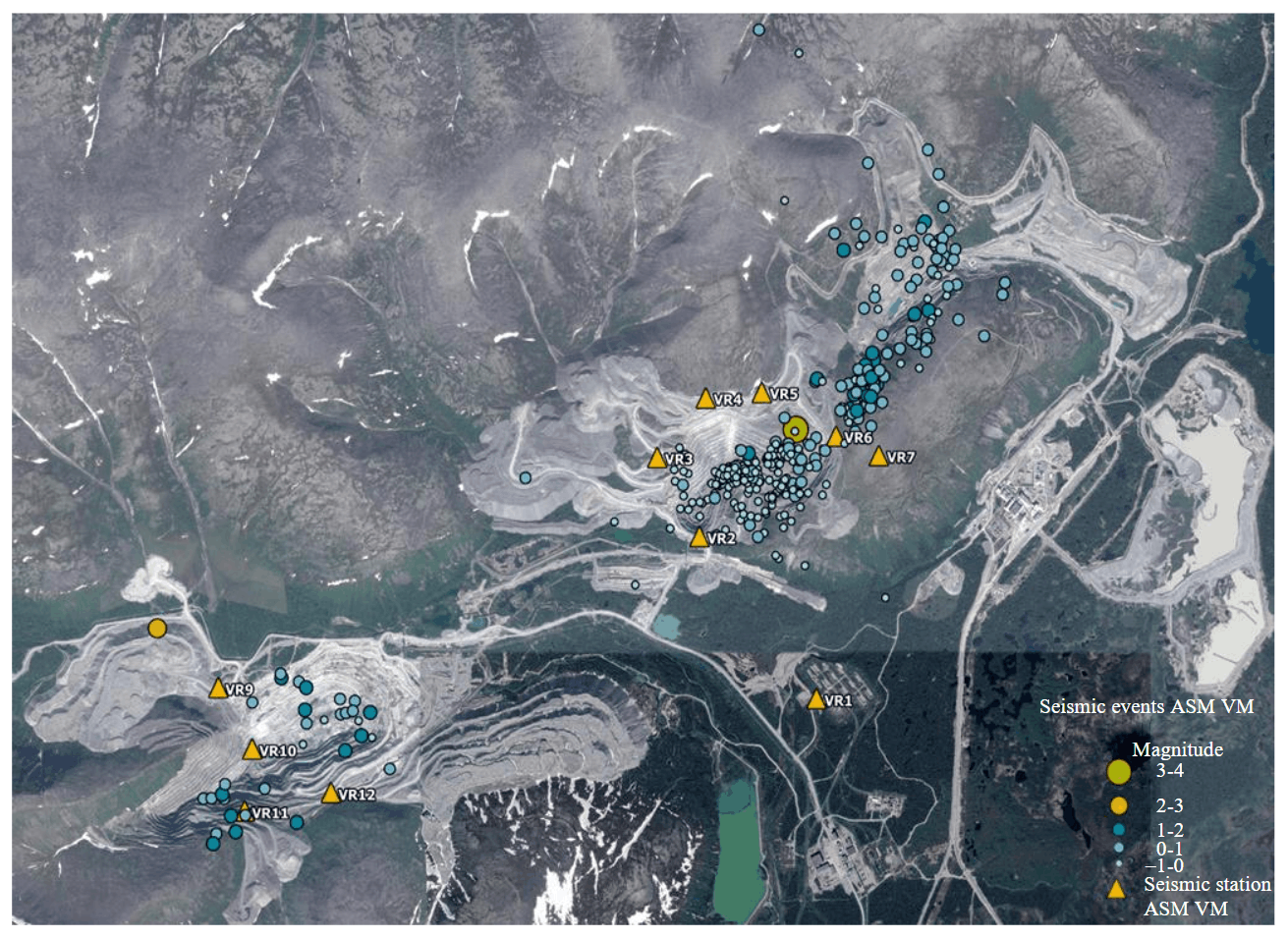
Fig.1. Results of seismic event recording at the industrial site in 2022
Analysis of photo documentation and core samples revealed that core discing is local in nature, occurring at limited depths and short borehole intervals (less than 0.25 m), which may indicate the presence of tectonic disturbance zones, lithotype contacts, as well as the intersection of rock layering by the borehole at acute angles. Discing zones are predominantly represented by 5-8 fragments and do not define zones of maximum horizontal stresses. Spatial visualization of discing intervals in a model with the framework of tectonic disturbances confirmed their association with local structural elements.
The observed core discing is caused by the localization of geomechanical processes within zones of influence of tectonic disturbances, which can be explained by two complementary mechanisms:
- stress concentration in near-fault regions during the redistribution of tectonic loads;
- reduction of strength characteristics directly within the disturbance due to rock disintegration and the development of secondary mineralization.
Analysis of the spatial distribution of discing intervals allows the following conclusion to be drawn: within the planned mining horizons (down to the +100 m level), the rock mass shows no signs of regional rock burst hazard; local discing sections are not a basis for assigning a rock burst hazard category. It should be noted that all boreholes were drilled down to the +100 m level; therefore, rock burst hazard below this level was not investigated by this method.
Seismicity monitoring. Seismicity monitoring of the rock mass at the Nyorkpakhk and Koashva open pits is carried out by the Automated Seismic Monitoring System of the Vostochny Mine (ASM VM), deployed together with the Kola Branch of the Unified Geophysical Service of the Russian Academy of Sciences (Fig.1). The configuration of the monitoring network ensures the accuracy of coordinate determination within the industrial site of the Vostochny Mine of no less than 50 m.
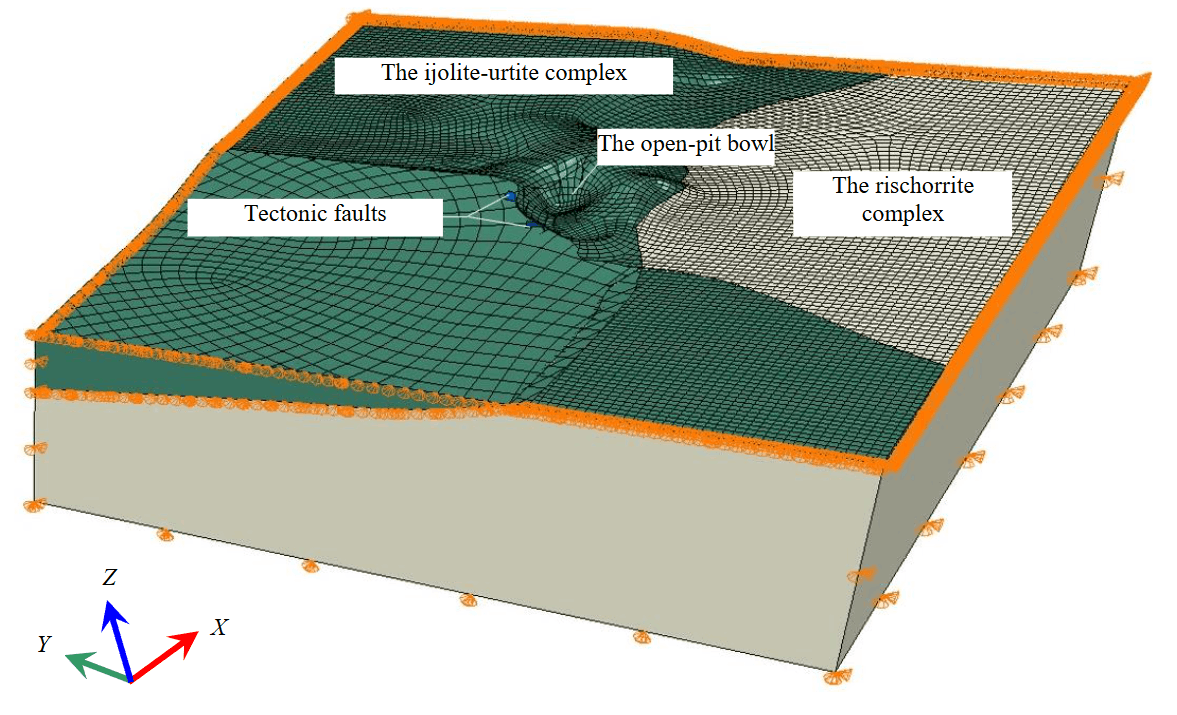
Fig.2. General view of the model
The seismic regime of the Nyorkpakhk deposit is determined by a combination of natural and technogenic geodynamic processes – the uplift of the Khibiny massif, an increase in water saturation of the rock mass during periods of snowmelt and rainfall, activation of displacements along tectonic disturbances due to a critical reduction in effective stresses [25, 26], the dynamic impact of large-scale blasts during mining and drifting, stress redistribution caused by mining, and fracture formation in the overlying rock strata during underground mining.
According to the General Seismic Zoning Map of the Russian Federation, the background seismicity of the ore field of the deposit is estimated at 6 points on the MSK-64 scale. This estimate takes into account regional seismogenic characteristics without correction for current mining-technical impacts [27].
Results of numerical modeling. The stress-strain state of the rock mass was investigated for the +125 m level, taking into account the influence of the open pit on stress redistribution in the pitwall zone. The modeling was performed using the CAE Simulia Abaqus software for two scenarios – before the start of mining operations and for the design contour of the open pit (Fig. 2).
The geometric dimensions of the model were 12000 × 10000 × 3500 m; its faces were fixed against displacements in the directions of the axes perpendicular to them. A stress field was applied to the model volume; the parameters of the field were selected so that the stresses in the computational part of the model matched the data from in situ measurements in the open pit and in underground drifts at analogue deposits.
Tectonic disturbances were defined as bodies whose thickness corresponds to the actual thickness of the disturbance zones. The strength parameters of the material of these bodies were assigned according to the genetic type of the disturbance. Within the framework of this model, faults were interpreted as zones of intense disintegration of the rock mass; therefore, their strength characteristics were set with a reduction of up to one order of magnitude relative to the undisturbed rock mass.
The model was discretized with a mesh of tetrahedral finite elements; the element size in the computational domain averages 3 m, reaching 100 m at the model faces. Key features of the geomechanical environment were taken into account: the mountainous topography, the contact of the two complexes – the rischorrite and ijolite-urtite complexes, and the similar physical-mechanical properties of the ore bodies and the host rock mass, minimizing the stress gradient at the contact.
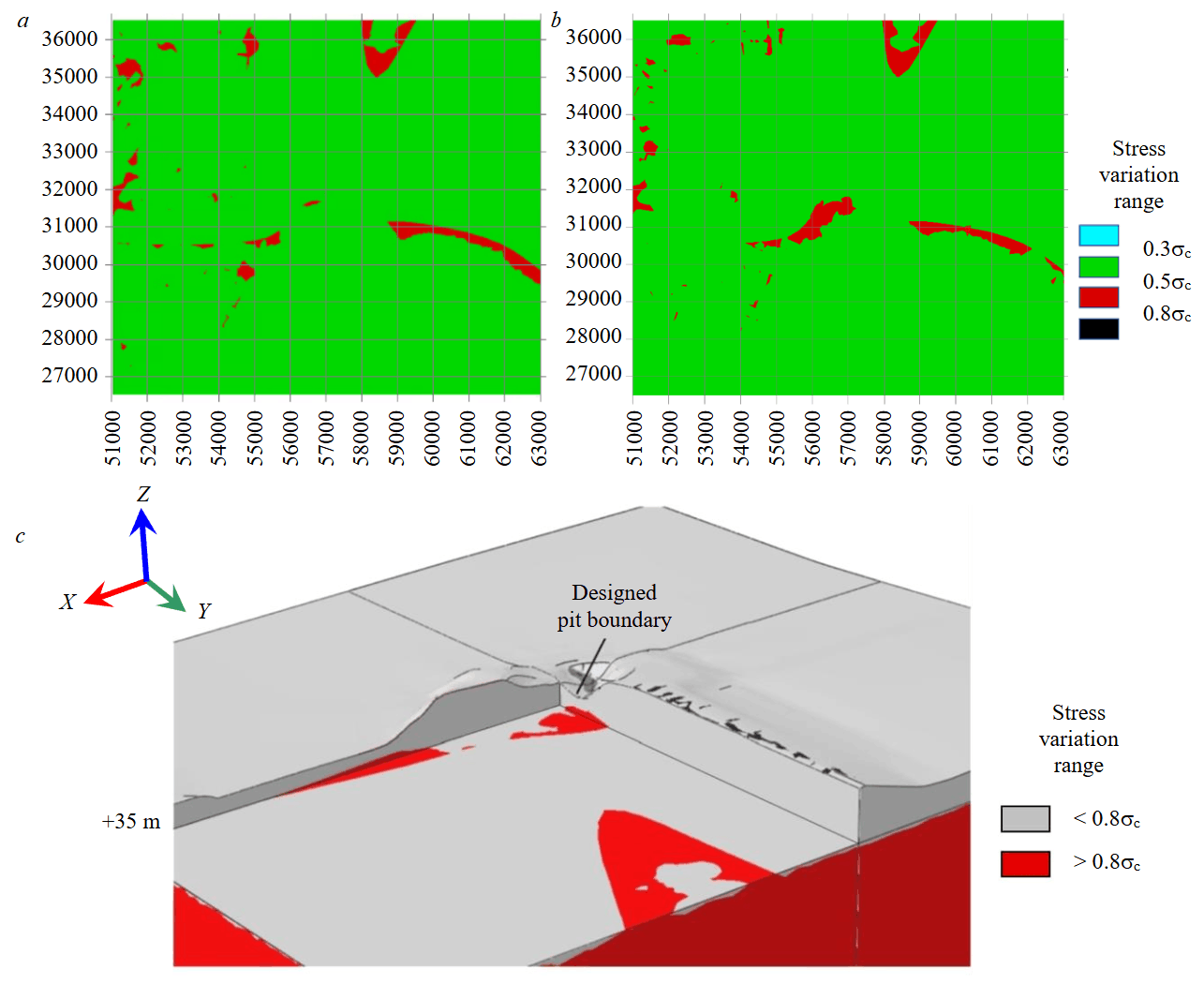
Fig.3. Map of maximum principal stress distribution at the +100 m level before the start (a) and after the completion (b) of open-pit mining, and stress distribution diagram in a three-dimensional view (c)
The modeling results before the start of mining operations (Fig.3, a) showed average values of maximum principal stresses of 35-45 MPa (< 0.5σс) with a local maximum of 84 MPa (0.8σс) in the rischorrites, caused by a higher elastic modulus; here, tectonic disturbances have only a local influence. Local stress relief at the edges of tectonic disturbances is associated with modeling specifics and is not observed in the actual rock mass. The modeling results for the design open-pit contour (Fig.3, b) show insignificant changes in background stresses within the ranges of 0.3σс-0.5σс-0.8σс without exceeding the critical rock burst hazard values. Fig.3, c shows the modeling results with the identified lower boundary of rock burst hazard at the +35 m level (highlighted in red); the deposit reserves at this level do not fall within the rock burst hazardous zone. The modeling confirms the non-rock burst hazardous state of the rock mass at the +35 m level both before the start of mining operations and after the completion of open-pit mining, since the critical stress threshold was not reached.
Strength characteristics and brittleness. One of the methods for assessing the potential of rocks for brittle failure is the evaluation of the rock burst hazard of lithotypes using the Kaiser criterion [19]. This approach makes it possible to comprehensively assess the probability of rock burst hazard for various rock types, taking into account two important parameters – compressive strength characteristics and the degree of material brittleness. The compressive strength of a rock reflects its ability to accumulate elastic deformation energy up to the moment of failure. The brittleness coefficient, in turn, demonstrates the potential of the rock for tensile failure under mechanical action.
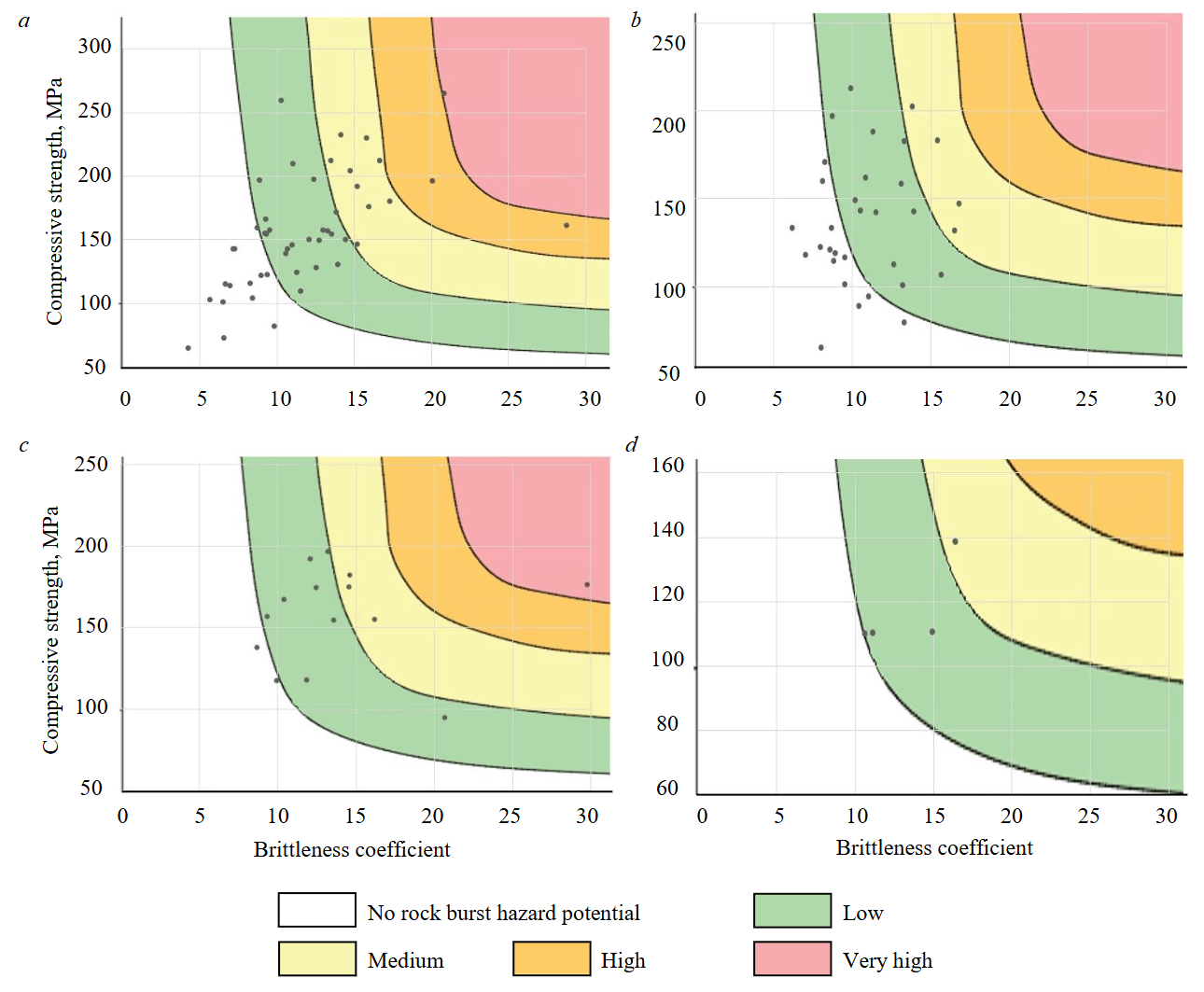
Fig.4. Graphs for assessing the rock burst hazard of rocks according to the Kaiser criterion [19] – urtites (a), ijolites (b), juvites (c), ores (d)
A significant advantage of this method is its practical feasibility – standard testing equipment and generally accepted methodologies are sufficient for conducting the research, which considerably accelerates the assessment process.
The relationship between strength characteristics and the brittleness coefficient is graphically presented in Fig.4, which demonstrates the results of studying specimens down to a depth of 190 m from the surface. The analysis of the point position on the graph allows a conclusion to be drawn about the degree of rock burst hazard of the rock:
- location in the green zone indicates a low probability of sudden failure;
- falling into the red zone indicates a high propensity of the rock to rock bursts.
The analysis of the physical-mechanical characteristics of rocks revealed that urtites demonstrated the maximum compressive strength exceeding 250 MPa, whereas the minimum values were recorded in the ore body. The maximum absolute value of the brittleness coefficient is characteristic of juvites, and the highest average value was recorded in ores, although, based on the experience of the analogue deposit, urtites are more prone to rock burst hazard than juvites. This shows that no direct correlation exists between high values of the brittleness coefficient and the rock burst hazard potential.
All rocks generally have low (or none) and medium rock burst hazard potential. However, when mining the lower horizons of the deposit, additional study and assessment of the strength and brittleness characteristics of the host rocks and ores are required to localize areas with rocks possessing high rock burst hazard potential.
The study also determined the absence of a direct correlation between the brittleness coefficient and the propensity to rock bursts, as the high brittleness values of juvites do not correspond to their actual geomechanical behavior.
Analogue method. An analogue deposit is designated as a deposit similar in petrography and genesis; it can be used for forecasting the mining-technical conditions of an unexplored deposit. The principle of selecting an analogue deposit is similarity in regional geological and tectonic setting, genesis, geological structure, type of mineral, rock characteristics, hydrogeological, and climatic conditions. The similarity principles of geomechanical processes occurring in rocks during their loading were described by Yu.N.Ogorodnikov [1] and are based on the principles of statistical similarity. For similar processes and phenomena, the governing criteria must be identical, and the unambiguity conditions must be similar. The unambiguity conditions make it possible to exclude objects in which deformation processes, for various reasons, develop according to different regularities. The unambiguity conditions can include the methods of rock failure, methods of testing the rock mass, and the time parameters of the loading process.
The criteria of geometric similarity are determined by the equality of the ratios of the characteristic dimensions of drifts and other geomechanical objects. The similarity criteria of the rock mass state for hard rocks represent the ratio of parameters determining the system behavior depending on the nature of deformation: the ratio of compressive strength to tensile strength σс/σt; the ratio of vertical stresses in the rock mass to tensile strength σz/σt; the ratio of compressive strength to cohesion σc/c.
The largest number of factors coinciding with the Nyorkpakhk deposit is observed at the Oleniy Ruchey deposit – it is the closest to the Nyorkpakhk deposit, and the mine workings at this deposit have already reached the –140 m level. According to Federal Norms and Rules (Order N 505), the Oleniy Ruchey deposit is rock burst hazardous from a depth of 400 m.
At this deposit, the horizontal component also exceeds the vertical one due to the action of tectonic stresses. The authors of the article and other researchers have carried out in situ stress state measurements [28, 29] by the stress relief method in the end face variant in dead-end drifts, which showed that the rate of increase of horizontal stresses with depth attenuates and has an exponential character [1]. It is assumed that the same dependence is characteristic of the Nyorkpakhk deposit; thus, the stresses at lower levels will be lower than those predicted at the present stage.
Within the framework of comparing the Nyorkpakhk deposit with the analogue deposit, it can be concluded that, in view of their complete similarity, the critical depth levels for rock burst hazard of the Nyorkpakhk deposit can be assigned based on the results of in situ studies from the +50 m level and below. However, at levels above +50 m, conditions may arise for the occurrence of signs of rock pressure manifestation in a dynamic form (primarily in the form of spalling), as occurred at the analogue deposit, which requires special approaches to drifting and the selection of the mining sequence and parameters.
Development of a comprehensive methodology for refining the critical depth of rock burst hazard
The methodology was developed to solve the problem of discrepancy between the regulatory values of the critical depth of rock burst hazard and the actual mining-geological and technogenic conditions of deposits. The methodology integrates three interrelated blocks of research (Fig.5), representing a sequential process from theoretical analysis to practical implementation and verification.
The first block of the methodology includes a comprehensive analysis of engineering-geological and geomechanical conditions and is the fundamental stage of the research. The block combines the analysis of historical data, world experience, and the analysis of regulatory documents, which makes it possible to avoid methodological errors associated with the use of outdated criteria or those unsuitable for specific conditions. A detailed assessment of engineering-geological conditions is carried out with an emphasis on the quantitative characterization of the structural disturbance of the rock mass (fault location, disturbance morphology, thickness of tectonic zones) and lithological-stratigraphic heterogeneity. Data from analogue deposits comparable in depth, geomechanical, and structural conditions are analyzed. The purpose of this block of research is to identify general regularities and analyze the experience of rock burst hazard management.
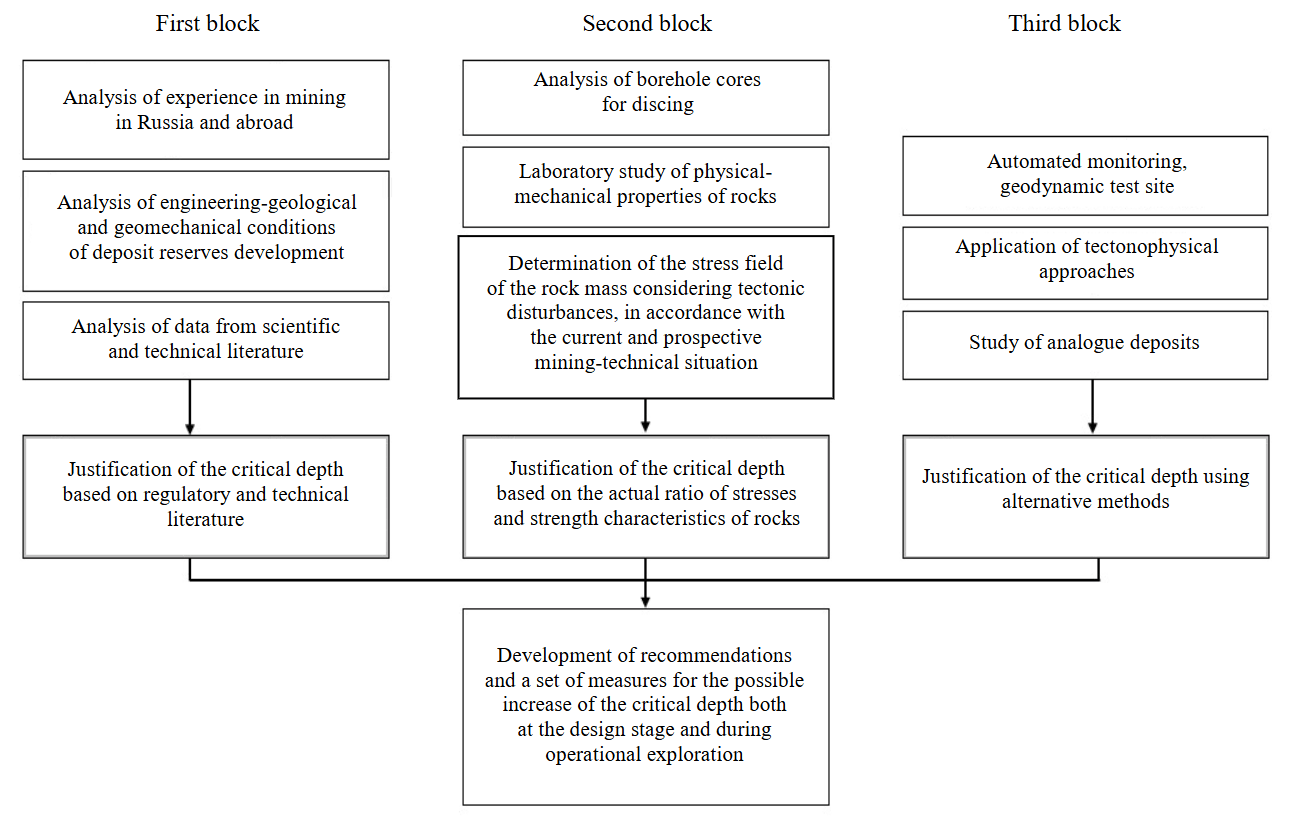
Fig.5. Principal sequence of refining the critical depth of rock burst hazard using sets of methods
The second block is aimed at obtaining quantitative initial data and transitioning to predictive modeling. Its main advantage over traditional methods lies in the integrated use of in situ data, laboratory experiments, and numerical modeling, which makes it possible to take into account the specifics of the region and forecast the change in the stress-strain state during mining of the deposit. Within the research of this block, in situ and laboratory tests of core are performed for strength, deformation, and rheological characteristics of rocks; a three-dimensional geomechanical model is created on the basis of the geological model. Tectonic disturbances are explicitly defined in the model as bodies with reduced strength characteristics; the initial and modified stress-strain state fields are calculated; and the change in stress fields is forecast when the mining-technical situation changes (deepening of mining operations, mining of new areas). Based on the analysis of zones of potential brittle failure and dynamic displacements along disturbance zones, a preliminary assessment of the critical depth is carried out.
The third block represents a system of dynamic control and increasing the reliability of the forecast. As part of the research, a network of seismoacoustic sensors is deployed to update the depth of rock burst hazard, providing continuous monitoring, which makes it possible to identify manifestations of dynamic processes in real time and assess their location in the rock mass. In addition, tectonophysical approaches are applied for reconstructing paleostress fields and analyzing fault kinematics. This provides a physically substantiated tool for forecasting zones of modern stress concentration near tectonic disturbances, where traditional criteria often fail.
The comprehensive methodology is intended for assessing and managing rock burst hazard in deep mines with a complex structure. The scientific significance lies in a substantial increase in the reliability of critical depth predictions through the integration of modern modeling methods, continuous monitoring, and comparative analysis, which ultimately makes it possible to optimize mining system parameters and enhance industrial safety.
Discussion
The developed comprehensive methodology for assessing the critical depth of rock burst hazard has demonstrated its applicability and effectiveness under the conditions of the Nyorkpakhk deposit. Its advantage lies in the integration of multi-level data – regulatory requirements, the actual ratio of stresses and rock strength [1, 30], as well as alternative approaches (the analogue method, tectonophysical analysis, automated monitoring). This combination made it possible to overcome the limitations of traditional methods, which aligns with modern trends in geomechanics [18, 19].
The conclusions of the study are based on a detailed understanding of the engineering-geological conditions of the Nyorkpakhk deposit, including the hierarchy of tectonic disturbances (dominance of rank IV disturbances of sublatitudinal strike), the distribution of fracture zones, and lithological-structural heterogeneity. This database ensured the representativeness of the models, which is a critical factor for a reliable rock burst hazard forecast [31].
The assessment of the seismic regime in the area of the Nyorkpakhk deposit revealed that the region is characterized by a background seismicity of 6 points on the MSK-64 scale; earthquakes of such intensity, according to the scale description, can cause damage in brick and panel structures and rarely landslides, i.e., no damage to drifts is expected. With the development of mining operations on the territory of the deposit, a moderate increase in seismic and geodynamic activity is predicted during periods of stoping and drifting operations near (no more than 30 m) tectonic disturbances composed of dike bodies thicker than 20 cm, and the main fault zone. No hazard of major seismic events (above 5 points on the MSK-64 scale) associated with the mining of the deposit down to the +100 m level is expected, which correlates with data from similar deposits in tectonically active regions.
The analysis of core material from thirteen boreholes confirmed the local nature of discing (≤ 0.25 m), associated with disturbance zones and lithological contacts. The complete absence of the core discing effect below the +125 m level indicates the absence of critical stresses.
It has been established that the maximum principal stress component is subhorizontal. At present, exact relationships for stress variation with depth have not been established, primarily due to the influence of open-pit mining on the stress-strain state. However, all studies confirm the dependence of stress increase with depth, and given the proximity of the Nyorkpakhk deposit to the analogue deposit Oleniy Ruchey, it is most justified to use its (the analogue’s) relationships for stress variation with depth, developed and reliably confirmed during operation (visual observations, core discing method, core stress relief, retrospective assessment based on failure zones, etc.). As mining progresses, it is necessary to refine these dependencies based on new data [32].
Based on the analysis of data from numerical modeling of the Nyorkpakhk deposit, carried out by various organizations dealing with the problem of rock bursts at apatite-nepheline ore deposits [33-36], and comparison with the results of numerical modeling, it has been established that both before the start of mining operations and with the open pit having the contour at the end of open-pit reserve extraction, down to the +35 m level, no exceeding of stress values of 0.8σc is expected, which indicates that the rock mass is non-rock burst hazardous.
Conclusion
The research results show that the rock and ore mass of the Nyorkpakhk deposit is represented by strong hard rocks with an average uniaxial compressive strength of about 150 MPa for rocks and 117 MPa for ores, capable of brittle failure under significant stresses. However, the existing stress field down to the +125 m level, even taking into account the influence of the open pit, does not form stresses sufficient for the transition of the rocks to a rock burst hazardous state.
Potential rock burst hazard levels of the Nyorkpakhk deposit according to different methods: core discing method +100 m (rock burst hazard assessment was performed only down to the +100 m level, since no core drilling was carried out below); method of stress-to-rock-mass strength comparison +50 m; numerical modeling method +35 m; analogue method +50 m.
Due to the significant surface irregularity, including that caused by open-pit mining, the critical depth of rock burst hazard at the deposit cannot be unambiguously established (it varies within 350-550 m with an average value of 450 m), but it is possible to reasonably, with a sufficient margin, assign the level of classifying the deposit as prone to rock bursts at the +100 m level and below, since according to all rock burst hazard assessment methods, no rock burst hazard levels above +100 m have been identified. The comprehensive methodology presented in the paper makes it possible to determine the critical depth of rock burst hazard of the deposit more reliably due to a systematic approach and high-quality training of engineering personnel [37].
For further implementation, the methodology requires testing at deposits with different geodynamic conditions and mandatory in situ verification after the start of underground mining, which includes comparison of predictive models with actual rock pressure manifestations, adjustment of stress dependencies on depth based on instrumental measurement data, and assessment of the representativeness of the Kaiser criterion for depths exceeding 500 m.
References
- Belyakov N.A., Emelyanov I.A. Development of the approach to processing the results of stress state measurements by the ring unloading method. News of the Tula State University. Sciences of Earth. 2022. Iss. 2, p. 192-207 (in Russian). DOI: 10.46689/2218-5194-2022-2-1-192-207
- Loktyukova O.Yu., Korchak P.A., Pavlovich A.A., Shabarov A.N. Application of an integrated methodology for forecasting tectonic disturbances to ensure safe open pit mining of apatite-nepheline ore deposits. Gornyi zhurnal. 2024. N 12, p. 42-50 (in Russian). DOI: 10.17580/gzh.2024.12.05
- Shabarov A.N., Smirnov E.V. Methodological framework of forecasting hazardous natural processes based on geodynamic zoning. Mining Informational and Analytical Bulletin. 2024. N 11-1, p. 157-170 (in Russian). DOI: 10.25018/0236_1493_2024_111_0_157
- Kozyrev A.A., Semenova I.E., Zemtsovskiy A.V. Predictive assessment of co-evolution of the stress-strain state of eastern part of the apatite Khibiny arc at mining. Mining Informational and Analytical Bulletin. 2015. N 4, p. 93-102 (in Russian).
- Lai X.P., Shan P.F., Cao J.T. et al. Simulation of Asymmetric Destabilization of Mine-void Rock Masses Using a Large 3D Physical Model. Rock Mechanics and Rock Engineering. 2016. Vol. 49. Iss. 2, p. 487-502. DOI: 10.1007/s00603-015-0740-z
- Ning Li, Yushi Zou, Shicheng Zhang et al. Rock brittleness evaluation based on energy dissipation under triaxial compression. Journal of Petroleum Science and Engineering. 2019. Vol. 183. N 106349. DOI: 10.1016/j.petrol.2019.106349
- Krinitsyn R.V. Stress-and-strain state of the rock mass in mining deposits in the Urals. Russian Mining Industry. 2022. N 5, p. 79-82 (in Russian). DOI: 10.30686/1609-9192-2022-5-79-82
- Trushko V.L., Baeva E.K. Substantiation of rational parameters of mine support system for underground roadways in difficult geological conditions. Mining Informational and Analytical Bulletin. 2023. N 12, p. 55-69 (in Russian). DOI: 10.25018/0236_1493_2023_12_0_55
- Protosenya A.G., Kuranov A.D. Procedure of rock mass stress-strain state forecasting in hybrid mining of the Koashvin deposit. Gornyi zhurnal. 2015. N 1, p. 17-20 (in Russian). DOI: 10.17580/gzh.2015.01.03
- Ilyinov M.D., Petrov D.N., Karmanskiy D.A., Selikhov A.A. Physical simulation aspects of structural changes in rock samples under thermobaric conditions at great depths. Mining Science and Technology. 2023. Vol. 8. N 4, p. 290-302. DOI: 10.17073/2500-0632-2023-09-150
- Diyuan Li, Zida Liu, Armaghani D.J. et al. Novel ensemble intelligence methodologies for rockburst assessment in complex and variable environments. Scientific Reports. 2022. Vol. 12. N 1844. DOI: 10.1038/s41598-022-05594-0
- Verbilo P.E., Vilner M.A. Study of the jointed rock mass uniaxial compression strength anisotropy and scale effect. Mining Informational and Analytical Bulletin. 2022. N 6-2, p. 47-59 (in Russian). DOI: 10.25018/0236_1493_2022_62_0_47
- Feng-qiang Gong, Yun-liang Wang. Rockburst proneness criteria for rock materials: Review and new insights. Journal of Central South University. 2020. Vol. 27. Iss. 10, p. 2793-2821. DOI: 10.1007/s11771-020-4511-y
- Kozyrev A.A., Savchenko S.N., Panin V.I. et al. Geomechanical processes in the geological media of mining systems and geodynamic risk management. Apatity: Kolskij nauchnyj czentr Rossijskoj akademii nauk, 2019, p. 431 (in Russian). DOI: 10.37614/978.5.91137.391.7
- Nosov V.V., Badmazhapov B.B., Chistyakov A.Yu. Assessment of the impact hazard of a section of a rock mass based on the results of recording the seismoacoustic activity of the rock massif after an explosion. Dangerous Natural and Technogenic Processes in Mountain Regions: Models, Systems, Technologies. Vladikavkaz: Geophysical Institute of Vladikavkaz Scientific Centre of the RAS, 2022, p. 346-351 (in Russian). DOI: 10.33580/9785904868277_346
- Peng Xiao, Diyuan Li, Guoyan Zhao, Huanxin Liu. New criterion for the spalling failure of deep rock engineering based on energy release. International Journal of Rock Mechanics and Mining Sciences. 2021. Vol. 148. N 104943. DOI: 10.1016/j.ijrmms.2021.104943
- Ghasemi E., Gholizadeh H., Adoko A.C. Evaluation of rockburst occurrence and intensity in underground structures using decision tree approach. Engineering with Computers. 2020. Vol. 36. Iss. 1, p. 213-225. DOI: 10.1007/s00366-018-00695-9
- Kuznetcov N.N., Kondrashov L.Yu. Rockburst hazard potential assessment of rocks of the Khibiny massif deposits according to the Kaiser criterion. Vestnik of MSTU. 2023. Vol. 26. N 2, p. 170-179 (in Russian). DOI: 10.21443/1560-9278-2023-26-2-170-179
- Ming Cai, Kaiser P.K. Rockburst Support. Reference Book. In 2 volumes. Vol. 1: Rockburst Phenomenon and Support Characteristics. Sudbury: Laurentian University, 2018, p. 284.
- Gospodarikov A.P., Zatsepin M.A., Kirkin A.P. Determination of impact hazard potential of rocks in the Norilsk Industrial Region. Journal of Mining Institute. 2025. Vol. 272, p. 83-90.
- Biryuchev I.V., Makarov A.B., Usov A.A. Geomechanical model of underground mine. Part II. Application. Gornyi zhurnal. 2020. N 2, p. 35-44 (in Russian). DOI: 10.17580/gzh.2020.02.04
- Malki J., Vennes I., Rowe C.D., Mitri H.S. Evaluation of Rock Burstability with Mechanical Property Testing and Microscopic Image Analysis. Rock Mechanics and Rock Engineering. 2025. Vol. 58. Iss. 4, p. 4441-4457. DOI: 10.1007/s00603-024-03797-7
- Sabyanin G.V., Alborov A.E., Andreev A.A., Rumyantsev A.E. Optimizing borehole location for stress state assessment by geomechanical method of core discing. Gornyi zhurnal. 2022. N 10, p. 58-63 (in Russian). DOI: 10.17580/gzh.2022.10.09
- Askaripour M., Saeidi A., Rouleau A., Mercier-Langevin P. Rockburst in underground excavations: A review of mechanism, classification, and prediction methods. Underground Space. 2022. Vol. 7. Iss. 4, p. 577-607. DOI: 10.1016/j.undsp.2021.11.008
- Kocharyan G.G., Zolotukhin S.R., Kalinin E.V. et al. Stress–Strain State of Rock Mass in the Zone of Tectonic Fractures in the Korobkov Iron Ore Deposit. Journal of Mining Science. 2018. Vol. 54. N 1, p. 13-20. DOI: 10.1134/S1062739118013270
- Abrashitov A.Yu., Onuprienko V.S., Korchak P.A. A three-tier system of seismic rock mass monitoring in the Khibiny apatite-nepheline ore deposits. Russian Mining Industry. 2023. Suppl. 1, p. 36-42 (in Russian). DOI: 10.30686/1609-9192-2023-S1-36-42
- Zhukova S.A., Zhuravleva O.G., Onuprienko V.S., Streshnev A.A. Seismic behavior of rock mass in mining rockburst-hazardous deposits in the Khibiny Massif. Mining Informational and Analytical Bulletin. 2022. N 7, p. 5-17 (in Russian). DOI: 10.25018/0236_1493_2022_7_0_5
- Samsonov A.A. Assessment of rock mass state of Oleniy Ruchey rock burst deposit based on the results of stress measurements. Herald of the Kola Science Centre of RAS. 2019. Vol. 11. N 1, p. 62-67 (in Russian). DOI: 10.25702/KSC.2307-5228.2019.11.1.62-67
- Semenova I.E., Zemtsovskiy A.V., Pavlov D.A. Complex geomechanical research of the rock mass during underground mining in hazardous rockburst deposit Oleny Ruchey. Mining Informational and Analytical Bulletin. 2014. N 4, p. 46-55 (in Russian).
- Afraei S., Shahriar K., Madani S.H. Statistical assessment of rock burst potential and contributions of considered predictor variables in the task. Tunnelling and Underground Space Technology. 2018. Vol. 72, p. 250-271. DOI: 10.1016/j.tust.2017.10.009
- Sinegubov V.Yu. Development of a comprehensive approach to predicting the stress state of the rock mass and testing it at the Oleniy Ruchey deposit. Bulletin of the Kuzbass State Technical University. 2025. N 2 (168), p. 68-79 (in Russian). DOI: 10.26730/1999-4125-2025-2-68-79
- Chen Xu, Xiaoli Liu, Enzhi Wang et al. Rockburst prediction and classification based on the ideal-point method of information theory. Tunnelling and Underground Space Technology. 2018. Vol. 81, p. 382-390. DOI: 10.1016/j.tust.2018.07.014
- Jinglin Wen, Husheng Li, Fuxing Jiang et al. Rock burst risk evaluation based on equivalent surrounding rock strength. International Journal of Mining Science and Technology. 2019. Vol. 29. Iss. 4, p. 571-576. DOI: 10.1016/j.ijmst.2019.06.005
- Hoek E., Brown E.T. The Hoek–Brown failure criterion and GSI – 2018 edition. Journal of Rock Mechanics and Geotechnical Engineering. 2019. Vol. 11. Iss. 3, p. 445-463. DOI: 10.1016/j.jrmge.2018.08.001
- Sinegubov V.Yu., Popov M.G., Vilner M.A., Sotnikov R.O. Influence of stoping on formation of damaged rock zones at boundaries of large cross-section excavations in apatite–nepheline mining. Gornyi zhurnal. 2021. N 8, p. 24-30 (in Russian). DOI: 10.17580/gzh.2021.08.04
- Sedrette S., Rebai N. A GIS Approach Using Morphometric Data Analysis for the Identification of Subsurface Recent Tectonic Activity. Case Study in Quaternary Outcrops – North West of Tunisia. Journal of Geographic Information System. 2022. Vol. 14. N 1, p. 94-112. DOI: 10.4236/jgis.2022.141006
- Litvinenko V.S. A model of mining engineering education for the 21st century. Sustainable Development of Mountain Territories. 2025. Vol. 17. N 2 (64), p. 603-615. DOI: 10.21177/1998-4502-2025-17-2-603-615