

Design of geotechnical complexes for open-pit mines to ensure the sustainable operation of mining enterprises
- 1 — Ph.D., Dr.Sci. Deputy Director for Research Institute of Mining of the Ural Branch of the RAS ▪ Orcid
- 2 — Ph.D., Dr.Sci. Chief Researcher Institute of Mining of the Ural Branch of the RAS ▪ Orcid
Abstract
The article describes the problem of reducing the competitiveness of mining enterprises due to the rising costs for transporting the rock mass due to the emergence of a mutual discrepancy between the transport system and the mining and technical system of the open-pit mine. The approach to the design of the mining and technical systems of deep open-pit mines is described being based on the consideration of the reliability of the technical subsystem that ensures the cargo turnover of rock mass. The formation of stable cargo turnover of rock mass is an urgent scientific and practical task to ensure the competitiveness of a mining enterprise. The parameters and indicators of subsystems of the mining and technical system have a large number of interrelations and change during the life of the open-pit mine, their formation is considered as a set of mining and transport equipment that comprise geotechnical complexes – drilling-and-blasting, excavator-and-vehicle, crushing-and-conveyor, crushing-and-reloading, etc., which are the main link for the extraction and delivery of minerals to the daylight surface. The mathematical models of the reliability of cargo flows formed by the technical subsystem of the mining and technical system of open-pit mine are presented, taking into account the relationship between the reliability of the system and the operational reliability of its constituent mining and transport equipment (vehicle, railway and conveyor transport, drilling rigs, excavators) under various interaction schemes. These relationships can be used for modeling both in the process of designing the mining and technical systems of open-pit mines, and in analyzing the reliability of individual schemes for transporting the rock mass and the entire transport system. The purpose of the research is to develop schemes and mathematical models for determining the reliability of cargo turnover provided by the technical subsystem of the open-pit mine (a combination of geotechnical complexes that have a significant impact on the technological subsystem, cargo turnover and productivity of the open-pit mine).
The paper has been prepared within the framework of the State project on topic 1 (2025-2027). Methodology for substantiating the prospects of technological development of the integrated development of mineral resources of solid minerals in Russia (FUWE-2025-0001), N 1022040200004-9-1.5.1.
Introduction
Open-pit mines for the development of solid mineral deposits are usually designed for 25-30 years, sometimes for 50 years or more. During this period, the equipment provided by the project becomes physically and morally obsolete, and the performance of geotechnical complexes deteriorates as the open-pit mine deepens, which, taken together, leads to higher mining costs and lower profitability in the mining industry [1-3]. At most large mining enterprises in Russia, cargo flows from deep open-pit mines are characterized by a high transportation concentration, instability of the main parameters and heterogeneity of the transported rock mass. This is also confirmed at foreign enterprises [4-6].
According to the definition of Corresponding Member of the RAS D.R.Kaplunov the mining and technical system (MTS) is a set of mining structures and technological subsystems in interaction with their inclosing subsurface areas. Developing this direction in order to increase the objectivity of the study of the accumulation of technical, technological and other discrepancies of the transport system with the conditions of its functioning as the open-pit mine becomes deeper, which naturally leads to increased costs, the authors of this article have identified two interrelated subsystems of the MTS – technological and technical.
The technological subsystem of the MTS is a set of elements of advance, overburden and mining workings that ensure the placement of geotechnical complexes and access to mineral resources for the purpose of their mining.
The technical subsystem of the MTS is a chain of interconnected geotechnical complexes that carry out the human-controlled and human-operated process of moving the rock mass in time and space. In this study, the technical subsystem of the MTS is vehicle-and-conveyor transport.
The geotechnical complex is a chain of interconnected vehicles and mechanisms that provide a fully mechanized, automated or robotic process in all its links and at all its stages (loading, transportation, crushing, grading).
Both Russian [11] and foreign specialists [12, 13] pay attention to the issues of assessing the quality of operation [7] and determining the rational structure [8-10] of the fleet of mining and transport equipment, using, among other things, a multi-criteria approach [14]. Much attention is paid to the issues of reliability [15, 16], evaluation of performance indicators of the equipment operation system of the technological complex of mining enterprises with various interactions of its subsystems [17].
The reliability problem of cargo flows in deep open-pit mines is to ensure the excavation, loading, and delivery of rock mass to dumps, reloading and homogenizing warehouses, processing plants (CGP, concentrating mills, etc.), corresponding in volume and time to the most efficient mining operations with minimal operating costs. At the current stage of mining production development and the achieved technical level of mining and transport equipment, the primary tasks of solving this problem are:
- development of methods for taking into account the reliability of the functioning of geotechnical complexes for open-pit mines in the design, operational, current and future planning of mining operations, the formation of a vehicle fleet, the determination of labor and material resources;
- determination of rational redundancy levels in the processes of preparing the rock mass for excavation, loading, transportation, reloading and primary processing, depending on the reliability of the mining and transport equipment, the cargo flow characteristics and the development of a technical service system;
- development of effective management systems for time and space coordination of the mining and transport equipment, distribution of the cargo flows in accordance with the specified criteria (the qualitative composition of ore, the restrictions on the capacity of reloading warehouses or the capacity of transport communications, etc.);
- development of modern automated methods and tools for diagnosing the current condition of vehicles.
To solve the cargo flow reliability tasks the probabilistic estimates of equipment [18] or processes are used, such as the probability for functioning the cargo flows [19] with the set intensity during the specified period, the probability for performing the specified volumes of mining and transporting the rock mass per shift, day, month, year, the probability of maintaining the ore quality over the specified period of time, etc.
When designing the mining and technical systems, the carrying capacity of transport communications is limited by the volume of rock mass and minerals extracted from the open-pit mine, and the number of transport communications and their location depend on many interrelated factors. Increasing the efficiency of mining production is aimed at improving the operational performance of equipment of geotechnical complexes: drilling-and-blasting (DBO), excavator-and-vehicle (EVC) [20-22], crushing-and-conveyor (CCC) [23, 24], crushing-and-reloading (CRP) [25] and others, which are the main link in the extraction of minerals in the open-pit mine and delivering it to the daylight surface.
The efficiency and stability of the process of transporting the rock mass [26-28] in open-pit mines is determined by not only the reliability of vehicles and the actual transport scheme, but also by the reliability and clarity of operation of all vehicles in adjacent links of the technological chain [29-31]. In terms of reliability, it is necessary to consider the joint operation of all mining and transport equipment and assess the reliability of each geotechnical complex (EVC, CCC, etc.), as well as the reliability of their joint operation as a technical subsystem (TS) of the mining and technical system in the open-pit mine.
In order to achieve this research goal, the task of developing the methods for the comprehensive assessment of the reliability of mining and transport equipment and its combinations in geotechnical complexes in the design of the mining and technical system in the open-pit mine is being solved.
Methods
The technical subsystem of the mining and technical system in the open-pit mine must be stable in order to achieve its goals – the formation of stable cargo turnover of rock mass from the mine face to the end points (CM, warehouses, dumps) in order to ensure the specified productivity under certain operating conditions. The reliability of the technical subsystem is determined by the formula
where Q(Pi) = qi/qm is the efficiency of the i-th state of the TS; Pi(tG) is the probability of the i-th state of the TS under specified operating conditions; n is the number of possible TS states; t is the selected time interval, h (shift, month, year); qi is the productivity of the TS in the i-th state, m3/unit of time t; qm is the maximum productivity of the TS, m3/unit of time t.
Technical subsystems are divided into simple and integrated ones. The simple ones include geotechnical complexes with the presence of rigid connection between the elements specific for the vehicle-and-conveyor, vehicle-and-skip, and vehicle-and-railway transport using the ramp-and-hopper reloading points. The integrated geotechnical complexes are characterized by the absence of rigid connection between the elements. The open-pit mines operate simultaneously up to 10 or more mine faces and from two to eight reloading points forming many routes of various lengths, herewith the mining and technical systems of open-pit mines can combine ore flows with and without homogenization of ores, independent and mixed ore cargo flows and overburdens. The cargo flows are provided by various schemes for interaction of the mining and transport equipment – series (monotransport), combined or parallel.
To describe the TS reliability Bernoulli's binomial distribution law is used [32, 33] based on the fact that each element of the mining and transport equipment of any geotechnical system can be in two states: operable (normal functioning) and faulted. Thus the state of the geotechnical system, consisting of several independent elements operating in parallel, is described by the binomial distribution law.
Discussion of results
For the purpose of modeling [34, 35] the process of transporting the rock mass in open-pit mines, it is proposed to use the schemes for the interaction of the mining and transport equipment, taking into account modern requirements for the design of the mining and technical systems:
* The series scheme provides for the series connection of the geotechnical complex elements: E – excavator in the mine face, C – conveyor, UP – unloading point (dump, ore warehouse, hopper, etc.). This option is most common when using continuous transport.
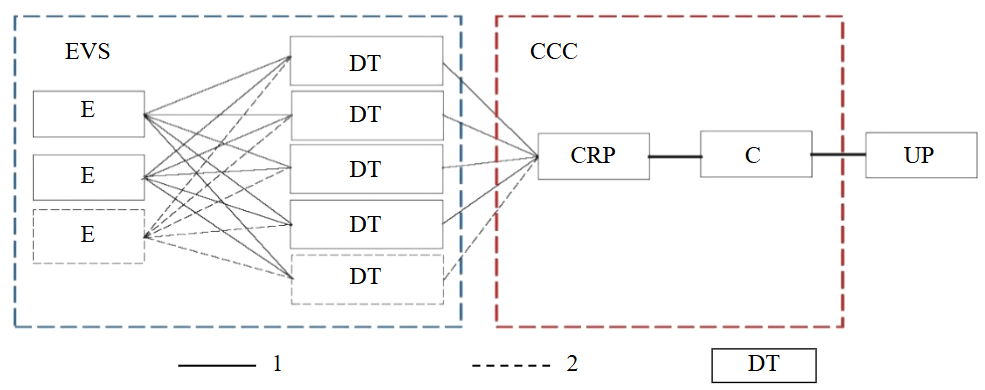
Fig.1. An extensive scheme for interaction of the geotechnical complex elements of the TS with partial redundancy
1 – main equipment; 2 – reserve equipment; DT – dump truck
The series scheme is characterized by the fact that if one of the elements fails, the entire geotechnical system becomes inoperable, and the reliability of such a scheme has the form:
where n is the number of vehicles in the geotechnical complex; kai is the availability rate of the i-th element of the equipment complex; ktai is the technical availability rate of the i-th element of the equipment complex.
* The partial redundancy scheme is used in the development of loose and hard rocks and the combination of operating extraction-and-loading and transport vehicles, most often with cyclical-and-continuous method (Fig.1). In this scheme, the CCC and UP elements operate in the series scheme, the EVC consists of technological links with elements operating in parallel, which ensures reliable operation while operating a varying number of excavators and dump trucks to maintain a certain technical efficiency of the TS.
In this case, the reliability of the TS will take the form:
where n is the number of transport links in the TS; l is the number of the CCC equipment; m, s are the numbers of excavators and dump trucks (or railway trains) that comprise the EVC; kal is the availability rate of the l-th element (equipment) of the CCC; kae, kad are the availability rates of excavators and dump trucks that comprise EVC; β is the coefficient that determines the ratio between the elements in the processes (complexes), in this case β = s/m; Qi, Qj are the efficiencies of individual states of the system when i and j are the operable elements of loading and transport processes; Nim, Njs are the numbers of combinations, respectively m for i and s for j.
As operational experience shows, the stability of the cargo flow organized by vehicle-and-conveyor transport largely depends on sudden failures of the CCC, which destabilize the operation of gathering vehicles and reduce the reliability of the TS. Increasing the reliability of the TS and reducing the downtime of the dump trucks is possible by organizing the operation of gathering vehicles according to the main scheme. This makes it possible to reserve the entire TS, but organizational decision-making in this case should be based on a technical and economic assessment.
* The redundant scheme of the mining and transport equipment interaction requires a certain number of vehicles on each section of the cargo flow. In existing and projected open-pit mines, this option is most common with the use of the vehicle (V) and railway (R) transport operating both in parallel and in combination with each other (in case of direct reloading of rock mass from dump trucks to dumpcars) (Fig.2).
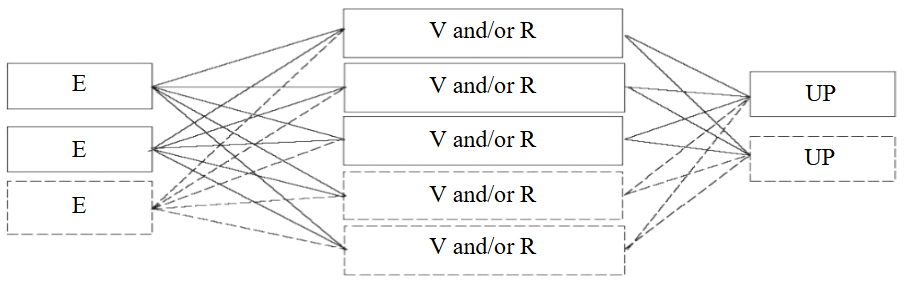
Fig.2. The scheme of interaction of the TS elements with full redundancy
This cargo flow organization scheme in the open-pit mine makes it possible to ensure the reliability of the TS in case of failure of some of the vehicles involved in the process. However, when the vehicles fail in various links, the technical efficiency does not remain constant and is determined by the amount of equipment that operates at this period of time.
Using the example of the EVC operation on the delivery of the rock mass from the open-pit mine to the external dump and/or the ore warehouse on the surface, the TS reliability model will take the following form:
where m, s, z are the numbers of excavators, dump trucks, and bulldozers in the extraction-and-loading, transportation, and dumping (warehousing) processes; kae, kad, kab are the availability rates of excavators, dump trucks, and bulldozers in the extraction-and-loading, transportation, and dumping (warehousing) processes; α, β are the coefficients which determine the relationship between the elements in adjacent processes (excavation, transportation and dumping (warehousing), in this case β = s/m, α = z/s; Qt is the efficiency of individual states of the system when t elements of the extraction-and-loading, transportation and dumping processes are operable; Ntz is the number of combinations of z for t.
* The accumulating scheme of the mining and transport equipment interaction provides for the accumulating elements (warehouses, equipment, structures) as a special type of relationship between individual technological processes (preparation of rock mass for extraction, extraction-and-loading operations, transportation, dumping, and warehousing). The scheme is used for vehicle, railway, conveyor and other types of transport, mainly in their various combinations. The stockpile of blasted rock mass in the mine face, the in-pit rock and ore depots, the storage hoppers, etc. serve as accumulating warehouses, equipment and structures.
Let us consider this scheme using the example of railway transport, where the shotpile (SP) in the mine face, prepared for excavation by drilling-and-blasting method, serves as an accumulating element (Fig.3).
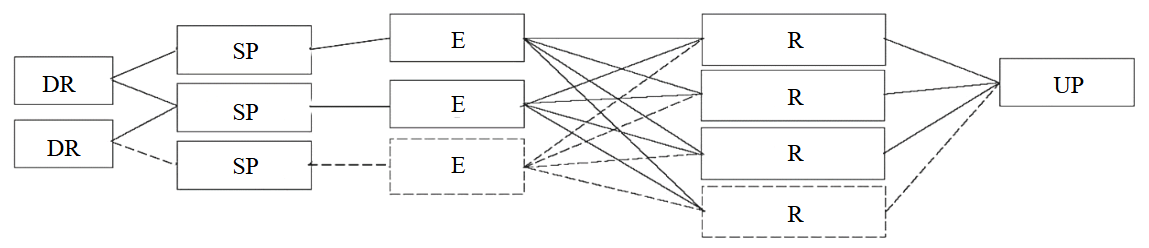
Fig.3. Accumulating scheme of mining and transport equipment interaction of geotechnical complexes of the mining and technical system
DR – drilling rig
In this scheme, the accumulating elements serve as connecting links in the technological chain for the extraction and delivery of ore to the ore warehouse and overburden to the dumps. With sufficient capacity of the accumulating elements, the insufficient reliability of geotechnical systems operating before them may not have any impact on the reliability of cargo flow as a whole. The relationship between the previous processes (drilling and blasting of rock mass) and their supporting geotechnical complexes with subsequent ones consists in constantly providing them with the necessary work front. If we denote the probability of providing the required work front for geotechnical complexes operating after accumulating elements as g, then the TS reliability model will take the following form:
* Combined schemes of the TS mining and transport equipment interaction represent various combinations of the considered schemes. They often involve two, three or more types of transport along with several extraction-and-loading vehicles and many unloading-and-receiving points, for example, a combined vehicle – conveyor – railway transport – dump scheme (Fig.4). The combinations of the considered cargo flow schemes and their reliability models are very different and unstable, so modeling is necessary in each specific case.
The scheme (Fig.4) implies the following option for organizing the cargo flows in the open-pit mine. From the upper horizons of the open-pit mine, the rock mass is transported directly from the mine faces to the unloading point by railway, and from the lower horizons the rock mass is delivered to the receiving and unloading points through reloading in-pit warehouses. The technological processes involve the following equipment: drilling, extraction-and-loading, vehicle, railway transport, receiving-and-unloading. The stockpile of blasted rock mass in the mine faces and its accumulation in reloading warehouses divide the cargo flow into three parts and serve as the accumulating equipment.
In the system under consideration, the common link for both cases is railway transport and unloading points. In this case, the railway transport is used with excavators at the reloading point, as well as with those operating in the upper horizons of the open-pit mine. However, the operation of mine face and reloading excavators has significant differences.
The operation of excavators at the reloading point is affected by the operation of previous links in the technological chain. The excavators in the upper horizons of the open-pit mine are not connected with the operation of the previous links of the system and, when provided with blasted rock mass, operate independently. This fundamental difference causes some special aspects in the compilation of the TS reliability model organized according to the combined scheme.
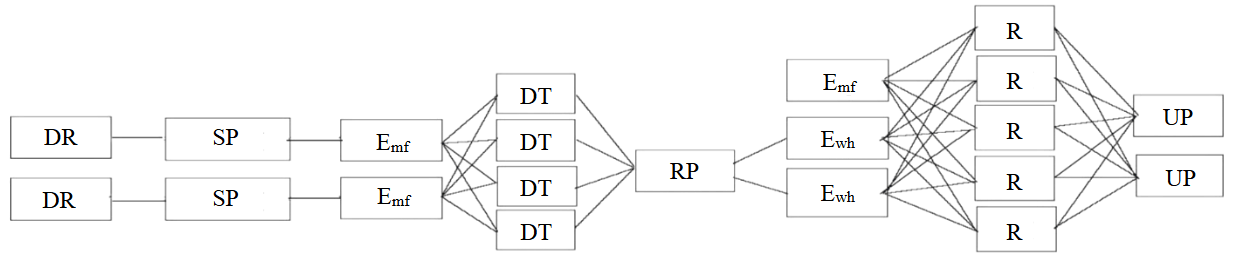
Fig.4. Combined scheme of mining and transport equipment interaction of geotechnical complexes of mining and technical system of open-pit mine
Emf – excavator in the mine face; Ewh – excavator in the warehouse; RP – reloading point (warehouse)
The mathematical reliability model in this case has the following form:
where m, s, z, f are the numbers of excavators, dump trucks, and vehicles at unloading points and operating in the upper horizons; g is the number of operable excavators in the upper horizons; kaf is the availability rate of excavators operating in the upper horizons.
Conclusion
The mathematical models of the reliability of cargo flows formed by the TS of the mining and technical system in the open-pit mine take into account the relationship between the reliability of the system and the operational reliability of its constituent mining and transport equipment under various interaction schemes. These relationships can be used for modeling both in the process of designing the mining and technical systems in the open-pit mines, and in the process of analyzing the reliability of the individual rock mass transportation schemes and the entire TS.
With the help of the developed reliability models, the following main tasks can be solved:
- assessing and comparing the reliability of various transport schemes in the design of the open-pit mine and selecting the technical solution option that best meets the reliability requirements;
- studying the influence of the reliability of individual vehicles with their various interactions on the reliability of the transport scheme or the entire TS.
The results of the study make it possible, using the simulation modeling, to assess the feasibility of various measures to improve the reliability of vehicles and determine their optimal reliability, including:
- the optimal amount of mining and transport equipment in the TS, ensuring the cargo flow of rock mass in the open-pit mine, starting from the preparation process to the unloading points on the daylight surface;
- the influence of the capacity of accumulating elements on the reliability of the entire transport scheme and the TS, which can result in identifying the optimal capacity of reloading points and homogenizing warehouses.
References
- Yakovlev V.L., Glebov A.V., Zhuravlev A.G. et al. Transient Processes in Formation of Geotechnical Systems in Deep Open Pit Mines: Methodical Aspects. Journal of Mining Science. 2024. Vol. 60. N 6, p. 954-965. DOI: 10.1134/S1062739124060103
- Yakovlev V.L. Study of Transient Processes is a New Direction in Evolution of Methodology of Complex Development of Georesources. Ekaterinburg: Institut gornogo dela UrO RAN, 2019, p. 284 (in Russian). DOI: 10.25635/IM.2020.54.57311
- Paricheh M., Osanloo M. Determination of the optimum in-pit crusher location in open-pit mining under production and operating cost uncertainties. 6th International Conference on Computer Applications in the Minerals Industries, 5-7 October 2016, Istanbul, Turkey. Istanbul: AGRO ARGE Danışmanlık San. ve Tic. A.Ş., 2016. N CAMI2016-34.
- Moniri-Morad A., Pourgol-Mohammad M., Aghababaei H., Sattarvand J. A methodology for truck allocation problems considering dynamic circumstances in open pit mines, case study of the Sungun copper mine. Rudarsko-geološko-naftni zbornik. 2019. Vol. 34. N 4, p. 57-65. DOI: 10.17794/rgn.2019.4.6
- Kamrani А., Pourrahimian Y., Askari-Nasab H. In-Pit Crushing and Conveying Systems in Long-term Open Pit Mine Planning – Literature Review. MOL Report Ten – 2021/2022. Edmonton: University of Alberta, 2022, p. 21-37.
- Afrapoli A.M., Tabesh M., Askari-Nasab H. A multiple objective transportation problem approach to dynamic truck dispatching in surface mines. European Journal of Operational Research. 2019. Vol. 276. Iss. 1, p. 331-342. DOI: 10.1016/j.ejor.2019.01.008
- Kurganov V.M., Gryaznov M.V., Kolobanov S.V. Assessment of operational reliability of quarry excavator-dump truck complexes. Journal of Mining Institute. 2020. Vol. 241, p. 10-21. DOI: 10.31897/PMI.2020.1.10
- Voronov Yu.E., Voronov A.Yu., Dubinkin D.M., Maksimova O.S. Dispatching in truck-shovel systems with unmanned transport at open-pit mines. Ugol. 2023. N 11, p. 65-71 (in Russian). DOI: 10.18796/0041-5790-2023-11-65-71
- Voronov A.Yu., Khoreshok A.A., Voronov Yu.E. et al. Assessment of the operation quality of shovel-truck systems at open-pit coal mines in Kuzbass. Mining Equipment and Electromechanics. 2020. N 2, p. 19-26 (in Russian). DOI: 10.26730/1816-4528-2020-2-19-26
- Burmistrov K.V., Osintsev N.A., Rakhmangulov A.N., Bagdasaryan M.A. Universal system of criteria for selecting deep open pit dump trucks. Bulletin of the Tomsk Polytechnic University. Geo Assets Engineering. 2025. Vol. 336. N 7, p. 29-44 (in Russian). DOI: 10.18799/24131830/2025/7/4786
- Shibanov D.A., Ivanov S.L., Yemelyanov A.A., Pumpur E.V. Evaluation of working efficiency of open pit shovels in real operating conditions. Mining Informational and Analytical Bulletin. 2020. N 10, p. 86-94 (in Russian). DOI: 10.25018/0236-1493-2020-10-0-86-94
- Dindarloo S.R., Osanloo M., Frimpong S. A stochastic simulation framework for truck and shovel selection and sizing in open pit mines. Journal of the Southern African Institute of Mining and Metallurgy. 2015. Vol. 115. N 3, p. 209-219.
- Nehring M., Knights P.F., Kizil M.S., Hay E. A comparison of strategic mine planning approaches for in-pit crushing and conveying, and truck/shovel systems. International Journal of Mining Science and Technology. 2018. Vol. 28. Iss. 2, p. 205-214. DOI: 10.1016/j.ijmst.2017.12.026
- Komlenovich D. A multi-criteria approach to the selection of mining equipment. Gornoe delo. 2017. N 2 (12), p. 10-19, 33-41 (in Russian).
- Moniri-Morad A., Sattarvand J. A comparative study between the system reliability evaluation methods: case study of mining dump trucks. Journal of Engineering and Applied Science. 2023. Vol. 70. N 103. DOI: 10.1186/s44147-023-00272-y
- Jakkula B., Mandela G.R., Chivukula S.M. Reliability, availability and maintainability (RAM) investigation of Load Haul Dumpers (LHDs): a case study. International Journal of System Assurance Engineering and Management. 2022. Vol. 13. Iss. 1, p. 504-515. DOI: 10.1007/s13198-021-01154-3
- Khazhiev V.A. On increasing the efficiency of interaction of subsystems of the technical use and repair maintenance of the equipment of the technological complex of a mining enterprise. Bulletin of the Kuzbass State Technical University. 2022. N 3 (151), p. 64-74 (in Russian). DOI: 10.26730/1999-4125-2022-3-64-74
- Zyryanov I.V. Improving the efficiency of open pit transport systems in extreme operating conditions: Avtoref. dis. … d-ra tekhn. nauk. St. Petersburg: Sankt-Peterburgskii gosudarstvennyi gornyi institut im. G.V.Plekhanova, 2006, p. 40 (in Russian).
- Agafonov O.A., Afonina N.B. Refinement of methods for calculating the material flows of conveyor transportation systems in coal mines. Russian Mining Industry. 2023. N 6, p. 89-94 (in Russian). DOI: 10.30686/1609-9192-2023-6-89-94
- Volokitin A.N., Naumov K.S., Burmistrov K.V. et al. Selection of mining-and-transport equipment complex for limestone quarries in difficult mining conditions. Mineral Mining & Conservation. 2021. N 5, p. 59-65 (in Russian). DOI: 10.26121/RON.2021.72.91.007
- Nasirov U.F., Zairov Sh.Sh., Karimov Sh.V. Research and evaluation of process fleet for effective haulage of rock mass in deep open pits. Ugol. 2023. N 12, p. 67-72 (in Russian). DOI: 10.18796/0041-5790-2023-12-67-72
- Voronov A.Y., Khoreshok A.A., Voronov Y.Y. et al. Optimization of parameters of shovel-truck systems at open-pit coal mines. Russian Mining Industry. 2022. N 5, p. 92-98 (in Russian). DOI: 10.30686/1609-9192-2022-5-92-98
- Yarmuch J., Epstein R., Cancino R., Peña J.C. Evaluating crusher system location in an open pit mine using Markov chains. International Journal of Mining, Reclamation and Environment. 2017. Vol. 31. Iss. 1, p. 24-37. DOI: 10.1080/17480930.2015.1105649
- Paricheh M., Osanloo M. Concurrent open-pit mine production and in-pit crushing-conveying system planning. Engineering Optimization. 2020. Vol. 52. Iss. 10, p. 1780-1795. DOI: 10.1080/0305215X.2019.1678150
- Paricheh M., Osanloo M., Rahmanpour M. A heuristic approach for in-pit crusher and conveyor system’s time and location problem in large open-pit mining. International Journal of Mining, Reclamation and Environment. 2018. Vol. 32. Iss. 1, p. 35-55. DOI: 10.1080/17480930.2016.1247206
- Zalyadnov V.Yu. Assessing sustainability of the operation of the mining system of open geotechnology based on an integral indicator of mining capabilities. Vestnik of Nosov Magnitogorsk State Technical University. 2024. Vol. 22. N 2, p. 5-13 (in Russian). DOI: 10.18503/1995-2732-2024-22-2-5-13
- Patterson S.R., Kozan E., Hyland P. Energy efficient scheduling of open-pit coal mine trucks. European Journal of Operational Research. 2017. Vol. 262. Iss. 2, p. 759-770. DOI: 10.1016/j.ejor.2017.03.081
- Burmistrov K.V., Osintsev N.A., Rakhmangulov A.N., Yusupov M.E. Multi-criteria analysis of deep pits sustainable development strategy. Bulletin of the Tomsk Polytechnic University. Geo Assets Engineering. 2023. Vol. 334. N 12, p. 76-96 (in Russian). DOI: 10.18799/24131830/2023/12/4223
- Bakhtavar E., Mahmoudi H. Development of a scenario-based robust model for the optimal truck-shovel allocation in open-pit mining. Computers & Operations Research. 2020. Vol. 115. N 104539. DOI: 10.1016/j.cor.2018.08.003
- Chernyh V.G., Otrokov A.V., Grinko D.A. et al. Determination of parameters of reliability-oriented maintenance of coal mine dump trucks. Mining Equipment and Electromechanics. 2025. N 2 (178), p. 50-58 (in Russian). DOI: 10.26730/1816-4528-2025-2-50-58
- Andreeva L.I., Ushakov Yu.Yu. Research of operational reliability of quarry dump trucks. News of the Ural State Mining University. 2016. Iss. 3 (43). p. 74-77. DOI: 10.21440/2307-2091-2016-3-74-77
- Kantemirov V.D., Yakovlev A.M., Titov R.S., Timokhin A.V. Methodology of planning excavator operations in open pit mines based on computer modeling. Russian Mining Industry. 2023. N 6, p. 75-80 (in Russian). DOI: 10.30686/1609-9192-2023-6-75-80
- Yakovlev A.M., Kantemirov V.D., Titov R.S. Methodology for assessing the fronts of mining operations of deep quarries based on GGIS modeling of the working area. Problems of Subsoil Use. 2023. N 1 (36), p. 41-52 (in Russian). DOI: 10.25635/2313-1586.2023.01.041
- Zhuravlev A.G., Kardashin E.D. Modeling of cargo flows during the operation of the crushing and conveyor complex of the quarry. Problems of Subsoil Use. 2024. N 4 (43), p. 6-15 (in Russian). DOI: 10.25635/2313-1586.2024.04.006
- Cheban A.Y., Khrunina N.P. Intensification of Open Mining Operations with a Small Distance of Transportation of Rock Mass. International Journal of Engineering Research in Africa. 2018. Vol. 38, p. 100-114. DOI: 10.4028/www.scientific.net/JERA.38.100