


Methodological aspects of integrated processing of geoscientific data with elements of neural network prediction as the basis for a reservoir model under conditions of low well density in the area
- 1 — Ph.D., Dr.Sci. Professor Sergo Ordzhonikidze Russian State University for Geological Prospecting ▪ Orcid ▪ Elibrary
- 2 — Chief Expert in Hydrodynamic Modelling Diall Alliance, Skolkovo ▪ Orcid
- 3 — Senior Lecturer Peoples’ Friendship University of Russia named after Patrice Lumumba ▪ Orcid
Abstract
During the comprehensive interpretation of geological and seismic data obtained while studying complex reservoirs in West Siberian fields, the methods and principles for processing field geological data to apply neural network-based porosity prediction for reservoirs were examined. The paper presents results of porosity prediction cubes used to identify reservoirs based on processed seismic data, well logging results, and geological information. The work demonstrates an approach to estimating reservoir porosity. Combining well logging interpretation with data on reservoir density variations and using synchronous seismic inversion methods can help in defining a set of probabilistic algorithms for lithotype identification. Based on the application of interactive tools for probabilistic interpretation of well data and 3D seismic surveying, the study provides a prediction and probabilistic assessment of reservoir location with varying saturation levels (water and gas saturation). The results substantiate the presence of oil and gas saturated sandstone within the studied field and horizon with a probability of 50-95 %.
The work was carried out under the State assignment of OGRI RAS on the topic “Fundamental basis of innovative, digital technologies for predicting, prospecting, exploration, and development of petroleum resources (fundamental, exploratory, applied, economic, and interdisciplinary research until 2030)”, State registration number 125021302095-2.
Introduction
Currently, the issues of economic efficiency of geological exploration at oil and gas fields for prospected structures are relevant, since one of the main tasks under conditions of low well density is predicting the variability of reservoir porosity and permeability and, consequently, predicting changes in well productivity. This requires differentiating reservoirs by lithological and petrographic composition and porosity and permeability [1-3]. Today, most oil fields in Western Siberia and other regions of the Russian Federation are at the final stage of development, which increases the importance of scientific and practical directions for searching for new accumulations in hard-to-reach regions. Such regions are characterized by low well density, which necessitates the use of new methods for acquiring and processing field data when defining tasks. To assess the petroleum potential of prospected structures, it is necessary to determine criteria based on the genesis of hydrocarbons at great depths, modern interpretation of geophysical data, and synthesis of lithological, biostratigraphic, and geochemical studies [4], as well as to identify the factors controlling the preservation of liquid and gaseous hydrocarbons at great depths (4-5 km) [5].
When addressing complex tasks, it is important to recognize that simple interpolation of well and seismic data can lead to significant errors in hydrocarbon reserves estimation. There is a need to apply various algorithms for integrating field geological data to model hydrocarbon accumulations, including through the use of artificial intelligence (AI) technologies. These issues are annually addressed during the long-standing Geomodel conference (organized by EAGE – the European Association of Geoscientists and Engineers), where in 2022-2024, papers by Yu.P.Ampilov, I.I.Priezzhev, D.A.Danko, and others were presented. They demonstrate methods of neural network predicting reservoir properties based on integrated data from seismic surveys, well logging, and petro-elastic modelling – which form the basis of previously published materials [6]. Implementing modern AI technologies and training approaches for modelling hydrocarbon accumulations based on comprehensive interpretation of geological (well) and seismic data significantly increases the likelihood of building more accurate geological and hydrodynamic models, which improves the quality of oil and gas field development in general.
Today, a wide range of methods and technologies is used to predict oil saturation in the inter-well space; however, they are mainly based on classical approaches, such as the use of pseudo-acoustic velocities (impedances) and their integrated interpretation via empirical methods [7-9]. It should be noted that the application of innovative methods – including neural network algorithms, inversion, and construction of probabilistic stochastic interpolation models for well logging data in vertical and lateral directions – will demonstrate varying effectiveness under different conditions, depending on the complexity of the accumulation structure due to the low well density in the area. This remains one of the key challenges in identifying promising hydrocarbon traps for prioritizing drilling locations. It is important to carry out a reliable assessment of the spatial distribution of reservoir properties, including permeability and porosity, lithological and petrographic features, and mechanicalproperties of the formation [10-12]. To address reservoir zoning issues through integration of well logging methods, statistical and analytical techniques are primarily used – such as component, factor, and multivariate regression analyses [13, 14] – alongside reservoir modelling based on neural network algorithms.
The paper presents a study substantiating an algorithm for processing geoscientific data during oil reservoir modelling under conditions of low well density in the studied area, using a neural network prediction as a rapid method for assessing reservoir porosity and oil saturation.
Given the need to analyse standard methods for determining reservoir porosity and permeability and to apply various algorithms for high-quality processing of the obtained data, as well as AI training techniques for solving issues of inter-well interpretation of well logging data and identifying oil-saturated intervals within structures that are promising for priority drilling, a field in Western Siberia was selected (area approximately 1200 km2). Quantitative and qualitative data were obtained from four prospecting wells. The initial studies are presented in [6], where the necessity of identifying “statistical relationships between seismic attribute(s) and reservoir porosity and permeability (for example, porosity factor Fp) is highlighted – the latter being determined based on core analysis data and results of well logging data interpretation”.
Many researchers also justify the need to integrate laboratory data (in particular, porosity), well logging, and 2D, 3D seismic data [15, 16]. After compiling a local database, it becomes clear that statistical analysis methods are not suitable for reservoirs characterized by high lateral variability and the presence of changes in lithology. The amount of input data (for example, the number of prospecting wells drilled within the studied field area) is limited; in such cases, 3D seismic surveying becomes the main source of information – specifically, the application of seismic data inversion to generate cubes of acoustic and shear impedance parameters, as noted in [17, 18]. This aspect was also discussed at the Geomodel scientific and practical conferences. For instance, in oral presentations in 2023, D.A.Danko, I.I.Priezzhev, I.O.Bayuk, and V.I.Ryzhkov noted that applying standard methods to determine linear relationships with seismic attributes derived from classical inversion-based constructions does not allow achieving the required accuracy for the reservoir porosity and permeability model of geological formations. Therefore, modelling reservoirs within the studied area with low well density (where there is insufficient laboratory core data and well logging data interpretation results) and constructing a predictive reservoir cube through stochastic distribution of various lithotypes within the reservoir volume is quite problematic.
When conducting studies under conditions of low well density in the area (exploration stage), the key issue is to identify methods that can supplement or upgrade standard techniques for determining correlation relationships between seismic attributes and petrophysical properties – which typically involve significant error when predicting porosity and permeability in the inter-well space.
Materials and methods
The paper presents, based on the study of technologies incorporating AI elements and the use of modern machine learning algorithms [19-22], an example of integrated processing of well logging data and 3D seismic survey data to identify uncertainties characterizing zones with or without a reservoir. The study was carried out in three stages, each building on the previous one: Stage I – ranking of research targets based on multiattribute analysis (justification of the field selection, creation of an initial local database, ranking of targets by the ratio of P-wave and S-wave velocities relative to background values typical for water-saturated rocks (AVO analysis; saturation parameter – Fluid Factor) and well logging results; Stage II – empirical processing of porosity and permeability data (porosity factor obtained from well logging and core analysis) and 3D seismic survey data; Stage III – training neural networks to predict the reservoir.
For structures penetrated with a limited number of wells, a method was used to construct a predictive cube of porosity and saturation factors for target intervals through integrated interpretation of well logging and seismic data in the Emerge module (CGG) within the HampsonRussell software package. Using the interactive FFP (Facies and Fluids Probabilities) tool, the diagram illustrates the main stages of probabilistic interpretation of well data and 3D seismic surveying; it provides a prediction and probabilistic assessment of the location of sandstone with varying saturation (water and gas saturation) and also predicts areas with clay occurrence. The results substantiate the presence of oil and gas saturated sandstone within the studied field and horizon with a probability ranging from 50 to up to 95 % in certain areas.
To select the methods and principles of integrated data processing required for applying a neural network prediction, it is necessary to consider the theoretical background and classical approaches to solving the issue – these will form the basis for developing the training dataset and training algorithms. Various approaches are used, for example: a training algorithm based on selecting and evaluating conditions to effectively enhance oil recovery in hard-to-recover, highly water-flooded fields [23]; linear regression analysis of machine learning methods to determine relationships between geophysical parameters and Poisson’s ratio [24]; a neural network-based technology for oil production management [25]; hydrodynamic modelling [26], considering different approaches to assessing the geomechanical state of the reservoir [27]; and others. For instance, it is known that by comparing the porosity of a reservoir saturated with oil, gas, and water, using acoustic impedance data, one can determine their bulk density. The effectiveness of such differentiation depends on porosity and fluid density. However, when determining porosity from well logging data, the influence of fluid density is often absent – usually either due to the replacement of the initial fluid with drilling mud filtrate or thanks to the use of special techniques that eliminate this influence. This means that even with constant porosity, a reservoir may exhibit different seismic characteristics depending on the type of saturation – and this must be considered when building velocity models [28] and interpreting AVO analysis data.
At Stage II of the research, the possibility of modifying the Aki – Richards approximation was also considered to apply the AVO analysis method and identify zones with different types of saturation (oil, gas, water).
Given that rock density is affected by the presence of fluids with varying densities in the pore space, one of the seismic data transformation methods adopted is the AVO (Amplitude Variation with Offset) analysis. This method involves studying the dependence of reflected wave amplitudes on offset and was addressed in the works by Ostrander (1982) and Hilterman (2001). It is based on two principles: first, the same rocks exhibit different values of primary Vp and shear Vs wave velocities depending on the type of fluid saturating the rock (gas, water, oil); second, if the interface between two elastic, homogeneous, and isotropic media is planar, the reflectivity factor of a plane harmonic primary wave is a function of four relative quantities – ρ2/ρ1, Vp2/Vp1, Vp2/Vs2,and Vp1/Vs1, where ρ1 and ρ2 are the densities of the medium from which the plane wave originates and the medium onto which the wave impinges; Vp1 and Vp2 are the primary wave velocities; Vs1 and Vs2 are the shear wave velocities. These parameters are related by the dependence R = f (Vp, Vs, ρ, α). The media differ only in the magnitude of the Vp/Vs jump at the interface (Fig.1, a).
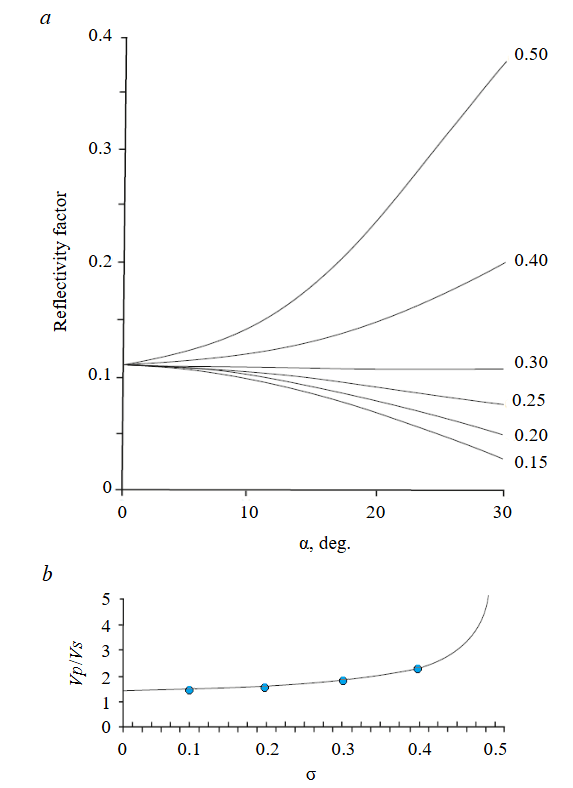
Fig.1. Key parameters for modelling the interface between media: a – graphs of the P-wave reflection coefficient versus the angle of incidence for models with Vp2/Vp1 = 1.25; Vp1/Vs1 = 1.73 (or σ = 0.25), ρ2/ρ1 = 1 (Coefoed, 1955); b – relationship between Poisson's ratio σ and the velocity ratio Vр/Vs
The Shuey approximation – an approximation of the Zoeppritz equation – is a modified version of the Aki – Richards approximation. The two-term Shuey approximation involves rearranging the terms in the Aki – Richards equation to obtain the classical three-term AVO approximation of the reflectivity factor:
where R0 is the P-wave reflectivity factor at normal incidence; θ is the angle of incidence; G is the gradient characterizing the reflectivity factor at oblique incidence, mainly in the 0-30° angle range; С is the curvature, a factor that becomes significant at incidence angles exceeding 30°.
Given that tg2θ-sin2θ=tg2θ·sin2θ
Therefore, at normal incidence, the gradient is zero, and the reflectivity factor depends solely on the contrast of acoustic impedances.
As the angle of incidence increases, the contribution of the gradient also grows; this gradient depends on the velocities of both primary and shear waves. Therefore, we decided to examine the relationships between the Vp/Vs ratio (in the Aki – Richards and Shuey approximations) and Poisson’s ratio:
where εii is the relative changes in the length of the body along the direction of the i-th axis (normal strains).
Poisson’s ratio is related to the Vp/Vs velocity ratio as follows (Fig.1, b):
if σ = 0, then Vp/Vs=√2; if σ = 0.1, then Vp/Vs=1.5 (gas-saturated rock); if σ = 0.33…, then Vp/Vs=2 (water-saturated rock); if σ = 0.5, then Vp/Vs=∞ (fluid).
Based on empirical algorithms (methods) for performing classical computations, it becomes possible to build a local database, carry out preliminary data processing, and create a dataset for applying a non-linear prediction of reservoir properties in the inter-well space – using both classical techniques and algorithms for identifying uncertainties. To predict the reservoir and identify uncertainties under conditions of low well density in the field area, it is necessary from a mathematical standpoint to apply the methods proposed by Yu.P.Ampilov (“Seismic Interpretation: Experience and Problems”), first introduced in 2004. Methods developed by Hampson et al. in 2001 (“Use of multiattribute transforms to predict log properties from seismic data”) were also considered. The prediction is made without explicitly defining a physical model that links the sought-for parameters of the geological medium in individual wells (i.e., under conditions of low well density in the area) with the recorded seismic wavefield. Instead, correlation relationships between them are identified – these manifest themselves in the obtained values of various dynamic attributes of the seismic record. The inverse operator L–1 is replaced by some (in the neural network approach – non-linear) transfer function of seismic attributes, “trained” on well data and describing the identified patterns. In this case, under conditions of low well density in the field, uncertainty analysis enables the most reliable assessment of the hydrocarbon accumulation volume and has a significant impact on the efficiency of locating prospecting and exploration wells within new structures.
Results
At Stage III, the methodological aspects of integrated processing of geoscientific data were substantiated and proposed. These were developed based on first and second principles of the AVO analysis method, as well as on the processed actual data. The intended result was to obtain predictive cubes representing the distribution of reservoirs in terms of both qualitative and quantitative characteristics – specifically, the boundary values of the porosity factor Fpor and the oil saturation factor Fo. The data processing algorithm included:
- selecting wells for analysis, considering the assessment based on the property cube with introduced static correction for topography – to adjust the boundaries of accumulation-type anomalies (ATA);
- processing the stacked 2D seismic section using the multiple coverage technique (MCT);
- constructing predictive cubes of reservoir porosity based on processing data from P-impedance cubes, Vp/Vs ratio cubes, and the seismic cube after depth migration – with well logging data incorporated following petro-elastic modelling for the neural network-based reservoir prediction.
The results for mitigating uncertainties related to topography variations were obtained using the low-velocity zone (LVZ) method. For further neural network training, a well sample was formed, considering the assessment based on the property cube with an introduced static correction for topography. In this case, the standard deviations δ for different study intervals amounted to 7.49 for the depths of the AS group reservoirs and 12.4 for the depths of the YuS group reservoir intervals (Fig.2, a).
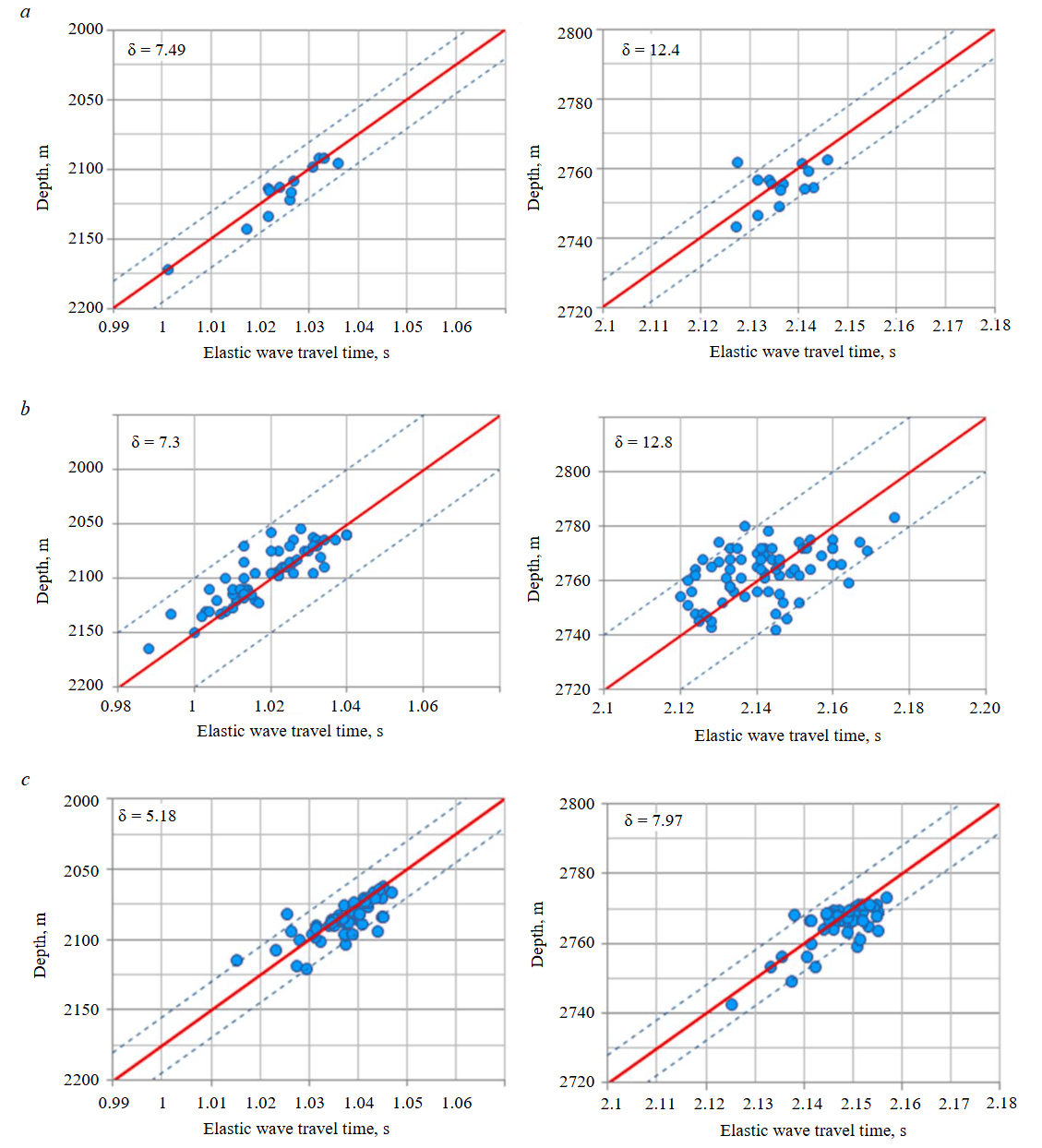
Fig.2. Processing data based on property cube to adjust reflector boundary positions: a – property cube assessment with the introduction of the topography static correction; b – assessment with the introduction of a static correction using the LVZ method; c – assessment with the introduction of a static correction using the LVZ and MCT methods
If a static correction is applied to the property cubes using the LVZ method, the standard deviations related to topography for the different study intervals will change and amount to 7.3 for the depths of the AS group reservoirs and 12.8 for the depths of the YuS group reservoir intervals (Fig.2, b). When assessing the reservoir cube property with static corrections applied using both the LVZ and MCT methods, the standard deviations related to topography for the study intervals decrease significantly and amount to 5.18 for the depths of the AS group reservoirs and 7.97 for the depths of the YuS group reservoir intervals (Fig.2, c).
This example demonstrates how the amount of uncertainty changes during preliminary data processing when applying various processing algorithms.
The result of applying the MCT is a stacked section of the accumulations, incorporating MCT corrections (Fig.3).
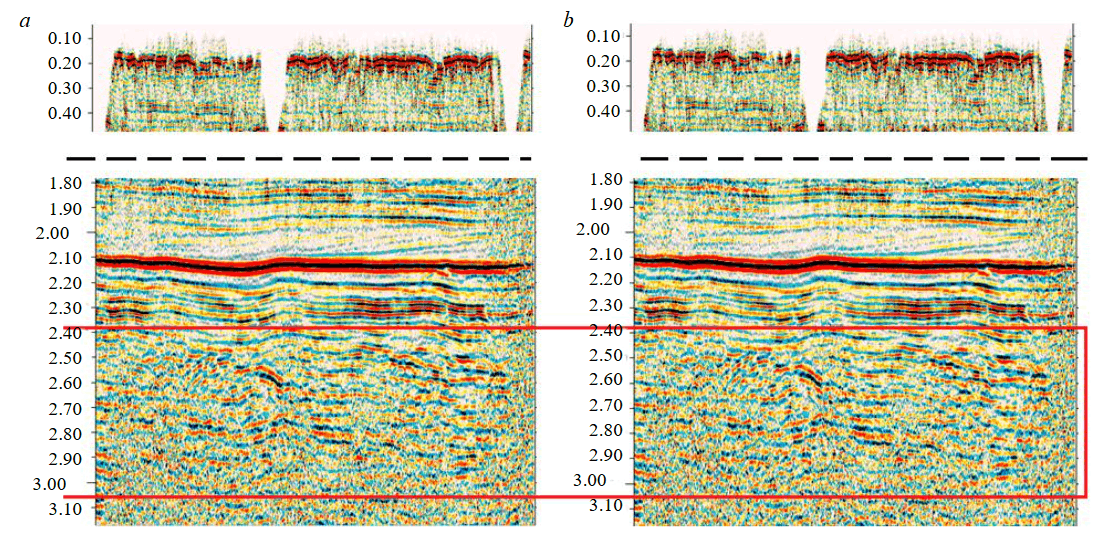
Fig.3. Fragment of the stacked record before (a) and after (b) considering the MCT corrections, line 15-8
When using elastic inversion technology to study ATA, the tasks involved interpreting correlation relationships – for example, acoustic impedance versus porosity (oil, gas, and water saturation), etc. Cross-plots of porosity versus acoustic impedance (AcI) were constructed; the data were obtained during field operations from 3D seismic survey and well logging results. The cross-plots and regression equation enabled 3D interpolation of these parameters in the inter-well space, allowing the identification and mapping of intervals with elevated porosity. Using AVO analysis, information on changes in velocities and frequencies was obtained, providing insights into lithology, porosity, and saturation. Data were also processed in a 3D coordinate system plus the offset coordinate of the recording receivers relative to the source. This approach allowed capturing reflections from interfaces at different angles of incidence. Therefore, in addition to the common depth point time section, wave characteristics were also obtained: the R0 section of reflected waves at zero offset – representing the projection of amplitudes at the intersection with the zero-offset axis (or the wave incident on the interface normally); and the G section of amplitude gradients – as the curvature factor describing how amplitudes change with offset.
For neural network training, cross-plots of the R0/G distribution at well points were constructed within the interval from −3 to +6 ms for the studied reservoir intervals (Fig.4, a). To delineate ATA boundaries, amplitude analysis was performed at well points through statistical processing of the obtained seismic traces (Fig.4, b). Based on the joint analysis of well data and AVO characteristics of the seismic data, the presence of zones with uniform reservoir types and the absence of zones with different saturation types were demonstrated. This indicates a uniform lithological and petrographic composition of the reservoirs with a consistent type of saturation – oil (Fig.4, c).
The thickness of the water-saturated part of the reservoir was determined (well logging results were missing for wells 2 and 6): Hw = 14.28 m (well 1); the thickness of the oil-saturated part of the reservoir: Ho = 5.9 m (well 2), Ho = 9.95 m (well 3), Ho = 12.69 m (well 4); the thickness of the water-saturated part: Hw = 18.1 m (well 5), Hw = 7.89 m (well 6). By examining the AVO analysis data, it is possible to predict the location of zones that differ in physical properties due to the presence of hydrocarbons.
The success of the prediction depends on the processing of seismic data, which must satisfy certain requirements, and the methodology of field seismic exploration must ensure uniform distribution of seismic traces and make it possible to use maximum angles of incidence on angular seismograms (not lower than 25°) over the entire time interval of analysis. The processing of deep-lying accumulations will be especially complex and multi-stage, for Western Siberia these are certainly Jurassic and pre-Jurassic petroleum complexes, where when selecting data processing algorithms it is also necessary to consider zones of anomalous temperatures and pressures [29, 30]; the presence of hard-to-recover reserves [31]; the correctness of well logging in deep and ultra-deep wells [32]; the presence of asphalt-resin deposits, their transformation processes [33, 34], etc.
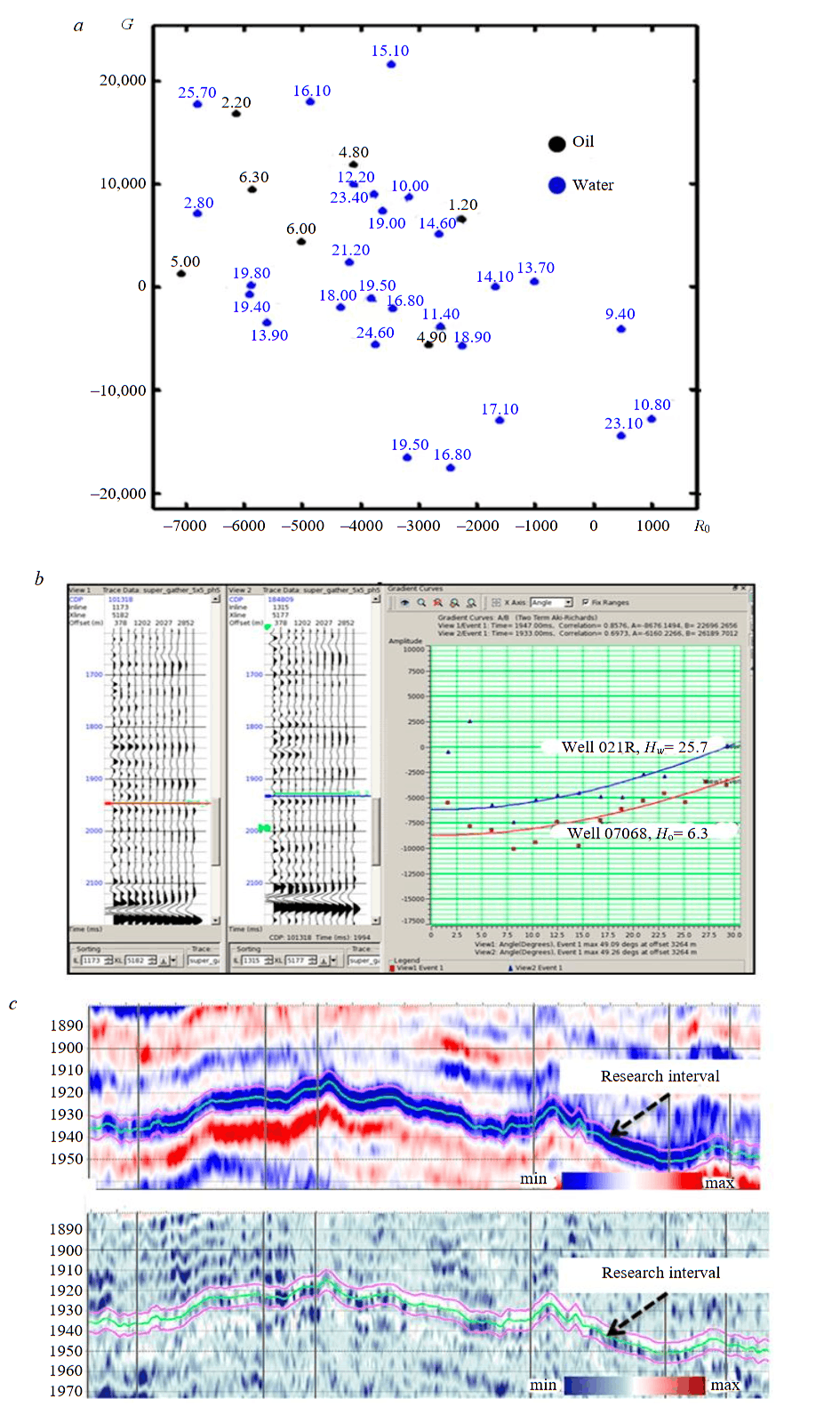
Fig.4. ATA studies: a – cross-plot of R0/G distribution at well points in the range from –3 to +6 ms; b – analysis of amplitudes at well points using statistical processing of the obtained seismic traces; c – integration of well data and AVO analysis data, identification of water- and oil-saturated intervals (top), construction of a cross-section using the Product attribute (bottom)
Results and discussion of the reservoir prediction cube method based on AVO analysis and the Fluid Factor saturation parameter, considering a neural network reservoir prediction
At Stage I of the study, algorithms for the probabilistic stochastic distribution of petrophysical parameters in space were used, without considering seismic data. Based on the cross-plot construction and empirical processing of Fp and Fp.logging data, considering only geophysical and laboratory studies, lithotypes of rocks were identified and reservoir properties and saturation of rocks were determined. Interpretation of AVO attributes in quantitative environmental parameters is possible only using standard empirical relationships during well calibration.
Based on standard core analysis results, porosity, permeability, water and oil saturation were determined. Numerical values for Fp, Fper, Fw, Fo were obtained, respectively. At Stage I, a 3D mineral petro-elastic model was built, and the petrophysical characteristics of the studied section were determined. Core laboratory studies in the area were carried out on core samples from four wells; these wells were used to estimate the boundary values for the “reservoir – non-reservoir” classification within the pay of the Cretaceous deposits.
To improve the quality of seismic trend interpretation under conditions of low well density at the studied field, it was found that constructing correlation relationships of the “seismic – density from well logs” type is the most preferable approach. It also provides a solid basis for building a density cube. Using bulk density derived from simultaneous inversion results for porosity prediction will be more accurate. This is because simultaneous inversion reconstructs bulk density values as well as primary and shear wave velocities from seismic data – enabling both quantitative (accounting for reservoir complexity due to frequent interbedding) and qualitative (oil, gas, or water saturation) predictions of reservoir properties.
Given the low well density in the study area (the license block within the Nizhnevartovsk Arch), we decided to predict the porosity parameter (reservoir prediction) by analysing simultaneous inversion of seismic data based on the Fluid Factor saturation parameter. Neural networks were trained to predict the reservoir under uncertainty conditions arising from the low well density across the area.
Neural networks were used to identify target intervals in the section by constructing predictive cubes of porosity and saturation. Mathematical algorithms were applied, incorporating seismic inversion data that reflect the methodology for predicting lithological and petrographic parameters and porosity and permeability for integrated interpretation of the well section.
The prediction was carried out in the Emerge module of the HampsonRussell software package (developed by CGG) and processed using a neural network after performing multiattribute statistical analysis and finding correlation relationships between well logging data and laboratory data – based on field geological data from the four wells. This made it possible to select the optimal six attributes for neural network training to build a probabilistic porosity cube. The principle of working with the neural network is described in [6].
Field geological data from four wells were used to train the neural network algorithms: Vp/Vs ratio; P-impedance; seismic cube after depth migration (porosity factor cube, accounting for the Fp boundary values – obtained by selecting optimal attributes for neural network training through a combination of attributes yielding the lowest error); comparison of well logging parameters with laboratory results of rock petro-elastic properties. To apply the neural networks, a multiattribute analysis was performed using data from the four wells, with a selection of six attributes: AcI values, m/s; AcI values at the Vp/Vs ratio; porosity determined from core data; porosity determined from petro-elastic modelling data; porosity determined from combined core and well logging data; porosity determined from combined petro-elastic modelling and well logging data. Quantitative criteria were determined based on average deviation plots.
Six attributes were selected for neural network training based on the multiattribute analysis results and the constructed average deviation plots for the parameters. The number of attribute selection iterations varied to achieve the lowest error during data validation (Fig.5, a, c).
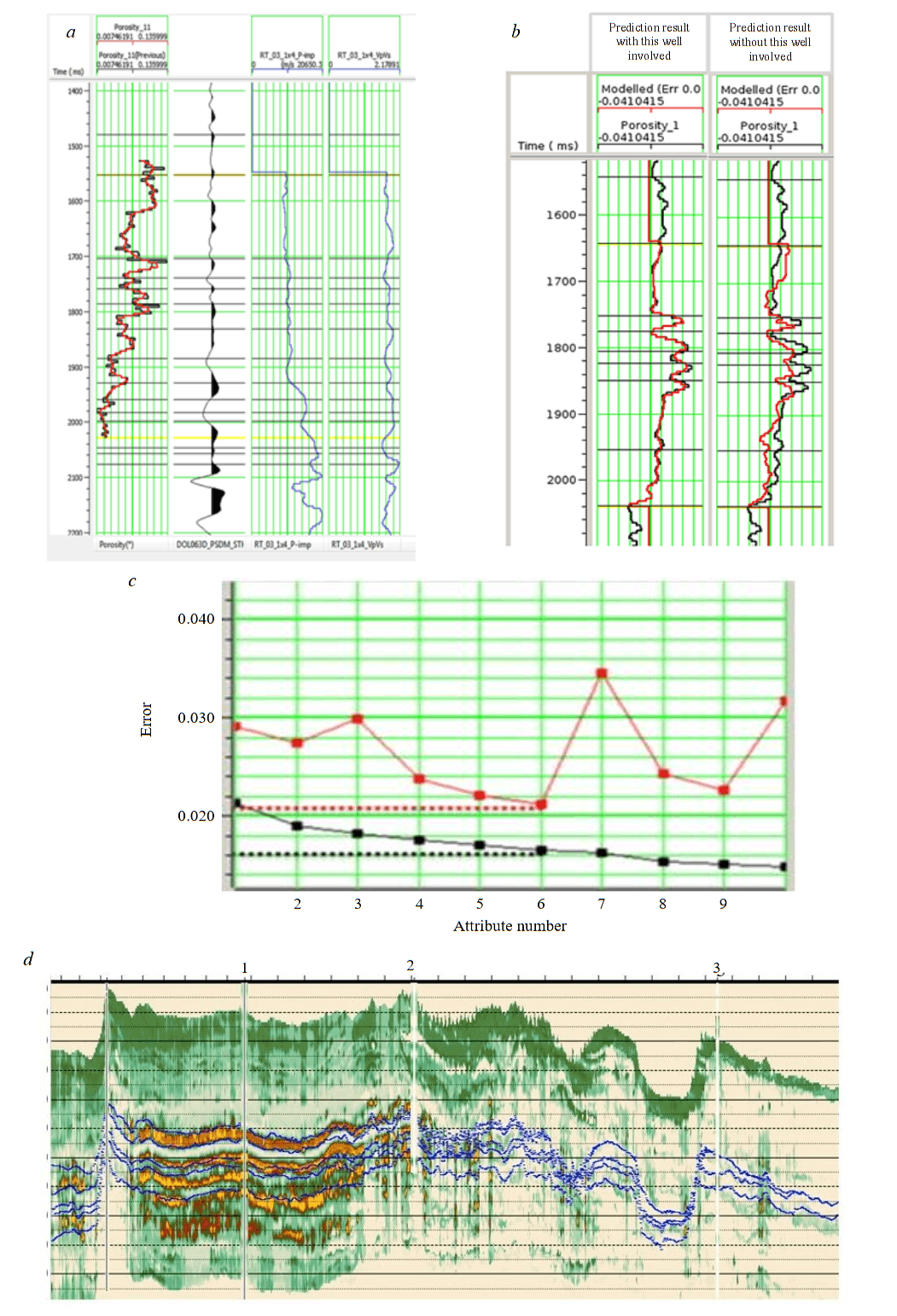
Fig.5. Key attributes for training the neural network and the resulting porosity cube: a – input data (acoustic impedance (AcI) values, m/s; AcI values at the Vp/Vs ratio; porosity determination based on core data and after petro-elastic modelling); b – porosity curve prediction result; c – error plot in wells using different numbers of attributes (black line – when all wells are included in the analysis, red – during validation); d – final porosity cube section obtained using the neural network prediction for wells 1-3. Parameter – AcI
Synthetic well logging curves generated by the neural network were compared with the original curves. The correlation coefficient, when all wells were used, reached 0.98 (with a mean error of 0.006). During cross-validation, the mean error was 0.029 when all wells were included, and 0.021 after data validation. Based on the preliminary empirical and analytical data, the optimal set of attributes was identified (Fig.5, b). Neural networks were then trained, and the final predictive porosity cube for the target intervals of the studied field was constructed (Fig.5, d).
The predictive porosity cube, modelled by the neural network with the inclusion of seismic data, was used as a trend for constructing the lithology cube. This provides a clearer pattern when determining locations for future prospecting wells. For a more accurate porosity prediction, it is recommended to identify uncertainty intervals based on boundary conditions. The results were obtained for a new license block with a limited number of wells (six wells in total; well logging data were missing for two of them, so the study was carried out using data from four wells). The studied license block is not covered by an operational well grid. Quality control of well data, including intervals highlighting caverns, is recommended to be performed as shown in Fig.6.
The lithology cube was built using the determined algorithms and computed via neural networks, considering previously obtained seismic interpretation data. It was found that the predictive porosity cube has high resolution – significantly higher than that of seismic cubes. The boundary porosity values obtained from petrophysical studies were used to delineate reservoir boundaries. In parallel, simultaneous inversion was performed in the Jason software package, and a probabilistic approach was applied to substantiate and delineate the “reservoir – non-reservoir” boundaries. To address this task, the FFP algorithm was used (Fig.7).
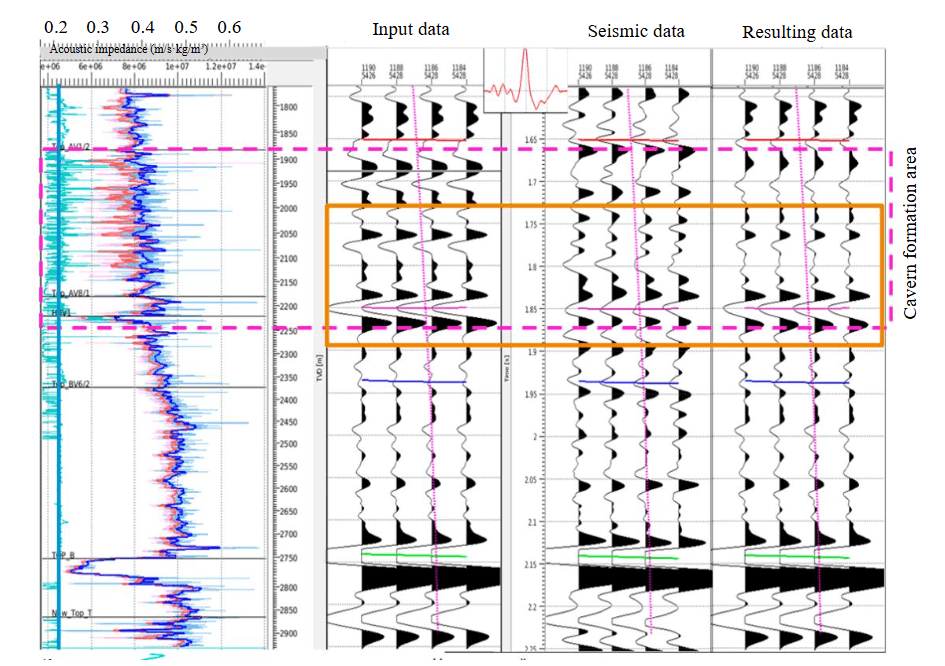
Fig.6. Well data quality control
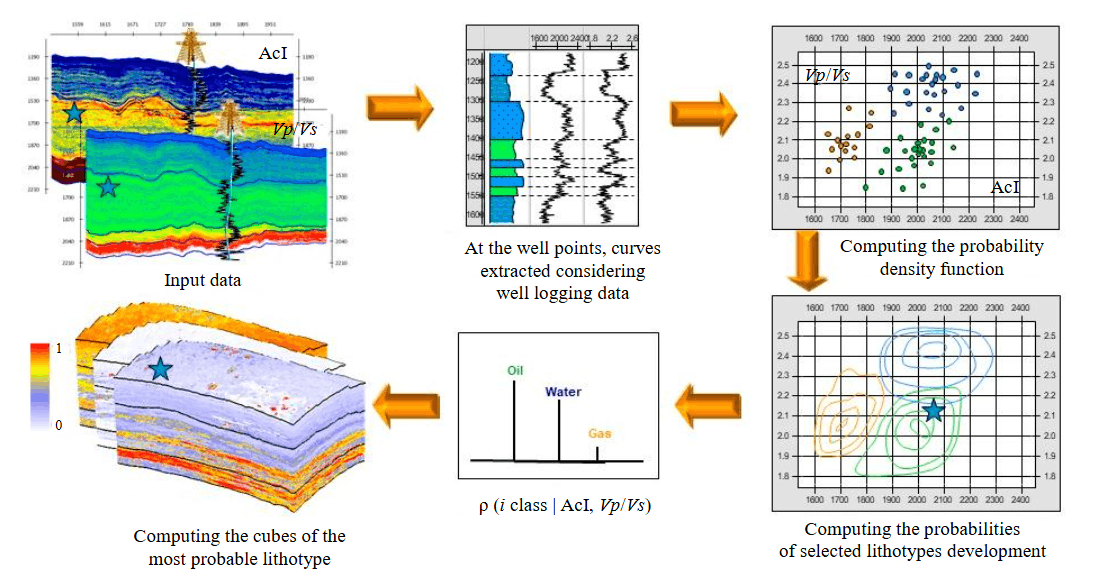
Fig.7. Data processing circuit (CGG) using the interactive FFP tool
It should be noted that a drawback of using neural networks for targets defined by empirical data is the complexity of algorithms for selecting the network structure and the dimensionality of the target function’s variable vector. Therefore, in the Emerge module, the developed algorithm for building a neural network model is based on cluster computing and counting the multiplicative and additive operations performed for sequential and parallel training algorithms, along with an assessment of their efficiency.
The obtained prediction should be considered only at a qualitative level, since in the elastic parameter field there is a weakly expressed separation by “reservoir – non-reservoir” types, and oil-saturated reservoirs are not distinguished from water-saturated ones. Another limitation of this method is the presence of interbedded zones (thin clay interlayers): due to the discrete seismic record, such zones cannot be reliably identified. Additionally, because of the low well density at the field, the data sample is limited. From the cube representing the most probable “reservoir” type, reservoir time thickness maps are compiled. Layers with increased thickness in the AcI section appear as zones of reduced acoustic impedance. Conversely, zones with high impedance values correspond to lower effective thickness values.
Conclusion
Today, geological exploration remains a stage that requires substantial capital investment and entails serious investment risks for oil companies. This is because simple interpolation of geological, production, and geophysical data leads to oversimplified trap modelling and may result in errors both during geological exploration and in the development of hydrocarbon accumulations.
Based on the results of the work performed, a three-stage algorithm is proposed: Stage I – application of probabilistic stochastic distribution of petrophysical parameters in space; Stage II – predicting the porosity parameter using AVO analysis – considering the Aki – Richards and Shuey approximations and incorporating Poisson’s ratio into the data processing algorithm. This enabled training neural networks to predict reservoirs. Additionally, by means of simultaneous inversion of seismic data (using the Fluid Factor saturation parameter), areas of water, oil, and gas saturation were substantiated; Stage III – data processing and comparison of well logging parameters with petro-elastic modelling results.
Data processing was carried out for Vp/Vs, P-impedance, and a seismic cube after depth migration, along with a comparison of well logging parameters with petro‑elastic modelling results. To apply neural networks, a multiattribute analysis was performed (using data from four wells) with a selection of six attributes: AcI value; AcI value at the Vp/Vs ratio; porosity determined from core data; porosity determined from petro-elastic modelling data; porosity determined from combined core and well logging data; porosity determined from combined petro-elastic modelling and well logging data. Quantitative criteria were determined based on average deviation plots.
The results of the studies presented are not final. For further work, it is planned to define clear data processing stages, considering new parameters obtained from newly drilled wells. The algorithm will be repeated, with the previously studied wells treated as non-participating in the training and neural network prediction. The correlation coefficient will be computed for the newly selected dependencies based on the results obtained at each stage.
References
- Kochnev A., Galkin S., Krivoshchekov S. et al. Application of Machine Learning Algorithms to Predict the Effectiveness of Radial Jet Drilling Technology in Various Geological Conditions. Applied Sciences. 2021. Vol. 11. Iss. 10. N 4487. DOI: 10.3390/app11104487
- Potekhin D.V., Galkin S.V. Use of machine learning technology to model the distribution of lithotypes in the Permo-Carboniferous oil deposit of the Usinskoye field. Journal of Mining Institute. 2023. Vol. 259, p. 41-51. DOI: 10.31897/PMI.2022.101
- Petrakov D.G., Penkov G.M., Zolotukhin A.B. Experimental study on the effect of rock pressure on sandstone permeability. Journal of Mining Institute. 2022. Vol. 254, p. 244-251. DOI: 10.31897/PMI.2022.24
- Kontorovich A.E., Burshtein L.M., Gubin I.A. et al. Deep-buried Lower Paleozoic oil and gas systems in eastern Siberian Platform: geological and geophysical characteristics, estimation of hydrocarbon resources. Journal of Mining Institute. 2024. Vol. 269, p. 721-737.
- Prishchepa O.M., Lutskii D.S., Kireev S.B., Sinitsa N.V. Thermodynamic modelling as a basis for forecasting phase states of hydrocarbon fluids at great and super-great depths. Journal of Mining Institute. 2024. Vol. 269, p. 815-832.
- Ananyev V.V., Barkov A.Y., Tyukavkina O.V. et al. Methodological basis for integrated interpretation of geological and seismic data in reservoir forecasting under conditions of uncertainty. Geophysics. 2024. N 3, p. 39-45 (in Russian). DOI: 10.34926/geo.2024.79.94.005
- Belozerov V.B., Korovin M.O. M1 formation tectono-structural features and gas-oil potential within Archinskaya area Paleozoic basement (Western Siberia). Journal of Mining Institute. 2024. Vol. 268, p. 520-534.
- Gubin I.A., Kontorovich A.E., Korovnikov I.V., Parfenova T.M. The Structure of Cambrian Deposits of the Vilyui Hemisyneclise, Based on an Integrated Analysis of Drilling and Seismic Data. Russian Geology and Geophysics. 2021. Vol. 62. N 8, p. 914-928. DOI: 10.2113/RGG20214353
- Zaklyuchnov I.S., Putilov I.S. Using an improved reservoir prediction method based on seismic attributes and well data comparison for reservoir prediction (Padunskoe oilfield). Geophysics. 2021. N 5, p. 19-23 (in Russian).
- Lapkovsky V.V., Kontorovich V.A., Kanakova K.I. et al. Prediction of the Spatial Distribution of Petrophysical Properties of Sediment Formations Using Multidimensional Splines. Georesursy. 2024. Vol. 26. N 3, p. 175-183 (in Russian). DOI: 10.18599/grs.2024.3.18
- Zhengjun Yu, Youzhuang Sun, Junhua Zhang et al. Gated recurrent unit neural network (GRU) based on quantile regression (QR) predicts reservoir parameters through well logging data. Frontiers in Earth Science. 2023. Vol. 11. N 1087385. DOI: 10.3389/feart.2023.1087385
- Wood D.A. Predicting porosity, permeability and water saturation applying an optimized nearest-neighbour, machine-learning and data-mining network of well-log data. Journal of Petroleum Science and Engineering. 2020. Vol. 184. N 106587. DOI: 10.1016/j.petrol.2019.106587
- Shuster V.L., Tyukavkina O.V., Shelepov V.V. Improving the efficiency of processing the results of reservoir filtration studies and parameters when modelling complex oil reserves. Moscow University Geology Bulletin. 2022. N 2, p. 91-100. DOI: 10.33623/0579-9406-2022-2-91-100
- Schuster V.L., Tyukavkina O.V., Shelepov V.V., Kapitonova I.L. An Assessment of the Oil and Gas-Bearing Capacity of the Pre-Jurassic and Jurassic Deposits of the Central Part of the West Siberian Plate. Moscow University Geology Bulletin. 2022. Vol. 77. N 5, p. 524-530. DOI: 10.3103/S0145875222050143
- Jingyu Liu, Luanxiao Zhao, Minghui Xu et al. Porosity prediction from prestack seismic data via deep learning: incorporating a low-frequency porosity model. Journal of Geophysics and Engineering. 2023. Vol. 20. Iss. 5, p. 1016-1029. DOI: 10.1093/jge/gxad063
- Doyen P.M. Seismic Reservoir Characterization: An Earth Modelling Perspective. EAGE, 2007, p. 256. DOI: 10.3997/9789462820234
- Kontorovich V.A., Kontorovich A.E., Kalinin A.Yu. et al. Seismogeologic, Structural, and Tectonic Characteristics of the Continental Margin of the Siberian Platform (Khatanga-Lena Interfluve). Russian Geology and Geophysics. 2021. Vol. 62. N 8, p. 947-963. DOI: 10.2113/RGG20214352
- Zhaodong Su, Junxing Cao, Tao Xiang et al. Seismic prediction of porosity in tight reservoirs based on transformer. Frontiers in Earth Science. 2023. Vol. 11. N 1137645. DOI: 10.3389/feart.2023.1137645
- Gilyazetdinov R.A., Kuleshova L.S., Mukhametshin V.V. An experimental approach to estimating the current oil recovery coefficient using a complex of stochastic and numerical computer modeling methods. SOCAR Proceedings. 2024. Special Issue 1, p. 47-52. DOI: 10.5510/OGP2024SI100984
- Shumeiko A.E., Tsygankov V.A. Development of a numerical algorithm for solving the problem of processing and determining the basic velocity model. Georesursy. 2022. Vol. 24. N 4, p. 138-147 (in Russian). DOI: 10.18599/grs.2022.4.12
- Sakhnyuk V.I., Novickov E.V., Sharifullin A.M. et al. Machine learning applications for well-logging interpretation of the Vikulov Formation. Georesursy. 2022. Vol. 24. N 2, p. 230-238 (in Russian). DOI: 10.18599/grs.2022.2.21
- Viggen E.M., Merciu I.A., Løvstakken L. et al. Automatic interpretation of cement evaluation logs from cased boreholes using supervised deep neural networks. Journal of Petroleum Science and Engineering. 2020. Vol. 195. N 107539. DOI: 10.1016/j.petrol.2020.107539
- Mukhametshin V.V., Bakhtizin R.N., Kuleshova L.S. et al. Screening and Assessing the Conditions for Effective Oil Recovery Enhancing Techniques Application for Hard to Recover High-Water Cut Reserves. SOCAR Proceedings. 2021. Special Issue 2. P. 48-56 (in Russian). DOI: 10.5510/OGP2021SI200588
- Shustov D.V., Kashnikov Yu.A., Kukhtinskii A.E., Efimov A.A. On the Relationship of Poisson’s Ratio with Geophysical Characteristics of Rocks. Georesursy. 2024. Vol. 26. N 2) p. 69-75 (in Russian). DOI: 10.18599/grs.2024.2.7
- Brilliant L.S., Dulkarnaev M.R., Danko M.Yu. et al. Oil production management based on neural network optimization of well operation at the pilot project site of the Vatyeganskoe field (Territorial Production Enterprise Povkhneftegaz). Georesursy. 2022. Vol. 24. N 1, p. 3-15 (in Russian). DOI: 10.18599/grs.2022.1.1
- Ivanov A.N., Nguyen Quynh Huy, Kudin E.V. et al. Automated history matching of simulation model using PEXEL algorithms on the example of the White Tiger field. Oil Industry. 2024. N 10, p. 28-31 (in Russian). DOI: 10.24887/0028-2448-2024-10-28-31
- Kashnikov Yu.A., Shustov D.V., Yakimov S.Yu. Consideration of the geomechanical state of a fractured porous reservoir in reservoir simulation modelling. Journal of Mining Institute. 2025. Vol. 271, p. 42-52.
- Shelokhov I.A., Buddo I.V., Smirnov A.S. et al. Shallow velocity model from the transient electromagnetic method data: results of application in Eastern and Western Siberia. Georesursy. 2021. Vol. 23. N 3, p. 60-72 (in Russian). DOI: 10.18599/grs.2021.3.9
- Schuster V.L., Punanova S.A. Oil and gas potential of the deep-lying Jurassic and pre‑Jurassic deposits of the North of Western Siberia in unconventional traps. Georesursy. 2021. Vol. 23. N 1, p. 30-41 (in Russian). DOI: 10.18599/grs.2021.1.3
- Van Thang Nguyen, Rogachev M.K., Aleksandrov A.N. A new approach to improving efficiency of gas-lift wells in the conditions of the formation of organic wax deposits in the Dragon field. Journal of Petroleum Exploration and Production Technology. 2020. Vol. 10. Iss. 8, p. 3663-3672. DOI: 10.1007/s13202-020-00976-4
- Weiqiang Li, Longxin Mu, Lun Zhao et al. Pore-throat structure characteristics and its impact on the porosity and permeability relationship of Carboniferous carbonate reservoirs in eastern edge of Pre-Caspian Basin. Petroleum Exploration and Development. 2020. Vol. 47. Iss. 5, p. 1027-1041. DOI: 10.1016/S1876-3804(20)60114-8
- Liexiang Han. New progress of drilling and completion technologies for ultra-deep wells in the Sichuan-Chongqing Area. Oil Drilling & Production Technology. 2019. Vol. 41. N 5, p. 555-561 (in Chinese). DOI: 10.13639/j.odpt.2019.05.001
- Xusheng Guo, Dongfeng Hu, Yuping Li et al. Theoretical Progress and Key Technologies of Onshore Ultra-Deep Oil/Gas Exploration. Engineering. 2019. Vol. 5. Iss. 3, p. 458-470. DOI: 10.1016/j.eng.2019.01.012
- Jinjun Zhang, Bo Yu, Hongying Li, Qiyu Huang. Advances in rheology and flow assurance studies of waxy crude. Petroleum Science. 2013. Vol. 10. Iss. 4, p. 538-547. DOI: 10.1007/s12182-013-0305-2