

Перспективы синтетических углеводородов в незрелых кайнозойских сланценосных толщах суши Восточного Азербайджана: геолого-геохимическая оценка
- 1 — д-р наук главный научный сотрудник Институт геологии и геофизики Министерства науки и образования Азербайджанской Республики ▪ Orcid
- 2 — д-р техн. наук директор научно-педагогического центра «Аспирантура» Санкт-Петербургский горный университет императрицы Екатерины II ▪ Orcid ▪ Elibrary ▪ Scopus ▪ ResearcherID
- 3 — канд. техн. наук ведущий специалист ЗАО «АзерГолд» ▪ Orcid
- 4 — д-р геол.-минерал. наук вице-президент Национальная академия наук Азербайджана ▪ Orcid
- 5 — д-р геол.-минерал. наук директор НИИ геотехнических проблем нефти, газа и химии Азербайджанский государственный университет нефти и промышленности ▪ Orcid
- 6 — д-р наук заведующая лабораторией Институт нефтехимических процессов им. академика Ю.Г.Мамедалиева Министерства науки и образования Азербайджанской Республики ▪ Orcid
- 7 — научный сотрудник Институт геологии и геофизики Министерства науки и образования Азербайджанской Республики ▪ Orcid
- 8 — научный сотрудник Институт геологии и геофизики Министерства науки и образования Азербайджанской Республики ▪ Orcid
Аннотация
Формирование основной базы ресурсов углеводородов Восточного Азербайджана связано преимущественно с глубокопогруженными очагами в интервале среднего эоцена – верхнего миоцена акватории Южно-Каспийского бассейна. Аналоги этих отложений широко распространены в пределах приподнятых структурных зон суши, где они выходят на поверхность или залегают на относительно малых глубинах. Геохимическое изучение образцов обнажений и обломков пород из выбросов грязевых вулканов позволило установить, что горючие сланцы среднего эоцена (среднекоунская свита) и среднего-верхнего миоцена (диатомовая свита) характеризуются исключительно высоким содержанием органического углерода. Отложения майкопской серии, традиционно считавшиеся основными нефтематеринскими породами региона, существенно уступают указанным толщам по степени обогащенности органическим веществом. Пиролиз Rock-Eval, термогравиметрический анализ и кинетическое моделирование подтверждают, что кероген эоценовых и диатомовых сланцев относится к нефтегенерирующему II типу с низкой энергией активации и характеризуется активной стадийной деструкцией. Майкопские сланцы являются материнскими породами с преобладанием керогена III типа, деструкция которого требует высоких энергий активации и обладает газогенерирующим потенциалом. Минеральный состав образцов, характеризующийся слабой степенью иллитизации, и данные ИК-Фурье спектроскопии, указывающие на присутствие длинноцепочечных алифатических соединений, свидетельствуют о низкой термической зрелости керогена, что подтверждают результаты петрографического анализа. Микроскопические исследования и данные пиролиза позволяют предположить, что сланцевая нефть может удерживаться в матрице керогена в адсорбированном или набухшем состоянии. Интеграция геолого-геохимических параметров, определяющих залегание незрелых высокоуглеродистых толщ эффективной мощностью до 40 м на глубинах до 4 км, подтверждает высокий потенциал их термической конверсии для получения синтетических углеводородов. Результаты исследования формируют научную базу для будущих проектов по освоению нетрадиционных углеводородов в сланцевых толщах.
Отсутствует
Введение
Глобальный энергетический переход XXI в. характеризуется активным вовлечением в освоение широкого спектра нетрадиционных углеводородных ресурсов, что отражает стремление к диверсификации сырьевой базы и повышению устойчивости энергоснабжения в условиях трансформации мировой энергетики [1-3]. Согласно современным глобальным оценкам, нефть и природный газ, включая ресурсы нетрадиционных сланцевых формаций, сохраняют определяющее значение для обеспечения мировой энергетической безопасности в среднесрочной перспективе, их долгосрочная роль рассматривается преимущественно в рамках сценарных прогнозов.
В геологическом аспекте нефтематеринские сланцевые толщи образуют единый эволюционный ряд, однако технологически они принципиально различаются [4-7]. К первой группе относятся зрелые сланцевые формации, где органическое вещество уже трансформировалось в подвижные углеводороды, активная разработка которых стала основой первой волны «сланцевой революции» [8, 9]. Вторую группу составляют незрелые горючие сланцы, содержащие исходное твердое органическое вещество (кероген) и представляющие собой крупный стратегический резерв для следующих этапов развития отрасли [10, 11].
Масштаб технологического прорыва в освоении первой группы ресурсов, обеспеченного методами горизонтального бурения и многостадийного гидроразрыва пласта, находит отражение в актуальной отраслевой статистике. Доля газа из сланцевых и плотных пород в США достигла 79%, в 2024 г. впервые зафиксировано снижение объемов добычи по сравнению с 2023 г., что может свидетельствовать о начале истощения наиболее продуктивных участков. Существенный технологический и промышленный прогресс демонстрирует экономика КНР, в 2023 г. среднесуточная добыча сланцевого газа здесь достигла 71 млн м3, обеспечив 12 % общенационального производства. При этом оценки геологических ресурсов указывают на значительный потенциальный ресурсный базис (118,67 трлн м3), реализация которого требует внедрения новых методов освоения [12]. Несмотря на технологический прогресс, эффективная разработка зрелых формаций по-прежнему критически зависит от зон высокой продуктивности [13]. Интенсивная выработка этих участков ведет к быстрому падению дебитов, что ограничивает долгосрочную устойчивость данной модели [14]. В этой связи вектор исследований смещается к незрелым горючим сланцам, специфика которых требует применения термической конверсии вместо гидродинамической добычи [15, 16]. Согласно глобальным оценкам, запасы этих ресурсов достигают около 690,2 млрд т в нефтяном эквиваленте, что существенно превышает объем традиционной нефти [17]. Однако реализация этого потенциала определяется эффективностью технологий и экономикой, а не только геологией [18]. Поэтому стратегия освоения ресурсов варьирует от наземной переработки для неглубоких залежей до методов внутрипластовой конверсии, являющихся ключевым технологическим решением для глубоких горизонтов [16].
Техническая реализуемость внутрипластовой конверсии горючих сланцев была убедительно подтверждена в ходе полевых и пилотных программ в США, где проект Mahogany (Shell), а также испытания Chevron и ExxonMobil продемонстрировали работоспособность концепции длительного подземного нагрева керогенсодержащих толщ. Снижение коммерческой активности в данном направлении после 2010 г. было обусловлено не технологическими ограничениями, а экономической неконкурентоспособностью энергоемких термических процессов на фоне быстрого роста добычи дешевой сланцевой нефти и газа [11]. В последнее десятилетие центр исследований сместился в Китай, где в бассейнах Ордос и Сунляо интенсивно развиваются технологии электрического, парового и микроволнового нагрева, а также схемы каталитического и автотермического пиролиза, что подтверждается рядом экспериментальных и пилотных работ [19, 20]. Применение данных подходов обеспечивает получение более легкой нефти, повышение выхода продукции более чем на 60%, устранение необходимости гидроразрыва пласта и снижение воздействия на окру-жающую среду [18, 21, 22]. Современные исследования [23-25] показывают, что ключевые научно-инженерные задачи сосредоточены на повышении энергоэффективности, оптимизации теплопереноса и управлении эволюцией порово-трещинной системы как взаимосвязанных термохимических и структурных процессов, определяющих эффективность внутрипластовой конверсии [26-29]. В совокупности результаты этих исследований, а также оценки технологической реализуемости и ресурсной применимости позволяют рассматривать внутрипластовую конверсию как ключевое и наиболее перспективное долгосрочное направление получения синтетических углеводородов в условиях роста технологической зрелости отрасли [30, 31].
Развитие описанных выше технологических подходов требует надежного научного обоснования, в рамках которого оценка нефтегазового потенциала горючих сланцев рассматривается как ключевая геологическая и геохимическая задача, формирующая фундаментальную основу для планирования будущих пилотных проектов и опытно-промышленных работ [32-34]. Основой такой оценки служат не только стратиграфическая позиция, глубина залегания и мощность обогащенных интервалов, но и системная характеристика органического вещества, включающая его содержание, тип керогена и степень термической зрелости [35, 36]. Наряду с этим принципиальное значение приобретает анализ фазового состояния углеводородов в породе, а именно их распределения между твердым органическим веществом, свободными флюидами в поровом пространстве и компонентами, удерживаемыми в сорбированном (адсорбированном или абсорбированном) виде внутри органо-минеральной матрицы [37, 38]. Системная геолого-геохимическая оценка, основанная на совокупной интерпретации этих параметров, а не их изолированное рассмотрение, позволяет повысить достоверность прогноза генерационного потенциала и обоснованно определить стратегию освоения ресурсов [39-44].
Южно-Каспийский бассейн известен значительными запасами углеводородов, сосредоточенными в продуктивном кайнозойском разрезе сверхмощного осадочного чехла, достигающего 25-30 км [45]. В глубокопогруженной части акватории основные материнские свиты палеоген-миоценового возраста залегают на больших глубинах более 6 км, где они достигли пика генерации, обеспечив формирование традиционных нефтегазовых месторождений [46-48]. Однако в приподнятых бортовых зонах на суше эти же отложения залегают на относительно малых глубинах или выходят на поверхность в виде мощных пластов горючих сланцев. Учитывая тенденцию истощения традиционных запасов [49], в настоящем исследовании впервые проводится системная геолого-геохимическая оценка этих отложений с целью определения их перспектив в качестве сырьевой базы для технологий наземной переработки и внутрипластовой конверсии.
Геологическое строение района исследования
Поверхностные обнажения сланцевых пород
В Восточном Азербайджане задокументировано более 100 выходов горючих сланцев в стратиграфическом диапазоне от среднего эоцена до верхнего миоцена (рис.1). Данная полоса выходов прослеживается в общекавказском направлении (с северо-запада на юго-восток) на расстоянии около 128 км.
На юго-восточном погружении Большого Кавказа эоценовый разрез сложен преимущественно глинистыми породами. Бурые литофации среднего эоцена (средний коун) литологически и визуально контрастируют с подстилающими белыми и перекрывающими зелеными отложениями. В северной зоне Гобустана сланцевые прослои в кровле разреза крайне тонки (1-2 см), что наблюдается, в частности, на участках Амбизляр и Шихандаг. К югу возрастает интенсивность ритмичного переслаивания горючих сланцев и глин. Наглядным примером служит площадь Агбурун, где в разрезе мощностью 118 м фиксируется до 2700 таких сланцево-глинистых ритмов. Мощность пластов здесь увеличивается от 2-3 см в подошве до 10-15 см в кровле. В Центральном Гобустане фиксируется инверсия распределения сланцев с приуроченностью основных пачек к нижней части разреза Дженгичай. В направлении с северо-запада (от участка Дияллы) на юго-восток к центру Гобустана в низах разреза прослеживается чередование сланцевых пластов, достигающих мощности 10 м. В направлении от центра Гобустана к югу общая мощность сланценосной толщи среднего коуна возрастает с 250 до 400 м [46].
Нижнемайкопские горючие сланцы (олигоцен) в Шамахы-Гобустанском и Предталышском районах сложены черными плотными породами, образующими переслаивание с тонкими прослоями других литофаций (разрез Джейранкечмез-Гаибляр). В Талыше сланценосная толща приурочена к перинбельской свите, максимальная мощность которой (более 1,5 км) фиксируется на площади Виляшчай.
Отложения верхнего майкопа (нижний миоцен) в Шамахы-Гобустане подразделяются на глинистую (север) и песчано-глинистую (юг) фации. С точки зрения сланценосности выделяется горизонт Рики, где многочисленные сланцевые прослои имеют преимущественно сантиметровую мощность, в лучшем случае достигая 1 м (разрез Гаибляр). Для горизонта характерны коричнево-бурые глины с ярозитом, гипсом и сидеритовыми конкрециями. Мощность сланценосной толщи горизонта Рики достигает 250 м.
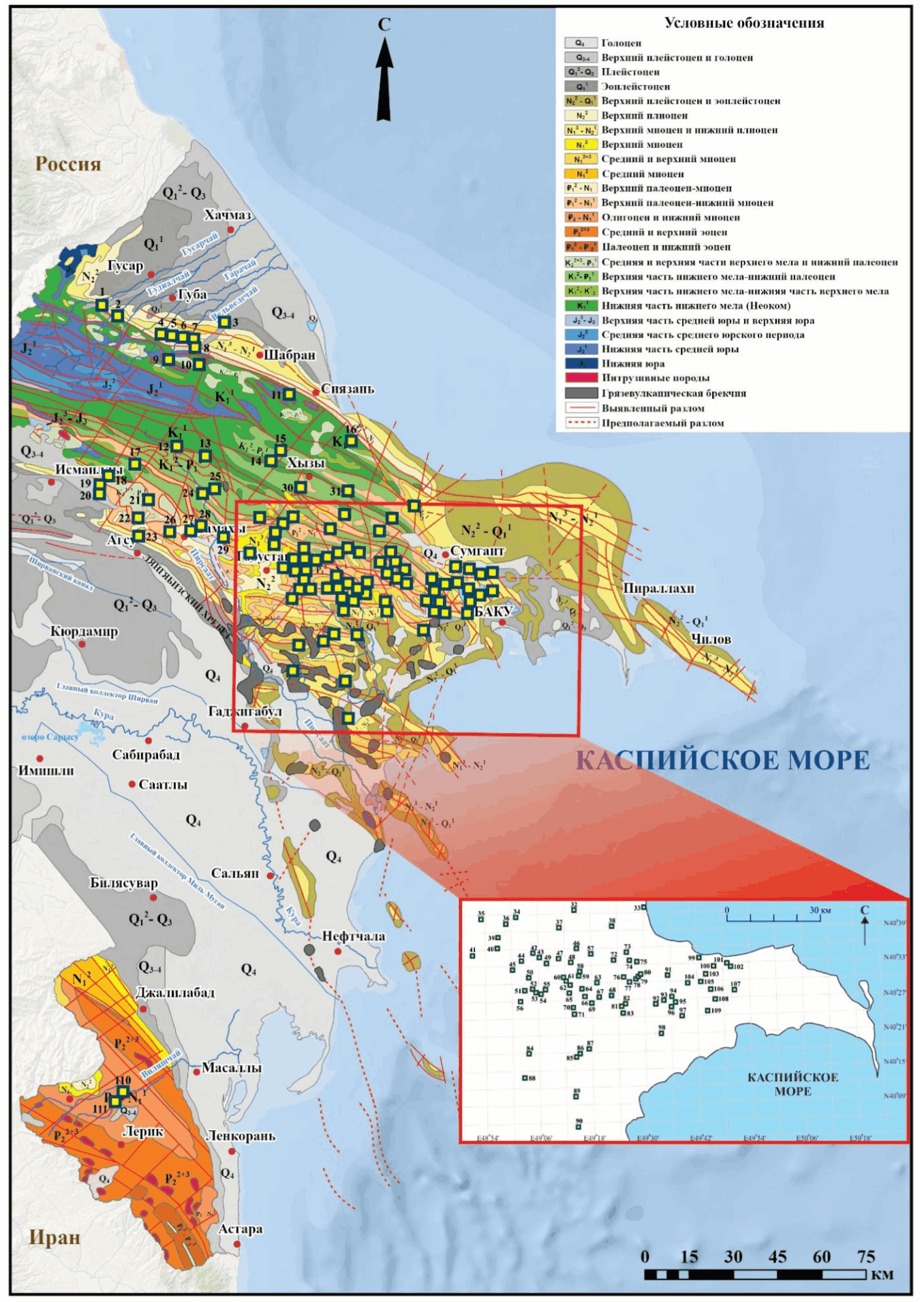
Рис.1. Геологическая карта Восточного Азербайджана с расположением выявленных обнажений горючих сланцев: 1 – Аниг; 2 – Гуручай (Сусай); 3 – Вельвелечай; 4 – Алыдж (Гарачай); 5 – Гарачай-Джагаджукчай; 6 – Рустов; 7 – Багчалы; 8 – Ханагях; 9 – Камалчай; 10 – Тенгеалты; 11 – Гильгильчай; 12 – Зарат-Хейбери; 13 – Сарыдашчай; 14 – Алтыагач; 15 – Бахышлы; 16 – Гилязи (Зарат); 17 – Лагич; 18 – Садиян; 19 – Дияллы; 20 – Дахар дереси; 21 – Сарсура; 22 – Хасыдере; 23 – Гюрджуван; 24 – Талышнуру; 25 – Гызмейдан; 26 – Мирикенд; 27 – Хыныслы-Пирдиреи; 28 – Ангехаран; 29 – Арабшалбаш; 30 – Амбизляр; 31 – Чаргышлаг; 32 – Кемчи; 33 – Шорабад-Яшма; 34 – Агдере; 35 – Хильмилли; 36 – Горадил; 37 – Шихандаг; 38 – Кюркечидаг; 39 – Набур; 40 – Бекле; 41 – Джеирли; 42 – Тува; 43 – Гараджюзлю; 44 – Ахудаг; 45 – Шимшади; 46 – Беюк Сияки; 47 – Кичик Сияки; 48 – Сиякилярарасы; 49 – Гаратахта; 50 – Кичик Мараза; 51 – Шихзарли; 52 – Гаибляр; 53 – Шаибляр; 54 – Джейранкечмез-Гаибляр; 55 – Джейранкечмез; 56 – Галача; 57 – Гиблядаг; 58 – Дженгидаг; 59 – Дженгичай; 60 – Чобандаг; 61 – Ийимиш; 62 – Дашлыджа; 63 – Достубозу; 64 – Сунгур; 65 – Биргут; 66 – Байгушгая; 67 – Алагышлаг; 68 – Баяната; 69 – Байгушлу; 70 – Донгузлуг; 71 – Ахиджан; 72 – Маяш; 73 – Агбурун; 74 – Юнусдаг; 75 – Ильхидаг; 76 – Кечалляр; 77 – Пирекяшкюль; 78 – Гараислам; 79 – Исламдаг; 80 – Чайлы (Готурдаг); 81 – Сарыдаш; 82 – Гырдаг; 83 – Гыргышлаг; 84 – Гюнгормез-Чеилдаг; 85 – Чеилдере; 86 – Чеилдаг-Нардаранахтарма; 87 – Чеилдаг-Чеилахтарма; 88 – Дашмардан; 89 – Гылынч; 90 – Солахай; 91 – Насосный-Гёйтепе; 92 – Кёсмелидаг; 93 – Учтепе; 94 – Агчала; 95 – Мушфигабад йолу; 96 – Дамламаджа; 97 – Караэйбат; 98 – Шорбулаг; 99 – Джорат; 100 – Орджандаг; 101 – Горадил; 102 – Фатмаи; 103 – Сенгер (Сарай); 104 – Гюздек; 105 – Кечалдаг; 106 – Масазыр; 107 – Бинагади; 108 – Зигильпири-Хырдалан; 109 – Шабандаг; 110 – Текдам; 111 – Виляшчай
Сланцевые отложения среднего и верхнего миоцена (диатомовая свита) генетически связаны с конком, сарматом и меотисом. В Прикаспийско-Губинском районе выделяется рустовский горизонт верхнего сармата, где сланцы чередуются с карбонатно-глинистыми породами. Наиболее значимые выходы данного горизонта сосредоточены в 30-километровом диапазоне между реками Вельвелечай и Гудиалчай. В Центральном Гобустане диатомовая сланценосная толща охватывает конк (байгушгаинская свита) и меотис (биргутская свита). Мощность комплекса на участках Сунду и Бекля (северо-запад) составляет 200 м, на севере 250 м, а в центре достигает 500 м. В разрезах Беюк Сияки и Маяш, сложенных глинами, мергелями и вулканическим пеплом, сланцевые пласты отличаются значительной мощностью. Текстурно они представляют собой так называемые «бумажные» сланцы, приобретающие на поверхности выветривания выраженную листоватость.
Следует отметить, что суммарная мощность сланценосных толщ в разрезах достигает 500 м, а толщина отдельных пластов – 40 м. Наиболее высокая сланценосность характерна для верхнего майкопа, где за счет частого чередования тонких прослоев доля сланцев в разрезе составляет до 60%. В среднем эоцене доля сланцевых пород составляет 15%, локально увеличиваясь до 25% в параавтохтонной зоне (район Дженгичай). В миоценовом комплексе в Губинском районе (сармат) сланцы занимают более 10% разреза, тогда как в Центральном Гобустане (конк-меотис) их содержание достигает 20%.
Сланцевые выбросы из грязевых вулканов
В результате извержений грязевых вулканов Восточного Азербайджана на поверхность в составе твердых выбросов выносятся также обломки горючих сланцев [47, 50]. Интегративная интерпретация результатов микропалеонтологических исследований данных фрагментов и региональных геолого-геофизических профилей, проходящих через зоны развития грязевых вулканов, позволяет оценить их стратиграфическую принадлежность и глубину залегания [46, 51]. Такой анализ создает условия для прослеживания пространственной непрерывности сланцевых толщ, выходящих на поверхность, и их трассирования в глубокопогруженные части разреза, а также позволяет оценить углеводородный потенциал на основе геолого-геохимических исследований фактических образцов. Данный подход приобретает критическую значимость для южных прибрежных частей Гобустана, Апшеронского п-ова и Нижнекуринской впадины, где вследствие развития мощного покрова плиоцен-четвертичных отложений поверхностные обнажения ограничены, а вскрытие погруженных горизонтов традиционными методами бурения недоступно [46].
Распространение сланценосных толщ в пределах различных тектонических зон
Распространение сланценосных толщ в регионе контролируется границами крупных тектонических элементов. Джейранкечмез-Южно-Каспийская мегавпадина характеризуется не только широким развитием этих отложений, но и многочисленными грязевыми вулканами и нефтяными месторождениями [52, 53]. В аккреционной призме Большого Кавказа (мегазона Южного склона) широко представлены обнажения сланцев среднего эоцена [46]. Центральная часть Гобустана (параавтохтонная зона) отличается развитием сланцевых отложений от среднего эоцена до верхнего миоцена.
Надвиг Большого Кавказа определяет северную тектоническую границу распространения среднеэоценовых сланцев Восточного Азербайджана. В пределах северной аллохтонной зоны Северного Гобустана выходы среднеэоценовых сланцев структурно приурочены преимущественно к ядрам синклиналей, где они вскрываются в верхних частях разреза. В параавтохтоне Центрального Гобустана (например, на структуре Дженгичай) сланценосные отложения участвуют в строении антиклинальных складок, слагая их крылья и сводовые части.
Распространение нижнемайкопских сланцев в Вандамской и Лерик-Ярдымлинской зонах имеет более широкое распространение по сравнению с Джейранкечмез-Южно-Каспийским мегабассейном, в частности его параавтохтонной зоной в Центральном Гобустане. Развитие толщ верхнемайкопских сланцев ограничено преимущественно пределами самой мегавпадины, где они участвуют в строении как синклинальных, так и антиклинальных структур.
Северный ареал распространения диатомовых сарматских сланцев локализован за пределами мегавпадины и приурочен к Губинской тектонической зоне [54]. В параавтохтоне Центрального Гобустана синклинальные структуры характеризуются широким развитием диатомовых сланцев конкского и меотического возраста с явным литологическим доминированием. В отдельных синклиналях мощность конкских сланцев также достигает значительных величин. Характерной особенностью данной тектонической зоны является совместное залегание указанных толщ в едином стратиграфическом разрезе.
В параавтохтонной зоне северной и центральной частей Западного Апшерона диатомовая сланценосная толща участвует в строении крупных антиклиналей. Линзовидные выходы этих пород приурочены к периклиналям и сводам антиклинальных структур, осложненных разрывными нарушениями и грязевыми вулканами. Аналогичная геолого-структурная обстановка характерна и для Ленгебиз-Алятской разрывной структуры в Южном Гобустане. Широкое развитие в пределах указанных структур естественных выходов нефти и скоплений закированных пород свидетельствует об активной вертикальной миграции углеводородов из глубокозалегающих горизонтов. Специфическая текстура диатомовых «бумажных» сланцев служит благоприятным фактором для их вторичного насыщения аллохтонными флюидами.
Глубинное залегание сланценосных толщ
В аллохтонной зоне Северного Гобустана сланцы залегают на относительно небольших глубинах, перекрытых надвиговым комплексом меловых отложений. В пределах Джейранкечмез-Южно-Каспийской мегавпадины, в частности в параавтохтонной зоне Центрального Гобустана, горючесланценосные толщи среднего эоцена и майкопской серии погружены на глубины свыше 4 км от поверхности (рис.2). Это резко контрастирует с геолого-структурными условиями прибрежной зоны Южного Гобустана и Южного Апшерона, где глубина залегания указанных комплексов значительно возрастает [46]. Имеющиеся данные указывают на экстремально глубокое погружение кайнозойских сланцев в морской части Восточного Азербайджана, на отдельных площадях скважины глубиной до 7 км вскрывали исключительно плиоценовые отложения. За пределами мегавпадины сарматские диатомовые и нижнемайкопские сланцы характеризуются малоамплитудным погружением, залегая на глубинах до 1,4 км.
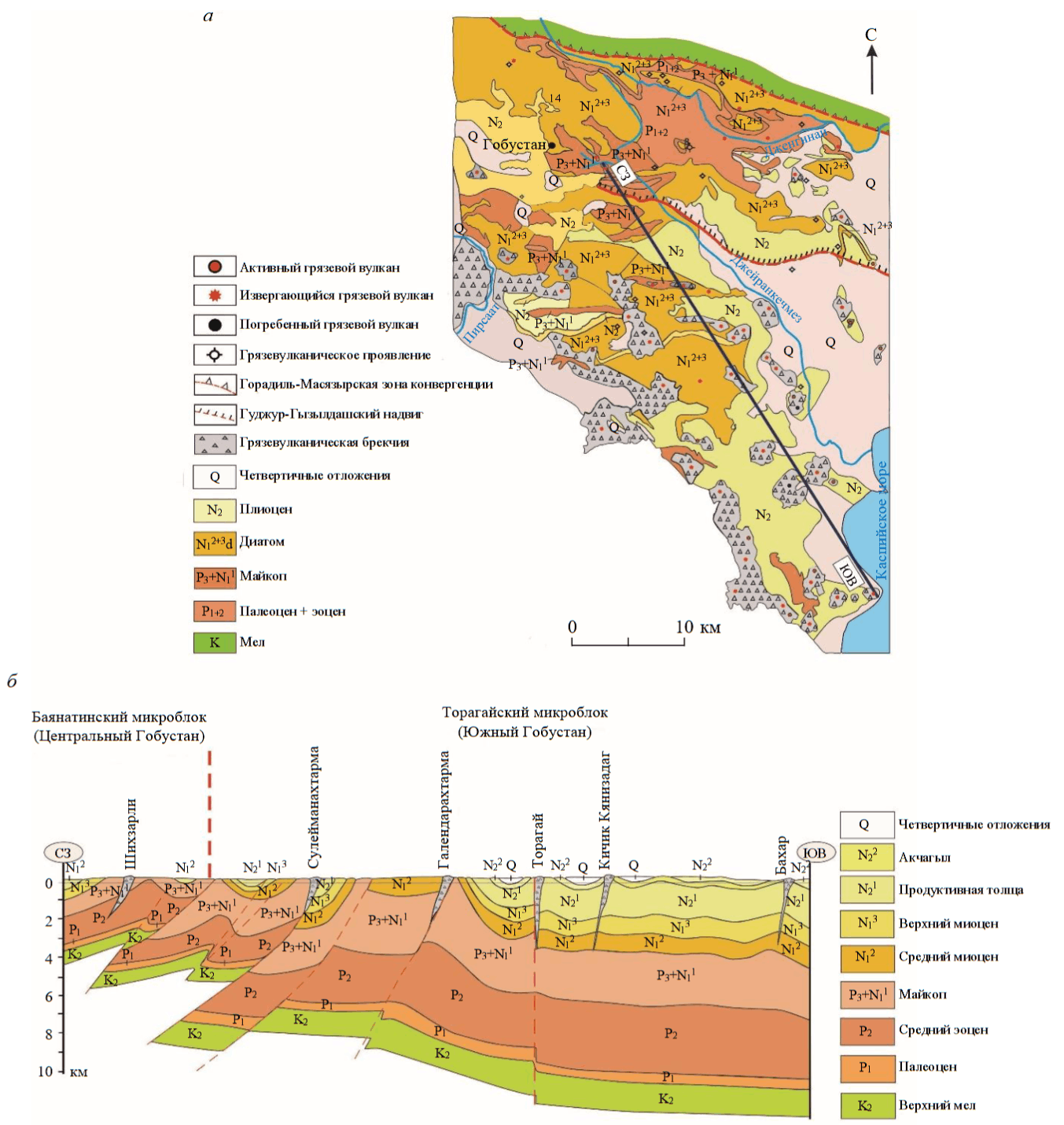
Рис.2. Геологическая карта (а) и геологический профиль (б) Центрального и Южного Гобустана [46]
Методы
Минералогические и петрографические исследования
Микрофаунистический анализ проводился при увеличениях ×200-300 с использованием микроскопов Loupe Zoom Paralux XTL 745 и MБC-10. Полученные изображения передавались на компьютер с помощью цифровой камеры OptixCam. Минералогия пород анализировалась методом рентгеновской дифракции на дифрактометре Rigaku MiniFlex X-ray [46].
Петрографические исследования осуществлялись с использованием поляризационного светового микроскопа Leica DM2500 P, работающего в отраженном и проходящем свете. Микроскоп, оснащенный объективами с 50- и 20-кратным масляным погружением, использовался с освещением белым и поляризованным светом, скрещенными поляризаторами, пластиной 1/4 λ, а также камерой Lumenera Infinity 1-5C.
Экстракция
Образцы сланцев были подвергнуты экстракции в аппарате Сокслета для определения количественного содержания хлороформенного битумоида и спирто-бензольного экстракта [55].
Геохимические анализы
Пиролитические анализы проводились на модифицированном приборе Rock-Eval 6. ИК-спектры были получены при комнатной температуре с использованием алмазного кристалла на ИК-Фурье-микроскопе LUMOS в диапазоне волновых чисел от 600 до 4000 см–1. Термогравиметрический анализ был выполнен на термоанализаторе NETZSCH STA 449F3 Jupiter. Образцы массой 7-10 мг нагревались со скоростью 10°C/мин при расходе азота 100 мл/мин. Все анализы проводились в термопрограммированном динамическом режиме.
Анализ газов
Концентрация адсорбированных углеводородных газов в образцах пород измерялась с помощью газового хроматографа Micro GC Fusion.
Результаты и обсуждения
Минералогическая классификация
В изученных образцах идентифицирован 21 минерал шести минеральных классов. Распределение десяти наиболее распространенных минералов: кварц, монтмориллонит, иллит, полевой шпат, кальцит, ярозит, хлорит, каолинит, гематит, пирит. Сравнительный анализ показал, что образцы из выбросов грязевых вулканов содержат более высокую долю хлорита, верхнемайкопские сланцы богаче кварцем по сравнению со сланцами среднего эоцена и диатомовой толщи.
Результаты минералогической классификации (рис.3) показывают, что сланцы Восточного Азербайджана преимущественно глинисто-кремнистые. В отличие от майкопских сланцев, образцы среднего эоцена и диатомовой толщи с содержанием кальцита более 10 % на диаграмме смещены к карбонатному полю. Карбонатсодержащие сланцы установлены в отложениях нижнего майкопа Лерик-Ярдымлинской тектонической зоны. Группа образцов среднего эоцена из Центрального Гобустана содержит более высокую долю хрупких минералов, как и сланцы Барнетта и Баккена, из которых добываются сланцевые углеводороды.
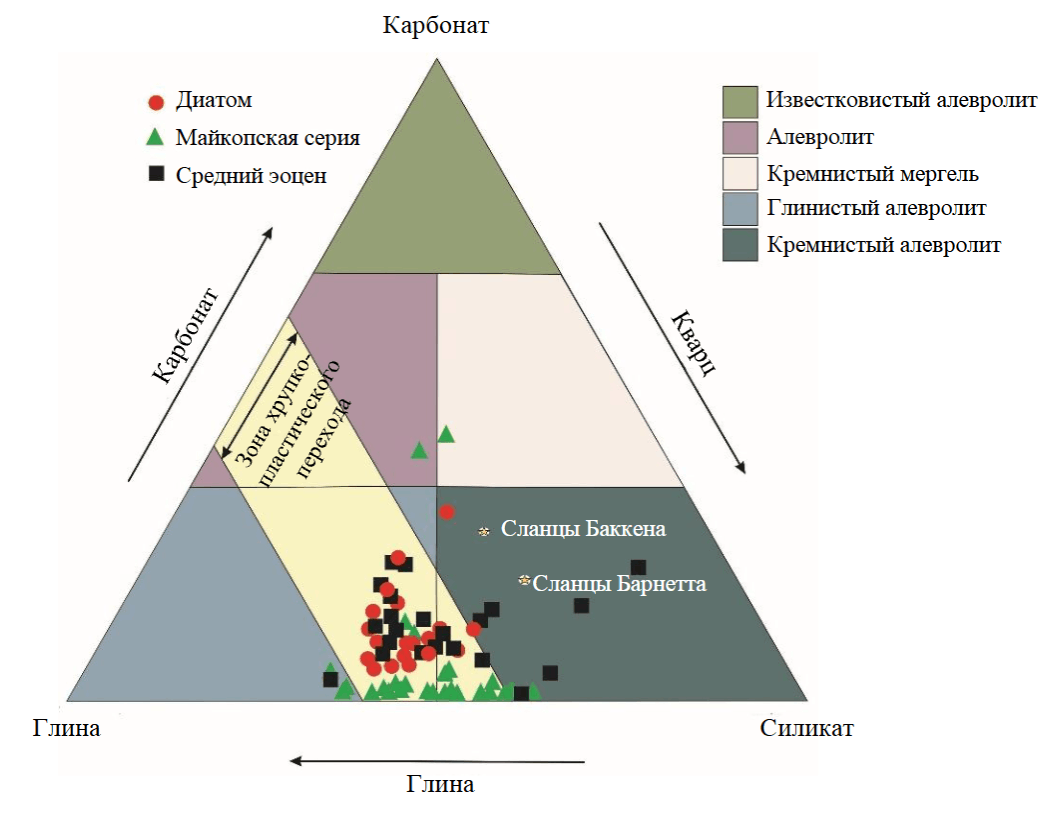
Рис.3. Распределение образцов сланца на трехмерной диаграмме минералогической классификации
Обогащенность органическим веществом
Сланцы среднего эоцена и диатомовой толщи демонстрируют значительно более высокие средние содержания общего органического углерода Сорг (11,18 и 9,87% соответственно) по сравнению с отложениями майкопской серии, которые считаются [56] наиболее эффективной нефтематеринской породой в Азербайджане. В сланцах майкопской серии средние значения Сорг для нижнего и верхнего майкопа составляют 2,9 и 5,26% соответственно. Генерационный потенциал (ГП) образцов, рассчитанный на основе значений (S1 + S2), варьируется от 24,92 до 209,49 мг УВ/г породы (в среднем 63,47 мг) для сланцев среднего эоцена, от 3,09 до 80,55 мг УВ/г породы (в среднем 18,63 мг) для сланцев майкопской серии и от 15,20 до 130,06 мг УВ/г породы (в среднем 56,05 мг) для диатомовых сланцев. Двумерный график зависимости ГП от Сорг (рис.4) показывает, что генерационный потенциал углеводородов в образцах находится в диапазоне от хорошего (майкопская серия) до отличного (средний эоцен и диатомовая толща).
Мацеральный состав органического вещества и его генерационный потенциал
Результаты петрографического анализа (рис.5) сланцев в интервале от среднего эоцена до диатомовых отложений: доля телальгинита и ламальгинита в сланцах среднего эоцена значительно выше, чем витринита и инертинита; телальгинит преобладает над ламальгинитом в нижнемайкопских сланцах, тогда как витринит является доминирующей мацеральной группой в верхнемайкопских сланцах; альгинит является ключевым мацералом в диатомовых сланцах, в три раза более распространен чем витринит, и в десять раз более чем инертинит. Верхнемайкопские сланцы, практически лишенные кальцита, характеризуются более высоким содержанием кварца в минералогическом составе. Эти особенности демонстрируют сильную корреляцию с преобладающим влиянием терригенной седиментации и аллохтонного органического вещества [46].
Сланцы среднего эоцена и диатомовой толщи, богатые кальцитом, формировались под воздействием морской воды, что привело к преобладанию в их составе автохтонного органического вещества [46]. Данные породы Восточного Азербайджана обнаруживают сходство с эоценовыми сланцами Хуадянь в Китае, в которых также преобладает автохтонный материал водорослевого происхождения, включая телальгинит (преимущественно из Botryococcus spp. и диатомей) и ламальгинит, а также мацералы витринитовой, инертинитовой и экзинитовой групп, образованные из остатков высшей растительности [57]. Эти незрелые сланцы считаются отличными нефтематеринскими породами со значениями Сорг, превышающими 10,6 %, и значениями водородного индекса (ВИ) более 500 мг УВ/г Сорг.
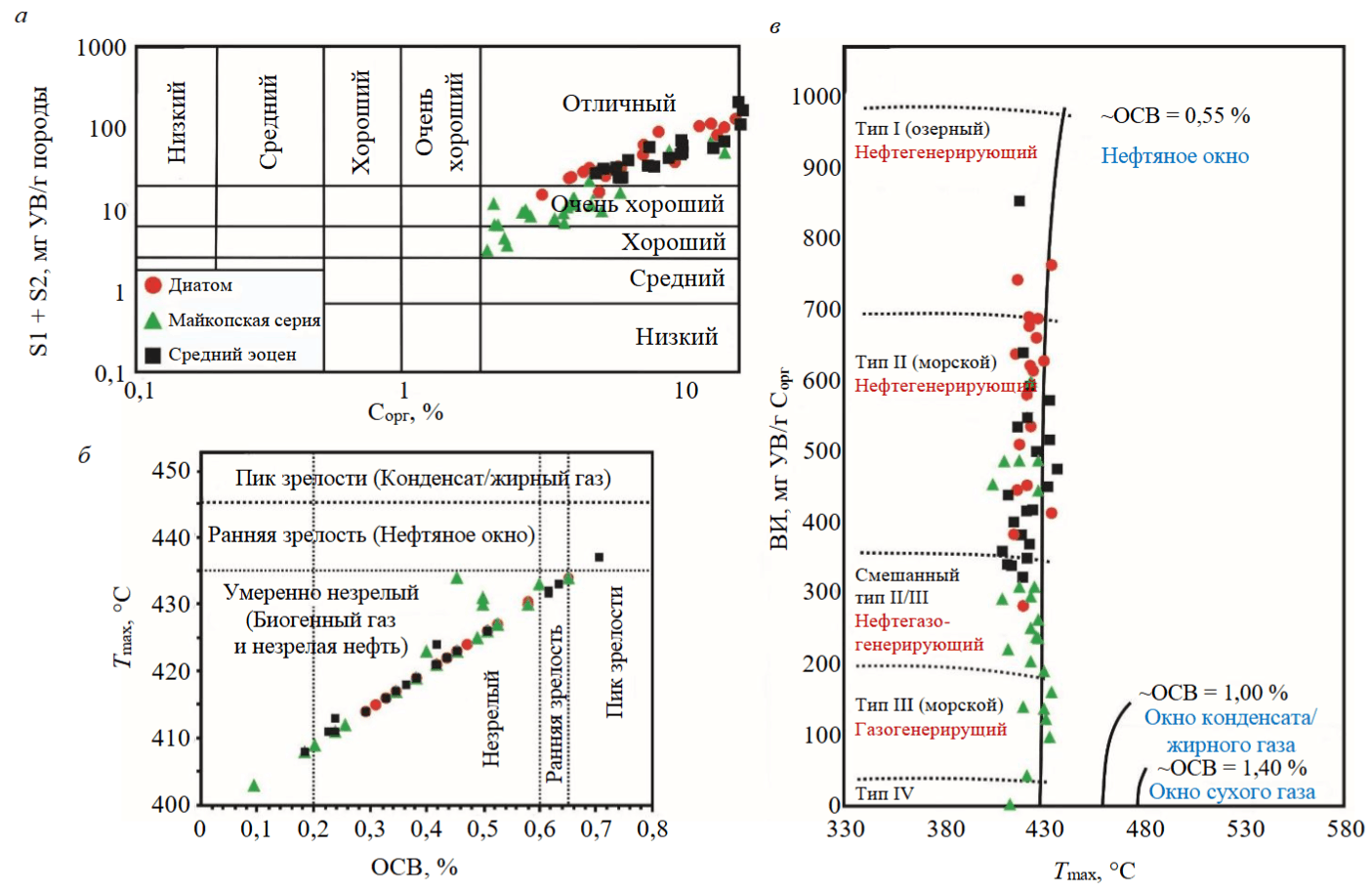
Рис.4. Диаграммы, показывающие содержание общего органического углерода Сорг (а), термическую зрелость (б) и тип керогена (в) в образцах по данным пиролиза
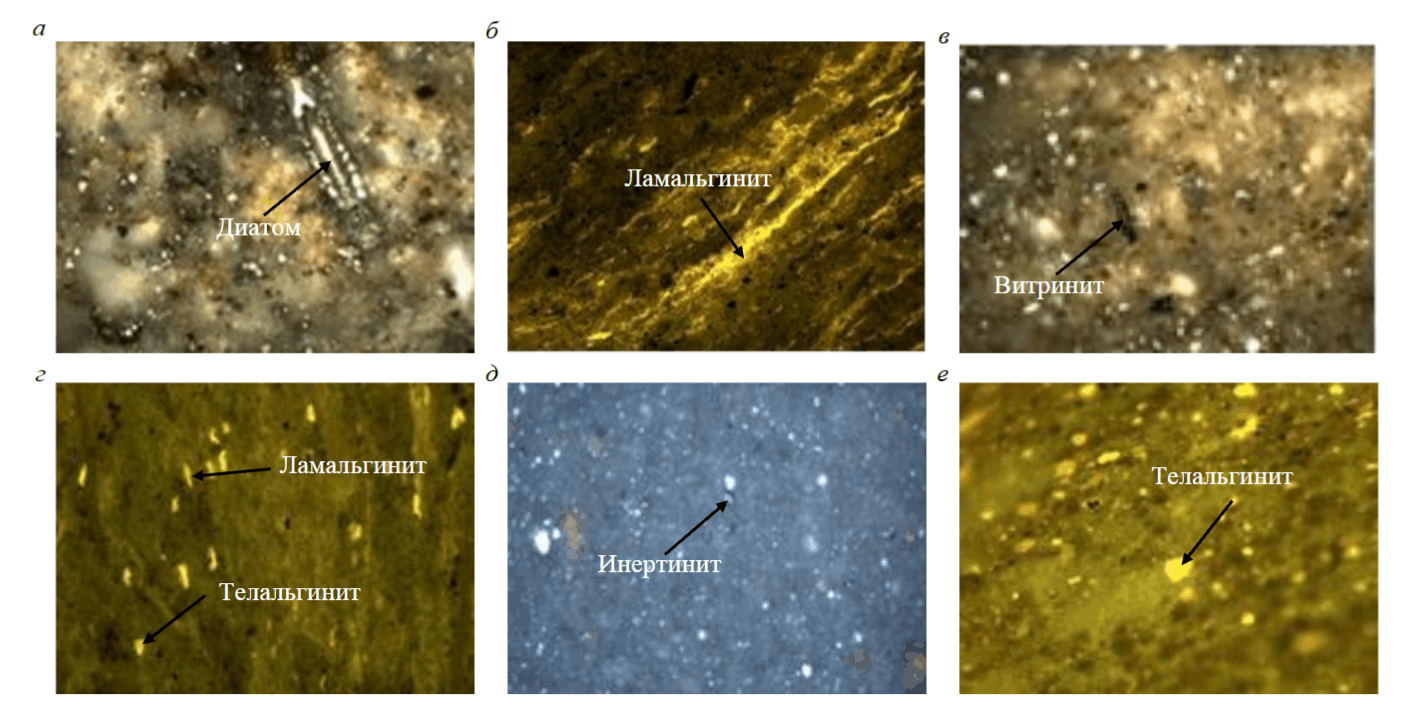
Рис.5. Фотомикрографии мацералов в исследованных образцах сланцев: а, б – диатомовый сланец; в, г – майкопский сланец; д, е – среднеэоценовый сланец [52]; а, в, д – отраженный свет микроскопа; б, г, е – флуоресцентный
Анализ экстрактов показал, что содержание спиртобензольных битумоидов в сланцах майкопской серии превышает содержание хлороформенных. В отличие от этого, в составе органического вещества сланцев среднего эоцена и диатомовых отложений, богатых хлороформенным битумоидом, преобладают насыщенные углеводороды. Полученные данные подтверждаются результатами ИК-Фурье спектроскопии, которая проводилась на исходных образцах сланцев и выделенном из них экстракте (см. таблицу).
Характеристика полос поглощения ИК-спектроскопии исходных и экстрагированных образцов и их геохимическое значение
|
Волновое число, см–1 |
Функциональные группы и типы связей |
Геохимическое значение |
|
2854; 2925; 2927 |
Валентные С–Н колебания в метиленовых (–CH2–) и метильных (–CH3) группах |
Высокая алифатичность органического вещества; значительный нефтегенерационный потенциал (кероген I и II типов), низкая термическая зрелость |
|
1385; 1457 |
Деформационные С–Н колебания алифатических структур |
Преобладание парафиновых цепей; низкая термическая зрелость органического вещества |
|
700; 715; 716 |
Маятниковые колебания (–CH2–)n (где n ≥ 4) |
Прямой индикатор наличия длинных нормальных алканов; высокий нефтепотенциал и низкая зрелость |
|
1212; 1234 |
Валентные колебания С–O связей (эфиры, фенолы, кислоты) |
Высокая концентрация кислородсодержащих групп; стадия диагенеза (незрелое органическое вещество) |
|
932; 935 |
Внеплоскостные деформационные колебания C–H (олефиновые/виниловые группы) |
Наличие олефиновых структур (терминальных двойных связей); сохранность исходной структуры при низкой зрелости |
|
1628; 1634 |
Валентные колебания ароматических C=C связей |
Характеристика структуры ароматического скелета; сохранность генерационного потенциала на ранних стадиях преобразования |
|
3418 |
Валентные колебания связанных O–H или N–H групп |
Наличие гетероатомных соединений и водородных связей, характерных для низкозрелого органического вещества |
|
3646; 3647 |
Свободные О–Н связи (структурный гидроксил минералов) |
Наличие структурной воды в решетке глин исследуемых пород |
В интервале 100-275 °C у диатомового сланца наблюдается потеря массы 4,15 % (рис.6, а), сопровождаемая выделением водяного пара и легких летучих углеводородов, что свидетельствует о начальной стадии термического битумообразования за счет разрыва наиболее коротких и нестабильных алифатических цепей керогена. При температурах от 275 до 550 °C совокупная потеря массы достигает 23,4 % и отражает более интенсивное битумообразование, а также генерацию нефти, газа и кокса. У образца среднего эоцена потеря массы составляет 38,05 % в интервале 300-700 °C (рис.6, в), при этом на интервал 650-700 °C обычно приходится не только разрушение остаточных органических соединений, но и декомпозиция карбонатных минералов, особенно кальцита, характерного для этих образцов. В обоих случаях алифатические соединения разрушаются в две стадии; для диатомового сланца вторая стадия завершается при температуре до 410 °C, для среднего эоцена – до 375 и 475 °C. У среднего эоцена высокотемпературный диапазон указывает на деградацию стабильных алифатических и начальных ароматических структур, характерную для переходной зоны нефть – газ, что сопровождается продолжающимся образованием тяжелой сланцевой нефти и начальной генерацией фракций C1–C5. Узкий, поэтапный характер термодеструкции и массированное разрушение алифатических компонентов в обоих образцах подтверждают эффективность нефтегенерации, что обосновывается более низкими значениями энергии активации (67,5 и 69,3 кДж/моль соответственно) и предэкспоненциальными множителями (3×10¹³ и ~7×10¹³ с–1 соответственно), характерными для парафинового керогена (II тип, см. рис.4, в). Термодеградация майкопского сланца происходит в диапазоне температур 250-600 °C (рис.6, б), при этом максимальная потеря массы сравнительно невелика (19,81 %). Это указывает на необходимость более высоких температур и энергии активации (76,4 кДж/моль при 2×10¹⁴ с–1) для разрушения прочных C–C связей, характерных для ароматически обогащенной структуры (см. таблицу). Такие кинетические параметры позволяют прогнозировать ограниченный нефтегенерационный потенциал при выраженной тенденции к генерации газа и кокса.
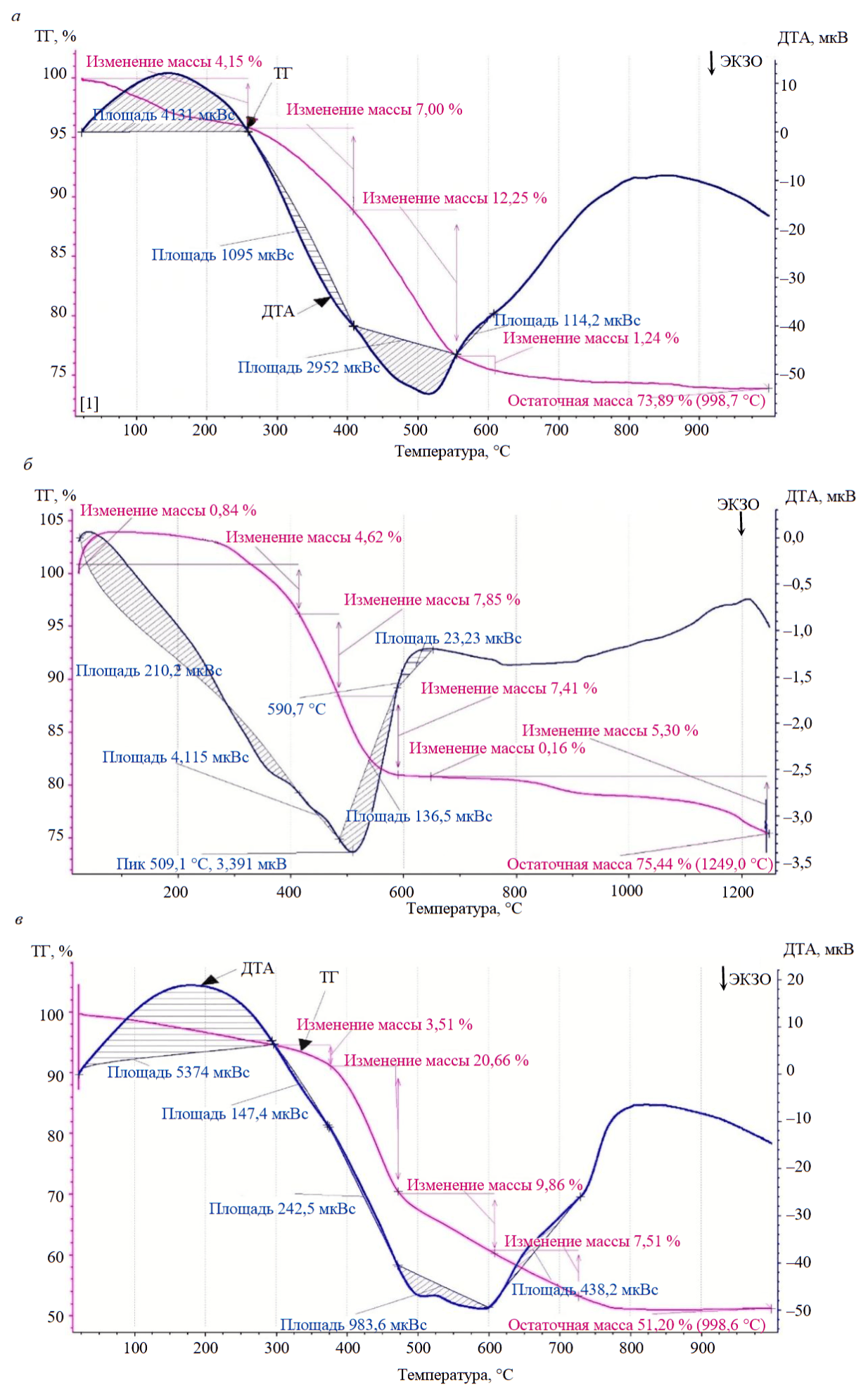
Рис.6. Спектры ТГ/ДТА образцов из высокоуглеродистых сланцевых отложений: диатомовых (а), верхнемайкопских (б) и среднеэоценовых (в)
Термическая зрелость органического вещества
В диагенетических условиях трансформация смектита в иллит происходит при температурах выше 50°C. Реакция иллитизации стимулирует миграцию углеводородов из сланцевой породы и формирование высокого пластового давления. Увеличение концентрации иллита в смешанослойном иллит-смектитовом минерале соответствует увеличению глубины и температуры. Повышение содержания иллита в этой смеси до 25% отражательной способности витринита (ОСВ = 0,5%), т.е. начальной стадии нефтегенерации, которая происходит при температуре около 60°C. Среднее содержание (14,69%) иллита в проанализированных образцах указывает на их незрелость. Это подтверждается результатами ИК-Фурье спектроскопии (см. таблицу), которые показывают, что алифатическая структура битума и керогена в образцах преимущественно состоит из структурных компонентов длинных алифатических цепей – метиленовых звеньев (–CH2–) и концевых метильных групп (–CH3). Присутствие этих длинноцепочечных алканов характерно для низкотемпературных условий диагенетической стадии (~45-50 °C). Они разрушаются на катагенетической стадии (при T >60°C), укорачиваясь и/или разветвляясь, что приводит к образованию легких углеводородов и газа.
Исследования [58] подчеркивают положительную корреляцию между кислородсодержащими группами и незрелостью органического вещества. Данные ИК-спектроскопии (см. таблицу), фиксирующие наличие связей C–O в образцах до и после экстракции, также подтверждают, что для достижения зрелости исследуемых сланцев необходимы более высокие температурные условия.
Некоторые среднеэоценовые и майкопские сланцы демонстрируют повышенные концентрации иллита и хлорита, а также умеренное и высокое содержание хлороформного битумоида, что указывает на приближение их керогена к фазе генерации нефти. Данные образцы, отобранные в районе грязевых вулканов вблизи Каспийского моря, представляют собой сланцы, залегающие на значительных глубинах [46]. Высокие значения термической зрелости, наблюдаемые в этих образцах (например, ОСВ = 0,62% для образцов Отманбоздага и ОСВ = 0,58% для Локбатана, см. рис.4, б), демонстрируют, что богатые органическим веществом среднеэоценовые и майкопские сланцы, залегающие в наиболее глубоких частях Каспийского моря, являются ключевыми нефтегазоматеринскими породами для месторождений нефти и газа, эксплуатирующимися уже почти два столетия. С учетом глубины миоценовых отложений в Каспийском море, вполне вероятно, что диатомовые сланцы также могут выступать в качестве зрелой нефтематеринской породы, вносящей вклад в генерацию нефти в Южно-Каспийском бассейне.
Несмотря на то, что исследованные сланцы в целом являются термически незрелыми нефтематеринскими породами, требующими искусственного нагрева для промышленной добычи нефти, образцы из Шамахинской зоны (например, Демирчи, Хильмилли и др.) демонстрируют повышенные значения ОСВ. Усиленный внутренний источник тепла в этой зоне, характеризующейся относительно небольшой мощностью осадочного чехла, вероятно, связан с присутствием крупных тектонических структур, включая глубинные разломы и надвиги в аллохтоне Северного Гобустана, а также магматические интрузивные тела под земной поверхностью [46]. Зафиксированный для этой зоны значительно высокий геотермический градиент (до 30 °C/км) дополнительно подчеркивает ее отличительные термические особенности.
Наше исследование выявляет слабую корреляцию между стратиграфическим возрастом и показателями термической зрелости (максимальная температура пиролиза Тmax и ОСВ) в некоторых образцах. На рис.4, б группа диатомовых образцов демонстрирует более высокие значения Тmax по сравнению с более древними сланцами. Аналогичный результат отмечен в работе [56]. Вероятно, это связано с происхождением керогена, включая его формирование под доминирующим влиянием планктонного органического вещества, которое характеризуется большей обогащенностью водородом. Хотя богатые водородом керогены проявляют стабилизацию на стадии, близкой к термической зрелости, их содержание водорода истощается на более низких или более высоких стадиях зрелости. С другой стороны, на графике зависимости ОСВ от Тmax (см. рис.4, б) в большинстве майкопских образцов ОСВ изменяется в диапазоне 0,4-0,5%. Это можно объяснить значительным вкладом терригенного органического вещества, в частности богатых витринитовых мацералов (см. рис.5, в), в формирование их керогена. Наличие богатых витринитовых мацералов в майкопских сланцах, которые демонстрируют лучшую корреляцию с керогеном III типа на рис.4, в, является причиной их относительно высоких значений ОСВ. Однако бассейн, в котором формировались исследованные сланцевые толщи, характеризуется высокой тектонической активностью. Следовательно, помимо поднятий и опусканий, происходивших здесь на протяжении геологического времени, на современный геотермический градиент могут также влиять различия в процессах осадконакопления, давлениях и минералогических факторах.
Детерминанты нефтеносности сланцев-коллекторов
Слоистые и (или) ламинированные сланцы, богатые органическим веществом, считаются первоочередными объектами для разработки сланцевой нефти, поскольку их текстура играет ключевую роль в контроле трещинообразования [59, 60]. В частности, одна из ключевых особенностей, определяющих значимость ламинированной текстуры как коллектора, объясняется тем, что образование трещины по слоистости типично для механически слабых поверхностей между различными ламинами [61]. Наряду с микротрещинами, сланцевая нефть в основном распределена в порах (свободная нефть), на поверхности минералов и в керогене (адсорбированная нефть) [62-64]. В работе [65] подчеркнуто, что макропоры содержат большую часть сланцевой нефти (более 80 %) в озерных сланцах с керогеном II типа (ВИ > 400 мг УВ/г Сорг). В исследовании [61] установлено, что средний размер пор и поровая сообщаемость в ламинированных сланцах являются преимуществом для удержания и подвижности сланцевой нефти, и хотя сланцевая нефть в таких сланцах связана с пористостью 10-30 нм, иногда поры размером более 100 нм также могут вносить определенный вклад. Значительная роль макропор в удержании более 80% свободной сланцевой нефти в богатых керогеном II типа сланцах (ВИ > 400 мг УВ/г Сорг) [65] в сочетании с вкладом макро- и микротрещиноватости в ламинированных сланцах подтверждает высокую оценку потенциала сланцевой нефти богатых органическим веществом среднеэоценовых и диатомовых сланцев Восточного Азербайджана.
Несмотря на то, что сланцы Восточного Азербайджана преимущественно обогащены глинистыми минералами, образцы из Центрального Гобустана содержат более высокую концентрацию хрупких минералов (см. рис.3). Этот минералогический состав повышает потенциал сланцевой нефти, так как облегчает образование микротрещин и движение нефти. В то же время высокое содержание глины, хотя и может создавать технологические трудности, также положительно влияет на адсорбцию и удержание нефти.
Для интенсификации добычи нетрадиционной нефти может применяться обогащение органическими кислотами и CO2 низкопроницаемых, богатых органическим веществом сланцев, поскольку в процессе генерации углеводородов органическое вещество само продуцирует органические кислоты и углекислый газ. Органические кислоты демонстрируют высокую способность растворять карбонаты и другие растворимые минералы в сланцах, тем самым способствуя образованию пор [66]. В работе [67] отмечено, что среди карбонатных минералов кальцит обладает наибольшим потенциалом хранения CO2 (даже при высоких температурах и давлениях). Принимая во внимание эти факты, термическая обработка незрелых среднеэоценовых и диатомовых сланцев, которые богаче органическим веществом и кальцитом, чем большинство майкопских образцов (за исключением образцов из Талышского бассейна), может эффективно высвобождать органические кислоты и CO2.
Потенциал сланцевой нефти нефтематеринских пород зависит от содержания в них липидов, в частности от ассоциации с сапропелево-богатым керогеном I и II типов, известным своим нефтегенерационным потенциалом [61]. В отличие от майкопских сланцев, которые сильно коррелируют с газогенерирующим керогеном (см. рис.4, в), диатомовые и среднеэоценовые сланцы демонстрируют очень низкое содержание витринита, что было выявлено в результате петрографического анализа органического вещества (см. рис.5). Высокий потенциал генерации нефти обоих сланцевых комплексов очевиден из их мацерального состава; в диатомовых сланцах преобладает альгинит (>70 %), а среднеэоценовые сланцы содержат до 70 % телальгинита и ламальгинита. Флуоресценция, наблюдаемая в микротрещинах по плоскостям наслоения или в минеральных порах (см. рис.5), указывает на благоприятные условия для удержания свободной нефти в сланцевой матрице на зрелой стадии [59].
Сильная положительная корреляция Сорг как с содержанием хлороформенного битумоида (рис.7, а), так и с S1 (рис.7, б), особенно в среднеэоценовых и диатомовых сланцах, подчеркивает роль органического вещества в контроле удержанной нефти и при низких значениях индекса продуктивности (ИП) и индекса нефтенасыщенности (ИН), подтверждает автохтонную природу органическоговещества без признаков вторичного загрязнения образцов (включая вулканические выбросы) аллохтонными флюидами. Слабая корреляция между Сорг и ИН (рис.7, в) предполагает, что значительная часть сланцевой нефти может удерживаться внутри твердого органического вещества в адсорбированном или набухшем состоянии [68].
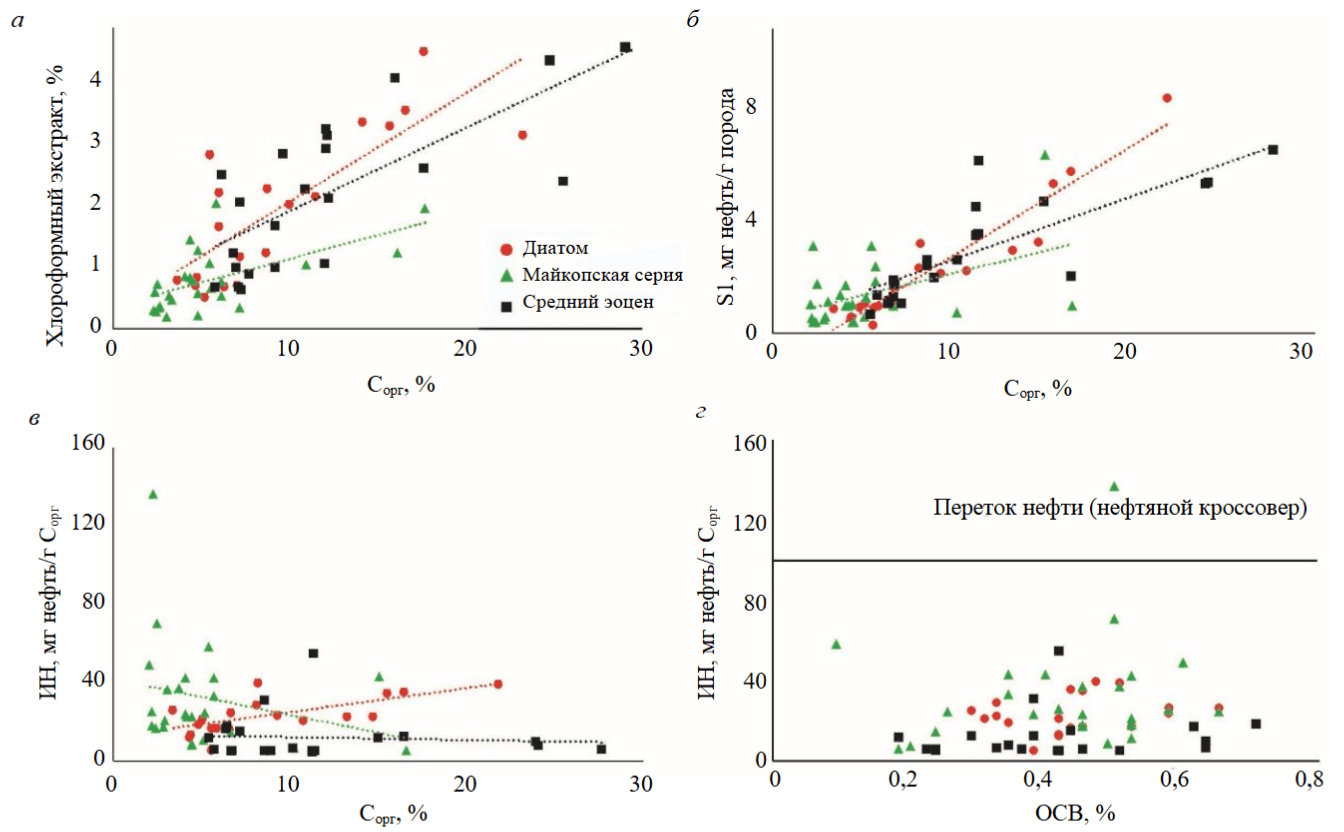
Рис.7. Диаграммы влияния Сорг на нефтеудерживающую способность исследованных сланцев: Сорг в зависимости от содержания хлороформенного экстракта (а); свободной нефти (б); ИН (в); ОСВ в зависимости от ИН (г)
Формирование органических пор может происходить не только при термическом крекинге керогена, но и на более ранних стадиях, в незрелом органическом веществе. В работе [58] предполагается, что для керогенов II типа вторичные органические нанопоры обычно формируются при показателе ОСВ около 0,8 % (Тmax ~445 °C) и ИН > ~90 мг УВ/г Сорг, что совпадает со снижением способности к набуханию и максимальным удержанием нефти. Однако на рис.7, г большинство образцов показывают значения ИН < 90 мг УВ/г Сорг при ОСВ 0,3-0,6 %, что указывает на то, что эти керогены все еще находятся в фазе набухания. На этой стадии, характеризующейся низкой зрелостью и слабым развитием поровой сети, они обладают высокой способностью удерживать нефть.
Детерминанты газоносности сланцев-коллекторов
Минералогическое сравнение глинисто-кремнистых сланцев (см. рис.3) с коммерчески значимыми эталонными сланцами Барнетт (США) показывает, что отложения Восточного Азербайджана имеют с ними относительно высокое сходство по содержанию кварца, полевого шпата и глинистых минералов. При этом повышенное содержание глинистой фракции в исследуемых сланцах по сравнению со многими типичными озерными формациями может выступать фактором, способствующим усилению адсорбции газа.
Углеводородные газы в сланцевых формациях встречаются в трех формах – свободной, адсорбированной и растворенной. Свободный и адсорбированный газы считаются наиболее значимыми для добычи сланцевого газа, причем их суммарная доля в сланцевых породах достигает 85 % [62]. Наличие адсорбированного газа в породах связано с глинистыми минералами, такими как каолинит, иллит и монтмориллонит, поры которых размером 1-2 нм идеально подходят для адсорбции метана и других газов благодаря их большой удельной поверхности. Статистически преобладание глинистых минералов в исследованных сланцах (см. рис.3) указывает на высокий потенциал адсорбции газа. Повышенное содержание кварца в майкопских сланцах играет решающую роль в концентрации свободного газа, что в сочетании с газогенерационным потенциалом керогена III типа определяет их общую газоносность.
Оценка потенциала адсорбции углеводородных газов в образцах сланцев выявила CH4 в качестве преобладающего компонента по сравнению с другими гомологами газов (C2H6, C3H8 и C4H10). Более высокие концентрации CH4 наблюдались в образцах из Шихзерли (0,00142 %) и Беюк Сияки (0,00130 %) Центрального Гобустана. Наш анализ показывает, что сланцы майкопской серии демонстрируют более высокий сорбционный потенциал углеводородных газов, чем среднеэоценовые и диатомовые сланцы.
Ряд исследований [69] продемонстрировал, что кероген обладает большей адсорбционной способностью по отношению к метану, чем глинистые минералы, которые имеют более высокую метаноемкость, чем кварц. Зоны добычи сланцевого газа обычно классифицируются как перспективные (0,3 % ≤ Сорг ≤ 1,5 %), благоприятные (1,5 % < Сорг ≤ 2 %) или целевые (Сорг > 2 %). Аномально высокое содержание органического вещества в исследованных сланцах (см. рис.4, а) создает впечатление, что это благоприятный фактор для формирования пористости, которая может положительно влиять на адсорбцию и удерживающую способность углеводородных газов. Однако изучение взаимосвязи содержания липтинита и адсорбции газа свидетельствует о том, что кероген морского генезиса обладает низкой газосорбционной емкостью. По сравнению с газоматеринским керогеном (тип III) кероген II типа характеризуется более низкой сорбционной способностью, что, вероятно, обусловлено пониженной степенью ароматичности его структуры. В работе [70] подчеркивалось, что кероген III типа, характеризующийся более крупными размерами пор из-за высокого содержания витринитовых мацералов, положительно влияет на сорбцию и емкость хранения газа. Следовательно, само по себе высокое содержание органического вещества в породе не всегда гарантирует улучшение ее газовмещающего потенциала. Тип керогена, особенно обилие витринитовых мацералов, является благоприятным фактором для потенциала сланцевого газа. Поэтому, принимая во внимание особенности керогена, мы оцениваем адсорбционный потенциал сланцевого газа сланцев майкопской серии как значительно более высокий, чем у других отложений.
Потенциал добычи синтетических углеводородов из сланцев Восточного Азербайджана
Выбор рациональной технологии освоения ресурсов горючих сланцев определяется комплексом жестких горно-геологических критериев. В мировой практике геолого-экономической оценки минимальный порог мощности пласта для его включения в ресурсную базу традиционно принимается на уровне 2,8-3,0 м. Для достижения промышленной рентабельности метода наземной переработки требуется эффективная мощность пласта более 7 м и глубина залегания до 300 м в условиях низкого коэффициента вскрыши. Освоение глубокопогруженных ресурсов (до 3000 м) требует применения методов внутрипластовой конверсии [18], для которых критическим условием тепловой эффективности является мощность залежи более 15 м [16]. Эффективность любого метода зависит не только от фильтрационно-емкостных свойств и наличия естественных трещин [71, 72], но и от комплекса физико-химических параметров: типа и зрелости керогена, а также кинетики его термического разложения, определяющих конечный выход углеводородов [21, 32].
Анализ геологических данных выделяет Центральный Гобустан как приоритетный объект. Уникальность этого района заключается в том, что сланцевые толщи среднего эоцена, майкопа и диатомовой свиты прослеживаются здесь как на больших глубинах (до 4 км), о чем свидетельствует вынос их материала грязевыми вулканами, так и в виде обширных поверхностных выходов (см. рис.2). Их суммарная мощность достигает 400-500 м, а толщина отдельных пластов – до 40 м [46]. Такая геологическая универсальность, подкрепленная благоприятной тектоникой и отсутствием социально-экологических барьеров (лесного покрова и населенных пунктов), фактически превращает эту территорию в естественный полигон для создания комплексной индустрии как для технологий наземной переработки, так и внутрипластовой конверсии. За пределами Джейранкечмез-Южно-Каспийского мегабассейна также фиксируются протяженные выходы сланцев, формирующие фонд для открытой разработки: Вандамская зона (например, участок Дияллы, средний коун), Талышская зона (нижний майкоп) и Губинская зона (сармат). В южных приморских районах погружение сланценосной серии до 6 км локализует перспективы внутрипластовой конверсии преимущественно в отложениях диатомовой свиты.
Комплексные минералого-геохимические исследования сланцев, отобранных из поверхностных обнажений и выбросов грязевых вулканов, подтверждают их высокий генерационный потенциал. Анализы свидетельствуют, что при аномально высокой концентрации органического вещества (см. рис.4, а) изученные образцы характеризуются еще низкой степенью термической зрелости (см. рис.4, б). На основе этой совокупности данных проведена дифференциация перспективных направлений нефтегазогенерации: отложения среднего эоцена и диатомовой свиты выделены как приоритетные для генерации сланцевой нефти, тогда как сланцы майкопской серии определены как объекты для генерации сланцевого газа.
Результаты термогравиметрического анализа показывают, что основной этап термодеструкции органического вещества в сланцах диатомовой свиты и среднего эоцена завершается при температурах порядка 475 °C (см. рис.6, а, в). Этот интервал соответствует фазе активной генерации легких и тяжелых нефтяных фракций. При дальнейшем повышении температуры до 650 °C интенсифицируются процессы вторичного крекинга и газообразования, сопровождающиеся ароматизацией и коксованием остаточного углерода. Данные высокотемпературные эффекты наиболее выражены в образцах майкопской серии (см. рис.6, б), что объясняется исходным преобладанием ароматических структур в составе их керогена. Полученные кинетические параметры имеют ключевое практическое значение для обоснования оптимальных температурных режимов промышленного ретортинга с целью оптимизации выхода целевых продуктов – синтетической нефти и газа.
Выводы
Данное исследование обобщает результаты геолого-геохимического изучения кайнозойских отложений среднего эоцена – верхнего миоцена приподнятых структурных зон суши Восточного Азербайджана, выступающих аналогами главных очагов генерации акватории Южного Каспия, и позволяет установить следующее:
- В структурно-стратиграфическом отношении установлено, что данные отложения прослеживаются как в пределах Джейранкечмез-Южно-Каспийской мегавпадины, так и в сопредельных тектонических зонах (Губинская, Вандамская, Ярдымлы-Лерикская). Принципиальным отличием мегазоны от сопредельных структур с их фрагментарной сланценосностью является стратиграфическая полнота разреза, где средний эоцен (среднекоунская серия), майкопская серия (олигоцен – нижний миоцен) и средний – верхний миоцен (диатомовая свита) образуют единый циклично-пачечный (кластерный) комплекс. Данные литостратиграфического анализа указывают на то, что разрез верхнего майкопа характеризуется доминированием ритмичного переслаивания многочисленных тонких (сантиметровых) прослоев, что обуславливает его высокую суммарную сланценосность, в то время как нижний майкоп, средний эоцен и диатомовая свита представлены более мощными индивидуальными пластами.
- Интеграция результатов минералогического, геохимического и спектроскопического анализов выявила устойчивые литогеохимические различия между сланцами среднего эоцена, диатомовой свиты и майкопскими породами. Обогащенные кварцем образцы верхнего майкопа, содержащие значительно меньше органического вещества (средний Сорг = 5,26 %), характеризуются преобладанием терригенной органики, где доминирующим мацералом выступает витринит, что указывает на условия активного аллохтонного приноса. В отличие от них, сланцы среднего эоцена и диатомовой свиты, проявляющие относительное обогащение карбонатами (>10 % кальцита), формировались при существенном влиянии морской среды и отличаются преобладанием автохтонного органического вещества с доминированием телалгинита, ламальгинита и альгинита (Сорг в среднем равен 11,18 и 9,87 %). Данные ИК-Фурье спектроскопии исходных и экстрагированных образцов свидетельствуют о сходстве спектральных характеристик при различиях, проявляющихся главным образом в интенсивности полос поглощения в интервале 700-2927 см–1, отражающих преобладание алифатических C–H связей. Повышенная интенсивность указанных полос в среднеэоценовых и диатомовых сланцах коррелирует с их обогащенностью хлороформенными битумоидами и указывает на преимущественно алифатическую природу и низкую степень термической зрелости органического вещества. Результаты ТГ/ДТА и кинетического моделирования показывают, что органическое вещество среднеэоценовых и диатомовых сланцев характеризуется пониженными значениями энергии активации (69,3 и 67,5 кДж/моль) при предэкспоненциальном множителе порядка 1013 с–1, что обуславливает его интенсивную термическую деструкцию в относительно узком температурном интервале. В верхнемайкопских сланцах деструкция терригенного органического вещества требует более высоких энергозатрат, что отражается в значении энергии активации 76,4 кДж/моль и предэкспоненциальном множителе порядка 1014 с–1. В совокупности полученные данные свидетельствуют о высоком нефтегенерационном потенциалеэоценовых и диатомовых отложенийи преимущественно газогенераторной направленности майкопских сланцев.
- Абсолютное доминирование мацералов группы липтинита (> 70 %) в эоценовых и диатомовых сланцах обуславливает их высокий жидкофазный углеводородный потенциал. Наблюдаемая в микротрещинах и минеральных порах флуоресценция указывает на благоприятные условия для удержания свободной нефти на зрелой стадии. Сопоставление индекса нефтенасыщенности (ИН < 90 мг УВ/г Сорг) и степени термической зрелости (ОСВ = 0,3-0,6 %) доказывает, что на текущей стадии кероген находится преимущественно в фазе «набухания». Это означает, что основная часть генерированных углеводородов не мигрировала в минеральную матрицу, а удерживается внутри макромолекулярной структуры керогена в адсорбированном состоянии.
- Значительные геологические ресурсы незрелых сланцев Восточного Азербайджана, в сочетании с их высокой обогащенностью органическим веществом и благоприятными геохимическими характеристиками, позволяют рассматривать эти отложения как перспективную сырьевую базу для производства синтетических углеводородов. Специфика залегания обосновывает применение дифференцированных методов конверсии, а также формирует фундаментальную научную базу для стимулирования практических инициатив по реализации нетрадиционного энергетического потенциала региона.
Литература
- Gandossi L., Bocin-Dumitriu A., Spisto A. International Developments in the Field of Inconventional Gas and Oil Extraction. Publication Office of the European Union, 2017. № EUR 28675 EN. DOI: 10.2760/372964
- Иванов Н.А. Сланцевая революция и глобальный энергетический переход. М.; СПб: Нестор-История, 2019. 540 с.
- Shuo Sun, Shuang Liang, Yikun Liu et al. A review on shale oil and gas characteristics and molecular dynamics simulation for the fluid behavior in shale pore // Journal of Molecular Liquids. 2023. Vol. 376. № 121507. DOI: 10.1016/j.molliq.2023.121507
- Caineng Zou, Zhi Yang, Guosheng Zhang et al. Theory, technology and practice of unconventional petroleum geology // Journal of Earth Science. 2023. Vol. 34. Iss. 4. P. 951-965. DOI: 10.1007/s12583-023-2000-8
- Guangyou Zhu, Yan Zhang, Zhiyao Zhang et al. Connotation and extension of non-traditional petroleum geology theory // Natural Gas Geoscience. 2024. Vol. 35. Iss. 5. P. 763-784. DOI: 10.11764/j.issn.1672-1926.2023.09.001
- Jun Liu, Yan-Bin Yao, Elsworth D. Morphological complexity and azimuthal disorder of evolving pore space in low-maturity oil shale during in-situ thermal upgrading and impacts on permeability // Petroleum Science. 2024. Vol. 21. Iss. 5. P. 3350-3362. DOI: 10.1016/j.petsci.2024.03.020
- Kouqi Liu, Hongyan Qi, Zhizhong Wang et al. The organic matrix: An in-depth review of kerogen and its significance // Fuel. 2025. Vol. 397. № 135493. DOI: 10.1016/j.fuel.2025.135493
- Chengzao Jıa. Breakthrough and significance of unconventional oil and gas to classical petroleum geology theory // Petroleum Exploration and Development. 2017. Vol. 44. Iss. 1. P. 1-10. DOI: 10.1016/S1876-3804(17)30002-2
- Soeder D.J. The successful development of gas and oil resources from shales in North America // Journal of Petroleum Science and Engineering. 2018. Vol. 163. P. 399-420. DOI: 10.1016/j.petrol.2017.12.084
- Huairong Zhou, Shuai Zeng, Lei Zhang et al. Modelling and analysis of oil shale refinery process with the indirectly heated moving bed // Computer Aided Chemical Engineering. 2018. Vol. 44. P. 1471-1476. DOI: 10.1016/B978-0-444-64241-7.50240-8
- Zhiqin Kang, Yangsheng Zhao, Dong Yang. Review of oil shale in-situ conversion technology // Applied Energy. 2020. Vol. 269. № 115121. DOI: 10.1016/j.apenergy.2020.115121
- Shujing Bao, Mingna Ge, Peirong Zhao et al. Status-quo, potential, and recommendations on shale gas exploration and exploitation in China // Oil & Gas Geology. 2025. Vol. 46. Iss. 2. P. 348-364. DOI: 10.11743/ogg20250202
- Jinbu Li, Min Wang, Shuangfang Lu et al. A new method for predicting sweet spots of shale oil using conventional well logs // Marine and Petroleum Geology. 2020. Vol. 113. № 104097. DOI: 10.1016/j.marpetgeo.2019.104097
- Hughes J.D. A reality check on the shale revolution // Nature. 2013. Vol. 494. Iss. 7437. P. 307-308. DOI: 10.1038/494307a
- Bao Jia, Jianzheng Su. Advancements and Environmental Implications in Oil Shale Exploration and Processing // Applied Sciences. 2023. Vol. 13. Iss. 13. № 7657. DOI: 10.3390/app13137657
- Shangli Liu, Haifeng Gai, Peng Cheng. Technical scheme and application prospects of oil shale in situ conversion: A review of current status // Energies. 2023. Vol. 16. Iss. 11. № 4386. DOI: 10.3390/en16114386
- Huairong Zhou, Shuai Zeng, Siyu Yang et al. Modeling and analysis of oil shale refinery process with the indirectly heated moving bed // Carbon Resources Conversion. 2018. Vol. 1. Iss. 3. P. 260-265. DOI: 10.1016/j.crcon.2018.08.001
- Bo Chen, Jiatie Cai, Xinran Chen et al. A review on oil shale in-situ mining technologies: Opportunities and challenges // Oil Shale. 2024. Vol. 41. Iss. 1. P. 1-25. DOI: 10.3176/oil.2024.1.01
- Guo Wei, Sun Youhong, Li Qiang et al. Oil shale in-situ conversion technology triggered by topochemical reaction method and pilot test project in Songliao Basin // Acta Petrolei Sinica. 2024. Vol. 45. № 7. P. 1104-1121, 1129. DOI: 10.7623/syxb202407006
- Dazhong Ren, Zhendong Wang, Fu Yang et al. Study on the applicability of autothermic pyrolysis in situ conversion process for low-grade oil shale: A case study of Tongchuan, Ordos Basin, China // Energies. 2024. Vol. 17. Iss. 13. № 3225. DOI: 10.3390/en17133225
- Lian-Hua Hou, Xia Luo, Sen-Hu Lin et al. Assessment of recoverable oil and gas resources by in-situ conversion of shale‒Case study of extracting the Chang 73 shale in the Ordos Basin // Petroleum Science. 2022. Vol. 19. Iss. 2. P. 441-458. DOI: 10.1016/j.petsci.2021.10.015
- Jiale He, Zhihong Zhao, Yiran Geng et al. Effect of fracture fluid flowback on shale microfractures using CT scanning // Journal of Rock Mechanics and Geotechnical Engineering. 2024. Vol. 16. Iss. 2. P. 426-436. DOI: 10.1016/j.jrmge.2023.07.006
- Yang Gao, Tao Wan, Yan Dong, Yingyan Li. Numerical and experimental investigation of production performance of in-situ conversion of shale oil by air injection // Energy Reports. 2022. Vol. 8. P. 15740-15753. DOI: 10.1016/j.egyr.2023.01.119
- Zhiqin Kang, Huanyu Xie, Yangsheng Zhao, Jing Zhao. The feasibility of in-situ steam injection technology for oil shale underground retorting // Oil Shale. 2020. Vol. 37. Iss. 2. P. 119-138. DOI: 10.3176/oil.2020.2.03
- Lei Wang, Dong Yang, Zhiqin Kang. Evolution of permeability and mesostructure of oil shale exposed to high-temperature water vapor // Fuel. 2021. Vol. 290. № 119786. DOI: 10.1016/j.fuel.2020.119786
- Yuan Wang, Nianyin Li, Xiaoqiang Pang et al. Evolutionary mechanisms of pore-fracture network development in oil shale during pyrolysis: current research progress and perspectives // Sustainable Energy & Fuels. 2025. Vol. 9. Iss. 13. P. 3495-3522. DOI: 10.1039/D5SE00396B
- Литвиненко В.С., Петров Е.И., Василевская Д.В. и др. Оценка роли государства в управлении минеральными ресурсами // Записки Горного института. 2023. Т. 259. С. 95-111. DOI: 10.31897/PMI.2022.100
- Котелева Н.И., Вальнев В.В., Симаков А.С., Ширази М.М. Цифровая трансформация процесса технического обслуживания и ремонта оборудования для построения промышленной метавселенной // Записки Горного института. 2025. Т. 275. С. 30-41.
- Litvinenko V., Trushko V. Modelling of geomechanical processes of interaction of the ice cover with subglacial Lake Vostok in Antarctica // Antarctic Science. 2025. Vol. 37. Iss. 1. P. 39-48. DOI: 10.1017/S0954102024000506
- Shiwei Ma, Shouding Li, Zhaobin Zhang et al. The feasibility study of in situ conversion of oil shale based on calcium-oxide-based composite materia hydration exothermic reaction // Energies. 2024. Vol. 17. Iss. 8. № 1798. DOI: 10.3390/en17081798
- Yue Li, Jiarui Cheng, Mou Yao et al. Review on in situ conversion of oil shale // Oil Shale. 2025. Vol. 42. Iss. 4. P. 343-372. DOI: 10.3176/oil.2025.4.01
- Changrong Li, Zhijun Jin, Liuping Zhang, Xinping Liang. Thermodynamic and microstructural properties of the lacustrine Chang-7 shale kerogen: Implications for in-situ conversion of shale // International Journal of Coal Geology. 2024. Vol. 283. № 104447. DOI: 10.1016/j.coal.2024.104447
- Zhaobin Zhang, Briceño Montilla M.J., Shouding Li et al. Optimization analysis of in-situ conversion and displacement in continental shale reservoirs // ACS Omega. 2024. Vol. 9. Iss. 38. P. 39972-39985. DOI: 10.1021/acsomega.4c05764
- Litvinenko V.S. A model of mining engineering education for the 21st century // Sustainable Development of Mountain Territories. 2025. Vol. 17. № 2 (64). P. 603-615. DOI 10.21177/1998-4502-2025-17-2-603-615
- Bai Jinmei, Qian Kun, Wu Xiaojun et al. Thermal cracking for upgrading medium-low maturity shale oil: evolution of organic matter occurrence // Scientific Reports. 2025. Vol. 15. № 43054. DOI: 10.1038/s41598-025-27082-x
- Odoma A.N., Joseph G.E. Chemostratigraphy, geomechanical characteristics, and petroleum indicators from southern Bida Basin outcrops, Nigeria // Discover Geoscience. 2026. Vol. 4. № 16. DOI: 10.1007/s44288-026-00392-x
- Yuhao Guo, Liqiang Sima, Liang Wang et al. Quantitative assessment of free and adsorbed shale oil in kerogen pores using molecular dynamics simulations and experiment characterization // Energies. 2025. Vol. 18. Iss. 21. № 5695. DOI: 10.3390/en18215695
- Xiaomei Zhou, Zhengdong Lei, Lei Li et al. Coupled analysis of shale oil occurrence states and spaces: Characteristics and influencing mechanisms // Fuel. 2026. Vol. 410. № 137893. DOI: 10.1016/j.fuel.2025.137893
- Nefedov Y.V., Yashmolkin A.M., Vostrikov N.N. Identification of facies zonation features of aptian deposits in Pokur Suite using seismic data, well logging, and core sedimentological analysis // International Journal of Engineering, Transactions B: Applications. 2025. Vol 38. Iss. 8. P. 1932-1938. DOI: 10.5829/ije.2025.38.08b.17
- Prischepa O.M., Sinitsa N.V. Prospects for oil and gas bearing potential of Paleozoic basement of West Siberian Sedimentary Basin // International Journal of Engineering, Transactions B: Applications. 2025. Vol. 38. Iss. 5. P. 1098-1107. DOI: 10.5829/ije.2025.38.05b.12
- Nefedov Y.V., Vostrikov N.N. Yashmolkin A.M. Impact of tectono-sedimentation factor on prospects of oil and gas potential of Sakhalin offshore of Okhotsk oil and gas province established through stochastic seismic data inversion and constructed digital paleotectonic model // International Journal of Engineering, Transactions A: Basics. 2025. Vol. 38. Iss. 7. P. 1726-1736. DOI: 10.5829/ije.2025.38.07a.22
- Prischepa O.M., Nefedov Y.V., Loginov A.V. et al. Geochemical characterization of Paleozoic source rocks in Nerutinskaya-3 Well, Timan-Pechora Petroleum Province // International Journal of Engineering, Transactions B: Applications. 2026. Vol. 39. Iss. 8. P. 1908-1917. DOI: 10.5829/ije.2026.39.08b.11
- Синица Н.В., Прищепа О.М. Концептуальная модель формирования зоны нефтегазонакопления в пределах палеозойского основания юго-востока Западно-Сибирского бассейна // Актуальные проблемы нефти и газа. 2023. Вып. 1 (40). С. 14-26. DOI: 10.29222/ipng.2078-5712.2023-40.art2
- Yue Feng, Xianming Xiao, Enze Wang et al. Oil mobility evaluation and light hydrocarbon restoration in shale reservoirs: a review // Gondwana Research. 2026. Vol. 154. P. 122-154. DOI: 10.1016/j.gr.2025.12.010
- Baldermann A., Abbasov O.R., Bayramova A. et al. New insights into fluid-rock interaction mechanisms at mud volcanoes: Implications for fluid origin and mud provenance at Bahar and Zenbil (Azerbaijan) // Chemical Geology. 2020. Vol. 537. № 119479. DOI: 10.1016/j.chemgeo.2020.119479
- Abbasov O.R., Baloglanov E.E., Yolchuyeva U.J. et al. Factors controlling the formation and oil-generating potential of the Middle Eocene organic-rich shales of Eastern Azerbaijan // Boletín de la Sociedad Geológica Mexicana. 2025. Vol. 77. Iss. 1. № A020724. DOI: 10.18268/BSGM2025v77n1a020724
- Bayramova A., Abbasov O.R., Aliyev A.A. et al. Tracing water–rock–gas reactions in shallow productive mud chambers of active mud volcanoes in the Caspian sea region (Azerbaijan) // Minerals. 2023. Vol. 13. Iss. 5. № 696. DOI: 10.3390/min13050696
- Feyzullayev A.A., Lerche Ian. Temperature-depth control of petroleum occurrence in the sedimentary section of the South Caspian basin // Petroleum Research. 2020. Vol. 5. Iss. 1. P. 70-76. DOI: 10.1016/j.ptlrs.2019.10.003
- Yolchuyeva U.J., Abbasov O.R., Jafarova R.A. et al. A study of asphaltene solubility and aggregation due to sulfur heteroatoms: molecular dynamics simulation // Journal of Molecular Modeling. 2025. Vol. 31. Iss. 5. № 133. DOI: 10.1007/s00894-025-06358-z
- Odonne F., Imbert P., Remy D. et al. Surface structure, activity and microgravimetry modeling delineate contrasted mud chamber types below flat and conical mud volcanoes from Azerbaijan // Marine and Petroleum Geology. 2021. Vol. 134. № 105315. DOI: 10.1016/j.marpetgeo.2021.105315
- Sokol E., Kokh S., Kozmenko O. et al. Mineralogy and geochemistry of mud volcanic ejecta: A new look at old issues (a case study from the Bulganak Field, Northern Black Sea) // Minerals. 2018. Vol. 8. Iss. 8. № 344. DOI: 10.3390/min8080344
- Gurbanov V.Sh., Narimanov N.R., Nasibova G.J. et al. Qualitative assessment of compressional stresses within the South Caspian megadepression and their impact upon structure formation and hydrocarbon generation // ANAS Transactions, Earth Sciences. 2021. Vol. 2. P. 39-49. DOI: 10.33677/ggianas20210200061
- Odonne F., Imbert P., Dupuis M. et al. Mud volcano growth by radial expansion: Examples from onshore Azerbaijan // Marine and Petroleum Geology. 2020. Vol. 112. № 104051. DOI: 10.1016/j.marpetgeo.2019.104051
- Khuduzade A.I., Abbasov O.R., Guliyev I.S. et al. Geochemical-paleontological study of Mesozoic source rocks, Eurasian–Gondwana junction, Azerbaijan // Episodes. 2026. Р. 1-19. DOI: 10.18814/epiiugs/2026/026002
- Kayukova G.P., Mikhailova A.N., Morozov V.P. et al. Comparative study of changes in the composition of organic matter of rocks from different sampling-depth intervals of Domanik and Domankoid deposits of the Romashkino Oilfield // Petroleum Chemistry. 2019. Vol. 59. Iss. 10. P. 1124-1137. DOI: 10.1134/S0965544119100050
- Aghayeva V., Sachsenhofer R.F., van Baak C.G.C. et al. New geochemical insights into Cenozoic source rocks in Azerbaijan: Implications for petroleum systems in the South Caspian Region // Journal of Petroleum Geology. 2021. Vol. 44. Iss. 3. P. 349-384. DOI: 10.1111/jpg.12797
- Xiaomin Xie, Volkman J.K., Jianzhong Qin et al. Petrology and hydrocarbon potential of microalgal and macroalgal dominated oil shales from the Eocene Huadian Formation, NE China // International Journal of Coal Geology. 2014. Vol. 124. P. 36-47. DOI: 10.1016/j.coal.2013.12.013
- Zhi-bing Chang, Mo Chu, Chao Zhang et al. Comparison of pyrolysis characteristics of two Chinese oil shales based on the migration and conversion of organic carbon // Carbon Resources Conversion. 2018. Vol. 1. Iss. 3. P. 209-217. DOI: 10.1016/j.crcon.2018.08.003
- Peng Cheng, Xianming Xiao, Qizhang Fan, Ping Gao. Oil retention and its main controlling factors in Lacustrine shales from the Dongying Sag, Bohai Bay Basin, Eastern China // Energies. 2022. Vol. 15. Iss. 12. № 4270. DOI: 10.3390/en15124270
- Bixiao Xin, Xianzheng Zhao, Fang Hao et al. Laminae characteristics of lacustrine shales from the Paleogene Kongdian Formation in the Cangdong Sag, Bohai Bay Basin, China: Why do laminated shales have better reservoir physical properties? // International Journal of Coal Geology. 2022. Vol. 260. № 104056. DOI: 10.1016/j.coal.2022.104056
- Shang Xu, Qiyang Gou. The importance of laminae for China lacustrine shale oil enrichment: A review // Energies. 2023. Vol. 16. Iss. 4. № 1661. DOI: 10.3390/en16041661
- Yue Feng, Xianming Xiao, Enze Wang et al. Oil retention in shales: A review of the mechanism, controls and assessment // Frontiers in Earth Science. 2021. Vol. 9. № 720839. DOI: 10.3389/feart.2021.720839
- Yuanjia Han, Brian Horsfield, Richard Wirth et al. Oil retention and porosity evolution in organic-rich shales // AAPG Bulletin. 2017. Vol. 101. № 6. P. 807-827. DOI: 10.1306/09221616069
- Chaofan Zhu, Wei Guo, Yajun Li et al. Effect of occurrence states of fluid and pore structures on shale oil movability // Fuel. 2021. Vol. 288. № 119847. DOI: 10.1016/j.fuel.2020.119847
- Guohui Chen, Shuangfang Lu, Junfang Zhang et al. A method for determining oil-bearing pore size distribution in shales: A case study from the Damintun Sag, China // Journal of Petroleum Science and Engineering. 2018. Vol. 166. P. 673-678. DOI: 10.1016/j.petrol.2018.03.082
- Wenjun Pang, Jing Li, Shixin Zhou et al. Distribution, origin, and impact on diagenesis of organic acids in representative continental shale oil // Processes. 2024. Vol. 12. Iss. 10. № 2092. DOI: 10.3390/pr12102092
- Chunlong Xue, Deluo Ji, Yutong Wen et al. Promising combination of CO2 enhanced oil recovery and CO2 sequestration in calcite nanoslits: Insights from molecular dynamics simulations // Journal of Molecular Liquids. 2023. Vol. 391. Part A. № 123243. DOI: 10.1016/j.molliq.2023.123243
- Chao Gao, Yiyi Chen, Jintao Yin et al. Experimental study on reservoir characteristics and oil-bearing properties of Chang 7 lacustrine oil shale in Yan’an area, China // Open Geosciences. 2022. Vol. 14. Iss. 1. P. 234-251. DOI: 10.1515/geo-2022-0346
- Yuan-Yuan Sun, Jian-Fei Yan, Yu-Peng Men et al. Geochemical and geological characteristics of the Upper Ordovician–Lower Silurian shales in the Upper Yangtze Basin, South China: Implication for the shale gas exploration // ACS Omega. 2020. Vol. 5. Iss. 18. P. 10228-10239. DOI: 10.1021/acsomega.9b03000
- Alafnan S., Solling T., Mahmoud M. Effect of kerogen thermal maturity on methane adsorption capacity: A molecular modeling approach // Molecules. 2020. Vol. 25. Iss. 16. № 3764. DOI: 10.3390/molecules25163764
- Bin Chen, Barboza B.R., Yanan Sun et al. A review of hydraulic fracturing simulation // Archives of Computational Methods in Engineering. 2022. Vol. 29. Iss. 4. P. 2113-2170. DOI: 10.1007/s11831-021-09653-z
- Hongyan Wang, Shangwen Zhou, Jiehui Zhang et al. Clarifying the effect of clay minerals on methane adsorption capacity of marine shales in Sichuan Basin, China // Energies. 2021. Vol. 14. Iss. 20. № 6836. DOI: 10.3390/en14206836