

Association of greisens (zwitters) and tourmalinites in the granites of the Severny pluton (Chukotka, Russia)
- 1 — Ph.D., Dr.Sci. Professor Empress Catherine ΙΙ Saint Petersburg Mining University ▪ Orcid ▪ Elibrary ▪ Scopus ▪ ResearcherID
- 2 — Ph.D., Dr.Sci. Professor Empress Catherine ΙΙ Saint Petersburg Mining University ▪ Orcid ▪ Elibrary ▪ Scopus
- 3 — Ph.D. Associate Professor Lomonosov Moscow State University ▪ Orcid
Abstract
In the Severny pluton in Chukotka, an association of rare-metal, tin-bearing topaz-zinnwaldite greisens (zwitters) and tourmaline metasomatites has been identified through geological mapping and mineralogical-petrographic studies. These formations are genetically linked to magmatism producing Li-F granite intrusions. The distribution and composition of zwitters and muscovite-quartz-tourmaline metasomatites forming halos around quartz-tourmaline veins were investigated. A wide spectrum of tourmaline mineral species was established, occurring in pegmatoid pockets of leucogranites (tourmaline I), pre-ore quartz-tourmaline metasomatite veins with fluorite (tourmaline II), early ore quartz-tourmaline metasomatite veins (tourmaline III), and ore tourmaline and quartz veins (tourmaline IV). An evolution of tourmaline from Sc-bearing fluor-schorl in pre-ore metasomatites to oxy-schorl and tin-bearing ferro-bosiite in tin-ore metasomatites was revealed, with a gradual increase in lithium content and variable iron oxidation state. In zwitters, muscovite-quartz-tourmaline metasomatites, and tourmalinite veins, a combination of tin and rare-metal mineralization is noted. The research results can be used to assess the metallogenic potential and develop criteria for forecasting rare-metal (Nb, Ce, Y, W, Bi) mineralization in the Severny pluton.
The study was carried out with financial support from the Russian Foundation for Basic Research (projects 11-05-00868-а, 14-05-00364, 20-15-50064), and the Ministry of Education and Science of Russia (State Contract N 14.740.11.0192, State assignment N 5.2115.2014/K).
Introduction
The Far East leads in Russia in reserves of strategic mineral resources such as tin, gold, and fluorite; prospects for rare-metal mineralization are also emerging [1, 2]. Ore districts of Chu-kotka are of great interest: the Baimskaya ore zone (large Peschanka Au-Mo-Cu deposit), the Kayemraveemsky ore cluster (large Kupol Au-Ag deposit), the Iultinsky ore cluster (large Svetloe Sn-W deposit), and the Ichuveem-Palyavaamsky ore district (large Maiskoe Au deposit) [3-5]. The Severny granite pluton in the Chaun district of Chukotka attracts the attention of exploration geologists [6], south of which the group of large tin deposits – the Pyrkakai stockworks – is located [1].
Along with improving mining and mineral processing, an important direction for developing the mineral resource base is the “diversification of the metallogenic potential of territories. Planning exploration for non-traditional geological-industrial deposit types in specific districts to identify large and unique objects” [1]. Scientific and methodological support for such work is provided by data on the composition and ore potential of hydrothermal-metasomatic formations in the territories [7].
In 1990-2011, expeditions to Chukotka were conducted by the Saint Petersburg Mining University under the leadership of Professor Yu.B.Marin. Large-scale geological mapping of metasomatites was carried out within the Severny granite pluton. Zwitter fields were mapped at several prospecting sites, and tin-ore tourmalinite veins identified by the Chaun Mining and Geological Enterprise were studied. Zwitters are the highest-temperature and most fluorine-rich metasomatites of the greisen family, forming the basis of many rare-metal and tungsten-tin deposits [8, 9]. Tourmalinites are essentially tourmaline-rich metasomatites characteristic of large tin deposits. The combination of zwitters and tourmalinites is observed at large rare-metal-tin deposits [6, 10, 11]. The aim of the article is the mineralogical-petrographic characterization of the association of zwitters and tourmalinites in the Severny granite pluton as a basis for assessing the metallogenic potential of the district.
Materials and methods
Following the methodology recommended in [11, 12], mineralogical-petrographic studies of more than 3000 samples and 2000 thin and polished sections were conducted (using POLAM R-312, Leica DM2500 M, and Olympus BX51 microscopes). The research is based on structural-geological, petrographic, mineralogical, geochemical, and metallogenic information obtained during large-scale geological mapping.
To diagnose and facially subdivide the metasomatites, their structural-textural features, composition, and anatomy of rock-forming (dark micas, tourmaline) and accessory (cassiterite, wolframoixiolite, allanite, etc.) minerals were studied, considering previous works [13-15]. As practice shows, genetic study of minerals and mineral aggregates allows obtaining information on their origin and formation conditions [16-18]. To establish the genesis and evolution of metasomatites, principles of ontogenetic analysis of mineral individuals and aggregates developed by the scientific school of the Saint Petersburg Mining University were used [14, 19].
Accessory and rock-forming minerals of metasomatites were studied using SEM-EDS on JEOL JSM-6460LV, JSM-7001F, JIB-4500, and Cameca MS-46 electron microscopes at the Mining University and the Karpinsky Institute, at accelerating voltages of 15-30 kV and a probe current of 1.5 nA. Interpretation was performed using INCA Energy software (Oxford Instruments Ltd.). Dark mica compositions were measured with a JEOL JXA-8230 electron microprobe at the Saint Petersburg Mining University (analyst E.V.Pigova). Conditions – accelerating voltage 20 kV, beam current 100 nA. Standards: hornblende (Si, Al, Ca, Mg, Fe), orthoclase (K), albite (Na), spessartine (Fe, Mn, Al), pyrophanite (Mn, Ti), apatite (P), fluorite (F, Ca). The ZAF correction method from JEOL software was used for data reduction. Trace elements were determined by inductively coupled plasma mass spectrometry (ICPE-9000 spectrometer) and atomic absorption spectrometry (AA6300, AAS5EA spectrometers) at the Shared Research Facilities Center of the Saint Petersburg Mining University; detection limits – 0.001 %. Li, Rb, and Cs contents in micas were determined by flame photometry using a PFM instrument at the Institute of Earth Sciences (analyst O.V.Volina). The Ti-in-biotite geothermometer was used [20]. Mica classification followed [21]. Composition of accessory tantaloniobates was determined using a JEOL JXA-8230 electron microprobe at the Shared Research Facilities Center of the Saint Petersburg Mining University (analyst E.V.Pigova). WDS analysis mode – accelerating voltage 20 kV, probe current 100 nA. Standards: columbite (Nb), synthetic ScVO4 (Sc), cassiterite (Sn), SrSO4 (Sr), synthetic Ta2O5 (Ta), TiO2 (Ti), metallic W (W), synthetic Y-garnet (Y), zircon (Zr).
Tourmaline compositions were determined using a JEOL JSM-IT500 scanning electron microscope equipped with an INCA Energy 350 energy-dispersive system at the Laboratory of Local Research Methods, Department of Petrology and Volcanology, Geological Faculty, Lomonosov Moscow State University (analysts N.N.Korotaeva, V.O.Yapaskurt). Conditions – accelerating voltage 20 kV, beam current ~2 nA, electron beam diameter 3 µm. Standards: fluorite M9 (F, Ca), jadeite M3 (Na, Al, Si), enstatite M12 (Mg), wollastonite M8 (Ca), ScPO4 (Sc), hematite O21 (Fe), cassiterite O1 (Sn). Measurement error for major and minor oxides was 1.5 and 5 rel.%. XPP corrections were applied. Tourmaline classification followed [22]. Li content in tourmaline was measured by laser ablation inductively coupled plasma mass spectrometry using an Element-XR mass spectrometer with a LSX-213 G2+ laser ablation system at the Vernadsky Institute of Geochemistry and Analytical Chemistry, RAS (analyst M.O.Anosova). Synthetic glass NIST-610 was used as the calibration standard for Li measurements.
Geological characteristics of the Severny pluton
The study area is located in the northwest of the Chukotka Autonomous District, on the coast of the Chaun Bay and the East Siberian Sea. Its exploration history began in 1927 with the famous expeditions of S.V.Obruchev. In 1936-1939, expeditions of the Arctic Institute of the Glavsevmorput obtained data on placer and bedrock tin potential on the eastern coast of Chaun Bay, including tin-ore occurrences in the western contact of the Severny pluton. The largest tin deposit in Russia, the Pyrkakai deposit, was discovered in the southern exocontact of the pluton.
The study area is within the Chaun zone of the Novosibirsk-Chukotka fold system, comprising Upper Triassic slate-siltstone and Upper Jurassic sandy folded sequences. The zone of granitoid magmatism, bounded by the Chaun and Pytlyan faults, underlies a belt of granitized basement and includes the Chaun cryptobatholith with surface outcrops, among which are the Severny, Pyrkanayansky, Inroginaisky, Yanranaisky, Kuiviveemsky, and Shelagsky granite plutons [6, 23]. The Severny pluton, with an area of 308 km2, is elongated in a northwesterly direction, coinciding with the fold trend. Judging by the presence of remnants of hornfelsed roof rocks and the gentle (40-45°) dip of contacts into the host rocks, the depth of the erosional section of the pluton is shallow. According to geophysical and structural data, it represents a sheet-like body 2-3 km thick with a gently dipping roof.
The Severny pluton is polyformational and composed of rocks of four intrusive complexes: the Purginsky complex of biotite-hornblende granites; the Ichuveem dike complex of monzogranites and granosyenites; the Chaun complex, including the main phase of coarse- and medium-grained leucogranites and an additional phase of fine-grained porphyritic leucogranites (89.4±0.7 Ma); and the Pyrkakay complex, comprising the first phase – stocks of medium-grained lithium-fluorine granites (LFG), and the second phase – sills of fine-grained LFG 1-50 m thick [24]. Leucogranites of the Chaun complex predominate. The Pyrkakay complex, with an age of 88.0±0.7 Ma, is part of the Far Eastern LFG belt and is ore-bearing (Fig.1).
Within the granite pluton, faults of northwestern and submeridional trends are developed, as well as sublatitudinal feathering strike-slip faults and gently dipping faults. Submeridional faults in the upper reaches of the Erguveem and Glubokaya rivers are fluid-controlling and ore-localizing (Fig.1).
Petrographic characteristics of zwitters and tourmalinites
As a result of field and laboratory studies, five groups of metasomatites were identified in the Severny pluton: albitites, greisens (zwitters), tourmalinites, chloritites, and argillisites. Rare-metal zwitters and rare-earth-tin-bearing tourmalinites are the most widespread and are the subject of this study.
Zwitters are specific dark-mica metasomatites consisting of trioctahedral micas of zinnwaldite (lithian siderophyllite), quartz, and topaz [9]. The main volume of this mineralization is distributed over the entire area of the main dome of the Severny pluton as weak alterations of leucogranites of the Chaun complex. Content of newly formed minerals in biotite leucogranites, %: quartz 1-10, zinnwaldite 1-5, topaz 0.1-3, fluorite 0-0.6. Signs of zwitterization of biotite leucogranites of the Chaun complex were established [16, 25]:
- Presence of two types of mica – dark brown biotite and lighter orange-brown zinnwaldite II (metasomatic zinnwaldite of zwitters). Relics of primary biotite are observed in zinnwaldite pseu domorphs (Fig.2, b) and as inclusions in primary magmatic quartz. Zinnwaldite II forms veinlet aggregates with quartz, fluorite, and topaz, replaces biotite, plagioclase, and less commonly orthoclase.
- Presence of two generations of quartz – primary dipyramidal quartz I (crystal size 2.5 mm; content 37 vol.% of granite) and secondary metasomatic granoblastic quartz II (0.3-1.5 mm; 5-10 %, rarely up to 60-70 %). Quartz II replaces orthoclase and plagioclase, forms lenses and pockets with zinnwaldite and topaz, disrupting the granite structure. Quartz I in altered granites is dislocated and recrystallized.
- Presence of topaz grains of two types – relatively large (0.2-2.0 mm) xenomorphic grains composing pockets and lenses of zwitters, and small (0.03-0.3 mm) isometric or angular grains re-placing magmatic plagioclase together with quartz, zinnwaldite II, and fluorite (up to 5-10 vol.%) (Fig.2, a). Granulometric studies showed that topaz grain size does not correlate with feldspar and quartz grain sizes.
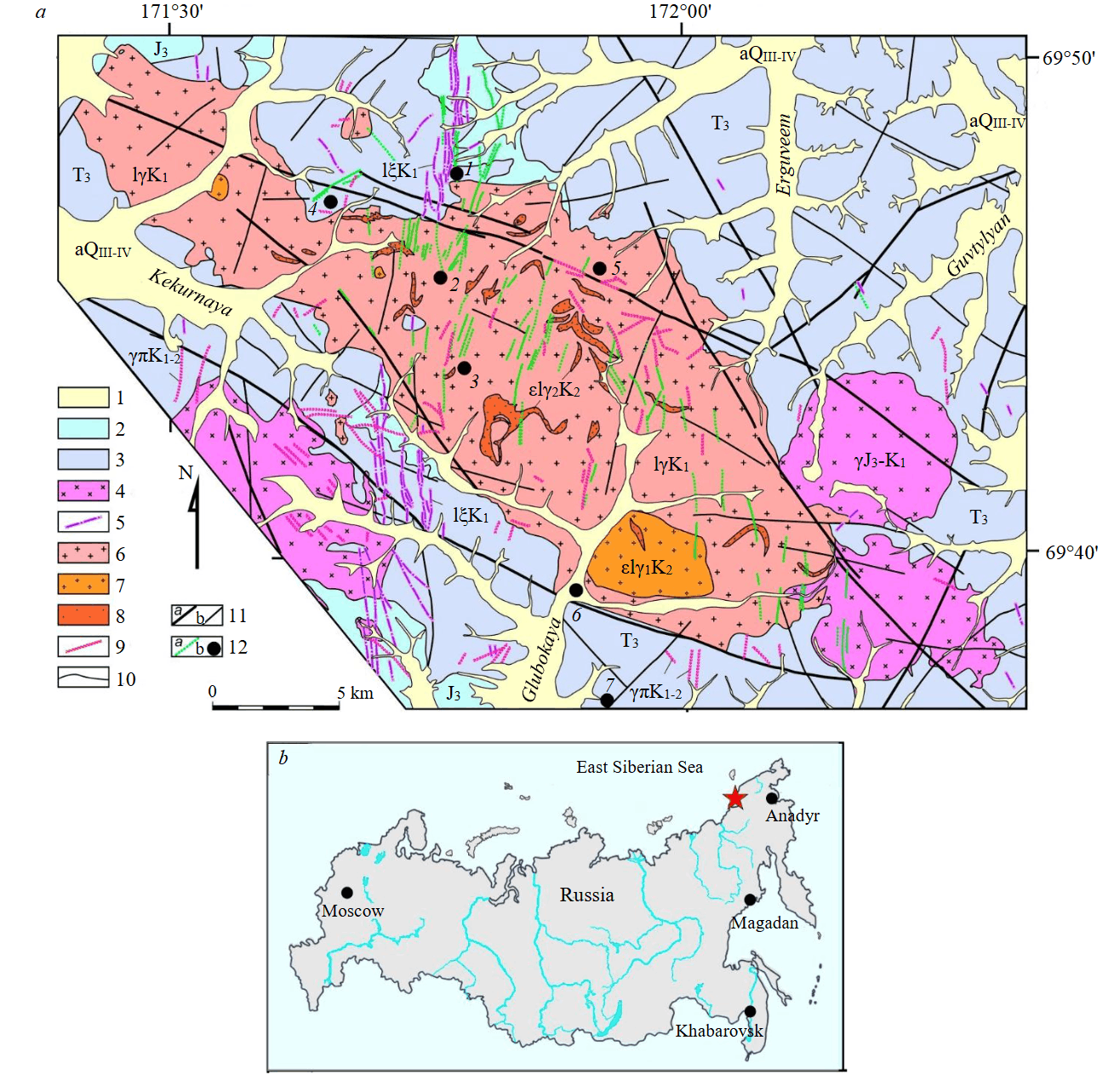
Fig.1. Geological map (a) and geographical location (b) of the Severny pluton (V.I.Alekseev, 1992)
1 – alluvial deposits (aQIII-IV); 2 – tuffaceous sandstones (J3); 3 – terrigenous rocks (T3); 4 – biotite-hornblende granites of the Purginsky complex, γJ3-K1; 5 – porphyritic monzogranite and granosyenite dikes of the Ichuveem complex, γξK1; 6 – undivided leucogranites of the main and additional phases of the Chaun complex, lγK1; 7 – microcline-albite Li-F granites of the first phase of the Pyrkakai complex, εlγ1K2; 8 – microcline-albite Li-F granites of the second phase of the Pyrkakai complex, εlγ2K2; 9 – granite-porphyry dikes, γπK1-2; 10 – geological boundaries; 11 – faults: regional (a), local (b); 12 – undivided greisen and tourmaline metasomatic zones (a), deposits and occurrences (b): 1 – Erguveem, 2 – Kekurnoe, 3 – Stremitelnoe, 4 – Terrassovoe, 5 – Utinoe, 6 – Glubokoe, 7 – Pyrkakai
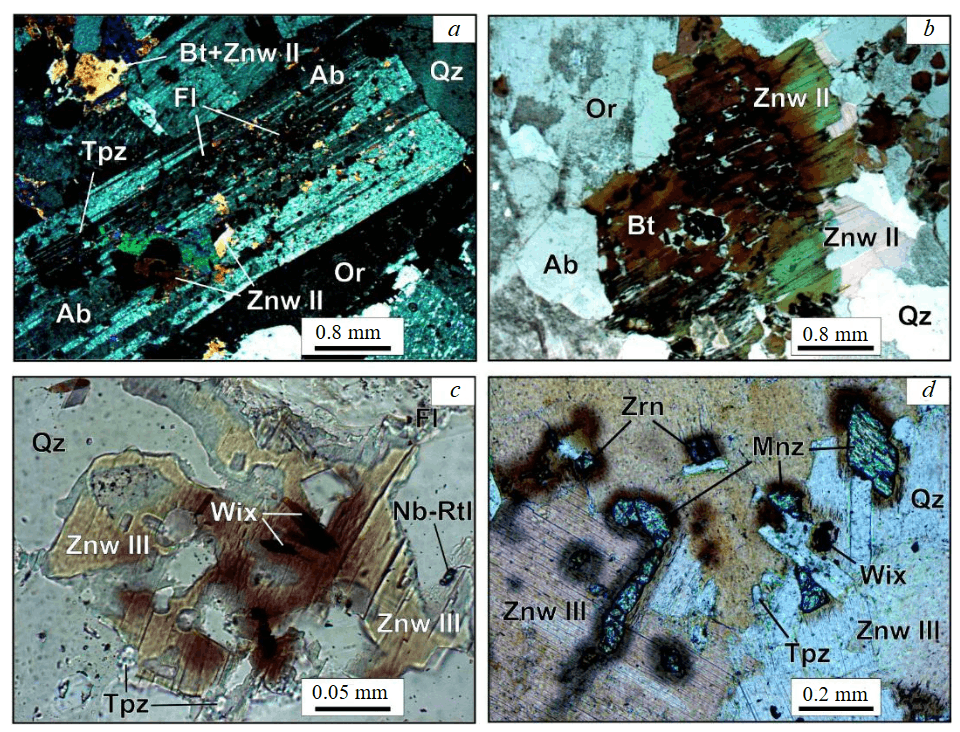
Fig.2. Zwitters of the Severny pluton, photomicrographs with analyzer (a);
without analyzer (b-d): a – replacement of albite by zinnwaldite II, fluorite, and topaz in leucogranite of the Chaun complex (Daikovoe); b – replacement of biotite by zinnwaldite II in leucogranite of the Chaun complex (Kekurnoe deposit); c – topaz-quartz-zinnwaldite zwitter with wolframoixiolite, Nb-bearing rutile (Stremitelnoe occurrence); d – topaz-quartz-zinnwaldite zwitter with monazite-(Ce), Hf-bearing zircon, wolframoixiolite (Valunnoe occurrence). Here and hereafter, mineral abbreviations are after [26]
According to drilling data, zwitter alterations of biotite leucogranites extend to depths of 280-400 m. The scale of weak zwitterization is such that with a 3 % content of secondary minerals, the volume of post-magmatic mineralization in the pluton reaches almost 1 billion m3. Zwitterization defines the altered appearance and geochemical features of the leucogranites of the Severny pluton. This led some researchers to interpret the altered rocks of the main phase of the Chaun complex as LFG [25].
In the Severny pluton, fields of fully developed zwitters with areas from 200-500 m2 to 1-2 km2, developed on leucogranites and Li-F granites, have been mapped. The largest zwitter fields are established at the Kekurnoe and Glubokoe deposits. According to drilling data, blanket-like zwitter areas 5-15 m thick are confined to hanging contacts of LFG sills. Individual bodies are represented by small sheet-like orebodies, pockets, and subvertical zones 0.1-4.5 m thick, 1-70 m long, with north-northeast and sublatitudinal strikes. Based on composition, zinnwaldite-quartz and topaz-quartz zwitters are distinguished. Zinnwaldite-quartz varieties consist of quartz (70-90 %), zinnwaldite III or Li-bearing siderophyllite (10-20 %), topaz and fluorite (1-10 %). Topaz-quartz zwitters are composed of quartz (60-90 %) and topaz (20-30 %), with admixtures of fluorite and zinnwaldite (1-10 %). Strongly corroded grains of plagioclase and orthoclase of the original granites are preserved in the zwitters (Fig.2, c, d).
In zwitter aggregates, irregular or hypidiomorphic grains of zinnwaldite III form chains and pockets in granoblastic quartz aggregates, less commonly they compose veinlet segregations with quartz and topaz. Topaz is distributed along mica and quartz boundaries, sometimes overgrows mica, and intergrows with fluorite. Fluorite in zwitters, unlike fluorite in LFG, almost never occurs as inclusions in mica. The texture of fully developed zwitters is massive, structure is fine- to medium-grained (0.5-3 mm), lepidogranoblastic. Accessory minerals (monazite-(Ce), Sn-Nb-W-bearing rutile, wolframoixiolite, W-bearing columbite-(Mn), etc.) tend to concentrate in mica and topaz segregations [24] (Fig.3, a, b).
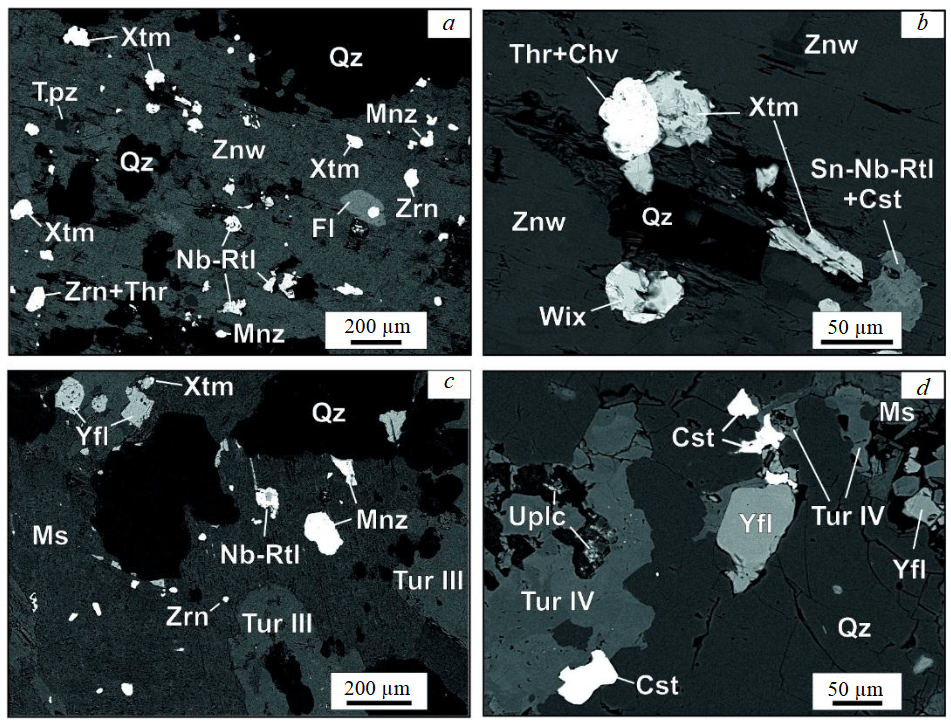
Fig.3. Tin-rare-metal minerals of zwitters and tourmalinites of the Severny pluton (backscattered electron images): a – topaz-quartz-zinnwaldite zwitter with Nb-bearing rutile, xenotime-(Y), monazite-(Ce), Hf-bearing zircon, thorite (Kekurnoe deposit); b – inclusions in zinnwaldite of the zwitter: wolframoixiolite, xenotime-(Y), Nb-W-Sn-bearing rutile, thorite, chernovite-(Y), cassiterite (Kekurnoe); c – quartz-tourmaline-muscovite metasomatite with monazite-(Ce), xenotime-(Y), yttrofluorite, and Hf-zircon (Stremitelnoe); d – cassiterite, uranopolycrase, yttrofluorite in an ore tourmaline-quartz vein (Utinoe)
Tourmalinites compose vein bodies of variable composition and structure, intersecting zwitter orebodies. The most widespread are muscovite-quartz-tourmaline metasomatites, developed in the central part of the pluton as steeply dipping zonal bodies 1.5-2.5 m thick. The rear zone is composed of a microgranular aggregate of tourmaline, quartz, and cassiterite; the intermediate zone – fine-grained quartz and tourmaline with admixtures of muscovite and fluorite; the frontal zone – micro- and fine-grained aggregate of muscovite, quartz, fluorite, and tourmaline. Tourma-linite zones intersect granitoid intrusions of all complexes. In many cases, tourmalinite veins form along faults in the selvages and axial parts of granite-porphyry and monzogranite-porphyry dikes (see Fig.1). Cases of zwitters being intersected by quartz-tourmaline veins and associated quartz-muscovite metasomatites with the formation of heterogeneous metasomatites composed of muscovite pseudomorphs after zinnwaldite and topaz, containing relics of topaz, arsenopyrite, and minerals of Nb, Ta, REE, Y, W, Bi are repeatedly noted.
All tourmaline formations of the pluton are divided into four groups based on their ore potential and tourmaline characteristics: 1) tourmaline I schlieren in pegmatoid pockets; 2) pre-ore veins with tourmaline II and fluorite; 3) early ore veins with tourmaline III; 4) ore veins with tourmaline IV.
- Numerous schlieren of tourmaline I with quartz-muscovite halos are confined to pegmatoid pockets up to 10 cm in size in biotite leucogranites throughout the pluton area. Schlieren contain fluorite, topaz, monazite-(Ce), zircon, thorite, and rutile. Tourmaline I forms xenomorphic and prismatic complexly zoned crystals up to 5 mm across, pleochroic from pale brown and colorless to blue. Dark blue non-pleochroic rims are sometimes developed along the edges.
- Pre-ore veins with tourmaline II and fluorite are rare bodies 2-80 cm thick and up to 5-8 m long. Veins are composed of a heterogranoblastic aggregate of quartz 0.1-2 cm in size with abundant tourmaline dissemination. Tourmaline is xenomorphic, 0.5-5 mm, or prismatic, 1-3 mm across and up to 2-3 cm long. Complexly zoned crystals of tourmaline II are pleochroic from light brown (almost colorless) to brown, from grayish to blue-green. They are associated with polychrome fluorite, topaz, phengite, and sometimes finest dark brown cassiterite (Fig.4, a). In tourmaline II crystals, microveinlets and rims of dark blue non-pleochroic tourmaline are observed.
- Early ore veins with tourmaline III up to 0.1 m thick and a few meters long are relatively rare throughout the pluton area. Veins are composed of black fine- and medium-grained quartz-tourmaline metasomatites with massive texture. Tourmaline III forms prismatic or acicular crystals 0.1-0.5 mm across, up to 5 mm long. Tourmaline III color is zonal: dark brown in the axial part and dark blue at the edges. Small (length tens of µm, width a few µm) crystals of blue and green non-pleochroic tourmaline IV are observed overgrowing large tourmaline III crystals (basins of the Stremitelny and Gusiny streams) (Fig.4, c). Tourmaline III is associated with accessory yttrofluorite, topaz, cassiterite, monazite-(Ce), Nb-bearing rutile, allanite-(Ce), allanite-(Y) (see Fig.3, c, Fig.4, b, c).
- Veins with tourmaline IV have submeridional strike, steep dip (80-85°), thickness from a few cm to 0.5 m, up to 1.5 m in swells, vein length up to 200 m. Systems of parallel veins extend for hundreds of meters and several kilometers (see Fig.1). Wallrock alterations of granites are represented by tourmaline-quartz-muscovite metasomatites. Tourmaline from veins and tourmaline from wallrock muscovite-quartz-tourmaline metasomatites do not differ in composition and are described as tourmaline IV. Veins have dark gray color, spotted or brecciated structure, and contain yttrofluorite. In veins, especially in brecciated varieties, cassiterite is present in economic quantities, associated with monazite-(Ce) and apatite (see Fig.3, d, Fig.4, d). Tourmaline IV forms bluish-green weakly zoned crystals up to 1 mm long and from a few to several hundred µm wide. At the Pyrkakai, Glubokoe, and Utinoe deposits, veins with tourmaline IV have a predominantly quartz composition. In a medium-grained quartz aggregate, lenses and veinlets of fine- to medium-grained quartz with disseminations of radial aggregates of acicular deep blue tourmaline IV, green fluorite, and microgranular (tenths of mm) cassiterite are observed. Cassiterite content ranges from 0.1 to 5-15 vol.% of the veins.
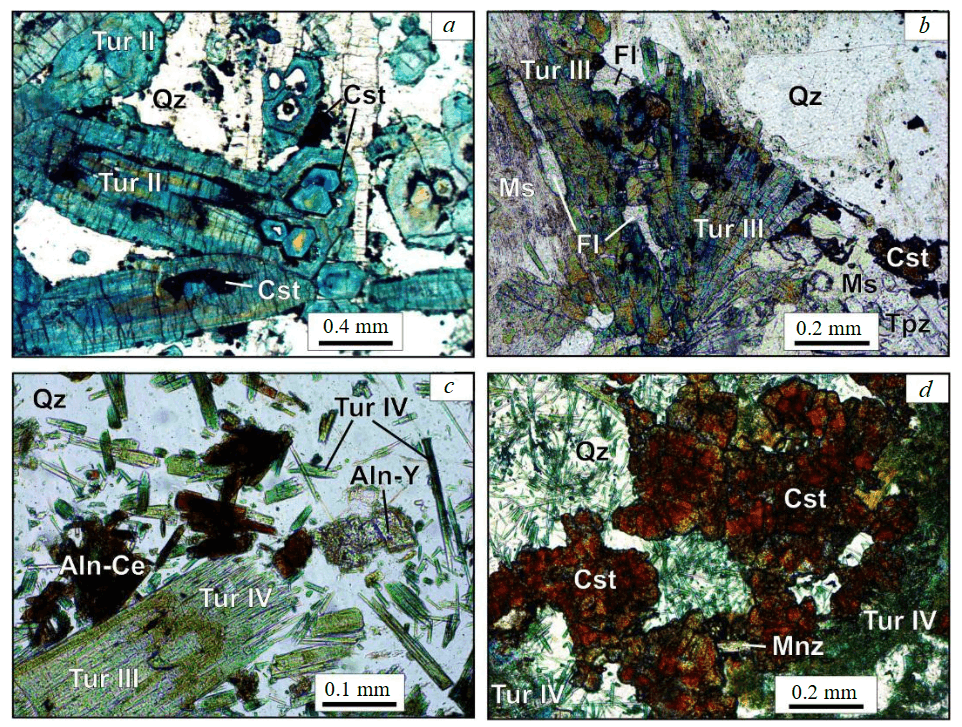
Fig.4. Tourmalinites of the Severny pluton (photomicrographs without analyzer): a – tourmaline II with cassiterite inclusions in a pre-ore vein of group 2 (Stremitelnoe occurrence); b – fluorite-muscovite-quartz metasomatite with tourmaline III and cassiterite in an early ore vein of group 3 (Kekurnoe deposit); c – tourmaline III with overgrowth of tourmaline IV in an early ore vein of group 3 with allanite-(Ce), allanite-(Y) (Kekurnoe deposit); d – tourmaline IV, cassiterite, and monazite-(Ce) in an ore vein of group 4 (Kekurnoe deposit)
Mineralogical features of zwitters and tourmalinites
Zwitters are composed of zinnwaldite III, containing rare alkalis (Table 1) and impurities of rare metals (Nb2O5 – 0.03-0.14; Ta2O5 – 0.001-0.002; Y2O3 – 0.01-0.03; Yb2O3 – 0.003-0.005 wt.%), characterized by high iron and alumina content. According to the Ti-in-biotite geothermometer [20], the crystallization temperature of zinnwaldite in zwitters is 430 °C. The crystallization temperature of zinnwaldite replacing magmatic biotite in zwitterized granites is also < 500 °C.
Zwitters contain tungsten-rare-metal accessory mineralization: yttrofluorite, monazite-(Ce), Sn-Nb-W-bearing rutile, wolframoixiolite, W-bearing columbite-(Mn), W-bearing ilmenite, beryl, xenotime-(Y), chernovite-(Y), ishikawaite, bismutopyrochlore, uranopolycrase, cassiterite [24] (see Fig.2, c, d, Fig.3, a, b).
Table 1
Chemical composition of micas of the siderophyllite – polylithionite series in zwitterized leucogranites and zwitters of the Severny pluton, wt.%
|
Component |
Sample groups |
Component |
Sample groups |
||||||
|
1 |
2 |
3 |
4 |
1 |
2 |
3 |
4 |
||
|
SiO2 |
40.16 |
43.31 |
44.81 |
42.09 |
Si |
3.02 |
3.18 |
3.26 |
3.10 |
|
TiO2 |
0.45 |
0.23 |
0.16 |
0.38 |
Ti |
0.03 |
0.01 |
0.01 |
0.02 |
|
Al2O3 |
20 |
19.17 |
18.93 |
19.39 |
Al |
1.77 |
1.66 |
1.62 |
1.68 |
|
Fe2O3 |
2.1 |
1.6 |
1.51 |
1.45 |
Fe3+ |
0.12 |
0.09 |
0.08 |
0.08 |
|
FeO |
19.21 |
14.72 |
14.04 |
15.73 |
Fe2+ |
1.21 |
0.91 |
0.85 |
0.97 |
|
MnO |
0.62 |
1.02 |
0.51 |
0.64 |
Mn |
0.04 |
0.06 |
0.03 |
0.04 |
|
MgO |
0.6 |
0.49 |
0.63 |
0.89 |
Mg |
0.07 |
0.05 |
0.07 |
0.10 |
|
CaO |
0.68 |
0.57 |
0.51 |
0.65 |
Ca |
0.05 |
0.04 |
0.04 |
0.05 |
|
Na2O |
0.86 |
0.93 |
0.87 |
0.81 |
Na |
0.08 |
0.09 |
0.08 |
0.08 |
|
K2O |
8.57 |
9.11 |
8.97 |
9.21 |
K |
0.82 |
0.85 |
0.83 |
0.86 |
|
Li2O |
1.55 |
2.83 |
3.01 |
3.13 |
Li |
0.47 |
0.84 |
0.88 |
0.93 |
|
Rb2O |
0.53 |
0.78 |
0.92 |
1.12 |
Rb |
0.03 |
0.04 |
0.04 |
0.05 |
|
Cs2O |
0.033 |
0.041 |
0.046 |
0.055 |
OH |
1.06 |
0.87 |
0.86 |
0.83 |
|
F |
3.94 |
4.87 |
4.96 |
5.03 |
F |
0.94 |
1.13 |
1.14 |
1.17 |
|
O=F |
1.66 |
2.05 |
2.09 |
2.12 |
|
|
|
|
|
|
Sum |
100.17 |
99.98 |
100.18 |
100.80 |
|
|
|
|
|
|
n |
3 |
3 |
2 |
4 |
|
|
|
|
|
Notes. n – number of analyses; 1-4 – average mica composition (1 – altered biotite in slightly zwitterized (15 %) leucogranites, 2 – moderately zwitterized (40 %) leucogranites, 3 – zinnwaldite in strongly zwitterized (70 %) leucogranites, 4 – zwitters). Formulae calculated based on 12 oxygen atoms per formula unit (O=F2).
Tourmaline species from the four described groups of tourmaline formations were identified:
- Tourmaline I from schlieren in pegmatoid pockets mainly belongs to fluor-schorl; some compositions are classified as fluor-dravite, schorl, foitite, oxy-schorl, and oxy-foitite (Fig.5, a, c, e). The Fe3+/Fetot ratio in schlieren tourmaline is 9-10 %.
- Tourmaline II from veins with fluorite is classified by chemical composition as fluor-schorl and schorl; some compositions are classified as foitite, oxy-schorl, and oxy-foitite (Fig.5, a, c, e). Tourmaline II contains Sc (up to 0.24 wt.% Sc2O3) – this is the highest concentration of the element ever recorded in tourmaline. Another feature of tourmaline II is high Li content – 135-163 ppm. The Fe3+/Fetot ratio is 7-11 %.
- Tourmaline III by composition is classified as fluor-schorl, schorl, oxy-schorl, foitite, oxy-foitite, and dravite (Fig.5, a, c, e). The Fe3+/Fetot ratio varies from 3 to 9 %.
- Tourmaline IV can be classified by chemical composition as schorl, oxy-schorl, and probably ferro-bosiite; a smaller number of compositions correspond to dravite, oxy-dravite, fluor-schorl, foitite (Fig.5, b, d, f). Ferro-bosiite composing crystal rims is tin-bearing – up to 1.28 wt.% SnO2. The Fe3+/Fetot ratio reaches 14 %.
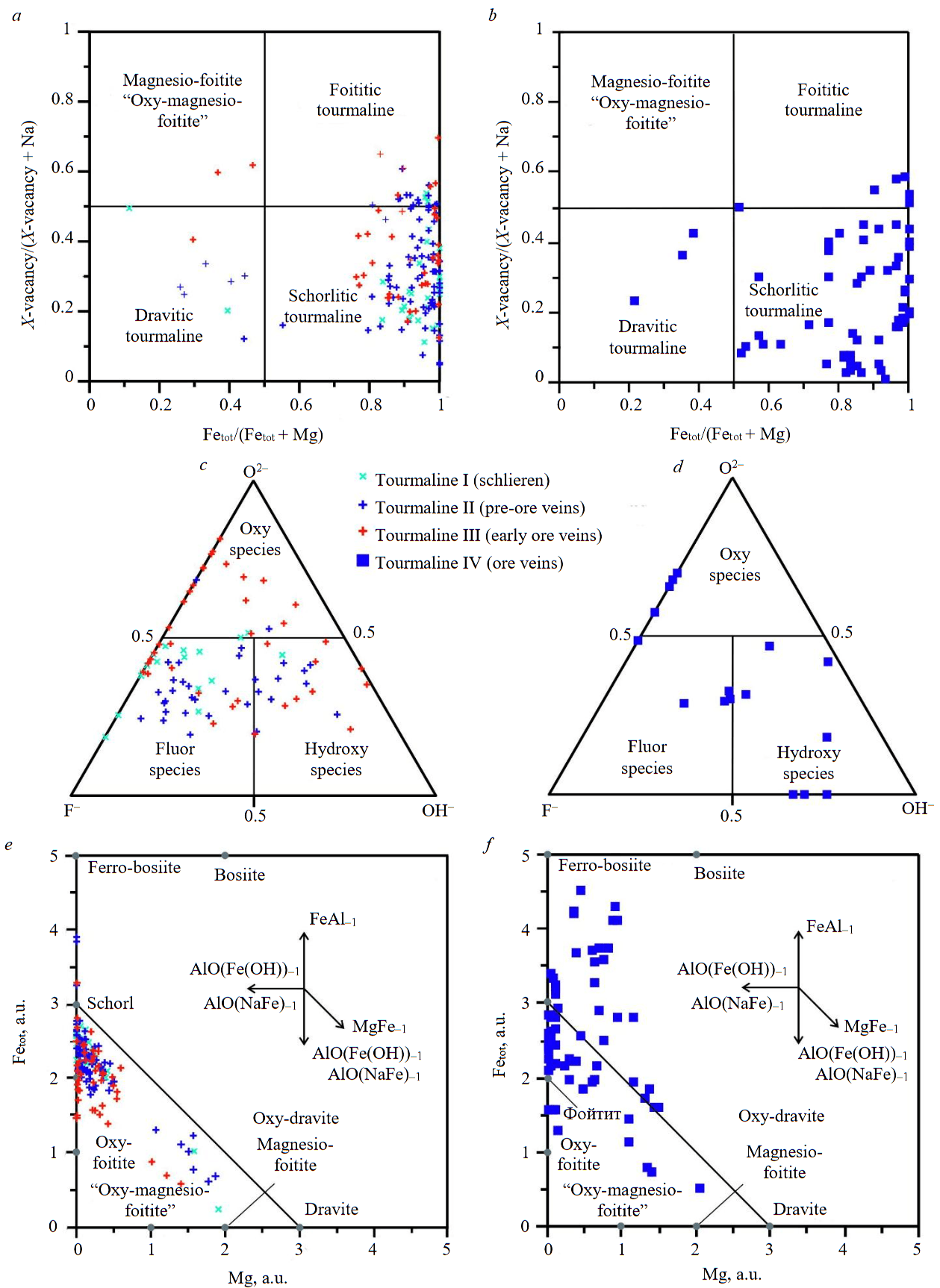
Fig.5. Binary and ternary diagrams [22], illustrating tourmaline compositions
of the Severny pluton and possible substitutions: a, b – Fetot/(Fetot + Mg) – X-vacancy/(X-vacancy + Na); c, d – O2– – F– – OH– at the W site; e, f – Mg – Fetot
Summarizing the data on tourmaline mineralogy of the Severny pluton, we note that its compositional variations lie within the limits of schorl, foitite, and bosiite. From pre-ore tourmalinites to ore ones, a decrease in the role of fluor-schorl and an increase in the significance of oxy-schorl and ferro-bosiite is observed, with a gradual increase in lithium content and variable Fe3+/Fetot ratio.
In pre-ore veins with tourmaline II, monazite-(Ce), thorite, rutile, and very rarely fine
(0.01-0.3 mm) cassiterite are observed (see Fig.4, a). Early ore veins with tourmaline III contain rare-earth-tin accessory mineralization: cassiterite, monazite-(Ce), bismutopyrochlore, xenotime-(Y), apatite-(CaF), fluocerite-(Ce), yttrofluorite, allanite-(Ce), allanite-(Y) (Table 2), ishikawaite, Y, Cu, Fe arsenates – chernovite-(Y), agardite-(Y), etc. (see Fig.3, c, Fig.4, b, c). Accessory and ore minerals of veins with tourmaline IV: cassiterite, monazite-(Ce), apatite, tin-tungsten-niobium rutile, fluocerite-(Ce), yttrofluorite, polycrase, uranopolycrase, chalcopyrite, pyrite, sakuraiite (see Fig.3, d, Fig.4, d).
Table 2
Chemical composition of allanite-(Ce) and allanite-(Y) in tourmaline metasomatites of the Severny pluton [27], wt.%
|
Component |
Allanite-(Ce) |
Allanite -(Y) |
||||||
|
1 |
2 |
3 |
4 |
5 |
6 |
7 |
8 |
|
|
SiO2 |
35.55 |
37.59 |
35.54 |
35.28 |
35.61 |
33.97 |
35.22 |
35.79 |
|
Al2O3 |
14.42 |
13.91 |
13.53 |
14.43 |
– |
0.83 |
0.42 |
0.54 |
|
FeO* |
17.37 |
15.61 |
19.18 |
17.27 |
9.38 |
8.88 |
7.72 |
8.94 |
|
CaO |
12.59 |
9.72 |
14.15 |
11.75 |
12.31 |
10.66 |
8.06 |
10.56 |
|
La2O3 |
4.69 |
4.84 |
4.82 |
4.99 |
– |
– |
– |
– |
|
Ce2O3 |
11.28 |
13.61 |
12.47 |
12.63 |
– |
0.27 |
– |
0.06 |
|
Nd2O3 |
3.81 |
3.41 |
2.68 |
3.05 |
– |
0.69 |
1.15 |
0.54 |
|
Sm2O3 |
– |
– |
– |
– |
– |
1.83 |
0.89 |
0.54 |
|
Gd2O3 |
– |
– |
– |
– |
– |
1.42 |
3.12 |
0.86 |
|
Dy2O3 |
– |
– |
– |
– |
– |
3.55 |
3.83 |
1.61 |
|
Er2O3 |
– |
– |
– |
– |
– |
3.45 |
– |
0.51 |
|
Yb2O3 |
– |
– |
– |
– |
– |
2.89 |
– |
0.42 |
|
Y2O3 |
– |
– |
|
– |
42.34 |
30.77 |
38.05 |
38.69 |
|
ThO2 |
– |
– |
– |
0.01 |
– |
– |
– |
0.03 |
|
Sum |
99.71 |
98.69 |
100.39 |
99.41 |
99.64 |
99.21 |
98.47 |
99.09 |
|
Si |
3.28 |
3.48 |
3.15 |
3.28 |
3.53 |
3.55 |
3.63 |
3.59 |
|
Al |
1.57 |
1.52 |
1.50 |
1.58 |
|
0.10 |
0.05 |
0.06 |
|
Fe* |
1.34 |
1.21 |
1.51 |
1.34 |
0.78 |
0.78 |
0.67 |
0.75 |
|
Σ M |
2.91 |
3.03 |
3.01 |
2.92 |
0.78 |
0.88 |
0.72 |
0.81 |
|
Ca |
1.25 |
0.96 |
1.42 |
1.17 |
1.31 |
1.19 |
0.89 |
1.14 |
|
La |
0.16 |
0.17 |
0.17 |
0.17 |
|
|
|
|
|
Ce |
0.38 |
0.46 |
0.43 |
0.43 |
|
0.01 |
|
0.00 |
|
Nd |
0.13 |
0.11 |
0.09 |
0.10 |
|
0.03 |
0.04 |
0.02 |
|
Sm |
|
|
|
|
|
0.07 |
0.03 |
0.02 |
|
Gd |
|
|
|
|
|
0.05 |
0.11 |
0.03 |
|
Dy |
|
|
|
|
|
0.12 |
0.13 |
0.05 |
|
Er |
|
|
|
|
|
0.11 |
|
0.02 |
|
Yb |
|
|
|
|
|
0.09 |
|
0.01 |
|
Y |
|
|
|
|
2.23 |
1.71 |
2.09 |
2.07 |
|
Th |
|
|
|
0.00 |
|
|
|
0.00 |
|
Σ A |
1.92 |
1.70 |
2.11 |
1.87 |
3.54 |
3.38 |
3.29 |
3.36 |
Notes. 1-3, 5-7 – representative microprobe analyses (Saint Petersburg Mining University) of allanite-(Ce) and allanite-(Y) in tourmalinites; 4, 8 – average composition of allanite-(Ce) and allanite-(Y) (33 and 12 analyses); dash – element not detected; FeO* = FeO + Fe2O3. Formulae calculated for 8 cations with charge balance for 12.5 oxygen ions.
Veins with tourmaline III are the main tin-ore formations of the Severny pluton and contain up to 5-15 % cassiterite (see Fig.4, b, c). Characteristic impurities in cassiterite from tourmaline veins: FeO – 0.82-1.52; WO3 – 0.00-0.37; TiO2 – 0.04-0.12; Nb – 0.01-0.11; In – 0.00-0.02; Ce – 0.00-0.03; Sc – 0.00-0.02 % (Table 3). In composition, cassiterite from the Severny pluton is similar to cassiterite from greisen deposits associated with LFG: Altenberg (Germany), Orlovskoe (Zabaikalsky Krai), Kester (Yakutia). Similarity with cassiterite from greisen deposits of the Russian Far East (Karadubskoe, Pravourmiyskoe, Priamurye) is observed.
Table 3
Chemical composition of cassiterite in tourmaline metasomatites and veins of the Severny massif
|
Component |
Samples |
|||||||||
|
1 |
2 |
3 |
4 |
5 |
6 |
7 |
8 |
9 |
10 |
|
|
SnO2, % |
99.58 |
98.93 |
98.04 |
99.08 |
97.26 |
97.65 |
97.29 |
99.45 |
99.62 |
99.78 |
|
WO3, % |
0.00 |
0.00 |
0.00 |
0.00 |
0.00 |
0.00 |
0.00 |
0.08 |
0.00 |
0.00 |
|
Fe2O3, % |
0.00 |
0.82 |
1.59 |
1.09 |
2.51 |
2.01 |
0.00 |
0.00 |
0.00 |
0.00 |
|
TiO2, % |
0.00 |
0.12 |
0.00 |
0.00 |
0.00 |
0.00 |
0.00 |
0.02 |
0.13 |
0.00 |
|
Be, ppm |
0.00 |
14 |
20 |
11 |
31 |
8 |
37 |
100 |
9 |
20 |
|
Sc, ppm |
0.01 |
30 |
45 |
15 |
20 |
17 |
10 |
200 |
50 |
260 |
|
Ce, ppm |
0.03 |
60 |
90 |
30 |
50 |
1600 |
110 |
1000 |
210 |
70 |
|
In, ppm |
0.01 |
170 |
150 |
74 |
60 |
80 |
49 |
50 |
20 |
24 |
|
Nb, ppm |
0.09 |
210 |
280 |
100 |
230 |
230 |
200 |
1100 |
550 |
380 |
|
Sum |
99.73 |
99.92 |
99.69 |
100.19 |
99.81 |
99.71 |
98.45 |
99.80 |
99.83 |
99.83 |
|
Nb/In |
6.43 |
1.24 |
1.87 |
1.35 |
3.83 |
2.88 |
4.10 |
22.00 |
27.50 |
15.83 |
Notes. 1-10 – representative analyses of cassiterite from deposits (1-6 – Kekurnoe deposit, 7 – Stremitelnoe occurrence; 8-10 – Utinoe occurrence). Sn, W, Fe, Ti – X-ray spectral analysis (Saint Petersburg State University, analyst E.V.Savva). Be, Sc, Ce, In, Nb – SEM-EDS (Saint Petersburg Mining University, analyst E.V.Pigova).
Tourmaline veins with rich rare-earth mineralization – allanite-(Ce) and replacing it fluocerite-(Ce) – are encountered. Nd-bearing allanite-(Y) has been identified in intergrowths with allanite-(Ce) (see Fig.4, d).
On the association of greisens and tourmalinites of the Severny pluton
The established association of mineralized greisens (zwitters) and tourmalinites in the Severny pluton deserves attention and requires mineralogical-petrographic and metallogenic assessment, as such complexes are characteristic of large rare-metal-tin deposits. These include Pravourmiyskoe (Priamurye) [6], Yaroslavskoe (Primorsky Krai) [7], Kougarok and Lost River (Alaska) [28, 29], St. Austell and Tregonning-Godolphin (England) [30, 31], Ehrenfriedersdorf (Germany) [32], Vykmanov (Czech Republic) [33], Panasqueira (Portugal) [34], and others.
The main feature of the identified association is the spatial connection of ore-bearing metasomatites with LFG, in the endocontact and exocontact of whose intrusions zwitter orebodies are located, and zones of tourmaline metasomatites are within the distribution areas of LFG and zwitters (see Fig.1). If the genetic link of zwitters with LFG has been established [8, 9], the genesis of tourmalinites requires study. Quartz-tourmaline veins and wallrock tourmaline-quartz-muscovite metasomatites are sometimes erroneously referred to as “tourmaline greisens” [31, 35]. The inconsistency of such a definition for tourmalinites was shown by D.V.Rundkvist et al., noting that “the separation of greisen and cassiterite-tourmaline-chlorite deposit types causes significant difficulties, having, on one hand, historical roots, on the other – objective reasons due to the wide distribution of tourmaline both in typical greisen and in cassiterite-tourmaline-chlorite deposits...” [36].
Zwitters and tourmalinites of the Severny pluton are an association that arose in connection with magmatism producing Li-F granite intrusions. The genetic relationship of metasomatites is reflected in the similarity of the geochemical specialization of zwitters (Nb, W, Y, Ce, Li, Sn, Th, As) and tourmalinite metasomatites (Sn, Ce, Y, W, Sc, Li). An argument in favor of zwitters and tourmalinites belonging to a single hydrothermal system is the presence of boron in fluid inclusions in quartz of zwitters. With fluorine playing the leading role in the volatile component composition, the boron concentration in zwitters, according to analysis of aqueous extracts from quartz, is 1±0.3 g/kg water. Raman spectroscopy of multiphase inclusions in quartz of zwitters showed the presence of inclusions of boric acid [24]. Data on high boron concentration in melt inclusions of LFG from known massifs also point to the connection of the zwitter – tourmalinite association with LFG: Orlovsky (Eastern Zabaikalsky Krai, up to 2.09 wt.% B2O3) [37], Ary-Bulak (Eastern Zabaikalsky Krai, up to 1138 ppm B) [38], Zinnwald (Germany, up to 640 ppm B) [39], etc.
A characteristic feature of tourmalinites associated with zwitters is the diversity of tourmaline mineral species. In pegmatoid schlieren and pre-ore veins, tourmaline I belongs to schorl and foitite species with a significant role of fluor-schorl. Tourmaline II of pre-ore veins contains elevated scandium concentration. Tourmaline III of early ore veins is predominantly oxy-schorl and oxy-foitite. Tourmaline IV of ore veins is represented by oxy-schorl, schorl, and tin-bearing ferro-bosiite. From pre-ore tourmaline I schlieren to syn-ore tourmaline IV, an intensification of the negative correlation between Fetot and Altot is observed: –0.49 → –0.52 → –0.77 → –0.86. The Fe3+/Fetot ratio changes, %: 9-10 → 7-11 → 3-9 → 14, indicating tourmaline crystallization under variable oxidative potential of the mineral-forming fluid.
High Li and F contents in tourmaline point to the connection of tourmalinites with LFG and zwitters. In general, lower F and higher Li content in tourmaline from early ore and ore veins compared to tourmaline from schlieren and pre-ore veins indicates decreasing fluorine fugacity and increasing Li activity during mineral formation. It is possible that the decrease in fF2 could have been one of the factors that initiated cassiterite deposition in early ore veins. In [40], it is shown that with increasing fluorine content in a granite melt, SnO2 solubility increases. It is quite possible that fluorine similarly affects SnO2 solubility in a hydrothermal fluid. Considering the presence of ferro-bosiite in ore veins, one can assume an increase in the oxidative potential of the solutions, which led to cassiterite crystallization in veins with tourmaline IV. The possibility of cassiterite crystallization under oxidizing conditions is shown in [41].
The association of zwitters and tourmalinites of the Severny pluton is characterized by complex rare-metal-tin ore potential. Tin mineralization explored at a number of deposits is confined to quartz veins (Pyrkakai, Utinoe, Glubokoe, etc. deposits). In tourmalinite veins, brecciated aggregates are the most tin-bearing, where cassiterite concentrates in quartz pockets and veinlets (Erguveem and Kekurnoe deposits, and Stremitelnoe occurrence). Rare-metal mineralization accompanies zwitters (Nb, Ce, Y, W, Bi) and tourmalinites (Y, Ce). Considering the rare-metal mineralization of zwitters and the rare-earth-tin mineralization of tourmalinites, the obtained results can be used to assess the metallogenic potential and develop criteria for forecasting rare-earth-rare-metal (Nb, Ce, Y, W, Bi) mineralization of the Severny pluton.
Conclusion
In the Severny pluton, an association of rare-metal-tin-bearing metasomatites related to magmatism producing Li-F granite intrusions has been established. The identified metasomatic association is characterized by the following features:
- Co-occurrence of zwitter orebodies, tourmaline metasomatite bodies, and small Li-F granite intrusions within common areas in the central part of the pluton.
- A wide spectrum of tourmaline mineral species composing tourmalinite veins and wallrock tourmaline-bearing metasomatites, related to wide variations in water, fluorine, and lithium contents, as well as iron oxidation state.
- Evolution of tourmaline from Sc-bearing fluor-schorl in pre-ore metasomatites to oxy-schorl and tin-bearing ferro-bosiite in tin-ore metasomatites, with a gradual increase in lithium content and variable iron oxidation state.
- Combination of cassiterite and rare-metal mineralization in zwitters and tourmalinites.
The results of the conducted comprehensive structural-geological, petrographic, and mineralogical studies of zwitters and tourmalinites of the Severny pluton can be used to assess the metallogenic potential of the district and develop criteria for forecasting rare-metal (Nb, Ce, Y, W, Bi) mineralization.
References
- State Report on the State and Use of Mineral Resources of the Russian Federation in 2020. Мoscow: Rosnedra, 2021, p. 572.
- Litvinenko V.S., Petrov E.I., Vasilevskaya D.V. et al. Assessment of the role of the state in the management of mineral resources. Journal of Mining Institute. 2023. Vol. 259, p. 95-111. DOI: 10.31897/PMI.2022.100
- Artemiev D.S., Krymsky R.Sh., Belyatsky B.V., Ashikhmin D.S. The age of mineralization of Mayskoe gold ore deposit (Central Chukotka): results of Re-Os isotopic dating. Journal of Mining Institute. 2020. Vol. 243, p. 266-278. DOI: 10.31897/PMI.2020.3.266
- Dashko R.E., Romanov I.S. Forecasting of mining and geological processes based on the analysis of the underground space of the Kupol deposit as a multicomponent system (Chukotka Autonomous Region, Anadyr district). Journal of Mining Institute. 2021. Vol. 247, p. 20-32. DOI: 10.31897/PMI.2021.1.3
- Evdokimov A.N., Fokin V.I., Shanurenko N.K. Gold-rare metal and associated mineralization in the western part of Bolshevik Island, Severnaya Zemlya archipelago. Journal of Mining Institute. 2023. Vol. 263, p. 687-697. DOI: 10.31897/PMI.2022.94
- Geodynamics, magmatism and metallogeny of the Russian East. In 2 books. Book 1. Ed by A.I.Khanchuk. Vladivostok: Dalnauka, 2006, p. 527 (in Russian).
- Rizvanova N.G., Alenicheva A.A., Skublov S.G. et al. Early Ordovician Age of Fluorite-Rare-Metal Deposits at the Voznesensky Ore District (Far East, Russia): Evidence from Zircon and Cassiterite U–Pb and Fluorite Sm–Nd Dating Results. Minerals. 2021. Vol. 11. Iss. 11. N 1154. DOI: 10.3390/min11111154
- Kovalenko V.I., Kuzmin M.I., Kozlov V.D., Vladykin N.V. Metasomatic zwitters and associated rare-metal mineralization (exemplified by deposits of Mongolia and Czechoslovakia). Metasomatizm i rudoobrazovanie. Мoscow: Nauka, 1974, p. 42-53.
- Borodkin N.A., Pristavko V.A. Petrochemical and geochemical criteria of zwitter classification. Otechestvennaya geologiya. 2012. N 4, p. 49-56 (in Russian).
- Tomson I.N., Tananaeva G.A. Basic formation of tin-bearing zwitters and their relationship with accompanying vein deposits. Etapy obrazovaniya rudnykh formatsii. Мoscow: Nauka, 1989, p. 72-78.
- Plyushchev E.V., Shatov V.V., Kashin S.V. Metallogeny of Hydrothermal-Metasomatic Formations. St. Petersburg: VSEGEI, 2012, p. 560.
- Plyushchev E.V., Ushakov O.P., Shatov V.V., Belyaev G.M. Methods for Studying Hydrothermal-Metasomatic Formations. Leningrad: Nedra, 1981, p. 262.
- Voitekhovsky Y.L., Zakharova A.A. Petrographic structures and Hardy – Weinberg equilibrium. Journal of Mining Institute. 2020. Vol. 242, p. 133-138. DOI: 10.31897/PMI.2020.2.133
- Marin Yu.B. On Mineralogical Studies and the Use of Mineralogical Information in Solving Petro- and Ore Genesis Problems. Geology of Ore Deposits. 2021. Vol. 63. N 7, p. 625-633. DOI: 10.31857/S0869605520040048
- Krivovichev V.G., Gulbin Yu.L. Recommendations for mineral formula calculations from chemical analytical data. Proceedings of the Russian Mineralogical Society. 2022. Vol. 151. N 1, p. 114-124 (in Russian). DOI: 10.31857/S0869605522010087
- Loufouandi Matondo I.P., Ivanov M.A. Composition and probable ore igneous rocks source of columbite from alluvial deposits of Mayoko district (Republic of the Congo). Journal of Mining Institute. 2020. Vol. 242, p. 139-149. DOI: 10.31897/PMI.2020.2.139
- Gawad A.E.A., Ene A., Skublov S.G. et al. Trace Element Geochemistry and Genesis of Beryl from Wadi Nugrus, South Eastern Desert, Egypt. Minerals. 2022. Vol. 12. Iss. 2. N 206. DOI: 10.3390/min12020206
- Gvozdenko T.A., Baksheev I.A., Khanin D.A. et al. Iron-bearing to iron-rich tourmalines from granitic pegmatites of the Murzinka pluton, Central Urals, Russia. Mineralogical Magazine. 2022. Vol. 86. Iss. 6, p. 948-965. DOI: 10.1180/mgm.2022.104
- Grigorev D.P. Ontogeny of Minerals. Lvov: Izd-vo Lvovskogo universiteta, 1961, p. 284.
- Chun-Ming Wu, Hong-Xu Chen. Revised Ti-in-biotite geothermometer for ilmenite- or rutile-bearing crustal metapelites. Science Bulletin. 2015. Vol. 60. Iss. 1, p. 116-121. DOI: 10.1007/s11434-014-0674-y
- Rieder M., Cavazzini G., Dyakonov Y.S. et al. Nomenclature of the Micas. Clays and clay minerals. 1998. Vol. 46. Iss. 5, p. 586-595. DOI: 10.1346/CCMN.1998.0460513
- Henry D.J., Novák M., Hawthorne F.C. et al. Nomenclature of the tourmaline-supergroup minerals. American Mineralogist. 2011. Vol. 96. Iss. 5-6, p. 895-913. DOI: 10.2138/am.2011.3636
- State Geological Map of the Russian Federation. Scale 1:1,000,000 (New Series). Sheet R-58-(60) – Bilibino. Explanatory Note. St. Petersburg: VSEGEI, 1999, p. 146.
- Kurguzova A.V. Formation Conditions of Zwitters and Tourmalinites of the Severny Massif (Chukotka): Avtoref. dis. … kand. geol.-mineral. nauk. St. Petersburg: Natsionalnyi mineralno-syrevoi universitet “Gornyi”, 2014, p. 20.
- Warr L.N. IMA–CNMNC approved mineral symbols. Mineralogical Magazine. 2021. Vol. 85. Iss. 3, p. 291-320. DOI: 10.1180/mgm.2021.43
- Dudkinskii D.V., Efremov S.V., Kozlov V.D. Lithium-Fluorine Granites of Chukotka and Their Geochemical Features. Geokhimiya. 1994. N 3, p. 393-402.
- Alekseev V.I., Marin Yu.B., Gembitskaya I.M. Allanite-(Y) and allanite-(Ce) paragenesis in tourmalinite of the Severnyi pluton, Chukchi Peninsula, and the relationship between yttrium and lanthanides in allanite. Geology of Ore Deposits. 2016. Vol. 58. N 6, p. 674-680. DOI: 10.1134/S107570151608002X
- Dobson D.C. Geology and alteration of the Lost River tin-tungsten-fluorine deposit, Alaska. Economic Geology. 1982. Vol. 77. N 4, p. 1033-1052. DOI: 10.2113/gsecongeo.77.4.1033
- Soloviev S.G., Kryazhev S., Dvurechenskaya S. Geology, igneous geochemistry, mineralization, and fluid inclusion characteristics of the Kougarok tin-tantalum-lithium prospect, Seward Peninsula, Alaska, USA. Mineralium Deposita. 2020. Vol. 55. Iss. 1, p. 79-106. DOI: 10.1007/s00126-019-00883-7
- Duchoslav M., Marks M.A.W., Drost K. et al. Changes in tourmaline composition during magmatic and hydrothermal processes leading to tin-ore deposition: The Cornubian Batholith, SW England. Ore Geology Reviews. 2017. Vol. 83, p. 215-234. DOI: 10.1016/j.oregeorev.2016.11.012
- Dehaine Q., Filippov L.O., Glass H.J., Rollinson G. Rare-metal granites as a potential source of critical metals: A geometallurgical case study. Ore Geology Reviews. 2019. Vol. 104, p. 384-402. DOI: 10.1016/j.oregeorev.2018.11.012
- Seifert Th., Кemре U. Sn-W-Lagerstatten und spatvariszische Magmatite des Erzgebirges. Beiheft zu European Journal of Mineralogy. 1994. Vol. 6. N 2, p. 125-172.
- Štemprok M., Pivec E., Langrová A. The petrogenesis of a wolframite-bearing greisen in the Vykmanov granite stock, Western Krušné hory pluton (Czech Republic). Bulletin of Geosciences. 2005. Vol. 80. N 3, p. 163-184.
- Marignac C., Cuney M., Cathelineau M. et al. The Panasqueira Rare Metal Granite Suites and Their Involvement in the Genesis of the World-Class Panasqueira W–Sn–Cu Vein Deposit: A Petrographic, Mineralogical, and Geochemical Study. Minerals. 2020. Vol. 10. Iss. 6. N 562. DOI: 10.3390/min10060562
- Gracheva O.S. Greisens of the Northeast USSR. Мoscow: Nedra, 1974, p. 172.
- Rundkvist D.V., Denisenko V.K., Pavlova I.G. Greisen Deposits (Ontogeny and Phylogeny). Мoscow: Nedra, 1970, p. 328.
- Badanina E.V., Syritso L.F., Volkova E.V. et al. Composition of Li–F Granite Melt and Its Evolution during the Formation of the OreBearing Orlovka Massif in Eastern Transbaikalia. Petrology. 2010. Vol. 18. N 2, p. 131-157. DOI: 10.1134/S0869591110020037
- Kuznetsov V.A., Andreeva I.A., Kovalenko V.I. et al. Abundance of water and trace elements in the ongonite melt of the Ary-Bulak massif, eastern Transbaikal region: Evidence from study of melt inclusions. Doklady Earth Sciences. 2004. Vol. 396. N 4, p. 571-576.
- Webster I., Thomas R., Förster H.-J. et al. Geochemical evolution of halogen-enriched granite magmas and mineralizing fluids of the Zinnwald tin-tungsten mining district, Erzgebirge, Germany. Mineralium Deposita. 2004. Vol. 39. Iss. 4, p. 452-472. DOI: 10.1007/s00126-004-0423-2
- Bhalla P., Holtz F., Linnen R.L., Behrens H. Solubility of cassiterite in evolved granitic melts: effect of T, fO2, and additional volatiles. Lithos. 2005. Vol. 80. Iss. 1-4, p. 387-400. DOI: 10.1016/j.lithos.2004.06.014
- Schmidt S., Gottschalk M., Rongqing Zhang, Jianjun Lu. Oxygen fugacity during tin ore deposition from primary fluid inclusions in cassiterite. Ore Geology Reviews. 2021. Vol. 139. Part A. N 104451. DOI: 10.1016/j.oregeorev.2021.104451