


Design improvement of a near-bit reaming-ejection device for enhancing rock-breaking efficiency during well construction
- 1 — Ph.D. Associate Professor Empress Catherine ΙΙ Saint Petersburg Mining University ▪ Orcid
- 2 — Ph.D., Dr.Sci. Special Representative of the Rector Empress Catherine ΙΙ Saint Petersburg Mining University ▪ Orcid ▪ Elibrary
- 3 — Ph.D., Dr.Sci. Professor National University of Oil and Gas “Gubkin Unversity”) ▪ Orcid ▪ Elibrary
- 4 — Assistant Lecturer Ukhta State Technical University ▪ Orcid
Abstract
This research investigates the operational performance of ejection systems integrated into drilling rock-breaking assemblies. The object of the study is a near-bit reaming-ejection device (RED), which is installed in the bottom hole assembly (BHA) and is intended to improve bottom hole cleaning efficiency during drilling through the operation of integrated ejection systems that ensure effective entrainment of drilling fluid jets from the near-bit region enriched with drilled cuttings and fragmented rock. The subject of the study is the flow of drilling fluid through ejection nozzles with different cross-sectional geometries, which determine the hydrodynamic characteristics of the fluid flow. The design of the near-bit RED combines two systems – a drilling reamer and ejection devices – which makes it possible to reduce the space occupied within the BHA, improve borehole diameter stabilization, and enhance bottom hole cleaning efficiency simultaneously. Computational fluid dynamics simulations of ejection nozzles with various cross-sectional geometries (circle, triangle, square, pentagon, regular hexagon, and specially oriented hexagon) showed that the increase in the velocity of the fluid-flow core issuing from the nozzle model with a specially oriented hexagonal cross-section amounted to approximately 4.5 % compared with the baseline design (circular cross-section) and approximately 5.5 % compared with the remaining models. It was found that the nozzle design with a specially oriented hexagonal cross-section enables the fluid flow to be directed at an angle toward the borehole wall. The results of additional computational fluid dynamic simulations made it possible to establish a relationship between the angle of deviation of the drilling fluid flow from the vertical and the value of the control angle of the specially oriented hexagonal cross-section of the ejection nozzle. This relationship provides an opportunity for purposeful control of the drilling fluid trajectory through modification of the nozzle geometry. This capability may be used for additional sealing of borehole walls without significant deviation from the designed borehole diameter.
None
Introduction
A key factor in improving the productivity and service life of drilling tools is the development of rational designs, engineering solutions, and methods for their reinforcement [1, 2]. However, regardless of the type of drilling tool used and the characteristics of the drilling equipment employed, bottom hole cleaning is of particular importance during drilling operations. This technological process is a key factor in the successful execution of drilling operations, since it performs a number of essential functions, including the prevention of drilling-related complications (bottom hole cuttings accumulation, tool wear, increased material and financial costs, etc.) [3-5]. At the same time, the efficiency of drilling tools largely depends on the successful operation of the circulation system, which plays one of the key roles in the well drilling process [6, 7]. Under modern conditions, characterized by a tendency toward increasing well depths and more complex geological conditions, a properly designed circulation system becomes critically important. It not only improves drilling efficiency but also significantly minimizes the likelihood of technological problems associated with the formation of stagnant zones and deterioration of reservoir parameters [8, 9]. Imperfections in the design of circulation units contribute to increased wear [10, 11], thereby affecting the rate of penetration of drilling tools, resulting in greater deviations from the designed wellbore diameter and potentially having a negative impact on the stress-strain state of the drill string.
The drilling process is influenced by numerous factors, including geological conditions (rock and reservoir properties), equipment and tools (drill bits, circulation systems), technological parameters (rotational speed, drilling fluid flow rate, etc.), physicochemical properties of the drilling fluid, and other factors (human factors, weather conditions, etc.) [12, 13]. Since geological features of the formation cannot be controlled, adaptability and innovation in rock-breaking tool designs, as well as in annular space cleaning technologies, become key factors for increasing drilling efficiency [14]. In this regard, more advanced designs of rock-breaking tools and bottom hole cleaning systems make it possible to optimize drilling and cleaning processes while maintaining high well productivity.
A key component of a roller-cone drill bit is the circulation system, the operability and durability of which critically affect the efficiency of the entire rock-breaking process during well drilling [15, 16]. Conventional bottom hole cleaning schemes for roller-cone bits have long been known and are classified into three types: side cleaning, central cleaning, and combined cleaning [17, 18]. Modern trends in drilling-tool design are aimed at improving these systems, further emphasizing their importance in enhancing drilling performance [7, 19, 20]. A wide range of specialized cleaning-system designs for roller-cone bits has been developed to increase their efficiency and optimize the transportation of drilled cuttings from the bottom hole area to the near-bit region and subsequently to the wellhead [21, 22]. All of these innovations are intended to ensure more efficient distribution and utilization of the kinetic energy of the drilling fluid.
Existing circulation systems of roller-cone drill bits are characterized by several design shortcomings that negatively affect bottom hole cleaning quality and the efficiency of drilled-cuttings removal from the operating zone, thereby increasing tool wear. The main disadvantages are as follows [13, 20, 23]:
- circulation-system designs that are unsuitable for specific drilling conditions and well characteristics, such as improper distribution, orientation, or shape of nozzles that fail to provide efficient direction of drilling fluid flow;
- drilling fluid velocities inside the nozzle exceeding recommended values, which may lead to erosive damage of circulation channels and roller-cone-bit components;
- insufficient efficiency of drilled-cuttings removal from the operating zone of the roller cones into the near-bit annular space.
Considering the evolution of drilling-tool designs and the experience gained from implementing various innovative solutions, these problems can only be solved through a comprehensive approach that includes both optimization of cleaning-system operation and improvement of its functionality (for example, the use of asymmetric circulation schemes, application of the ejection principle, installation of vortex chambers in drill bits, implementation of pulse-cleaning systems, and other methods) [24, 25].
To reduce the negative impact of shielding effects created by high-velocity jets during drilling, methods involving modifications to drill-bit designs are widely used [26, 27]. These modifications include the creation of openings in the bit legs for efficient removal of drilled cuttings from the contact zone between the roller-cone teeth, the bottom hole, and the borehole wall. In particular, the bit legs located directly above the bearings are equipped with channels connecting the area near the bit-bottom hole contact zone with the near-bit annular space. However, according to scientific studies, this approach allows the removal of only up to 11 % of the drilled cuttings through these openings [17, 28], indicating limited efficiency and suggesting that the remaining cuttings may undergo secondary grinding by the drilling tool.
Thus, the development and improvement of equipment intended to enhance bottom hole cleaning efficiency is an important task that contributes to increasing the efficiency of rock destruction during the construction of oil and gas wells.
Previous studies have demonstrated the potential and effectiveness of integrating an ejector pump into a drilling reaming device to improve rock-breaking efficiency and wellbore cleaning [29]. The reaming-ejection device (RED) is capable of simultaneously reaming the borehole wall and creating an ejection effect that entrains drilling fluid containing drilled cuttings into the near-bit region. The device is integrated into the body of a standard blade-type reamer of modified design, allowing redistribution of drilling fluid flows and directing them upward through the annular space [30] (Fig.1).
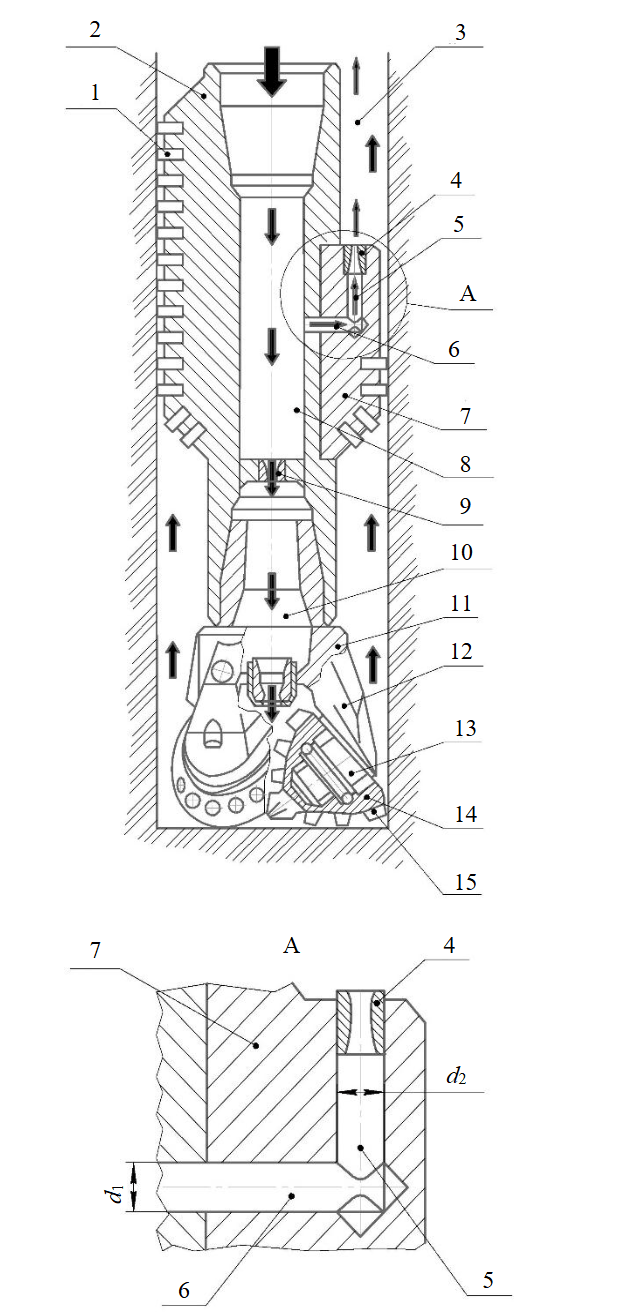
Fig.1. Design and operating principle of the drilling reaming-ejection device [30]
1 – carbide-reinforced wear-resistant inserts; 2 – body; 3 – ejection chamber; 4 – ejection nozzle; 5, 6 – flow channels; 7 – ejection blade; 8 – central drilling fluid circulation channel; 9 – throttling nozzle; 10 – rock-breaking tool; 11 – roller-cone drill bit; 12 – bit legs; 13 – journals; 14 – roller cones; 15 – teeths
The near-bit RED consists of a hollow cylindrical body equipped with a system of reaming blades of different lengths. All blades are reinforced with carbide elements, while the shorter blades contain special openings of two configurations (horizontal and vertical) into which special nozzles are installed. The pressure-distribution system operates due to a throttling nozzle located in the lower part of the internal circulation channel. An important parameter is the ratio between the area of the throttling nozzle and the total area of all ejection nozzles, which prevents insufficient cooling of the drilling tool.
The operation of the device begins when the drill string rotates together with the drill bit 11. During operation, the rotating roller cones interact with the bottom hole, their cutting structure 15 destroys the rock, and the reinforced inserts of the reamer stabilize the borehole wall. Bottom hole cleaning is achieved through circulation of drilling fluid through the drill pipes, the internal channels of the RED 8, and the drilling tool 10, thereby ensuring removal of cuttings from the rock-destruction zone. The fluid passing through channel 8 encounters resistance from the throttling nozzle 9, which creates the pressure required within the system and directs the flow into the ejection channels. The operating principle of the RED is based on the Bernoulli effect, according to which an increase in fluid-flow velocity results in a decrease in static pressure within the mixing zone. The drilling fluid enters through the ejection nozzle 4 into a specially formed chamber bounded by the borehole wall, the reamer body, and two adjacent long blades that are part of the RED body. In this zone, high-velocity fluid jets from nozzles 4 mix with slower upward flows containing rock particles and drilled cuttings transported from the bottom hole through the spaces between the blades into the ejection chamber 3. Interaction of these flows leads to the formation of an integrated ejected flow characterized by significantly higher velocity and lifting capacity compared with the original flow. At the same time, a low-pressure zone is formed in the near-bottom hole region, creating favorable conditions for efficient rock destruction. This effect is achieved through a reduction in the differential pressure acting on the bottom hole, which significantly facilitates the drilling process. These processes reduce the probability of secondary grinding of drilled rock and decrease the wear intensity of drilling tools.
It is well known that increasing the contact area between the drilling fluid jet and the side surface of the nozzle can improve the removal of drilled cuttings to the surface and increase the performance of nozzles used in rock-breaking tools. This is because a larger contact area can improve the efficiency of energy transfer from the jet to the drilled rock by increasing the jet velocity. Analysis of the calculated data confirms the evident advantage of a hexagonal nozzle profile in the process of drilling fluid jet formation. The design feature of this type of nozzle is that it generates a fluid flow with a significantly larger contact area with the working medium in the near-bottom hole zone compared with conventional circular nozzles. Such a design provides more effective interaction between the drilling fluid flow and the hydraulic environment of the bottom hole [9, 28].
This design solution ensures a more efficient involvement of large volumes of bottom hole hydraulic medium containing drilled cuttings in the circulation process. Consequently, the quality of cleaning of both the drilling tool and the entire near-bottom hole zone is improved. Therefore, the correct selection of nozzle type 4 and cross-sectional geometry directly affects the density and velocity of the emerging jet, which ultimately determine the operating efficiency of the RED.
Methods
To ensure a rational and well-founded selection of the optimal design of the RED ejection nozzles, this study proposes an investigation and comparison of cross-sections of different geometries (circular, triangular, square, pentagonal, regular hexagonal, and specially oriented hexagonal) using Computational Fluid Dynamics (CFD) simulation, which is one of the most accurate methods and has been validated in a sufficient number of similar applied studies [22, 31, 32]. For a detailed investigation of this issue, the design parameters of ejection nozzles with cross-sections of different geometric shapes were analyzed: circle, triangle, square, pentagon, regular hexagon, and specially oriented hexagon. The main initial condition of the simulation was the equality of the nozzle cross-sectional areas at the inlet and outlet, as well as equal nozzle height and outer cylinder diameter.
For numerical simulation of hydrodynamic processes in the CFD software package, the following initial system parameters were specified: working volume 0.017 m3; distance between the outlet nozzle and the boundary of the computational domain 0.4 m; fluid flow rate at the nozzle inlet 0.03 m3/s; process medium – liquid phase with a density of 1200 kg/m3; outlet pressure 0.2 MPa.
The computational domain used for the simulation is shown in Fig.2, a, while the geometric shapes of the modeled cross-sections are presented in Fig.2, b. The dimensions of the computational domain correspond to the overall dimensions of the ejection chamber formed by the borehole wall and the adjacent long blades of the RED body. The lower plane of the computational domain coincides with the nozzle inlet cross-section.
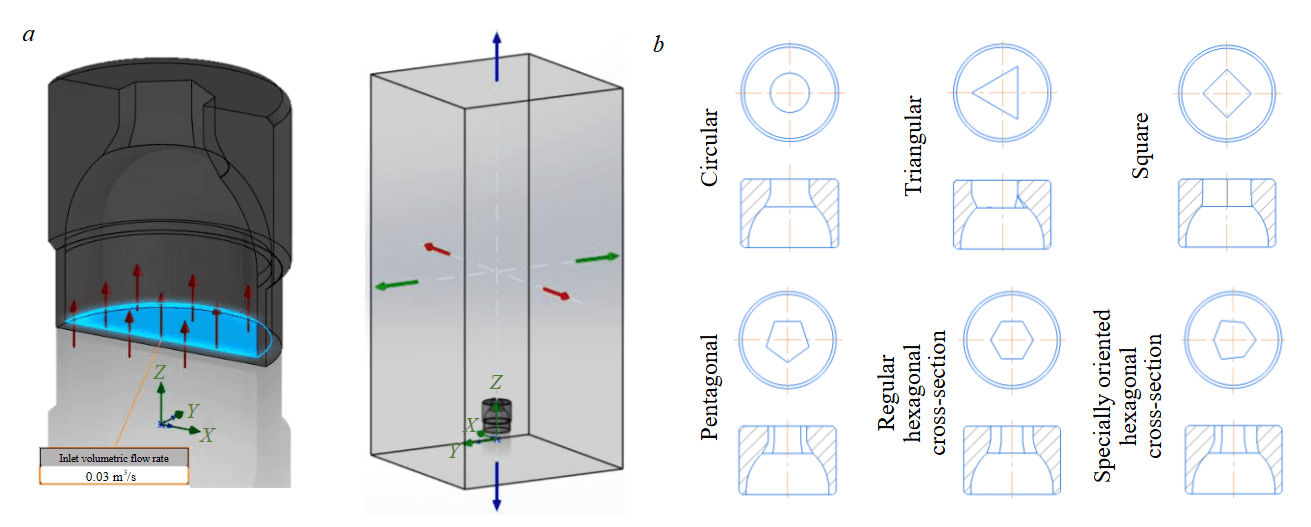
Fig.2. Input data for the simulation of fluid flow through an ejection nozzle: а – computational model and simulation domain; b – geometries of the modeled nozzle cross-sections
A submerged vertical jet of liquid with a density of 1200 kg/m3 issuing from the nozzle was simulated. An ejection nozzle with a circular cross-section was selected as the reference case for analysis because the prototype of the RED ejection nozzles is the hydraulic monitor nozzle of drilling rock-breaking tools, which predetermines their future interchangeability.
It is important to note the following limitations of the model:
- the model does not account for drill-string rotation effects and the associated dynamic loads;
- idealized boundary conditions were adopted;
- dynamic changes in the rheological properties of the drilling fluid during actual drilling operations were not considered;
- the results were obtained for steady-state conditions, whereas real drilling is characterized by an inherently unsteady process.
These limitations should be taken into account when interpreting the results and applying them in practice. Additional studies are recommended to refine the obtained relationships under actual drilling conditions.
The geometric feature of the specially oriented hexagonal cross-section is that it consists of three angles of one size (β1 = β2 = β3) and three angles of another, smaller, size (α1 = α2 = α3) (Fig.3). In the design of the drilling RED, the ejection nozzle with this cross-section is fixed against rotation relative to the ejection blade. One of the vertices formed by the smaller angles is oriented toward the RED axis, while the second is directed toward the leading face of one adjacent long blade. The third vertex formed by the smaller angles is directed toward the trailing face of the other adjacent long blade [30].
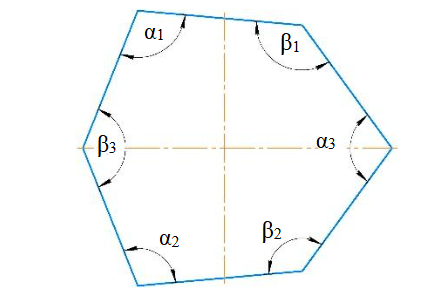
Fig.3. Geometric parameters of specially oriented hexagonal cross-section
Discussion of the results
The main indicators characterizing the efficiency of ejection nozzles are the velocity and height of the core of the drilling fluid jet issuing from the nozzle. Among these parameters, flow velocity is the most important, since it directly affects the occurrence and intensity of the ejection (suction) effect, which draws fluid from the operating zone of the drilling tool into the near-bit region and subsequently accelerates it upward through the annular space, thereby improving cleaning efficiency [15, 17]. The simulation results are presented in Fig.4 as a comparative analysis of the velocity and height of the jet core for nozzles with the investigated cross-sectional geometries.
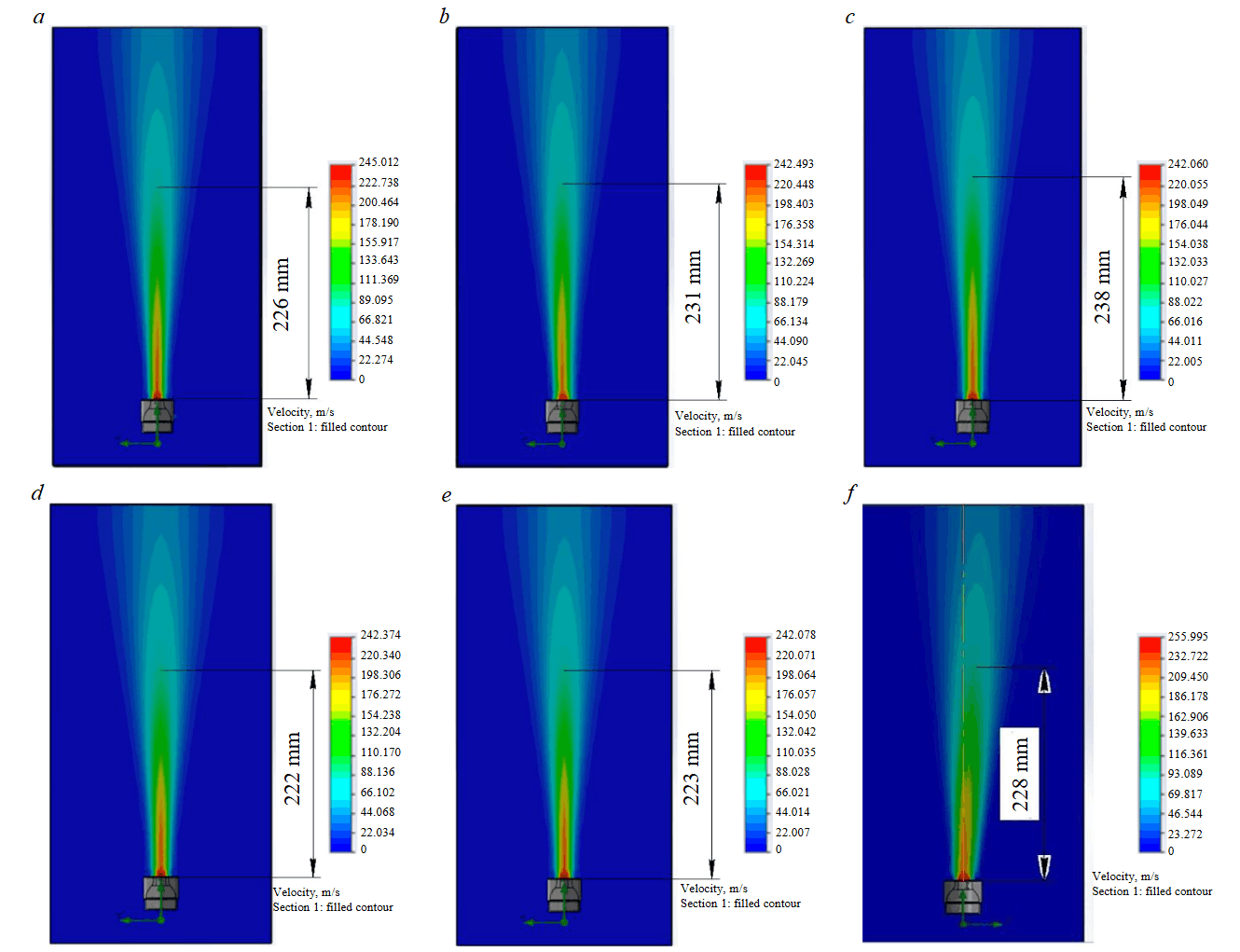
Fig. 4. Results of CFD simulation of drilling fluid flow through ejection nozzles with different cross-sectional geometries (jet-core velocity at the end of the potential core, m/s / maximum height of the main flow, mm): a – circular (111/226); b – triangular (110/231); c – square (110/238); d – pentagonal (110/222); e – regular hexagonal (110/223); f – specially oriented hexagonal (116/228)
All nozzles with different cross-sectional geometries, except for the specially oriented hexagonal nozzle, exhibited the same flow velocity. The increase in the velocity of the fluid-flow core issuing from the nozzle model with a specially oriented hexagonal cross-section amounted to approximately 4.5 % compared with the baseline design (circular cross-section) and approximately 5.5 % compared with the remaining models. This contributes to an increase in the velocity of the integrated mixed flow and improves the efficiency of drilled-cuttings removal from the bit operating zone, which in turn enhances bit reliability by reducing the probability of secondary rock grinding. Therefore, it can be concluded that the drilling RED equipped with ejection nozzles having a specially oriented hexagonal cross-section will operate more efficiently than the baseline circular nozzle and the other investigated designs.
As a result of the simulations, it was established that the nozzle with a specially oriented hexagonal cross-section deflected the fluid flow from the vertical by 2° (Fig.4, f ). A detailed analysis showed that this deviation occurred toward one of the three smaller angles, α3, whose value was 105°50′. This observation prompted an additional investigation in which nozzles with different values of α3 (85°, 95°, 115°, and 125°) were modeled while maintaining the principal simulation condition, namely, equality of the inlet and outlet cross-sectional areas. The jet-deflection angle from the vertical was designated as β. The simulation results for fluid flow through asymmetric hexagonal cross-sections with different α3 values are presented in Fig.5.
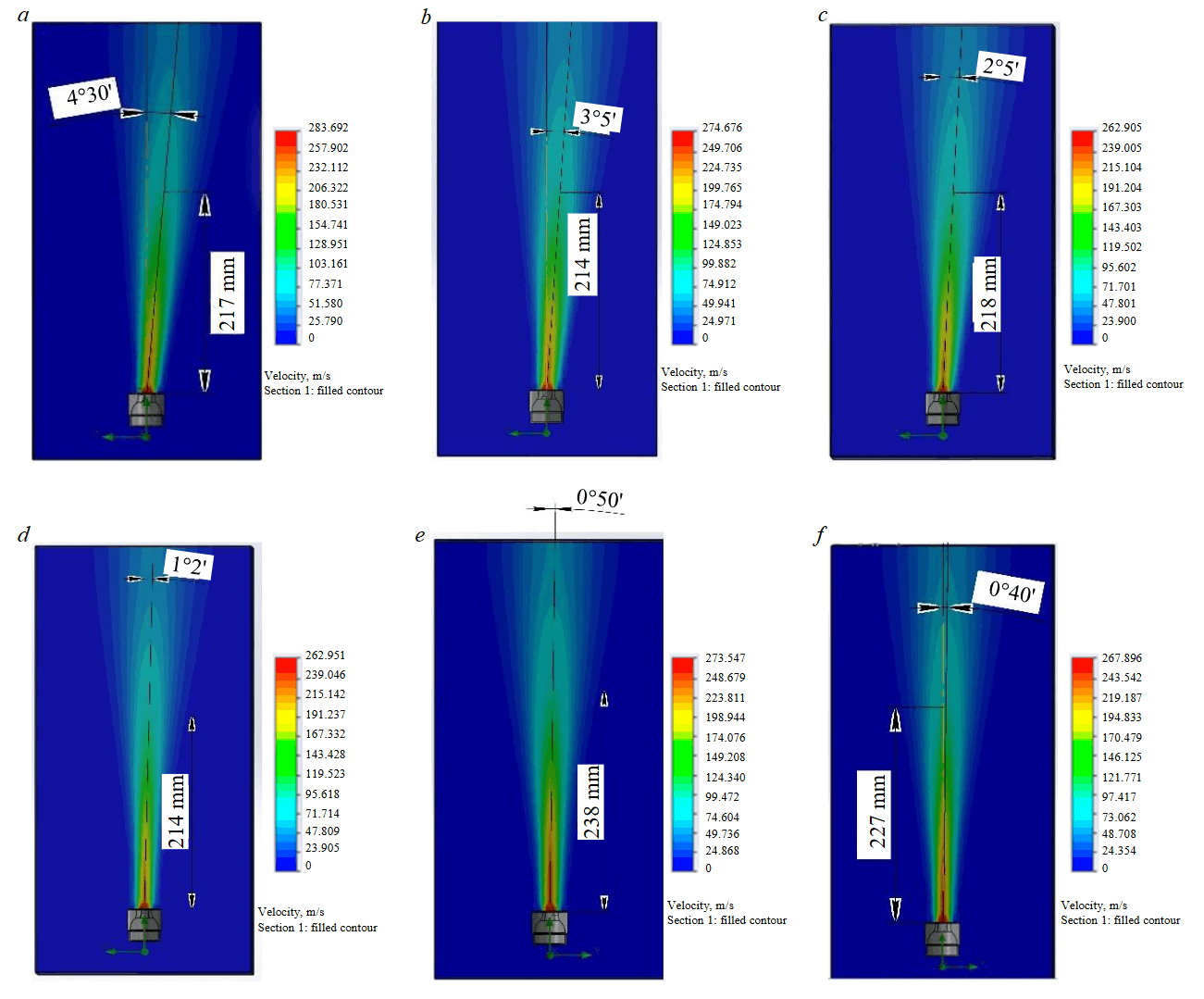
Fig.5. Results of drilling fluid flow simulation through an ejection nozzle with a specially oriented hexagonal cross-section at different values of α3: a – 85°; b – 95°; c – 100°; d – 110°; e – 115°; f – 125°
Based on the additional data obtained, a graph was constructed showing the relationship between the deviation angle β of the drilling fluid flow from the vertical and the angle α3 of the specially oriented hexagonal ejection nozzle (Fig.6). The following relationship was established between the deviation angle β of the drilling fluid flow and the control angle α3 of the specially oriented hexagonal cross-section: β=0.0012α32 – 0.3519α3 + 26.084. This relationship indicates that as the angle α3 increases, the deviation angle β also increases, confirming the possibility of purposeful control of the drilling fluid flow direction through modification of nozzle geometry. The coefficient of determination R2 = 0.9633 indicates a high degree of reliability of the established relationship. The obtained coefficient of determination falls within the range typical of precise engineering measurements, demonstrating the high reliability of the relationship and the possibility of its practical application.
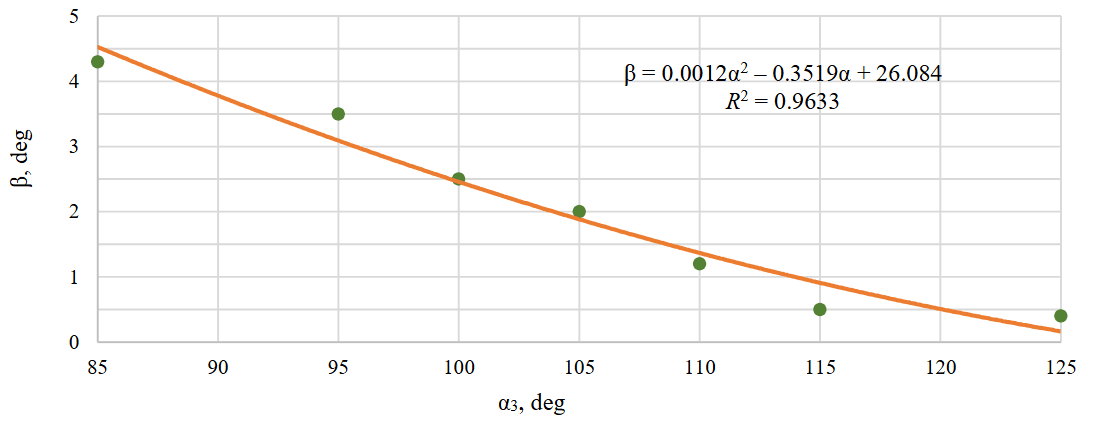
Fig.6. Dependence of the drilling fluid flow deviation angle β from the vertical on the control angle α3 of the specially oriented hexagonal cross-section of the ejection nozzle
The physical meaning of this phenomenon can be explained as follows. When the nozzle geometry changes (through variation of the control angle α3), the flow pattern of the fluid also changes. This leads to a redistribution of flow velocities, changes in the pressure distribution within the system, and the emergence of lateral forces that deflect the flow. The quadratic relationship indicates that the influence of the control angle on flow deviation is nonlinear: at small values of α3, its effect on β is relatively weak, whereas with increasing α3 the deflection effect increases nonlinearly. Thus, for different drilling conditions, optimal angle ranges can be identified in which maximum flow deflection is achieved.
Conclusion
Based on the conducted studies, it was established that the increase in the velocity of the drilling fluid flow core issuing from the nozzle model with a specially oriented hexagonal cross-section amounted to approximately 4.5 % compared with the baseline design (circular cross-section) and approximately 5.5 % compared with the remaining models. In addition, it was found that the nozzle design with a specially oriented hexagonal cross-section also makes it possible to direct the fluid flow at an angle toward the borehole wall.
The results of the additional numerical simulations made it possible to establish a relationship between the deviation angle of the drilling fluid flow from the vertical and the control angle of the specially oriented hexagonal cross-section of the ejection nozzle: β = 0.0012α32 – 0.3519α3 + 26.084. This relationship provides an opportunity for purposeful control of the drilling fluid trajectory through modification of nozzle geometry. In practice, this capability may be used for additional sealing of borehole walls without significant deviation from the designed borehole diameter. However, to increase the efficiency of this process, it is necessary to additionally employ modern innovative drilling fluids, such as those described in [33, 34].
As a result of the conducted study, relationships governing the influence of ejection-nozzle geometry on the hydrodynamic characteristics of drilling fluid flow, as well as on the possibility of influencing the flow trajectory in a controlled manner, were established. These findings expand the scientific understanding of ejection processes in rock-breaking drilling tools.
The obtained results create prerequisites for further research aimed at optimizing the design parameters of ejection nozzles (including hydraulic monitor nozzles of drill bits), investigating the influence of new geometric parameters on the efficiency of circulation systems as a whole, and developing methodologies for selecting optimal parameters for specific drilling conditions. In the future, these developments may be of considerable importance for the advancement of well drilling technologies and may be applied in the design of modern drilling tools to improve rock-breaking efficiency and the quality of bottom hole cleaning.
References
- Alieva L., Zhukov I.A. Upgrading rotary-percussion drilling of high-strength rocks by improving the structure of a rock-crushing blade-free tool. Sustainable Development of Mountain Territories. 2024. Vol. 16. N 4 (62), p. 1681-1694 (in Russian). DOI: 10.21177/1998-4502-2024-16-4-1681-1694
- Afanasev A., Simisinov D., Zubov V. Modeling of gear production in loose-abrasive machining technique. Materials Today: Proceedings. 2019. Vol. 19. Part 5, p. 2358-2360. DOI: 10.1016/j.matpr.2019.07.693
- Xiaohua Zhu, Keyu Shen, Bo Li. Investigation: Cutting Transport Mechanism in Inclined Well Section under Pulsed Drilling Fluid Action. Energies. 2021. Vol. 14. Iss. 8. N 2141. DOI: 10.3390/en14082141
- Al-Rubaii M., Al-Shargabi M., Al-Shehri D. A Novel Automated Model for Evaluation of the Efficiency of Hole Cleaning Conditions during Drilling Operations. Applied Sciences. 2023. Vol. 13. Iss. 11. N 6464. DOI: 10.3390/app13116464
- Rastvorova I.I., Dvoynikov V.M. Analysis of Mathematical Models for Developing a Methodology to Measure Energy and Spatial Characteristics of Axial Impact During Well Drilling. WSEAS Transactions on Applied and Theoretical Mechanics. 2025. Vol. 20, p. 130-137. DOI: 10.37394/232011.2025.20.15
- Xiaohua Zhu, Keyu Shen, Bo Li, Yanxin Lv. Cuttings Transport Using Pulsed Drilling Fluid in the Horizontal Section of the Slim-Hole: An Experimental and Numerical Simulation Study. Energies. 2019. Vol. 12. Iss. 20. N 3939. DOI: 10.3390/en12203939
- Povalikhin A.S., Bliznyukov V.Yu. Drilling technology features and the preparation of vertical borehole to the running of casing of large diameter. Inzhener-neftyanik. 2017. N 1, p. 5-12 (in Russian).
- Xiaoming Li, Yuyue Fan, Jiahua Li et al. Research on the Influence of a Cuttings Bed on Drill String Friction Torque in Horizontal Well Sections. Processes. 2022. Vol. 10. Iss. 10. N 2061. DOI: 10.3390/pr10102061
- Kunshin A.A., Buslaev G.V., Reich M. et al. Numerical Simulation of Nonlinear Processes in the “Thruster–Downhole Motor–Bit” System While Extended Reach Well Drilling. Energies. 2023. Vol. 16. Iss. 9. N 3759. DOI: 10.3390/en16093759
- Šporin J., Balaško T., Mrvar P. et al. Change of the Properties of Steel Material of the Roller Cone Bit Due to the Influence of the Drilling Operational Parameters and Rock Properties. Energies. 2020. Vol. 13. Iss. 22. N 5949. DOI: 10.3390/en13225949
- Ovchinnikov V.P., Ryabukha A.V., Rozhkova O.V., Listak M.V. Causes and types of accidents with rock-cutting tools (by the example of well N 307 of the Kopan field). Bulletin of the Association of Drilling Contractors. 2022. N 3, p. 18-22 (in Russian).
- Boreiko D.A., Lutoev A.A., Serikov D.Yu. Theoretical studies on the nature and conditions of interaction of heel and peripheral nose cones of offset roller cone bits with a bottom hole. Mining Science and Technology. 2022. Vol. 7. N 3, p. 231-239. DOI: 10.17073/2500-0632-2022-3-231-239
- Litvinenko V.S., Dvoinikov M.V. Methodology for determining the parameters of drilling mode for directional straight sections of well using screw downhole motors. Journal of Mining Institute. 2020. Vol. 241, p. 105-112. DOI: 10.31897/PMI.2020.1.105
- Tretyak A.Ya., Popov V.V., Grossu A.N., Borisov K.A. Innovative approaches to designing highly efficient rock-breaking tool. Mining Informational and Analytical Bulletin. 2017. N 8, p. 225-230 (in Russian). DOI: 10.25018/0236-1493-2017-8-0-225-230
- Rawal R., Karmakar N.C., Sharma S.K. Optimization of Fluid Flushing Rate: A Study on Laboratory Drilling Setup. Journal of the Institution of Engineers (India): Series C. 2022. Vol. 103. Iss. 4, p. 985-990. DOI: 10.1007/s40032-022-00809-9
- Toshniyozov L.G., Toshov J.B. Theoretical and experimental research into process of packing in drilling. Mining Informational and Analytical Bulletin. 2019. N 11, p. 139-151 (in Russian). DOI: 10.25018/0236-1493-2019-11-0-139-151
- Bogomolov R.M., Panin N.M. Improvement of Components of Roller-Cone Drill Bit Circulation Systems. Sfera. Neft i Gaz. 2021. N 3 (82), p. 52-57 (in Russian).
- Serikov D.Yu., Blinkov O.G., Panin N.M., Shigin A.O. Improvement of central washing of a rolling drilling tool. Equipment and technologies for oil and gas complex. 2019. N 3 (111), p. 23-27 (in Russian). DOI: 10.33285/1999-6934-2019-3(111)-23-27
- Povalikhin A.S., Bliznyukov V.Yu. Selective control of a drill-pipe casing string when drilling a horizontal well. Construction of oil and gas wells on land and sea. 2019. N 5, p. 5-10 (in Russian). DOI: 10.30713/0130-3872-2019-5-5-10
- Shigin A.O., Gilev A.V., Shigina A.A. Stresses and stability of rolling cutter bits in complex-structure rock masses. Mining Informational and Analytical Bulletin. 2013. N 4, p. 325-333 (in Russian).
- Tungusov S.А. Pulsed flow and its generation for borehole flushing. Proceedings of higher educational establishments. Geology and Exploration. 2024. Vol. 66. N 1, p. 109-115 (in Russian). DOI: 10.32454/0016-7762-2024-66-1-109-115
- Kun Bo, Fangzhou Ji, Zhiqiang Zhao et al. Optimum Design of Large-Diameter Reverse Circulation Drill Bit for Drilling Rescue Wells Using Orthogonal Experimental Method and CFD Simulation. Energies. 2023. Vol. 16. Iss. 9. N 3913. DOI: 10.3390/en16093913
- Leusheva E., Alikhanov N., Tabatabaee Moradi S.S. Experimental Evaluation of Influence of Physico-chemical Properties of Surfactants on Drilling Process in Pay-zones. International Journal of Engineering, Transactions A: Basics. 2025. Vol. 38. Iss. 4, p. 819-829. DOI: 10.5829/ije.2025.38.04a.13
- Xinda Qi, Weishan Chen, Yingxiang Liu et al. A Novel Well Drill Assisted with High-Frequency Vibration Using the Bending Mode. Sensors. 2018. Vol. 18. Iss. 4. N 1167. DOI: 10.3390/s18041167
- Jalakani R., Tabatabaee Moradi S.S., Morenov V. Reliability Analysis of a Drilling Bit Penetration Model in Oil and Gas Wells: A Case Study. International Journal of Engineering, Transactions B: Applications. 2024. Vol. 37. Iss. 11, p. 2213-2222. DOI: 10.5829/ije.2024.37.11b.08
- Elovyh P.F., Neskoromnyh V.V., Elovyh V.F. Determination of the coefficient side of the milling abilities of the deflection system in the drilling of a directional wellbore. Inzhener-neftyanik. 2018. N 1, p. 11-14 (in Russian).
- Djuraev R.U., Merkulov M.V., Khatamova D.N., Asanov A.T. Engineering solutions for sludging prevention at bottomhole. Mining Informational and Analytical Bulletin. 2025. N 7, p. 102-114 (in Russian). DOI: 10.25018/0236_1493_2025_7_0_102
- Shigin A.O., Boreyko D.A., Tskhadaya N.D., Serikov D.Yu. Comparative Analysis of Roller Drill Bit Performance. SOCAR Proceedings. 2021. N S2, p. 7 (in Russian). DOI: 10.5510/OGP2021SI200536
- Serikov D.Yu., Myagkov K.A., Vasiliev A.A. Improvement of the design of the supra-bit rectilinear calibrator-ejector. Construction of oil and gas wells on land and sea. 2019. N 10, p. 21-26 (in Russian). DOI: 10.30713/0130-3872-2019-10-21-26
- Serikov D.Yu., Borejko D.A., Muradov A.V. Patent N 2799295 RF. Downhole calibrator. Publ. 04.07.2023. Bul. N 19 (in Russian).
- Buslaev G.V., Konoplyannikov A.V. Mathematical Modeling of a Hydro-mechanical System with a Positive Displacement Motor and Hydraulic Thruster to Optimize the Drilling Process for Extended-reach Drilling Wells. International Journal of Engineering. 2026. Vol. 39. Iss. 5, p. 1077-1087. DOI: 10.5829/ije.2026.39.05b.03
- Ganiev R.I., Deboer L., Agliullin A.Kh., Ismakov R.A. CIRCUL+ self-activated circulation translator: modeling, bench validation and field tests. Bulletin of the Association of Drilling Contractors. 2025. N 4, p. 31-39 (in Russian).
- Litvinenko V.S., Nikolaev N.I. Technological fluids for increasing effectivity of construction and exploitation oil and gas wells. Journal of Mining Institute. 2011. Vol. 194, p. 84-90 (in Russian).
- Shishov A.M., Ulyasheva N.M. On the possibility of regulating the formation of the bottom hole zone of the well by controlling the composition of the drilling mud. Inzhener-neftyanik. 2023. N 4, p. 67-71 (in Russian).