


A combined method for remediation of contaminated areas of the oil complex based on electrochemical treatment with the creation of a geochemical barrier
Abstract
The scale of the environmental problem associated with the pollution of vast areas of industrial zones in the oil industry is significant and requires the use of new technological approaches in solving it. A developing technology in this field is the use of electrochemical remediation, i.e., the removal of petroleum products and associated aqueous contaminant solutions from environments using low-voltage electric currents. The advantage of this method is the purification of both the surface fertile soil and the deeper soil layers. A current trend in the deve-lopment of electrochemical remediation methods is their integration with other remediation technologies, which increases remediation efficiency through oxidation or pollutant extraction, as well as significantly reduces the time required for remediation. This work is devoted to combining the treatment of oil-contaminated soils with direct electric current with the adding of the oxidizing component, calcium peroxide. The creation of a reactive geochemical barrier made of calcium peroxide in the interelectrode zone is proposed. This barrier will act as an inductor of oxidative reactions that promote the gradual mineralization of petroleum hydrocarbons. The formation of a directed contaminated electrophoretic flow moving from the anode to the cathode through a layer of calcium peroxide is simulated under laboratory conditions, and the characteristics of the purification process are investigated. The dynamics of such important environmental parameters as voltage, acidity of the treated medium, volume of the generated electrophoretic flow and the content of petroleum products in the solid (soil) and liquid (water) phases after cleaning are studied.
None
Introduction
Industrial operations can lead to pollution, which significantly change the chemical composition of soils and groundwater. Groundwater and upper confined aquifers are particularly vulnerable. Groundwater accounts for a quarter of all freshwater reserves, while surface water accounts for less than one percent. The interconnectedness of these two water resources leads to the active migration of pollutants between them and the soil environment. Groundwater pollution can quickly spread over large areas, affecting surface water bodies and drinking water systems, making this problem extremely pressing.
According to the State report “On the state and protection of the environment of the Russian Federation in 2023”, 4516 cases of groundwater pollution were identified, 2799 of which were related to drinking and domestic water intake. Approximately 36 % of these cases are related to industrial activities.
The main pollutants of groundwater are nitrogen compounds (nitrates, nitrites, ammonia or ammonium), oil products, sulfates, and chlorides, as well as heavy metals and phenols [1-6]. Contamination of soils and groundwater by organic compounds, particularly petroleum hydrocarbons, is an increased danger. The number of cases of groundwater contamination by oil products at the beginning of 2025 was 913. The routes of entry are quite varied and include accidental spills during oil production and transportation, infiltration due to damaged storage facility insulation, and inadequate treatment of industrial wastewater. The content of organic components in groundwater exceeds regulatory limits by tens of times in areas of the oil industry. The situation is complicated by the extremely difficult and resource-intensive monitoring of the underground migration of pollutants and their removal.
One of the developing approaches to solving this problem is the use of electrokinetic [7-9] and electrooxidating technologies [10, 11], which allow not only for the purification of soil and water in wells at significant depths, but also, if necessary, for the correction of the direction of groundwater movement by creating an electrophoretic flow between oppositely charged electrodes [12-16].
The combination of this technology with other remediation methods is of interest [17-22]. In particular, it is possible to create additional active geochemical barriers to accelerate the electrochemical cleaning process and increase its efficiency [23-25]. Geochemical barriers are areas of geochemical systems in which a sharp decrease in the intensity of chemical element migration occurs and, as a consequence, their accumulation or transformation occurs too. Artificially created active barriers, including fillers or active elements from substances capable of entering into physicochemical reactions with pollutants, allow for their removal [26-28]. In general, the barrier is installed perpendicular to the trajectory of contaminated groundwater. As water passes through the barrier, contaminants are retained and undergo chemical reactions [29]. These reactions facilitate the purification of the flowing stream. Ideally, barriers should have sufficient reactivity to completely trap toxicants – they should be permeable to water, but not to pollutants, and they should not require high energy consumption.
This paper presents the results of studies on the cleaning of oil-contaminated environments by combining low-current electrical treatment and chemical purification in a calcium peroxide (CaO2) barrier. The addition of calcium peroxide promotes the oxidation of petroleum hydrocarbons [30, 31]. Petroleum hydrocarbon particles surrounded by a water shell move in the soil, and the ions resulting from dissociation migrate to the anode and cathode during using the electrokinetic method. All this creates a controlled electrophoretic flow throughout the entire volume of the soil and facilitates the passage of the flow through a permeable barrier of CaO2.
Methodology
Experimental studies were aimed at removing diesel fuel from the aqueous soil phase and soil using a permeable reactive barrier of calcium peroxide and directed electrokinetic action.
During the experiments, conditions were created where calcium peroxide served as the primary cleaning agent, and the application of electric current generated a flow of contaminated liquid toward the CaO2 barrier, accelerating its movement.
A laboratory installation, which included an open-type electrochemical cell, an APS-1203 stabilizing power source, electrodes, vessels for electrolyte (water) and polluted water flow, was used for the experiments (Fig.1, 2).
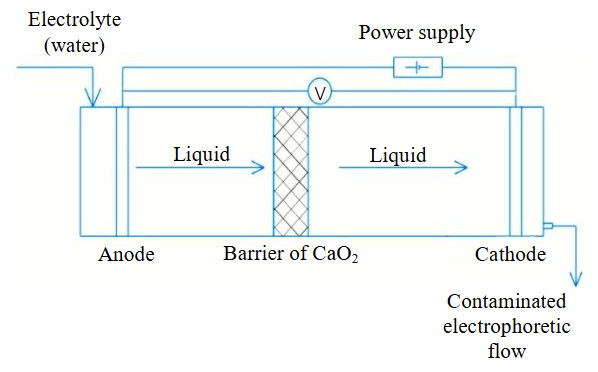
Fig.1. Scheme of the research facility
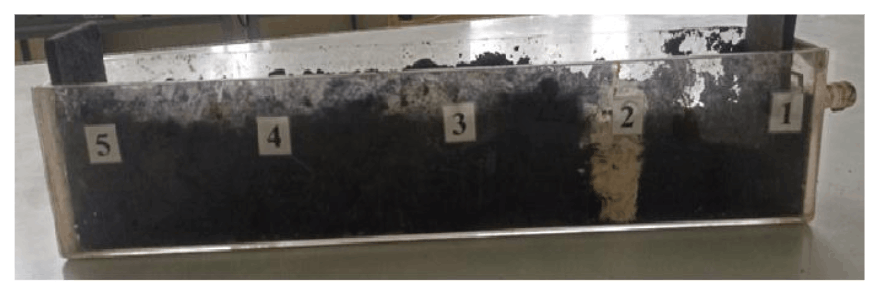
Fig.2. Cell loading variant for experiments. Soil sampling reference points: 1 – cathode; 2 – calcium peroxide layer; 3, 4 – points in the anode space; 5 – anode
The experimental electrochemical cell was shaped like a parallelepiped made of plexiglass. Its dimensions were 380 mm long, 58 mm wide, and 90 mm high. The electrodes used were rectangular stainless steel plates with a mesh structure, ensuring a uniform electric field throughout the soil volume. The electrode material was sufficiently resistant to surface reactions.
A model environment was previously prepared, it was loam-based soil specially contaminated with diesel fuel. Previous studies on electrochemical cleaning conducted by the authors revealed general patterns in the reduction of oil product content in various soil types. Cleaning efficiency decreases in the order clay, loam, and sand (average 84.5 – 75 – 69 %) [9], with loam representing the median value. This, as well as the widespread occurrence of loams, led to the use of this soil type as the basis for the model soil. Diesel fuel was chosen as the pollutant component for the experiments due to its widespread use in transport and technical equipment, making it one of the most common water and soil pollutants. The reduction in oil and diesel fuel content follows similar patterns.
Ten grams of diesel fuel were added to 1 kg of soil, mixed, and left to stand for 24 h. Key fuel properties: density at 15 °C (GOST R 57037-2016) – 841.5 kg/m3; mass fraction of polycyclic aromatic hydrocarbons (GOST EN 12916-2017) – 2.2 %; mass fraction of sulfur (GOST ISO 20884-2016) – 7.6 mg/kg; closed crucible flash point (GOST 6356-75) – 71 °C; coking properties of 10 % distillation residue (ISO 10370-2014) – < 0.10 wt.%; ash content (GOST 1461-2023) – none; water content (ISO 12937-2000) – < 30 mg/kg; total contamination (GOST EN 12662-2016) – < 12 mg/kg; copper plate corrosion at 50 °C (3 h) (GOST ISO 2160-2013) – class 1; kinematic viscosity at 40 °C (GOST 33-2016) – 3.247 mm2/s.
A CaO2 layer served as an active geochemical barrier with oxidizing properties. A 50-gram sample of calcium peroxide was placed in the central zone of an electrochemical chamber, in which soil contaminated with diesel fuel had been manually compacted. The calcium peroxide area was initially separated from the bulk of the soil using a paper filter, which was later removed.
Water (electrolyte) was supplied to the soil container through a system of perforated tubes. Additional containers were used to collect the overflowing liquid exiting the main cell. One metal plate was connected to the positive pole of the electric current source (anode), and the other to the negative pole (cathode). A uniform distribution of electric current was achieved in the soil samples. A voltage of 20 V was applied to the electrodes. During the treatment, process parameters such as amperage, pH, volume of electrophoretic flow passing through the soil, and oil products concentration were measured. The primary indicator determining the treatment effectiveness was the oil products content in the outgoing liquid stream and the soil.
Tap water was used for the experiments, since distilled water does not ensure a sufficient rate of liquid flow transfer due to the absence of salts capable of dissociation. The main physicochemical characteristics of the water (electrolyte) before entering the unit: pH – 7.40; total mineralization (dry residue) – 348 mg/l; total hardness – 5.7 °J; permanganate oxidizability – 0.037 mg/l; oil products – < 0.05 mg/l; iron (Fe, total) – 0.04 mg/l; nitrates (as NO3–) – 1.1 mg/l; sulfates (SO42–) – 105 mg/l; chlorides (Cl–) – 11 mg/l; residual free chlorine – 0.41 mg/l.
The treatment time was 10 h (600 min). Electric current measurements were taken every 30 min.
The gross oil product content in soil was determined according to RD 52.18.575-96 “Determination of the gross oil product content in soil samples by infrared spectrometry”, and in water according to PND F 14.1:2:4.5-95 “Methodology for measuring the mass concentration of oil products in drinking, surface, and wastewater by IR spectrometry”. A KN-3 concentration meter was used in the experiments.
The acidity of the purified water flow was determined using a potentiometric pH measurement method using an ANION-4100 device, while soil acidity was determined using an HI9921 soil temperature and moisture meter.
The electrolyte (water) volumes fed into the cell and exiting it after the cathode were measured to estimate the volume of the purified liquid (electrophoretic) flow. Measurements were taken every hour.
Results and discussion
During the experiments, current measurements were taken every 30 min at an interelectrode voltage of 20 V. Current changes over time are shown in Fig.3. The average values for three replicate experiments are presented here and below.
As can be seen from the graph in Fig.3, at the initial stage (up to 180 min), the amperage increases, which is explained by the transition of salts from the sorbed to the dissolved (ionic) state. Furthermore, the temperature of the treated soil increases, leading to a decrease in the viscosity of the electrophoretic flow and an increase in the velocity of ion movement. The ion concentration then decreases, and the current reaches a steady-state value determined by the mineralization of the water (electrolyte).
The electrophoretic flow volume, corresponding to the volume of purified liquid flow passing through the calcium peroxide barrier, was measured every hour. The results are presented as a diagram in Fig.4.
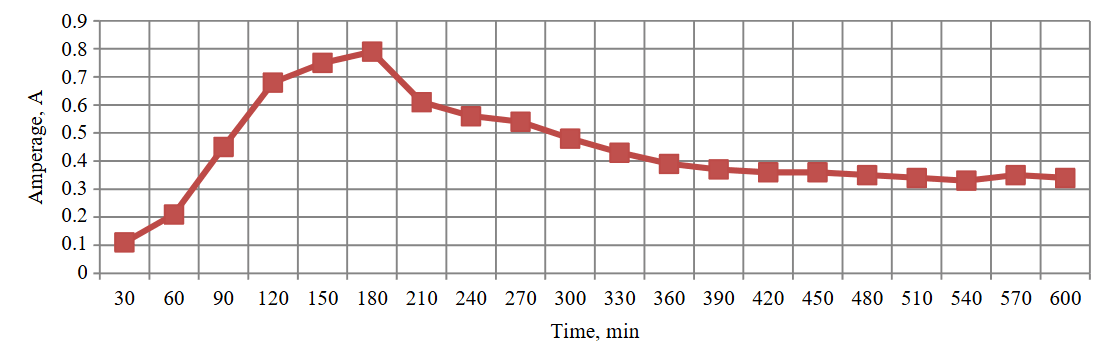
Fig.3. Amperage dynamics over time
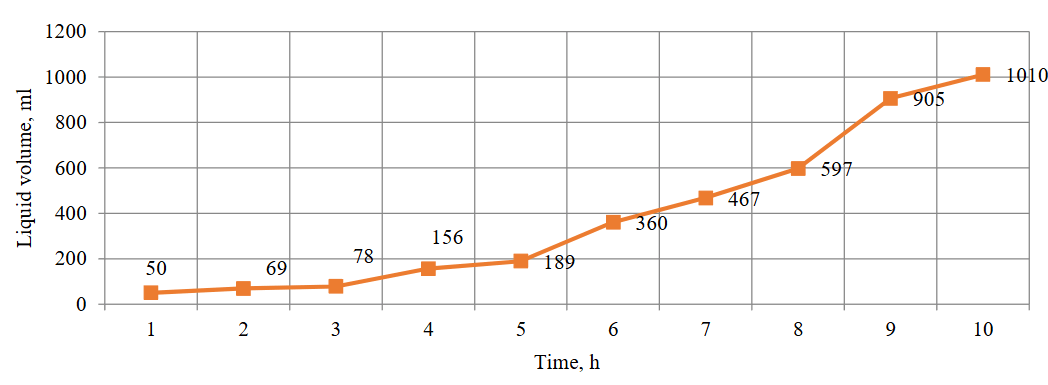
Fig.4. Electrophoretic flow volume changing over time
Formation of an electrophoretic flow ensures the transport of pollutants toward the cathode, which in this case was used to create a directed flow of contaminated water toward the active calcium peroxide barrier. The electrophoretic flow rate increases from G1 ≈ 19 ml/h ≈ 19∙10–3 l/h–1 to G2 ≈ 200∙10–3 l/h–1 due to an increase in the treated soil temperature from 20 to 61 °C, which leads to a decrease in the pore fluid viscosity and an increase in the filtration coefficient, which determine the volumetric flow rate in the interelectrode space.
The acidity of the medium – the soil at the cathode and anode, and the liquid after passing through the cell – was measured hourly. The results of the pH measurements at the cathode and anode are presented in Fig.5. The acidity of the liquid flow at the cell outlet after the cathode and the soil acidity in the near-cathode zone were identical.
As can be seen from the graphs in Fig.5, an alkaline environment forms at the cathode, while an acidic environment forms at the anode. The excess concentration of negative ions at the cathode coincides with the positive ions excess concentration at the anode. This is explained by the fact that the velocity of ion movement toward the electrodes can be estimated using the equation
where k is the permeability coefficient; µ is the dynamic viscosity coefficient of the liquid, Pa·s; P is the hydrostatic pressure, Pa; U is the voltage between the electrodes, V; ρ± is the charge density of positive and negative ions, C/m3;
zi is the charge number of positive ions of type i; ni is the concentration of positive ions of type i, m–3; zj is the charge number of negative ions of type j; nj is the concentration of negative ions of type j, m–3; e is the elementary charge, e = 1.6·10–19 C.
Since hydrostatic pressure is small compared to electrostatic interaction P << ρ±U, it follows from the velocity equation that, with equal charge densities of positive and negative ions, the velocities of positive ions moving to the cathode and negative ions moving to the anode are practically the same.
The key parameter determining the effectiveness of the cleaning is the oil products content in the soil and liquid after the calcium peroxide barrier. Analysis for the quantitative content of oil products was carried out after 10 h. Soil was collected in the near-cathode zone. Each sample was divided into three parts and analyzed using a concentration meter, after which the arithmetic mean value of the oil product content was determined, which was then used to determine the cleaning efficiency.
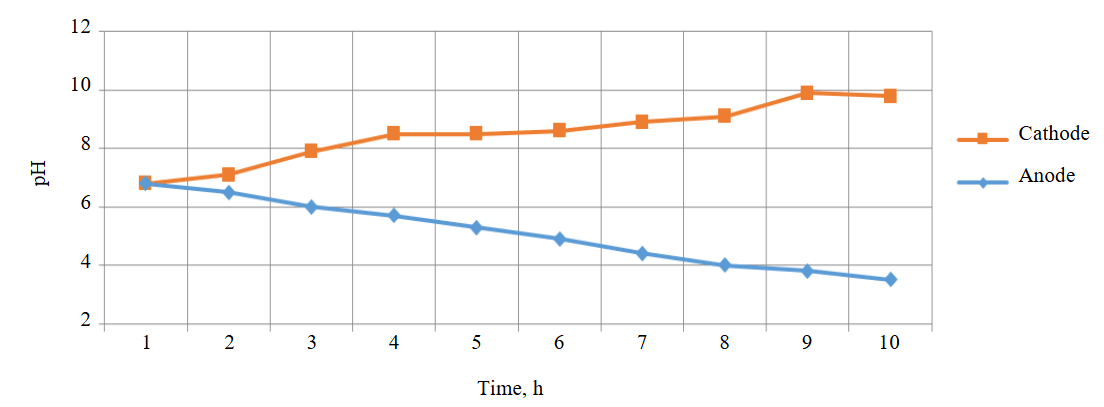
Fig.5. Acidity change at the electrodes
The initial oil products concentration in the soil Cin was 10,020 mg/kg (averaged over three measurements). The concentration in the cathode zone after the calcium peroxide layer Ccl after 10 h of the experiment was 1601 mg/kg. Based on this, the effectiveness of soil remediation after the peroxide barrier
The oil product content in the liquid exiting the cell was 1826 mg/l.
The creation of an electroosmotic flow under the influence of an electric current leads to the movement of contaminants, including oil products, into the cathode zone, followed by their leaching with the liquid phase. This results in an increased oil product content in the water compared to the soil medium (approximately 2 %). The oil product content in the near-cathode zone of the soil was 3737 mg/kg in a similar experiment without a calcium peroxide layer. The soil cleaning efficiency without a peroxide barrier reached 62.7 %. The oil product content in the electrophoretic flow without peroxide purification was 8461 mg/l. Therefore, it can be concluded that the calcium peroxide barrier increased the groundwater cleaning efficiency to 78.42 %.
The reduction of oil product content in the peroxide layer is achieved through oxidation processes, specifically the formation of hydrogen peroxide (H2O2) and hydroxyl radicals. The hydroxyl radical is a powerful oxidizing agent that plays a crucial role in the chemical oxidation of hydrocarbons; however, its lifetime does not exceed 10–9 s. When hydroxyl radicals interact with monoaromatic rings, so-called hydroxycyclohexadienyl radicals are formed. Subsequently, more than 80 % of these radicals are converted to phenol and undergo further oxidation. Under ideal conditions, complete mineralization of organic compounds is possible [32-34]. Hydrogen peroxide is unstable and also actively participates in the oxidation of organic matter [35, 36]. The relatively short lifetime of hydrogen peroxide (from several minutes to several hours) and hydroxyl radicals can be compensated for by using solid peroxides, such as calcium peroxide, in groundwater cleaning.
As a result of the interaction of calcium peroxide with water, the following chemical reactions occur:
When optimal process conditions are created, complete mineralization of petroleum hydrocarbons in groundwater gradually occurs. However, it should be noted that deviating from optimal process conditions can lead to secondary contamination of the treated environment due to the formation of highly toxic intermediate oxidation products, including organochlorine compounds. Therefore, it is crucial to monitor the environment toxicity after treatment using chemical analysis or integrated assessment using biotest methods. To prevent and minimize the formation of toxic compounds, it is recommended to conduct preliminary laboratory tests on samples collected from a specific contaminated site before implementing electrochemical treatment technology in the field. This will allow for the selection of the most appropriate treatment parameters (voltage, time, etc.) and, in extreme cases, the need for additional soil flushing.
A key parameter of the system is energy consumption
where 0, T are the time integration limits; I is the amperage, A; U is the average voltage, V; q is the electric charge passed between the anode and cathode, C.
The energy consumption calculated based on the obtained data was 35.58 MJ per 1 kg of oil products.
Conclusion
Experimental studies have shown that the combined use of electrochemical treatment with the creation of a reactive geochemical barrier made of calcium peroxide is effective for both soil remediation and groundwater cleaning.
The cleaning process operates simultaneously in several directions. During electrokinetic cleaning, passing an electric current through oil-contaminated soil causes the movement of oil particles surrounded by an aqueous phase toward the cathode, creating an electrophoretic flow directed toward the geochemical barrier. The barrier's active element, calcium peroxide, promotes the oxidation of organic compounds by generating hydrogen peroxide upon reaction with the aqueous medium. The decomposition of some hydrocarbons occurs through electrically induced oxidation reactions, including those involving hydroxyl radicals formed in the soil.
The use of an additional oxidizing layer increased cleaning efficiency by 21.32 %. Overall, combining the two methods under consideration resulted in a diesel fuel removal efficiency of 84.02 %. The oil products concentration in the electrophoretic outlet stream also decreased significantly. The oil product content in the simulated groundwater (the contaminated water stream exiting the electrochemical chamber) without peroxide treatment was 8461 mg/l. This value decreased by 6635 mg/l with the formation of a calcium peroxide barrier layer. Thus, the cleaning efficiency reached 78.42 %, suggesting that this method can be used to treat contaminated groundwater.
It should be noted that the electrochemical cleaning processes with the formation of a geochemical barrier, discussed in this article, were studied using a simulated contaminated medium – loam soil contaminated with diesel fuel. In this regard, expanding the scope of the study to other soil types or contamination with other types of oil products is of practical interest. However, the obtained results already allow us to understand the general patterns of cleaning processes in aquatic and soil environments. Clayey soils are characterized by fine dispersion and the presence of iron-containing mineral compounds, which creates more favorable conditions for electrooxidative processes, particularly Fenton-like reactions, compared to sand. However, the high permeability of sand promotes the intensification of electrokinetic processes – the movement of pollutants in the aqueous phase.
The presented studies can be used to determine the operating parameters of an industrial-scale groundwater cleaning equipment, as well as to design future models of such installations. In particular, calculations based on the experimental results showed that the specific energy consumption of a soil cleaning installation for combined cleaning is relatively low and amounts to 35.58 MJ, or 9.8 kW·h per 1 kg of oil products. The cost of 1 kg of oil products removing will be 98 rub. at an electricity price of 10 rub. per 1 kW·h. The oil content of dry soils ranges from 10 to 300 g/kg. Soil containing more than 150 g of oil products per 1 kg of soil is classified as extremely contaminated. If the contamination level of a soil plot is 30 % (300 g/kg), which corresponds to an accidental oil spill, the cost of 1 kg of soil cleaning will be 29.4 rub. It should be noted that electricity will not be consumed immediately, but over a long period (for example, during the warm season), making it possible to use alternative energy sources such as solar panels. In general, the economic costs are justified when electrochemical soil treatment is carried out at significant depths, as well as for groundwater, when other treatment technologies are difficult or practically impossible to implement. The overall cost of remediation can be reduced by combining electrochemical treatment with other technologies, such as sorbents and phytoremediation, if necessary.
This combined method of remediating contaminated areas using electrochemical treatment and the creation of a geochemical barrier can be used to clean both deep soil horizons and groundwater contaminated with various types of oil products. Of interest is further study of the specific spatial distribution of pollutants in the zones between the electrodes and the geochemical barrier as well as the selection of optimal volumes of calcium peroxide necessary and sufficient for effective remediation.
References
- Talabi A.O., Kayode T.J. Groundwater Pollution and Remediation. Journal of Water Resource and Protection. 2019. Vol. 11. N 1, p. 1-19. DOI: 10.4236/jwarp.2019.111001
- Sidiropoulos P. Groundwater Pollution: Sources, Mechanisms, and Prevention. Hydrology. 2024. Vol. 11. Iss. 7. N 98. DOI: 10.3390/hydrology11070098
- Zohud A., Alam L., Goh C.T. Evaluation of Groundwater Quality Using the Water Quality Index (WQI) and Human Health Risk (HHR) Assessment in West Bank, Palestine. Hydrology. 2023. Vol. 10. Iss. 10. N 198. DOI: 10.3390/hydrology10100198
- Erzova V.A., Rumynin V.G., Nikulenkov A.M. et al. Forecast of radionuclide migration in groundwater of the zone affected by construction drainage at the Leningrad NPP-2. Journal of Mining Institute. 2023. Vol. 260, p. 194-211. DOI: 10.31897/PMI.2022.27
- Peiyue Li, Karunanidhi D., Subramani T., Srinivasamoorthy K. Sources and Consequences of Groundwater Contamination. Archives of Environmental Contamination and Toxicology. 2021. Vol. 80. Iss. 1, p. 1-10. DOI: 10.1007/s00244-020-00805-z
- Semyachkov A.I., Pochechun V.A., Semyachkov K.A. Hydrogeoecological conditions of technogenic groundwater in waste disposal sites. Journal of Mining Institute. 2023. Vol. 260, p. 168-179. DOI: 10.31897/PMI.2023.24
- Gingine V., Shah R.P., Venkata Koteswara Rao P, Hari Krishna P. A review on study of Electrokinetic stabilization of Expansive soil. International Journal of Earth Science and Engineering. 2013. Vol. 6. N 2 (1), p. 176-181. DOI: 10.13140/2.1.2809.4086
- Vocciante M., Dovì V.G., Ferro S. Sustainability in ElectroKinetic Remediation Processes: A Critical Analysis. Sustainability. 2021. Vol. 13. Iss. 2. N 770. DOI: 10.3390/su13020770
- Meshalkin V.P., Shulaev N.S., Pryanichnikova V.V., Kadyrov R.R. Energy-Efficient Engineering of Technologies in the Field of Electrochemical Treatment of Oil-Containing Soils. Theoretical Foundations of Chemical Engineering. 2024. Vol. 58. N 4, p. 1135-1142. DOI: 10.1134/S0040579525600251
- Ganiyu S.O., Gamal El-Din M. Insight into in-situ radical and non-radical oxidative degradation of organic compounds in complex real matrix during electrooxidation with boron doped diamond electrode: A case study of oil sands process water treatment. Applied Catalysis B: Environmental. 2020. Vol. 279. N 119366. DOI: 10.1016/j.apcatb.2020.119366
- Ferreira M.B., Sales Solano A.M., dos Santos E.V. et al. Coupling of Anodic Oxidation and Soil Remediation Processes: A Review. Materials. 2020. Vol. 13. Iss. 19. N 4309. DOI: 10.3390/ma13194309
- Ganiyu S.O., Martínez-Huitle C.A., Rodrigo M.A. Renewable energies driven electrochemical wastewater/soil decontamination technologies: A critical review of fundamental concepts and applications. Applied Catalysis B: Environmental. 2020. Vol. 270. N 118857. DOI: 10.1016/j.apcatb.2020.118857
- Streche C., Cocârţă D.M., Istrate I.-A., Badea A.A. Decontamination of Petroleum-Contaminated Soils Using The Electrochemical Technique: Remediation Degree and Energy Consumption. Scientific Reports. 2018. Vol. 8. N 3272. DOI: 10.1038/s41598-018-21606-4
- Dehghan Abkenar S., Khakipour N., Alahdadi I. Recent Advances in Electrochemical Treatment Technology for the Remediation of Contaminated Soil. Analytical and Bioanalytical Electrochemistry. 2024. Vol. 16. Iss. 3, p. 280-306. DOI: 10.22034/abec.2024.712243
- Shulaev N.S., Meshalkin V.P., Pryanichnikova V.V. et al. Electrochemical Cleaning of Oil-Contaminated Soils, Taking into Account the Terrain. Ecology and Industry of Russia. 2022. Vol. 26. N 2, p. 9-13 (in Russian). DOI: 10.18412/1816-0395-2022-2-9-13
- Shaoyang Han, Baotian Wang, Yu Wang et al. Experimental study on soil improvement by electrochemical injection of calcium chloride solutions with time interval. Scientific Reports. 2024. Vol. 14. N 15748. DOI: 10.1038/s41598-024-66508-w
- Wukui Zheng, Tian Cui, Hui Li. Combined technologies for the remediation of soils contaminated by organic pollutants. A review. Environmental Chemistry Letters. 2022. Vol. 20, p. 2043-2062. DOI: 10.1007/s10311-022-01407-y
- Shulaev N.S., Kadyrov R.R., Pryanichnikova V.V. Combined method of phytoremediation and electrical treatment for cleaning contaminated areas of the oil complex. Journal of Mining Institute. 2024. Vol. 265, p. 147-155.
- Wenwen Gu, Xixi Li, Qing Li et al. Combined remediation of polychlorinated naphthalene-contaminated soil under multiple scenarios: An integrated method of genetic engineering and environmental remediation technology. Journal of Hazardous Materials. 2021. Vol. 405. N 124139. DOI: 10.1016/j.jhazmat.2020.124139
- Crognale S., Cocarta D.M., Streche C., D’Annibale A. Development of laboratory-scale sequential electrokinetic and biological treatment of chronically hydrocarbon-impacted soils. New Biotechnology. 2020. Vol. 58, p. 38-44. DOI: 10.1016/j.nbt.2020.04.002
- Chen Yao, Dong Liangfei, Zhang Feng’e. Degradation of Organochlorine Pesticides by Ultrasonic-Thermally Co-activated Persulfate in Soil System. Journal of Changzhou University (Natural Science Edition). 2017. Vol. 29. N 1, p. 35-40.
- dos Santos E.V., Sáez C., Cañizares P. et al. Treatment of ex-situ soil-washing fluids polluted with petroleum by anodic oxidation, photolysis, sonolysis and combined approaches. Chemical Engineering Journal. 2016. Vol. 310. Part 2, p. 581-588. DOI: 10.1016/j.cej.2016.05.015
- Andrade D.C., dos Santos E.V. Combination of electrokinetic remediation with permeable reactive barriers to remove organic compounds from soils. Current Opinion in Electrochemistry. 2020. Vol. 22, p. 136-144. DOI: 10.1016/j.coelec.2020.06.002
- Fardin A.B., Jamshidi-Zanjani A. A critical review on soil remediation using electrokinetic-enhanced permeable reactive barriers: Challenges and enhancements. Chemical Engineering Journal Advances. 2025. Vol. 23. N 100774. DOI: 10.1016/j.ceja.2025.100774
- Mengwei Li, Haidong Zhou, Yadan Wangjin et al. Remediation of Cd-contaminated soil by electrokinetics coupled with the permeable reactive barrier from immobilized yeast. Science of the Total Environment. 2023. Vol. 882. N 163451. DOI: 10.1016/j.scitotenv.2023.163451
- Jiang Xiao, Zhaohui Pang, Shukui Zhou et al. The mechanism of acid-washed zero-valent iron/activated carbon as permeable reactive barrier enhanced electrokinetic remediation of uranium-contaminated soil. Separation and Purification Technology. 2020. Vol. 244. N 116667. DOI: 10.1016/j.seppur.2020.116667
- Budania R., Dangayach S. A comprehensive review on permeable reactive barrier for the remediation of groundwater contamination. Journal of Environmental Management. 2023. Vol. 332. N 117343. DOI: 10.1016/j.jenvman.2023.117343
- Sakr M., El Agamawi H., Klammler H. et al. A review on the use of permeable reactive barriers as an effective technique for groundwater remediation. Groundwater for Sustainable Development. 2023. Vol. 21. N 100914. DOI: 10.1016/j.gsd.2023.100914
- Opekunov A.Yu., Korshunova D.V., Opekunova M.G. et al. Analysis of the geochemical barriers effectiveness as the basis for the use of nature-like water purification technologies. Journal of Mining Institute. 2024. Vol. 267, p. 343-355.
- Guoxuan Fan, Xitao Liu, Xiaowan Li et al. Mechanochemical treatment with CaO-activated PDS of HCB contaminated soils. Chemosphere. 2020. Vol. 257. N 127207. DOI: 10.1016/j.chemosphere.2020.127207
- Więckol-Ryk A., Thomas M., Białecka B. Solid Peroxy Compounds as Additives to Organic Waste for Reclamation of Post-Industrial Contaminated Soils. Materials. 2021. Vol. 14. Iss. 22. N 6979. DOI: 10.3390/ma14226979
- Wei Zhou, Ljiljana Rajic, Long Chen et al. Activated carbon as effective cathode material in iron-free Electro-Fenton process: Integrated H2O2 electrogeneration, activation, and pollutants adsorption. Electrochimica Acta. 2019. Vol. 296, p. 317-326. DOI: 10.1016/j.electacta.2018.11.052
- Zanko L.M., Wittle J.K., Pamukcu S. Case study: Electrochemical Geo-Oxidation (ECGO) treatment of Massachusetts New Bedford Harbor sediment PCBs. Electrochimica Acta. 2020. Vol. 354. N 136690. DOI: 10.1016/j.electacta.2020.136690
- Adhami S., Jamshidi-Zanjani A., Darban A.K. Remediation of oil-based drilling waste using the electrokinetic-Fenton method. Process Safety and Environmental Protection. 2021. Vol. 149, p. 432-441. DOI: 10.1016/j.psep.2020.11.018
- Targhan H., Evans P., Bahrami K. A review of the role of hydrogen peroxide in organic transformations. Journal of Industrial and Engineering Chemistry. 2021. Vol. 104, p. 295-332. DOI: 10.1016/j.jiec.2021.08.024
- Pai Z.P., Parmon V.N., Bukhtiyarov V.I. Catalysts for Liquid-Phase Oxidation of Organic Compounds with Hydrogen Peroxide: Homogeneous and Phase Transfer Systems. Kinetics and Catalysis. 2023. Vol. 64. N 4, p. 329-361. DOI: 10.1134/S0023158423040110