

Потенциал оливина в транспорте воды в мантию при тепловом режиме промежуточной и горячей субдукции
- 1 — старший научный сотрудник Институт геологии и минералогии им. В.С.Соболева СО РАН ▪ Orcid
- 2 — д-р геол.-минерал. наук главный научный сотрудник Институт геологии и минералогии им. В.С.Соболева СО РАН ▪ Orcid
Аннотация
В работе экспериментально при давлении 5,5 ГПа и температурах 850, 940, 1030 и 1100 °С исследованы закономерности гидрогенизации кристаллов оливина водным флюидом, равновесным с оливином и ортопироксеном. Показано, что при P-T параметрах, характерных для слэбов, и механически связанной со слэбами части мантийного клина при тепловом режиме промежуточной и горячей субдукции взаимодействие водного флюида с оливином в значительной мере контролируется концентрацией существующих в нем кремниевых вакансий. За счет этого при температуре 850 °С концентрация ОН дефектов на Si вакансиях заметно возрастает относительно исходной величины, однако в пересчете на H2O не превышает 110 ppm. При 1030 °С новые Si вакансии не образуются и содержание воды в оливине остается на том же уровне, что и после экспериментов при более низких температурах. Образование Si вакансий и их протонирование при перекристаллизации оливина в водном флюиде фиксируются только при 1100 °С, вблизи солидуса перидотита. В новообразованном оливине содержание воды достигает 350 ppm. Установлено, что увеличение фугитивности кислорода от значений буфера Ni-NiO (NNO) до значений буфера Fe2O3-Fe3O4 (HM), а также концентрации NaCl во флюиде с 0 до 9 мас.% слабо влияют на растворимость воды в оливине либо не влияют вовсе. Сделан вывод, что из-за низкой растворимости воды в оливине сразу после полной дегидратации серпентинизированных перидотитов на глубинах ~150-200 км эффективность транспорта воды в мантию слэбами при температурных режимах промежуточной и горячей субдукции должна резко падать. В таких условиях в слэбах высвобождается значительный объем водного флюида, который может участвовать в генерации глубинных магм и мантийном метасоматозе.
Эксперименты по изучению закономерностей протонирования существующих и новых вакансий в оливине выполнены по Государственному заданию ИГМ СО РАН (FWZN-2026-0013). Серия экспериментов с добавкой NaCl, а также при контролируемых буфером редокс-условиях выполнена за счет гранта Российского научного фонда (проект 22-17-00005).
Введение
Субдукция океанической коры и литосферы является основным механизмом доставки 1015 г/год воды из экзосферы Земли в мантию [1-4]. Основную роль в транспорте воды играют стабильные в условиях зон субдукции водосодержащие и номинально безводные минералы [3, 4]. Особенности температурных режимов и характер фракционирования щелочей в зонах субдукции указывают на то, что эффективность амфибола и фенгита в качестве транспортеров воды на глубины более 120 км низка по сравнению с возможным переносом воды антигоритом – модификацией серпентина, стабильной при высоким давлении, и номинально безводными минералами [4, 5]. Серпентин образуется в ходе гидротермального изменения океанической коры и литосферы морской водой через систему глубинных разломов [6, 7]. По геофизическим данным, в верхней части литосферы (< 10 км от уровня Мохо) содержится от < 4 до 20 % серпентина, что эквивалентно от < 0,5 до 2,5 мас.% H2O [6].
В холодных слэбах температуры не выходят за пределы стабильности водосодержащих фаз [1, 8]. Это хорошо видно по положению границы Мохо для таких слэбов, приведенному на рис.1, а. В этом случае основными транспортерами воды в мантию остаются водосодержащие фазы – хлорит и серпентин, а затем и 10 Å фаза [9]. При дальнейшем погружении в холодных слэбах, вплоть до переходной зоны мантии, вода может транспортироваться сменяющимися водосодержащими фазами высокого давления – A → E → B [3]. Стабильные в переходной зоне вадслеит и рингвудит могут содержать до 1-2 мас.% H2O [10]. Переходная зона мантии выступает глобальным резервуаром воды и важным звеном ее глубинного цикла. Обогащенное водой вещество переходной зоны может участвовать в генерации коматиитовых магм [11] и агентов метасоматоза верхней мантии [12], а также являться средой кристаллизации алмаза [13].
Для слэбов, субдуцирующихся при более высоких тепловых режимах, стабильность анти-горита ограничивается давлением от ~3 до ~6 ГПа, что эквивалентно глубинам 100-200 км (рис.1, а, б) [5, 14-17]. По экспериментальным данным, при больших давлениях в системе перидотит-H2O нет стабильных водосодержащих фаз, способных заменить серпентин [3-5]. Тради-ционно считается, что номинально безводные минералы могут вносить значительный вклад в субдукцию воды в мантию [4, 18]. По оценкам исследователей [4], при давлении 3-4 ГПа и температуре 800-1000 °С за счет номинально безводных минералов в субдуцируемом перидотите (60 % оливина и 40 % глиноземистого ортопироксена) может содержаться 1400-2900 ppm H2O. Большая часть воды при таких P-T параметрах будет содержаться в ортопироксене [19]. Однако при P > 5 ГПа из-за снижения содержания алюминия растворимость воды в ортопироксене резко падает [20]. Для определения эффективности транспорта воды слэбами не хватает систематических данных об особенностях процесса поглощения воды оливином, образующимся в процессе дегидратации антигорита, а также в ходе протонирования кремниевых [Si] и магниевых [Mg] вакансий в уже существующем оливине перидотитов. Требуют экспериментальной проверки выводы работы [18]. Ее авторами на основе экспериментальных данных, полученных в ограниченном диапазоне Р-Т параметров, и построенной на их основе полуэмпирической модели сделано предположение, что максимальные концентрации воды в оливине, от 400 до 2000 ppm, могут возникать в разогретом до 1100 °С слое мантийного клина, драгируемого слэбом в мантию.
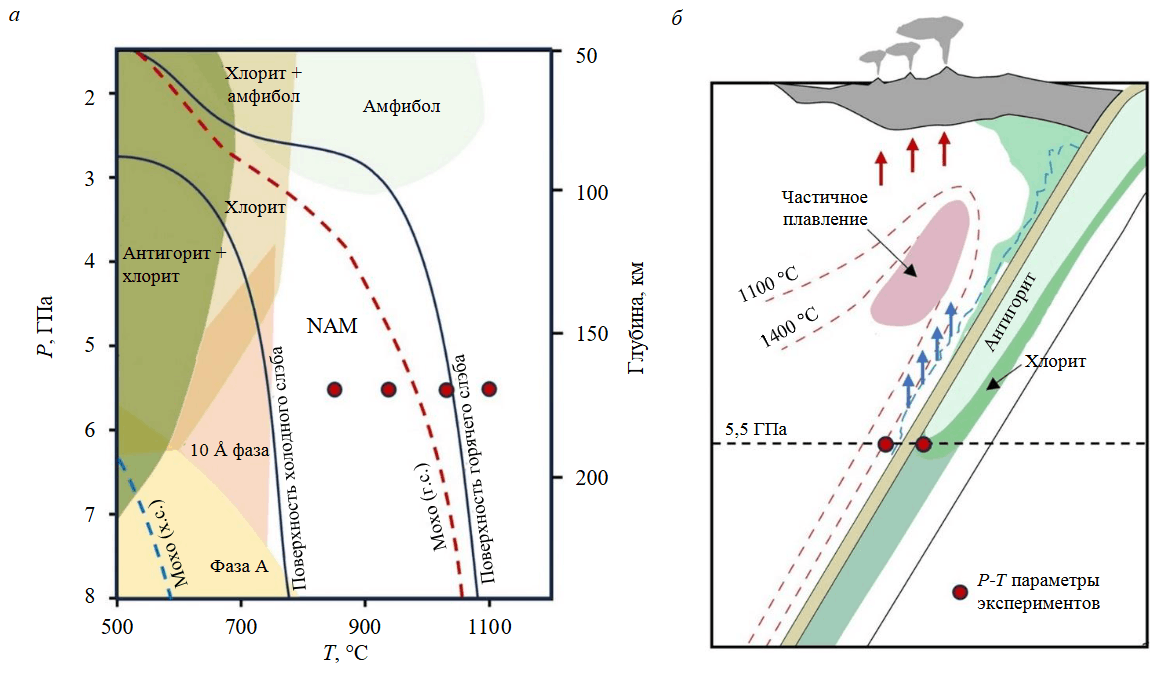
Рис.1. Фазовая диаграмма перидотит-H2O с полями стабильности водосодержащих фаз по данным работ [4, 5] и Р-Т параметрами проведенных экспериментов (а). Схематический разрез субдуцируемого слэба с границами стабильности в перидотитах антигорита и хлорита по данным работы [14] (б). Линии Мохо для горячего (г.с.) и холодного (х.с.) слэба приведены согласно [15]. Синими стрелками показано направление движения водного флюида, красными стрелками – направление движения магмы
NAM – номинально безводные минералы
В настоящей работе авторами экспериментально при Р-Т параметрах, характерных для тепловых режимов промежуточной и горячей субдукции, были исследованы: закономерности гидрогенизации оливина водным флюидом, образующимся при дегидратации антигорита; влияние процессов перекристаллизации оливина в водном флюиде на растворимость воды в нем; влияние редокс-условий и примеси NaCl в водном флюиде на растворимость воды в оливине.
Методы
В малоградиентную зону ячейки высокого давления многопуансонного аппарата БАРС размещали по четыре герметично заваренные Au ампулы (рис.2). Ампулы имели диаметр 2,0 мм и толщину стенок 0,2 мм. В ампулы загружали серпентин (Полярный Урал) и специально приготовленные из кристаллов оливина, ориентированные по осям, полированные призмы. Использованный для экспериментов серпентин имеет состав, мас.%: 42,6 SiO2, 0,3 Al2O3, 1,6 FeO, 39,5 MgO, 0,2 CaO. Примесь кальция появляется из-за того, что в серпентине встречаются тончайшие прожилки кальцита. Для сборки ампул использовали навеску серпентина около 15 мг (см. таблицу). На дно ампул размещали призмы оливина массой от 1 до 2 мг. В дополнительной серии экспериментов в образцы серпентина вводили 0,2 мг NaCl. Для изготовления призм использовали два типа материала: первый – не содержащий воду оливин с Mg# 93 из ксенолита шпинелевого перидотита из кимберлитовой трубки «Удачная»; второй – оливин, содержащий около 70 ppm H2O, c Mg#91 из ксенолита гранатового перидотита из кимберлитовой трубки «Удачная» (UV-419/09) [21]. В ходе сборки ампул проводилось взвешивание всех компонентов системы. Приготовленные к экспериментам ампулы герметично заваривали высокочастотной дуговой сваркой с использованием прибора Lampert PUK 4U. По оценкам авторов, фугитивность кислорода (f O2) в образцах была близка к значениям буфера Ni-NiO (NNO). Для выяснения влияния fO2 на концентрацию ОН дефектов в оливине один эксперимент был выполнен с использованием буфера Fe3O4-Fe2O3 (HM). Эксперименты длительностью от 60 до 150 ч проводились на многопуансонном аппарате типа «разрезная сфера» при давлении 5,5 ГПа и температурах 850, 940, 1030 и 1100 °С. Давление и температура измерялись с точностью ±0,1 ГПа и ±20 °С соответственно.
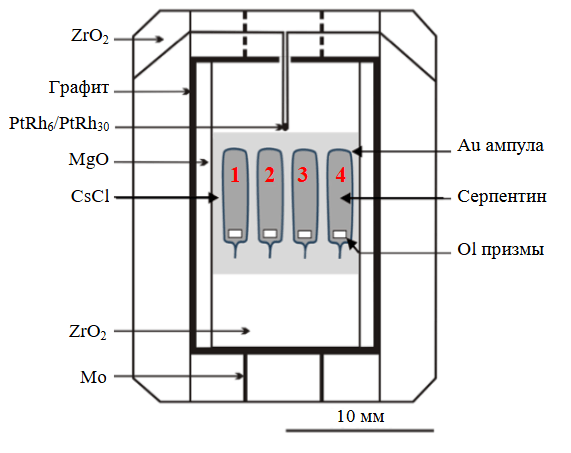
Рис.2. Схема ячейки высокого давления с расположением в малоградиентной зоне Au ампул с образцами (1-4). Серым прямоугольником выделена малоградиентная зона
PtRh6/PtRh30 – термопара, использованная для измерения температуры
Составы полученных фаз исследованы с использованием сканирующего электронного микроскопа Tescan MIRA 3 LMU, снабженного системой микроанализа INCA EDS 450 с детектором EDS X-Max-80 Silicon Drift Detector (Oxford Instruments). Ускоряющее напряжение составляло 20 кВ, ток пучка 1 нA, диаметр пучка 3-10 мкм, время набора спектра 20 с.
Тип ОН дефектов и концентрация Н2О в оливинах определялись с помощью ИК-Фурье спектроскопии. Спектры ИК-поглощения измерялись с использованием спектрометра Bruker Vertex 70, оснащенного микроскопом Hyperion 2000. Измерения проводились с разрешением 2 см–1 и усреднением по 64-м сканированиям. Размер апертуры составлял 30-60 мкм. При анализе измеренных спектров поглощения коррекция базовой линии проводилась несколькими способами, включая аппроксимацию прямой линией, полиномом и сплайном. Погрешность в определении интегрального поглощения составляла 15-20 %. Для расчета содержания Н2О в оливинах использовались калибровочные коэффициенты экстинкции, равные 0,119 и 0,055 вес. рpm Н2О см–2 для высоко-(3650-3350 см–1) [22, 23] и низкочастотной (3350-3000 см–1) [24] частей спектров ОН поглощения соответственно.
Исходные составы, параметры экспериментов при P = 5,5 ГПа и фазовый состав полученных образцов
|
Номер эксперимента |
Исходный состав |
Буфер |
T, °С |
Время, ч |
H2O*, мас.% |
Фазовый состав |
|||
|
Серпентин, мг |
Оливин |
NaCl, мг |
|||||||
|
Тип |
Масса, мг |
||||||||
|
2304_2_3 |
11,9 |
– |
– |
– |
– |
850 |
150 |
16 |
Ol, Opx, Fl |
|
2304_2_4 |
12,0 |
Ol(сух)** |
5,8 |
– |
– |
850 |
150 |
9 |
Ol, Opx, Fl |
|
2306_2_1 |
12,0 |
Ol(сух) |
5,0 |
– |
– |
940 |
240 |
н.п. |
Ol, Opx, Fl |
|
855_6_3 |
13,8 |
Ol(сух) + Ol(H2O) |
1,3 + 1,9 |
– |
– |
850 |
90 |
11 |
Ol, Opx, Fl |
|
2332_2_3 |
11,8 |
Ol(сух) + Ol(H2O) |
1,2 + 1,5 |
– |
– |
1030 |
90 |
9 |
Ol, Opx, Fl |
|
845_8_1 |
12,5 |
– |
– |
– |
– |
1030 |
90 |
12 |
Ol, Opx, Fl |
|
872_6_1 |
14,2 |
Ol(H2O)*** |
1,4 |
– |
– |
1100 |
60 |
н.п. |
Ol, Opx, Fl |
|
872_6_4 |
13,9 |
Ol(сух) |
2,7 |
– |
– |
1100 |
60 |
н.п. |
Ol, Opx, Fl |
|
845_8_2 |
12,1 |
– |
– |
– |
HM |
1030 |
90 |
12 |
Ol, Opx, Fl |
|
1772_3_5 |
15,0 |
– |
– |
0,2 |
– |
850 |
100 |
11 |
Ol, Opx, Fl |
|
1400_4_6 |
15,0 |
– |
– |
0,2 |
– |
1030 |
100 |
12 |
Ol, Opx, Fl |
* Количество H2O, выделившейся при вскрытии Au ампул после экспериментов, нормированное к массе образца.
** Безводный оливин из ксенолита шпинелевого перидотита из кимберлитовой трубки «Удачная».
*** Оливин, содержащий около 70 ppm H2O, из ксенолита гранатового перидотита из кимберлитовой трубки «Удачная» (UV-419/09) [21]; Ol – оливин; Opx – ортопироксен; Fl – флюид; н.п. – не определено.
Обсуждение результатов
При разложении антигорита, содержащего 13 мас.% H2O, образуется ассоциация фаз – оливин, ортопироксен и водный сверхкритический флюид. В экспериментах при давлении 5,5 ГПа и температуре 850 °С длительностью от 90 до 150 ч образовался агрегат зерен оливина и ортопироксена неправильной формы размером до 15 мкм (рис.3, а). В полученных образцах зерна оливина и ортопироксена располагаются в окружении игольчатых и дендритных кристаллов, возникших при закалке водного флюида, с растворенными в нем компонентами силикатов. Закалочные кристаллы содержат переменные концентрации SiO2 и MgO. Новообразованный оливин содержит 4,1 мас.% FeO. Ортопироксен содержит 3,2 мас.% FeO, 0,8 мас.% Al2O3 и 0,3 мас.% CaO. Часть приготовленных призм из оливина на этапе подъема давления растрескивалась, часть осталась целой. Собственно оливин призм после экспериментов сохранял исходный состав. Однако на поверхности призм появился слой до 10 мкм новообразованного оливина, который содержит 4,2-4,4 мас.% FeO. В эксперименте при температуре 940 °С длительностью 90 ч составы полученных фаз в образце практически не отличаются от тех, что были получены при 850 °С.
С ростом температуры до 1030 °С при той же длительности экспериментов содержание FeO в оливине из продуктов дегидратации серпентина увеличилось до 4,6 мас.%. Ортопироксен в ассоциации с оливином содержит 2,8 мас.% FeO, 0,5 мас.% Al2O3 и 0,4 мас.% CaO. Сохранившие целостность призмы и их фрагменты после экспериментов имеют на поверхности слой ново-образованного оливина толщиной до 20 мкм (рис.3, б). Его состав соответствует составу мелкозернистого оливина из продуктов дегидратации серпентина. В образце, полученном в эксперименте при 1100 °С, составы оливина и ортопироксена остались теми же, что и при 1030 °С. Однако в призмах зафиксированы обширные зоны перекристаллизации оливина, трассирующиеся пониженным содержанием FeO (рис.3, в). Расположение в пределах таких зон цепочек включений позволяет сделать вывод, что перекристаллизация осуществлялась вдоль трещин. Трещины могли возникнуть на начальном этапе эксперимента при подъеме давления и затем, при выходе на целевые Р-Т параметры, частично залечиваться.
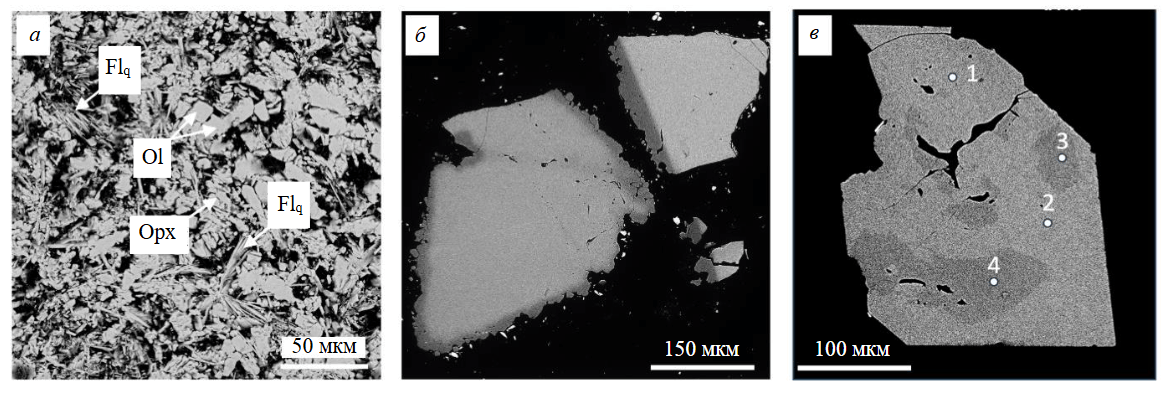
Рис.3. Агрегат из зерен Ol, Opx и продуктов закалки водного флюида после эксперимента № 855_6_3 (850 °С) (a). Фрагменты исходных призм оливина после эксперимента № 2332_2_3 (1030 °С) (б). Фрагмент призмы из безводного оливина с внутренними областями перекристаллизации (эксперимент № 872_6_4, 1100 °С) (в)
1-4 – области измерения ИК-спектров
Из призм, извлеченных из ампул после экспериментов, изготовлены плоскопараллельные пластинки толщиной 200-300 мкм, и проведено их исследование методом ИК-спектроскопии. Рассмотрим результаты, полученные для каждого типа исходных оливинов. Как следует из ИК-спектров, представленных на рис.4, преобладающим типом ОН дефектов в исходном водосодержащем оливине из гранатового перидотита являются протонированные кремниевые вакансии (VSi + 4H+, далее – [Si]-OH), проявляющиеся в спектрах серией полос поглощения с максимумами 3613, 3580, 3567 и 3550 см–1 [24-26]. Слабые линии в диапазоне 3400-3300 см–1, которые также присутствуют в спектрах исходного оливина, относятся к ОН дефектам, связанным с трехвалентными катионами Fe3+, Al3+, Cr3+ [27, 28]. По расчетам авторов, концентрация воды в исходном оливине составляет 70 ppm. Спектры ИК-поглощения, измеренные после экспериментов, представлены на рис.5. Для водосодержащего оливина установлено, что интенсивность полос поглощения, связанных с протонированными Si вакансиями, заметно возрастает после экспериментов, при этом величина прироста практически не зависит от температуры. По оценкам авторов, концентрации H2O в нем после экспериментов при температурах 850 и 1030 °С составляют 110 и 120 ppm соответственно. Общий вид спектров в ОН области практически не изменяется. В спектрах доминируют полосы [Si]-OH дефектов, несколько изменяется относительная интенсивность слабых полос в области 3400-3300 см–1, полосы поглощения, связанные с ОН дефектами на магниевых вакансиях (3300-3000 см–1), не фиксируются.
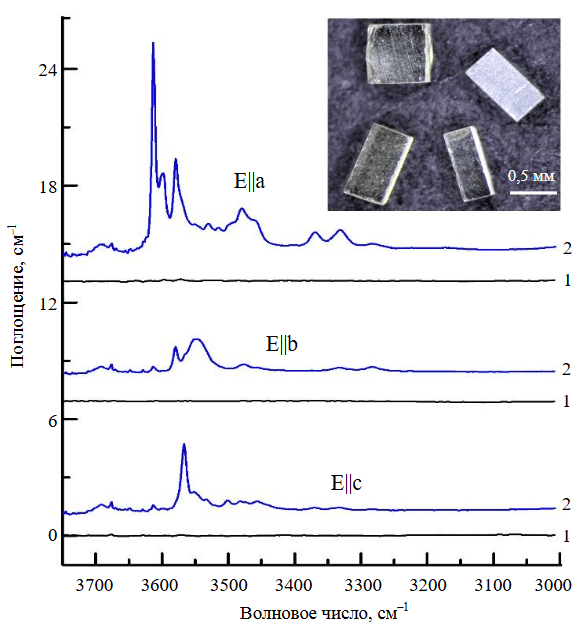
Рис.4. Поляризованные ИК-спектры, измеренные для исходного безводного оливина из ксенолита шпинелевого перидотита (1) и исходного водосодержащего оливина из ксенолита гранатового перидотита (2) из трубки «Удачная». Спектры смещены вдоль вертикальной оси. На вставке показаны ориентированные призмы из оливина, изготовленные для экспериментов
Для безводного оливина из шпинелевого перидотита установлен иной характер поведения ОН дефектов (рис.5, б). После эксперимента при температуре 850 °С в ИК-спектре оливина зафиксирована только слабая, относительно широкая полоса с максимумом около 3190 см–1, которая, по общепринятым представлениям, связана с OH дефектами на магниевых вакансиях (VMg + 2H+, далее – [Mg]-OH) [24, 25, 29]. После эксперимента при Т = 1030 °С интенсивность полосы существенно возросла, при этом интенсивность полос, обусловленных [Si]-ОН дефектами, едва превышает уровень шумов. По оценкам авторов, в этом случае концентрации H2O после экспериментов при температурах 850 и 1030 °С составляют 3 и 17 ppm соответственно. Изучение приготовленных после экспериментов ориентированных пластинок показало, что для обоих типов исходных оливинов распределение ОН дефектов в них имеет однородный характер при условии, что образцы не обнаруживают особенностей внутреннего строения, связанных с процессами перекристаллизации оливина в экспериментах.
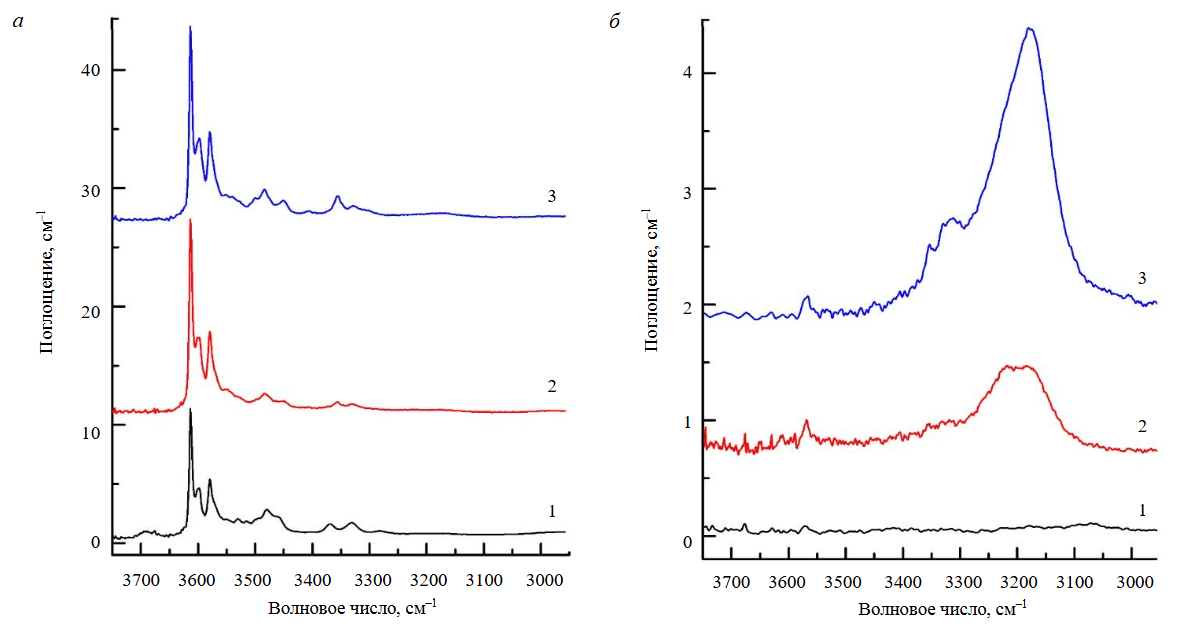
Рис.5. Спектры ИК-поглощения, измеренные для водосодержащего (а) и безводного (б) оливина в исходном состоянии (1) и после экспериментов при температурах 850 °C (2) и 1030 °С (3)
На рис.6 представлены усредненные неполяризованные ИК-спектры, измеренные для кристаллитов новообразованного оливина из экспериментов при температурах 940, 1030 и 1100 °С. Размер зерен оливина, образовавшегося в эксперименте при Т = 850 °С, не превышал 20 мкм, что недостаточно для ИК-измерений. На рис.6 видно, что интенсивность полос ОН дефектов непрерывно увеличивается с ростом температуры. По оценкам авторов, концентрация Н2О в оливине, образовавшемся при Т = 940 °С, составляет 140 ppm, возрастает до 230 ppm при Т = 1030 °С и достигает 350 ppm при Т = 1100 °С. В последнем случае в ИК-спектрах наблюдаются полосы поглощения как [Si]-OH, так и [Mg]-OH дефектов, тогда как в спектрах оливинов, полученных при более низких температурах, преобладают [Si]-OH дефекты. Введение в серпентин добавки NaCl обеспечивало присутствие в водном флюиде 9 мас.% NaCl, то есть на уровне, характерном для дегидратационных флюидов зон субдукции [30]. Полученные в экспериментах при 850 и 1030 °С данные свидетельствуют о том, что такое содержание хлорида в водном флюиде не оказывает влияние на концентрацию воды в новообразованном оливине либо влияет минимально. В эксперименте при 1030 °С было изучено влияние резко окислительных условий, контролируемых буфером HM, на фракционирование воды между водным флюидом и новообразованным оливином. Согласно полученным данным, рост fO2 от значений буфера NNO, характерных для основной части экспериментов, до значений буфера HM не оказал фиксируемого влияния на содержание воды в новообразованном оливине.
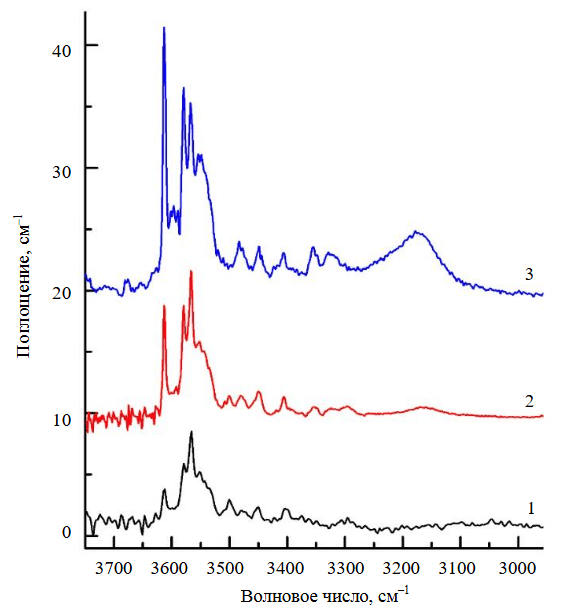
Рис.6. ИК-спектры новообразованного оливина, полученного в экспериментах при температурах 940 °С (1), 1030 °С (2) и 1100 °С (3)
Отмечено, что в эксперименте при 1100 °С в оливиновых призмах зафиксированы обширные зоны перекристаллизации, трассирующиеся пониженным содержанием FeO. На рис.7 представлены ИК-спектры, измеренные в различных областях образца из безводного оливина с внутренними областями перекристаллизации (см. рис.3, в). На рис.7 видно, что в этом случае распределение ОН дефектов имеет неоднородный характер. Интенсивность ОН полос и, соответственно, концентрация ОН дефектов существенно выше в областях, подвергшихся процессам перекристаллизации.
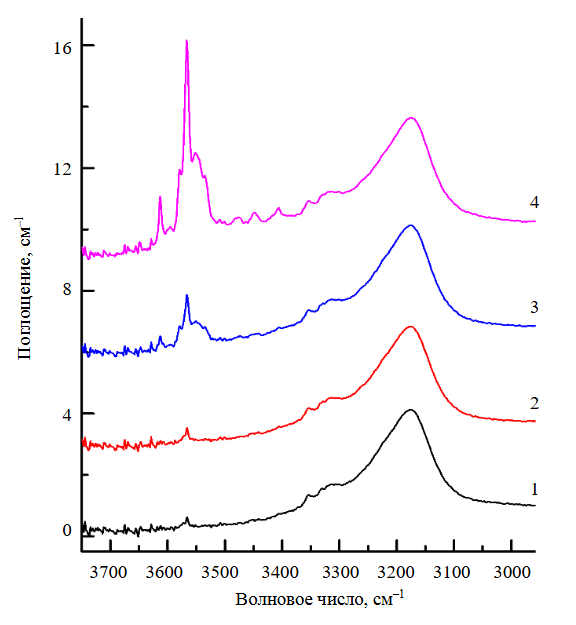
Рис.7. ИК-спектры, измеренные в различных областях фрагмента призмы из безводного оливина с внутренними зонами перекристаллизации (Т = 1100 °С). Номера спектров соответствуют номерам областей на рис.3, в
Анализ полученных данных позволил сделать вывод, что после достижения давления 5,5 ГПа и температур 850, 940, 1030, 1100 °С серпентин претерпевал дегидратацию, в ходе которой образовывалась фазовая ассоциация оливина, ортопироксена и водного флюида. Водный флюид в ходе экспериментов большой длительности растворял силикатные компоненты и благодаря этому достигал равновесия с оливином и ортопироксеном. Образование слоев новообразованного оливина на поверхности призм оливина прямо свидетельствует об этом. В этом случае активность кремния во флюиде контролировалась оливином и ортопироксеном на уровне, характерном для перидотитов. Это принципиально важно, поскольку от активности кремния в среде кристаллизации зависит концентрация в новообразованном оливине кремниевых и магниевых вакансий [31]. Концентрация вакансий в оливине субдуцируемого перидотита, генезис которого не связан с дегидратацией серпентина, определяется особенностями его кристаллизации в средах вне зон субдукции.
Взаимодействие водного флюида с оливином при Р-Т параметрах, характерных для зон субдукции, в значительной мере контролируется дефектностью кристаллической структуры оливина, прежде всего концентрацией в нем уже существующих кремниевых вакансий. Согласно полученным данным, при температуре 850 °С протонируются уже существующие в оливине кремниевые вакансии, при этом концентрация [Si]-OH дефектов заметно возрастает относительно исходного значения. При увеличении температуры до 1030 °С новые кремниевые вакансии не возникают и концентрация [Si]-OH дефектов практически не меняется относительно экспериментов при более низких температурах. Концентрация ОН дефектов на магниевых вакансиях растет с увеличением температуры, однако вклад этого механизма в общую концентрацию ОН дефектов крайне мал, не превышает 20 ррm при температурах ~1000 °С. Образование новых кремниевых вакансий и их протонирование в процессе перекристаллизации оливина в водном флюиде фиксируются только при 1100 °С, вблизи солидуса системы перидотит-H2O [31]. Этот механизм обеспечивает наибольший вклад в рост растворимости воды в оливине, причем он реализуется лишь при температурах, характерных для мантийного клина.
Известно, что на растворимость воды в номинально безводных минералах существенно влияют редокс-условия [32, 33], активность воды в среде кристаллизации [18, 31, 34], а также состав ростовой среды [31, 35-37]. Согласно данным исследования [38], дегидратация серпентина вызывает в субдуцируемых перидотитах рост fO2 практически до значений, близких к буферу HM. Полученные авторами данные указывают на то, что такое изменение редокс-условий слабо влияет на растворимость воды в оливине либо не влияет вовсе. Отмечено, что дегидратационные флюиды зон субдукции содержат NaCl на уровне 10 мас.% [30]. При мантийных P-T параметрах NaCl существенно снижает растворимость SiO2 в водном флюиде [39], что должно повышать активность воды в среде кристаллизации оливина. Однако данные авторов свидетельствуют о том, чтоконцентрации NaCl, характерные для дегидратационных флюидов зон субдукции, не оказывают влияние на концентрацию воды в новообразованном оливине либо влияют минимально.
Анализ полученных данных показывает, что они не согласуются с моделью субсолидусной растворимости воды в оливине, предложенной в работе [18]. Модель построена на экспериментальных данных по гидрогенезации оливинов, полученных при фиксированном давлении 3 ГПа и температурах в интервале 750-1050 °С и при фиксированной температуре 950 °С и давлениях в интервале 0,5-6 ГПа. Исходные оливины содержали примесь Ti, что привело к существенному вкладу титан-клиногумитовых точечных ОН дефектов в общую концентрацию Н2О. Модель позволяет рассчитать максимальное содержание воды в оливине для тепловых условий, характерных для зон субдукции, а также оценить потенциал мантийного клина в качестве транспортера воды в мантию. Согласно модели, максимальная концентрация воды в оливине при давлении 5,5 ГПа и температуре 850 °С, характерной для мантийного клина на расстоянии 1,5 км от поверхности холодного слэба, по данным исследования [1], составляет 400 ppm. Тогда как при температуре 1100 °С, характерной для мантийного клина на расстоянии 5,5 км от поверхности холодного слэба, концентрация по модели [18] может достигать 900 ppm. По данным авторов, эти значения существенно завышены. В присутствии равновесного с перидотитом водного флюида при давлении 5,5 ГПа и температуре 940 °С концентрация воды в новообразованном оливине не превышает 140 ppm, а в оливине, не претерпевшем перекристаллизацию, – 110 ppm. С ростом температуры до 1030 °С концентрация воды в новообразованном оливине достигает только 230 ppm, а в оливине перидотитов с уже существовавшим набором кремниевых вакансий остается практически неизменной – 120 ppm.
С дальнейшим ростом давления в погружающемся слэбе растворимость воды в оливине может существенно увеличиваться [31, 35, 36]. Это связано с тем, что активность кремния в равновесном с перидотитом водном флюиде может существенно снижаться. Об этом, по мнению исследователей [36], свидетельствует преобладание Si вакансий над Mg в оливине, полученном при P ≥ 8 ГПа. Уже при давлении 12 ГПа активность кремнезема в среде кристаллизации оказывает второстепенное влияние на растворимость воды, которая достигает 8900 ppm при 1250 °С [35].
Анализ полученных авторами данных с учетом слабой зависимости растворимости воды в оливине от давления в диапазоне 4-6 ГПа при субдукционных температурах [18] позволяет сделать вывод о том, что эффективность транспорта воды в мантию номинально безводными минералами и, прежде всего, оливином минимальна именно на глубинах ~150-200 км, сразу после полной дегидратации серпентина в слэбе. В мантийном клине распад серпентина происходит много раньше, при P < 3 ГПа [1]. Установленная при давлении 5,5 ГПа низкая концентрация H2O в оливине в форме OH дефектов указывает на незначительную роль перидотитов литосферной мантии и механически связанных со слэбами частей мантийного клина в транспорте воды на глубины более 150 км в режимах промежуточной и горячей субдукции. По мнению авторов работы [4], особенности температурных режимов и характер фракционирования щелочей в зонах субдукции указывают на то, что эффективность амфибола и фенгита в качестве транспортеров воды на глубины более 120 км низка. При этом последние экспериментальные данные показывают, что роль хлорита и лавсонита в этом процессе, возможно, остается недооцененной [8, 40]. В этих условиях возникает возможность для высвобождения и подъема водного флюида в области генерации магм. Поскольку флюиды в зонах субдукции перемещаются субвертикально, то в крутопогружающихся (≥60°) слэбах Marianas, New Britain, Solomon, Vanuatu дегидратационные флюиды, образующиеся на глубинах 130-200 км (соответствуют 4-6 ГПа), могут непосредственно попадать в области генерации островодужных магм [41]. Кроме того, водные флюиды, перемещаясь в мантию, могут участвовать в процессах минералообразования, в том числе алмазообразовании [42-44].
Заключение
Анализ полученных экспериментальных данных позволил сделать вывод, что эффективность транспорта воды в мантию номинально безводными минералами, прежде всего, оливином, минимальна именно на глубинах ~150-200 км, сразу после полной дегидратации серпентина в слэбах, субдуцирующихся при тепловых режимах промежуточной и горячей субдукции. Это связано с тем, что при таких условиях взаимодействие дегидратационного водного флюида с оливином в значительной мере контролируется дефектностью кристаллической структуры оливина, прежде всего, наличием кремниевых вакансий. При давлении 5,5 ГПа и температуре 850 °С протонируются уже существующие в оливине кремниевые вакансии, при этом концентрация [Si]-OH дефектов заметно возрастает относительно исходной величины, но содержание воды остается на уровне 110 ppm. При увеличении температуры до 1030 °С новые кремниевые вакансии не возникают и концентрация [Si]-OH дефектов остается на том же уровне, что и при гидрогенезации при более низких температурах. Концентрация ОН дефектов на магниевых вакансиях растет с увеличением температуры, однако вклад этого механизма в общую концентрацию ОН дефектов крайне мал. Возникновение новых кремниевых вакансий в процессе перекристаллизации оливина в водном флюиде вблизи солидуса перидотита вносит наибольший вклад в рост растворимости воды. Однако и в этом случае содержание воды в новообразованном оливине достигает лишь 350 ppm.
Литература
- van Keken P.E., Hacker B.R., Syracuse E.M., Abers G.A. Subduction factory: 4. Depth-dependent flux of H2O from subducting slabs worldwide // Journal of Geophysical Research: Solid Earth. 2011. Vol. 116. Iss. B1. № B01401. DOI: 10.1029/2010JB007922
- Hirschmann M.M. Comparative deep Earth volatile cycles: The case for C recycling from exosphere/mantle fractionation of major (H2O, C, N) volatiles and from H2O/Ce, CO2/Ba, and CO2/Nb exosphere ratios // Earth and Planetary Science Letters. 2018. Vol. 502. P. 262-273. DOI: 10.1016/j.epsl.2018.08.023
- Ohtani E. Hydration and Dehydration in Earth’s Interior // Annual Review of Earth and Planetary Sciences. 2021. Vol. 49. P. 253-278. DOI: 10.1146/annurev-earth-080320-062509
- Keppler H., Ohtani E., Xiaozhi Yang. The Subduction of Hydrogen: Deep Water Cycling, Induced Seismicity, and Plate Tectonics // Elements. 2024. Vol. 20. № 4. P. 229-234. DOI: 10.2138/gselements.20.4.229
- Schmidt M.W., Poli S. Devolatilization During Subduction // Treatise on Geochemistry. Elsevier, 2014. Vol. 4. P. 669-701. DOI: 10.1016/B978-0-08-095975-7.00321-1
- Grevemeyer I., Ranero C.R., Ivandic M. Structure of oceanic crust and serpentinization at subduction trenches // Geosphere. 2018. Vol. 14. № 2. P. 395-418. DOI: 10.1130/GES01537.1
- Chen Cai, Wiens D.A., Weisen Shen, Eimer M. Water input into the Mariana subduction zone estimated from ocean-bottom seismic data // Nature. 2018. Vol. 563. P. 389-392. DOI: 10.1038/s41586-018-0655-4
- Hermann J., Lakey S. Water transfer to the deep mantle through hydrous, Al-rich silicates in subduction zones // Geology. 2021. Vol. 49. № 8. P. 911-915. DOI: 10.1130/G48658.1
- Fumagalli P., Stixrude L., Poli S., Snyder D. The 10Å phase: a high-pressure expandable sheet silicate stable during subduction of hydrated lithosphere // Earth and Planetary Science Letters. 2001. Vol. 186. Iss. 2. P. 125-141. DOI: 10.1016/S0012-821X(01)00238-2
- Inoue T., Wada T., Sasaki R., Yurimoto H. Water partitioning in the Earth’s mantle // Physics of the Earth and Planetary Interiors. 2010. Vol. 183. Iss. 1-2. P. 245-251. DOI: 10.1016/j.pepi.2010.08.003
- Sobolev A.V., Asafov E.V., Gurenko A.A. et al. Komatiites reveal a hydrous Archaean deep-mantle reservoir // Nature. 2016. Vol. 531. Iss. 7596. P. 628-632. DOI: 10.1038/nature17152
- Harte B., Harris J.W., Hutchison M.T. et al. Lower mantle mineral associations in diamonds from Sao Luiz, Brazil. In: Fei Y, Bertka C.M., Mysen B.O. (eds.) Mantle petrology: Field Observations and High-pressure Experimentation (A Tribute to Francis R. (Joe) Boyd). 1999. Vol. 6, P. 125-153.
- Pearson D.G., Canil D., Shirey S.B. Mantle Samples Included in Volcanic Rocks: Xenoliths and Diamonds // Treatise on Geochemistry. Elsevier, 2003. Vol. 2. P. 171-275. DOI: 10.1016/B0-08-043751-6/02005-3
- Flemetakis S., Tiraboschi C., Rohrbach A. et al. The stability of antigorite in subduction zones revisited: the effect of F on antigorite stability and its breakdown reactions at high pressures and high temperatures, with implications for the geochemical cycles of halogens // Contributions to Mineralogy and Petrology. 2022. Vol. 177. Iss. 7. № 70. DOI: 10.1007/s00410-022-01934-5
- Syracuse E.M., van Keken P.E., Abers G.A. The global range of subduction zone thermal models // Physics of the Earth and Planetary Interiors. 2010. Vol. 183. Iss. 1-2. P. 73-90. DOI: 10.1016/j.pepi.2010.02.004
- Ferrand T.P. Neither antigorite nor its dehydration is «metastable» // American Mineralogist. 2019. Vol. 104. Iss. 6. P. 788-790. DOI: 10.1016/j.pepi.2010.02.004
- Maurice J., Bolfan Casanova N., Demouchy S. et al. The intrinsic nature of antigorite breakdown at 3 GPa: Experimental constraints on redox conditions of serpentinite dehydration in subduction zones // Contributions to Mineralogy and Petrology. 2020. Vol. 175. Iss. 10. № 94. DOI: 10.1007/s00410-020-01731-y
- Padrón‐Navarta J.A., Hermann J. A Subsolidus Olivine Water Solubility Equation for the Earth's Upper Mantle // Journal of Geophysical Research: Solid Earth. 2017. Vol. 122. Iss. 12. P. 9862-9880. DOI: 10.1002/2017JB014510
- Mierdel K., Keppler H., Smyth J.R., Langenhorst F. Water Solubility in Aluminous Orthopyroxene and the Origin of Earth’s Asthenosphere // Science. 2007. Vol. 315. Iss. 5810. P. 364-368. DOI: 10.1126/science.1135422
- Férot A., Bolfan-Casanova N. Water storage capacity in olivine and pyroxene to 14 GPa: Implications for the water content of the Earth’s upper mantle and nature of seismic discontinuities // Earth and Planetary Science Letters. 2012. Vol. 349-350. P. 218-230. DOI: 10.1016/j.epsl.2012.06.022
- Doucet L.S., Ionov D.A., Golovin A.V. The origin of coarse garnet peridotites in cratonic lithosphere: new data on xenoliths from the Udachnaya kimberlite, central Siberia // Contributions to Mineralogy and Petrology. 2013. Vol. 165. Iss. 6. P. 1225-1242. DOI: 10.1007/s00410-013-0855-8
- Withers A.C., Bureau H., Raepsaet C., Hirschmann M.M. Calibration of infrared spectroscopy by elastic recoil detection analysis of H in synthetic olivine // Chemical Geology. 2012. Vol. 334. P. 92-98. DOI: 10.1016/j.chemgeo.2012.10.002
- Towbin W.H., Plank T., Klein E., Hauri E. Measuring H2O concentrations in olivine by secondary ion mass spectrometry: Challenges and paths forward // American Mineralogist. 2023. Vol. 108. Iss. 5. P. 928-940. DOI: 10.2138/am-2022-8247
- Kovács I., O’Neill H.St.C., Hermann J., Hauri E.H. Site-specific infrared O-H absorption coefficients for water substitution into olivine // American Mineralogist. 2010. Vol. 95. Iss. 2-3. P. 292-299. DOI: 10.2138/am.2010.3313
- Berry A.J., Hermann J., O’Neill H.S.C., Foran G.J. Fingerprinting the water site in mantle olivine // Geology. 2005. Vol. 33. № 11. P. 869-872. DOI: 10.1130/G21759.1
- Xianyu Xue, Kanzaki M., Turner D., Loroch D. Hydrogen incorporation mechanisms in forsterite: New insights from 1H and 29Si NMR spectroscopy and first-principles calculation // American Mineralogist. 2017. Vol. 102. Iss. 3. P. 519-536. DOI: 10.2138/am-2017-5878
- Berry A.J., O’Neill H.St.C., Hermann J., Scott D.R. The infrared signature of water associated with trivalent cations in olivine // Earth and Planetary Science Letters. 2007. Vol. 261. Iss. 1-2. P. 134-142. DOI: 10.1016/j.epsl.2007.06.021
- Blanchard M., Ingrin J., Balan E. et al. Effect of iron and trivalent cations on OH defects in olivine // American Mineralogist. 2017. Vol. 102. Iss. 2. P. 302-311. DOI: 10.2138/am-2017-5777
- Crépisson C., Bureau H., Blanchard M. et al. Theoretical infrared spectrum of partially protonated cationic vacancies in forsterite // European Journal of Mineralogy. 2014. Vol. 26. № 2. P. 203-210. DOI: 10.1127/0935-1221/2014/0026-2366
- Manning C.E., Frezzotti M.L. Subduction-Zone Fluids // Elements. 2020. Vol. 16. № 6. P. 395-400. DOI: 10.2138/gselements.16.6.395
- Bali E., Bolfan-Casanova N., Koga K.T. Pressure and temperature dependence of H solubility in forsterite: An implication to water activity in the Earth interior // Earth and Planetary Science Letters. 2008. Vol. 268. Iss. 3-4. P. 354-363. DOI: 10.1016/j.epsl.2008.01.035
- Sokol A.G., Palyanov Y.N., Kupriyanov I.N. et al. Effect of oxygen fugacity on the H2O storage capacity of forsterite in the carbon-saturated systems // Geochimica et Cosmochimica Acta. 2010. Vol. 74. Iss. 16. P. 4793-4806. DOI: 10.1016/j.gca.2010.05.032
- Bolfan-Casanova N., Martinek L., Manthilake G. et al. Effect of oxygen fugacity on the storage of water in wadsleyite and olivine in H and H–C fluids and implications for melting atop the transition zone // European Journal of Mineralogy. 2023. Vol. 35. Iss. 4. P. 549-568. DOI: 10.5194/ejm-35-549-2023
- Sokol A.G., Kupriyanov I.N., Palyanov Y.N. Partitioning of H2O between olivine and carbonate–silicate melts at 6.3 GPa and 1400 °C: Implications for kimberlite formation // Earth and Planetary Science Letters. 2013. Vol. 383. P. 58-67. DOI: 10.1016/j.epsl.2013.09.030
- Smyth J.R., Frost D.J., Nestola F. et al. Olivine hydration in the deep upper mantle: Effects of temperature and silica activity // Geophysical Research Letters. 2006. Vol. 33. Iss. 15. № L15301. DOI: 10.1029/2006GL026194
- Withers A.C., Hirschmann M.M. Influence of temperature, composition, silica activity and oxygen fugacity on the H2O storage capacity of olivine at 8 GPa // Contributions to Mineralogy and Petrology. 2008. Vol. 156. Iss. 5. P. 595-605. DOI: 10.1007/s00410-008-0303-3
- Sokol A.G., Kupriyanov I.N., Palyanov Y.N. et al. Melting experiments on the Udachnaya kimberlite at 6.3–7.5 GPa: Implications for the role of H2O in magma generation and formation of hydrous olivine // Geochimica et Cosmochimica Acta. 2013. Vol. 101. P. 133-155. DOI: 10.1016/j.gca.2012.10.018
- Cannaò E., Malaspina N. From oceanic to continental subduction: Implications for the geochemical and redox evolution of the supra-subduction mantle // Geosphere. 2018. Vol. 14. № 6. P. 2311-2336. DOI: 10.1130/GES01597.1
- Rustioni G., Audetat A., Keppler H. The composition of subduction zone fluids and the origin of the trace element enrichment in arc magmas // Contributions to Mineralogy and Petrology. 2021. Vol. 176. Iss. 7. № 51. DOI: 10.1007/s00410-021-01810-8
- Hernández-Uribe D., Tsujimori T. Progressive lawsonite eclogitization of the oceanic crust: Implications for deep mass transfer in subduction zones // Geology. 2023. Vol. 51. № 7. P. 678-682. DOI: 10.1130/G51052.1
- Schmidt M.W., Jagoutz O. The global systematics of primitive arc melts // Geochemistry, Geophysics, Geosystems. 2017. Vol. 18. Iss. 8. P. 2817-2854. DOI: 10.1002/2016GC006699
- Luth R.W., Palyanov Y.N., Bureau H. Experimental Petrology Applied to Natural Diamond Growth // Reviews in Mineralogy and Geochemistry. 2022. Vol. 88. № 1. P. 755-808. DOI: 10.2138/rmg.2022.88.14
- Симаков С.К., Стегницкий Ю.Б. О наличии постмагматической стадии формирования алмазов в кимберлитах // Записки Горного института. 2022. Т. 255. С. 319-326. DOI: 10.31897/PMI.2022.22
- Губанов Н.В., Зедгенизов Д.А., Васильев Е.А., Наумов В.А. Новые данные о составе среды кристаллизации волокнистых алмазов из россыпей Западного Урала // Записки Горного института. 2023. Т. 263. С. 645-656.