

Early-Middle Devonian ore-bearing volcanogenic formations of the Zmeinogorsky Ore District, NW Rudny Altai
- 1 — Ph.D. Senior Researcher V.S.Sobolev Institute of Geology and Mineralogy SB RAS ▪ Orcid
- 2 — Ph.D., Dr.Sci. Chief Researcher Institute of Geology of Ore Deposits, Petrography, Mineralogy and Geochemistry RAS ▪ Orcid
- 3 — Ph.D., Dr.Sci. Director V.S.Sobolev Institute of Geology and Mineralogy SB RAS ▪ Orcid
- 4 — Head of Department Territorial Fund of Geological Information for Siberian Federal District ▪ Orcid
- 5 — Leading Geologist Siberian Research Institute of Geology, Geophysics and Mineral Raw Materials ▪ Orcid
- 6 — Ph.D. Senior Researcher Institute of Geology of Ore Deposits, Petrography, Mineralogy and Geochemistry RAS ▪ Orcid
- 7 — Junior Researcher V.S.Sobolev Institute of Geology and Mineralogy SB RAS ▪ Orcid
- 8 — Junior Researcher V.S.Sobolev Institute of Geology and Mineralogy SB RAS ▪ Orcid
- 9 — Junior Researcher V.S.Sobolev Institute of Geology and Mineralogy SB RAS ▪ Orcid
- 10 — Researcher V.S.Sobolev Institute of Geology and Mineralogy SB RAS ▪ Orcid
- 11 — Laboratory Technician V.S.Sobolev Institute of Geology and Mineralogy SB RAS ▪ Orcid
- 12 — Laboratory Technician V.S.Sobolev Institute of Geology and Mineralogy SB RAS ▪ Orcid
Abstract
The paper presents the results of geological, geochemical and isotope geochronological studies of Early-Middle Devonian volcanogenic-sedimentary strata of the NW Rudny Altai, which host Devonian VMS-type (volcanogenic massive sulphide) deposits. The study provides a solution to the problems of identification and correlation of volcanic formations, study of their structural and lithological-facial features, which is traditionally a necessary element in the reconstruction of ore-magmatic systems. The aim of the study is to reconstruct the volcanic sequence in the Early-Middle Devonian and to evaluate the contribution of volcanogenic formations of riftogenic and supra-subduction nature to which VMS-type deposits are genetically related. Isotopic U-Pb dating of zircons from representative tuffs is consistent with an age of ~390 Ma. The formation of the volcanogenic strata occurred in a tectonic setting associated with the opening of the sea basin, corresponding to the initial stage of riftogenesis in the Rudny Altai. In terms of geochemical characteristics, the rocks of the lower section are similar to those of the ensialic arcs. The petrogenesis of such magmas should be associated with fluid-saturated conditions of partial melting of crustal substrates and under the control of dehydration of the subducting plate. In the upper section, the volcanic rocks are geochemically similar to bimodal formations from riftogenic settings behind the ensialic arc. This is confirmed by analyses of the genetic type of the formation community (magmatic, sedimentary and ore-bearing) and is consistent with the geochemical type of the volcanic rocks, which is similar to that of riftogenic settings. The conceptual geodynamic scenario corresponds to the formation of the Rudny Altai ore deposits in the transition zone between the island-arc and the back-arc basin, similar to the riftogenic settings of the Eastern Asian margin.
This work was supported by the Ministry of Education and Science of the Russian Federation Project N 13.1902.24.44, Agreement 075-15-2024-641.
Introduction
The Rudny Alta i metallogenic belt with sulphide-polymetallic deposits of various scales has a high industrial potential, surpassing in its uniqueness the largest metallogenic provinces, e.g. Japan, Canada, Cyprus [1-3]. This corresponds to the most important geological and genetic type of ore deposits occurring in volcanogenic host-rocks (VMS – volcanogenic massive sulphide; Cu, Pb, Zn) [4-6]. Identification and correlation of volcanic formation, their relation to ore-magmatic systems and geodynamic reconstructions require the study of structural-formational, lithological-facial and paleostructural features of volcanogenic-sedimentary strata [7]. In this context, despite numerous studies of the Rudny Altai, a number of questions related to deciphering the petrogenesis of magmatism, geochemical variations in vertical and lateral sequences, and the correlation between its geochemical specialization and the types of ore mineralization of different ages remain unresolved. The present study focuses on an understudied geological unit belonging to the initial ore-bearing volcanogenic-sedimentary formations and located in the northwestern part of Rudny Altai. The objective of the study is to reconstruct the Early-Middle Devonian volcanic sequence and to qualitatively assess the contribution of riftogenic and supra-subduction volcanogenic formations to which the VMS-type deposits are genetically related. Isotope-geochemical studies of magmatic complexes [8-10] and analyses of their formational affiliation [11-13] are one of the tools to solve the problems of magmatic petrology and correlation with ore deposit formation.
Geological framework
The Rudny Altai block belongs to the western part of the Altai-Sayan sector of the Central Asian Fold Belt or the Altai tectonic collage, the Altaids [14-16]. The Rudny Altai block is bounded by the Irtysh Shear Zone from a fragment of the Irtysh-Zaisan paleoceanic plate, as well as by the North-Eastern Regional Fault from the overthrust Gorny Altai tectonic block of the Siberian continent (Fig.1).
The volcanogenic-sedimentary strata associated with the Early Devonian activation at the margin of the Siberian continent were formed directly on the metamorphosed strata of the Early Paleozoic folded basement; the magmatism had features of antidromic contrasting basalt-rhyolite formation, manifested as a consequence of riftogenic processes in a shallow-marine environment [14]. In the NW Rudny Altai stratigraphic cross-section under consideration, the initial volcanogenic-sedimentary strata correspond to two volcanic rhythms [17] – the Melnychnaya (D2e1, rhyolites) and Sosnovskaya Suites (D2zv1, rhyolites). It is assumed that injection of Early Devonian mantle magmas associated with riftogenesis led to large-scale melting of the thick terrigenous strata of the paleoshelf and generation of essentially felsic products of magmatism, with which the main VMS-type deposits of Rudny Altai are genetically related.
The formation of ore deposits in the first half of the Devonian occurred mainly during periods of temporary cessation of volcanic activity, synchronous with sedimentation, and was related to hydrothermal activity on the seafloor. According to modern concepts, the deposits are characterised as pyrite-polymetallic, belonging to the unique Rudny Altai geological and industrial type, and contain four main components: Fe, Cu, Pb and Zn, with higher concentrations of Ba, Ag, Au, and some chalcophile (As, Bi, etc.) and siderophile (Co, Ni, etc.) elements [18, 19]. In some cases, the formation of deposits can be identified with the activity of black smokers, fragments of whose sulphide pipes have been found in various parts of Rudny Altai [18].
In world practice, such geological settings are usually considered in the context of lithospheric extensional processes, associated either with the riftogenesis of island arcs or with the formation of back-arc basins [4-6]. One of the relevant geodynamic scenarios for Rudny Altai in the Devonian [20] is the migration of the volcanic front from the continent to the ocean, with riftogenesis and opening of a back-arc basin [21-23], close to the development of the Western-Pacific type [16]. Based on this hypothesis, it is urgent to verify it by studying the geochemical types of Devonian volcanism and, in the long term, to reconstruct its mantle sources and formation mechanisms at each tectonic stage of Rudny Altai development.
In this regard, we conducted a geological study of the Melnychnaya and Sosnovskaya Suites in the area of their stratigraphical cross-section at the Melnychnye Sopki reference site, west of Zmeinogorsk, NW Rudny Altai (Fig.2, a, с). A more detailed characterisation of the Devonian volcanism at this site is given in the explanatory notes to the Geological Maps of the Altai Series [23].
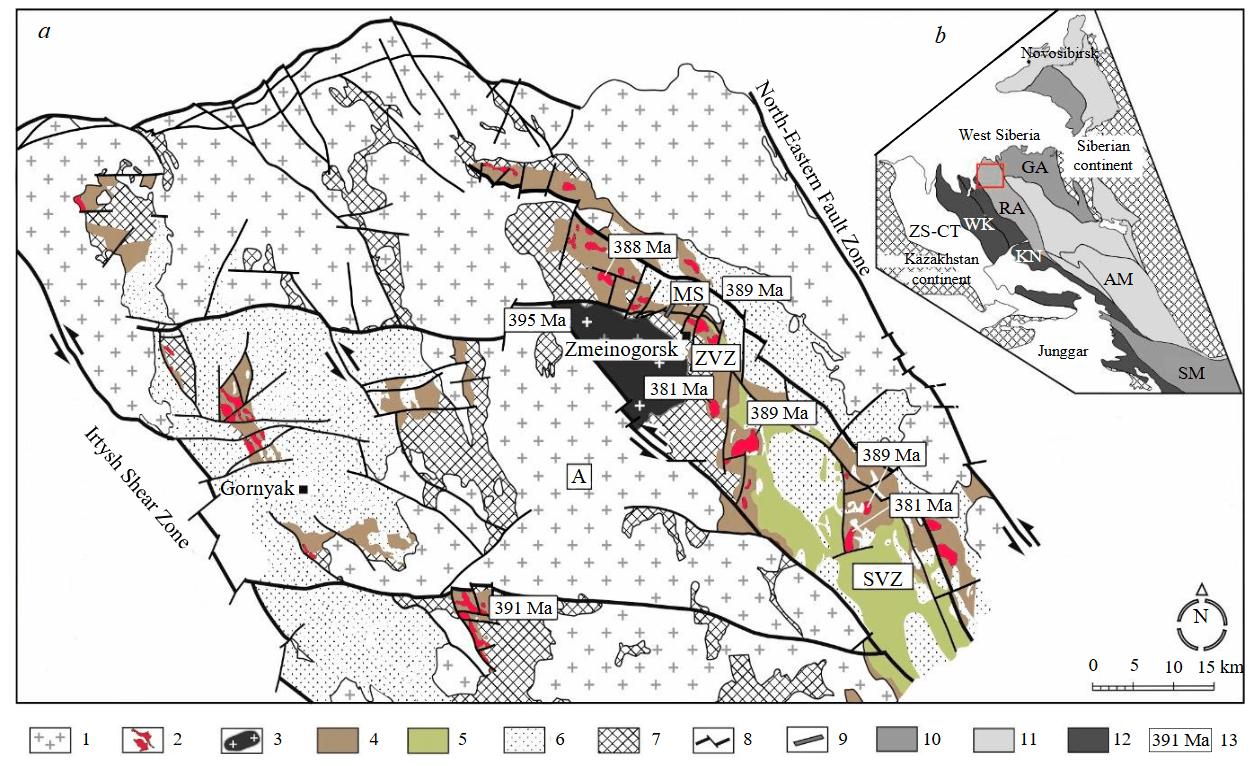
Fig.1. Structural and geological scheme with the location of Devonian magmatic formations of the NW Rudny Altai [17], with additions (a), and tectonic scheme of the western part of the Altai-Sayan Fold Belt [15] (b)
1 – granitoids, D2-C2 (combined); 2 – subvolcanic rhyolite porphyry of the Melnychno-Sosnovsky volcanic complex (D1-2); 3 – granitoids of the Mokhnatye Sopki intrusion with the dating point [20] and contours of the supposed magma chamber of the eroded paleovolcano; 4 – Melnychnaya and Sosnovskaya volcanic Suites (D1-2); 5 – Shipunikha volcanic Suite (D2-3); 6 – other Devonian volcanic and sedimentary formations (combined); 7 – Caledonian basement of the Rudny Altai (S-D1); 8 – faults; 9 – profile of stratigraphical cross-section in the Melnychnye Sopki site; 10 – Hercynian volcanic-plutonic belts; 11 – Caledonian terrane-orogenic belt of the Siberian continent; 12 – Suture zone (Irtysh-Zaisan Paleocean); A – Aleisky block; ZVZ – Zmeinogorskaya volcanic zone, SVZ – Shipunikha volcanic zone; terranes: GA – Gorny Altai; RA – Rudny Altai; KN – Kalba-Narym; WK – Western Kalba;
ZS-CT – Zharma-Saur and Chingiz-Tarbagatai; AM – Altai-Mongolian; SM – South Mongolian; 13 – previously studied volcanic centers with dating points [17]
Analytical methods
Analytical studies were performed at the Central Research Center for Multi-element and Isotope Studies of the SB RAS (IGM SB RAS, Novosibirsk), including: XR analysis of rocks (Na2O, MgO, Al2O3, SiO2, P2O5, K2O, CaO, TiO2, MnO, Fe2O3; S4Pioneer spectrograph), ICP-MS analysis with decomposition of solid samples into a standard set of up to 25 trace elements (14 REE, 4 HFSE, Cs, Ba, Sr, Y, Rb, Th, U; Finnigan Element mass spectrometer; AC IGM SB RAS, Novosibirsk); isotopic age of zircons by ICP-MS method on the Element XR (Thermo) device (Thermo Fisher Scientific, Germany) with a prefix for laser ablation New Wave UP-213 (New Wave Research, Inc., USA), D.V.Semenova, A.V.Karpov; CL images of zircons by electronic scanning microscope JSM 6510LV (Jeol), A.T.Titov. The concentration of ore components was determined by the Olympus Vanta M-Series portable XRF analyzer (Laboratory N 214, IGM SB RAS, P.A.Nevolko). The classification of rocks is based on petrochemical diagrams for secondary altered rocks based on non-mobile elements [4-6], as well as an assessment of the degree of secondary alteration in rocks in the thin-sections (chloritization, calcification, albitization). The classification of stratified volcanogenic-sedimentary and sub-volcanic formations was based on recommendations from [11]. The interpretation of the geodynamic setting was based on regional geological data [17], petrogeochemical classifications [4-6] and formation analysis [12, 13].
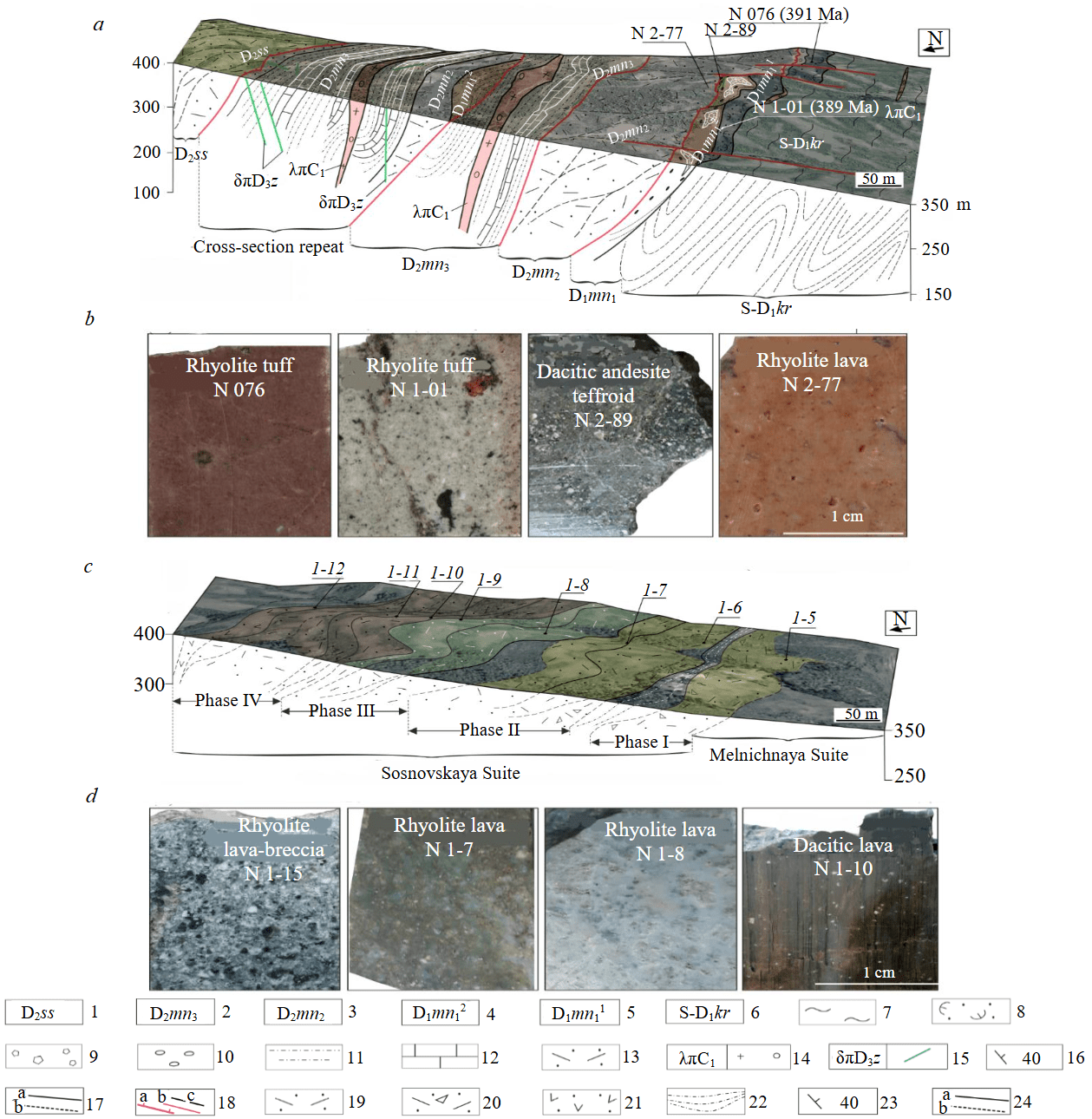
Fig.2. Shadow relief model of the Melnychnye Sopki Site with outlines of Melnychnaya Suites geological bodies illuminated from the west (a), with representative photographs of Melnychnaya Suites samples S-D1kz (b), and shadow relief model with outlines of Sosnovskaya Suites geological bodies illuminated from the west (c), with representative photographs of Sosnovskaya Suite samples (d)
1-7 – Stratigraphic subdivisions of the Melnychno-Sosnovsky volcanic complex: 1 – Sosnovskaya Suite, 2 – upper section of the Melnychnaya Suite, 3 – middle section of the Melnychnaya Suite, 4 – lower section of the Melnychnaya Suite, 5 – lower section of the Melnychnaya Suite (upper bedset), 6 – lower section of the Melnychnaya Suite (lower bedset), 7 – Korbalikha metamorphic strata; 8-15 – lithological composition: 8 – metamorphic schists, 9 – felsic tuffs, 10 – tuffites, 11 – conglomerates, gravelites, sandstones, 12 – limestones, marls, 13 – felsic lavas, 14 – rhyodacites subvolcanic intrusions, 15 – dolerite dikes of the Zmeinogorsk Intrusive Complex (?); 16 – elements of occurrence; 17 – geological boundaries: a – reliable, b – assumed; 18 – faults: a – thrusts, b – other, c – assumed; 19-22 – lithological composition: 19 – rhyolite lavas; 20 – rhyolite lava-breccias; 21 – dacite lavas; 22 – siltstones; 23 – bedding elements; 24 – geological boundaries: a – reliable, b – assumed.
The geological scheme is based on data by O.V.Murzin
Analysis of the sedimentary formation
In the studied cross-section of the Melnychnye Sopki we identified 3 subformations of different granulometric composition, which correspond to the three main pauses in volcanic activity (Fig.2, a, b). A more detailed delineation of the sedimentary beds, which would allow a finer identification of all the pauses in volcanic activity, is difficult due to the tectonic duplexing at different scales of the site.
The first subformation (lower section of the Melnychnaya Suite) is represented by homogeneous weakly calcified, coarse clastic (psephitic) gravelites. The gravelite clasts are composed of green schists from the underlying Caledonian lithology and certain siliceous rocks, possibly representing earlier volcanogenic material from the Melnychnaya Suite.
The second subformation (middle section of the Melnychnaya Suite) is consist of tuffite formed by erosion of former rhyolitic ash-tuffs and fine-clastic sandy-siltstone sediments with carbonate component. Limestones and sandstones form lenticular thin bodies, while the siltstones form linear stratified bodies.
The third subformation is represent by the upper section of the Melnychnaya Suite and the lower section of the Sosnovskaya Suite. It is characterised by uniform fine-clastic siltstones with thin micro-layering and, as shown above, has the maximum thickness of all sedimentary bedsets. According to the classification of terrigenous rocks, they can be classified as feldspathic greywackes, quartz-lithoclastite-mixtite sandstones or quartz greywackes. On geodynamic diagrams (not shown), the sandstone compositions correspond to those of the so-called uplifted basement, recycled orogen and mixed orogenic sand provinces [24].
Оur analysis shows that the sedimentary component of the Melnychnaya Suite is represented mostly by fine clastic rocks – siltstones, which are confined to the upper section of the Melnychnaya strata (D2mn3), and only in subordinate amounts – tuffites, gravelites, sandstones and limestones in its lower and middle sections (D1mn12). The sedimentary component of the Sosnovskaya Suite (D2ss) is confined to the lower section, representing a thin siltstone bed.
The terrigenous and carbonate sediments of the site described have a consistent occurrence. The dip direction of the strata is predominantly north, with variations in dip azimuth from 350° to 10-20° and variations in dip angle from 45-50° to 60°. The morphology of the geological bodies is layer- and lenticular in the Melnychnaya Suite and layer-shaped in the Sosnovskaya Suite. The observed lenticular shapes of the geological bodies may either indicate that they were formed mainly by sedimentary material filling in the negative relief forms of the seafloor, or such morpho-logy may be of tectonic nature. The sedimentary component of the Melnychnaya Suite consists of 97 % siltstones and 3 % tuffites, sandstones and limestones. The entire sedimentary component of the Sosnovskaya Suite is entirely contained in a single thin siltstone bed, which accounts for 3 % of the total thickness. The main sedimentary component of the Melnychnye Sopki cross-section is siltstones with a total thickness of ~ 650 m, while the total thickness of other sediments (tuffites, gravelites, sandstone-siltstones and limestones) is ~ 60-65 m. Thus, the main volume of the sedimentary component of the formation is actually concentrated only in its middle section, separating two distinct stages of volcanic activity, corresponding to the Melnychnaya Suite and the Sosnovskaya Suite.
Analysis of magmatic formation
The main volcanogenic components of the Melnychnaya and Sosnovskaya Suites are rhyolitic tuffs and lavas, in the ratio of 15:85 %, respectively (Fig.2, b). Of the more mafic rocks, only tuffites of dacitic andesites forming a thin bed in the middle section of the Melnychnaya Suite and dacitic lavas in the upper section of the Sosnovskaya Suite are identified. Volcanogenic formations are represented by lavas, lava-breccias, tuffs and subvolcanic intrusions. The latter consist of both bedded and lenticular bodies. In the Melnychnaya Suite ~ 20 % of its volume is occupied by rhyolitic lavas and lava-breccias and their tuffs, with sedimentary component accounting for ~ 80 %. The Sosnovskaya Suite consists of 97 % rhyolitic lava, rhyolitic lava-breccia and dacitic lava, with a minor amount of ~ 3 % sedimentary rocks (Fig.2, d).
Subvolcanic formations of basiс composition are represented by rare dolerite dikes in the middle part of the studied cross-section. Based on petrographic characteristics, we believe that they are of a later age – Givetian-Frasnian, which corresponds to the basaltic eruption of the Davydovsko-Kamenevsky volcanic complex [17]. As mentioned, the upper section of the Melnychnaya Suite contains thin lenses of brecciated dacitic andesites, whose petrographic definition is difficult. If we consider these rocks from the point of view of their effusive origin, they contain clastic material, all components of which correspond to only one petrographic type different from that of the underlying strata, which allows us to consider them as alien to the studied volcanogenic formation.
U-Pb (LA-ICP-MS) dating results
Previously obtained U-Pb isotopic ages of zircons from syngenetic granitoids (395-384 Ma) and subvolcanic rhyolites (390 Ma) provide a first approximation to the period of initial magmatism in NW Rudny Altai [17]. For the present study, zircon samples were collected from rhyolitic tuffs of the lower section of the Melnychnaya Suite. Zircons were not detected in samples of rhyolite lavas from the Sosnovskaya Suite. It should be noted that zircon grains are also absent from volcanomictic sandstones of the middle section of the Melnychnaya Suite. For zircon dating, we selected areas mainly in the marginal parts of the grains, taking into account zonality, fracturing and visible inclusions (Fig.3).
The Th/U ratio diagrams for the studied samples show that all values are in the range of 0.2 to 0.6, indicating the magmatic nature of the zircons. Errors of age determinations and isotopic ratio measurements are given at the 1σ level, while errors of concordant ages and discordant-concordant intersections are given at the 2σ level.
In sample N 76 the grains are pale yellow, diamond lustrous, dipyramidal in habitus (k = 1.6-3.4, with a mean of 2.5), with narrow oscillatory zonation, sometimes fractured. We performed 45 age determinations on 35 zircon grains during one measurement session. Isotopic ages obtained by intersecting discordia with the line of equal age for 35 zircon grains with a total of 37 dating points gave values of ~ 391 Ma.
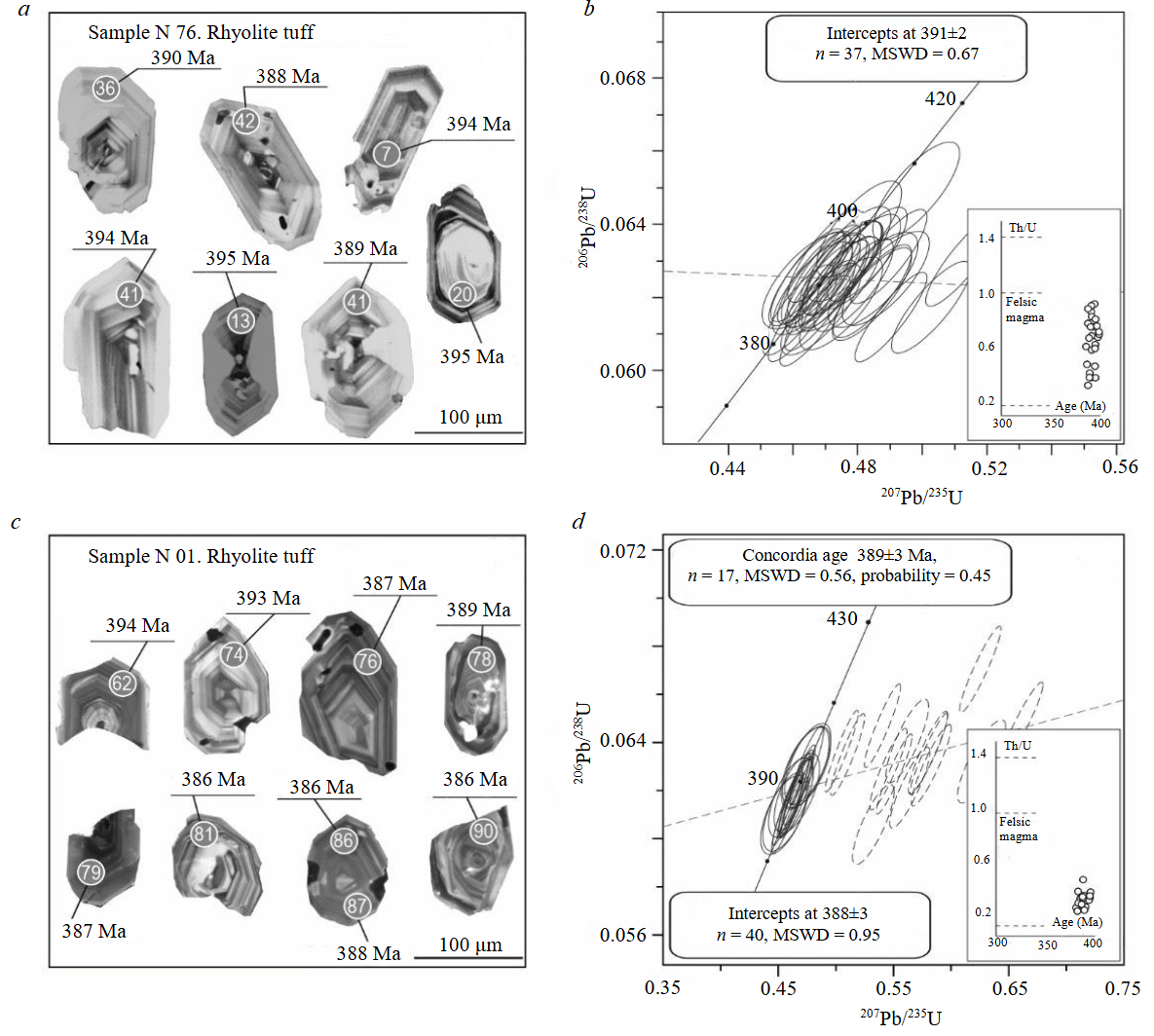
Fig.3. Cathode-luminescent (CL) images of zircons from volcanogenic rocks at the Melnichnye Sopki Site (a, c) and Concordia diagrams of U-Pb isotope dating results (b, d).
The Th/U ratio values in the studied zircons are shown in the inserts (b, d)
Sample N 01 contains grains of pale yellow colour, diamond lustre, dipyramidal habitus (k = 0.7-2.8, with a mean of 1.4), with narrow oscillatory zoning. We made 40 age determinations on 35 zircon grains during one measurement session. Isotopic ages obtained from the intersection of the discordia with a line of equal age on 14 zircon grains with a total of 17 dating points gave values of ~ 389 Ma. The results obtained for the two samples are in agreement with previously obtained U-Pb isotopic ages for subvolcanic rhyolites of the Melnychno-Sosnovsky volcanic complex [20].
Petrogeochemical classification of volcanic rocks
For the purposes of this study, 15 samples of volcanogenic rocks (lavas and tuffs), 5 samples of tuffogenic-sedimentary rocks (tuffites, sandstones, siltstones) from the Melnychnaya Suite and 8 samples of lavas from the Sosnovskaya Suite were analysed. Since the formation of the discussed volcanogenic strata was associated with the seafloor environment, it allows us to consider them as components of the classical spilite-keratophyre formation [7], in the composition of which, in addition to volcanogenic rocks, there may be widespread varieties of pyroclastic nature (tuffs, tuffites, etc.). Variations in mobile elements in volcanogenic rocks of submarine environments are considered the result of mass exchange of components during the reaction of magma with penetrating seawater and/or rising heated hydrothermal fluids [4, 5, 25]. Predecessors pointed out that the ultra-felsic volcanic rocks of the Rudny Altai do not represent a specific rock class, but have been subjected to intense secondary alteration, expressed in silicification and albitization [20].
In our case, the analysis of alkali variations [26, 27] indicates a significant role of potassium metasomatism in some volcanogenic rocks of the Melnychnaya Suite (K2O/Na2O = 28-343). Most compositions have extreme SiO2 contents (81.26-89.48 wt.%), which are in the silexite field on the TAS-diagram (Fig.4, a), suggesting interaction with secondary silica-bearing fluids. The tuffs of the lower section of the Melnychnaya Suite (SiO2 = 80.38-89.48 wt.%, K2O/Na2O = 35-342) were most strongly metasomatised, while the lavas of the middle section of the Melnychnaya Suite and some lavas of the Sosnovskaya Suite (SiO2 = 82.25-88.68 wt.%, K2O/Na2O = 1.12-50.3) were altered to a slightly lesser extent. In fact, the character of secondary alteration in these volcanic rocks corresponds to that of the subvolcanic rhyolites of the Melnychno-Sosnovsky volcanic complex [20]. The weakly altered compositions of the felsic lavas of the Melnychnaya and Sosnovskaya Suites, in the general sequence of their formation, are characterised by a decrease in SiO2 content (from 74.26 to 67.81 wt.%) and the sum of alkalis (Na2O + K2O = 6.03-7.89 wt.%), which allows them to be formally assigned to rhyolites of the medium potassium calc-alkaline series and to the low-K tholeiite series (K2O = 1.11-3.7 wt.%) on the SiO2 – K2O diagram (Fig.4, b). In comparison with the lavas and tuffs of the Melnychnaya Suite, the petrochemical compositions of the syngenetic tuffogenic-sedimentary rocks do not show any significant secondary alteration, being characterized by lower SiO2 contents (70.06-76.17 wt.%), K2O/Na2O ratios (0.1-0.79) and alkali sums (Na2O + K2O = 2.54-4.84 wt.%). It should be noted that the petrochemical characteristics of the assemblage studied indicate the absence of a continuous differentiated series including andesites, traditionally considered as part of volcanic series of supra-subduction settings.
Geochemical classification
The geochemical classification of altered rocks is mainly based on relatively immobile elements that are least affected by post-magmatic processes, including seafloor setting and metamorphism to the level of amphibolite facies. Many studies (references in [25]) have shown that in submarine settings, elements of the light rear elements (LREE – La-Sm, including Eu) are more efficiently leached and mobile than heavy rear elements (HREE – Er-Lu, including Y), especially when hydrothermal fluid movement is concentrated along well-permeable zones where high fluid/rock ratios are realized. Based on the classification with high field strength elements (Zr, Nb, Y, Ti) immobile in hydrothermal fluid at low degrees of metamorphism, the compositions of volcanic rocks of the Melnychnaya and Sosnovskaya Suites do not differ fundamentally, corresponding to the compositional field of rhyolites, less frequently dacites, within the range of compositions of normal alkalinity (Fig.4, c). The variations of LREE concentrations relative to HREE (La/Ybn = 1.12-12.6) have a wide range from tholeiitic to calc-alkaline series (Fig.4, d); calc-alkaline series – La/Yb > 5; transition compositions – La/Yb ~ 3-5; tholeiitic series – La/Yb < 3.
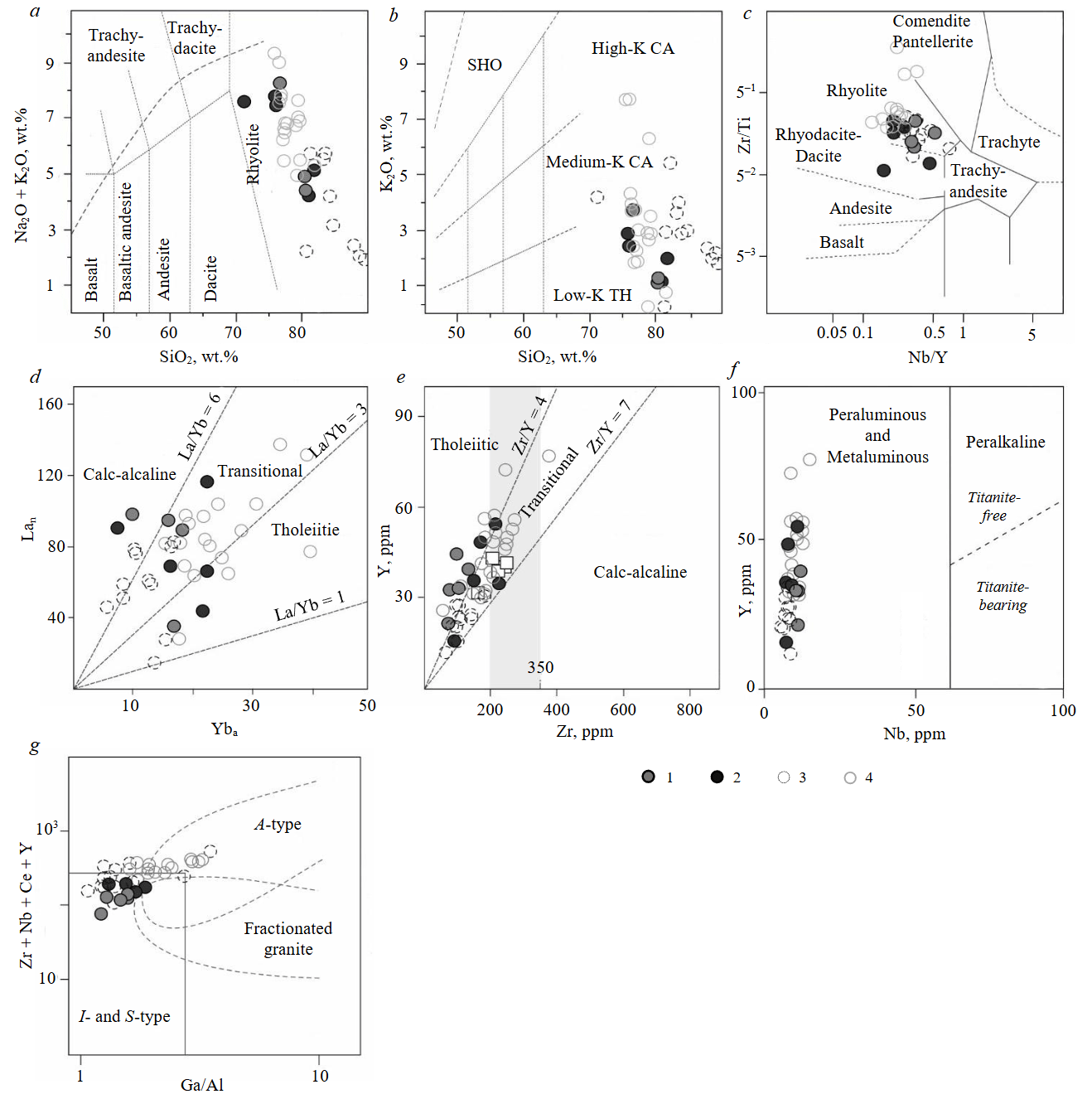
Fig.4. Geochemical classification of felsic rocks: SiO2–(Na2O+K2O) (a); SiO2–K2O [26, 27] (b); Nb/Y–Zr/Ti [28] (c); Yba–Lan (d); Zr–Y [5, 29] (e); Nd–Y [29] (f); Ga/Al–(Zr+Nb+Ce+Y) [30] (g)
1 – rhyolite lavas and their tuffs (D2mn); 2 – rhyolite and dacite lavas (D2ss); 3 – metasomatites on lavas; 4 – subvolcanic rhyolite porphyry (D2ms)
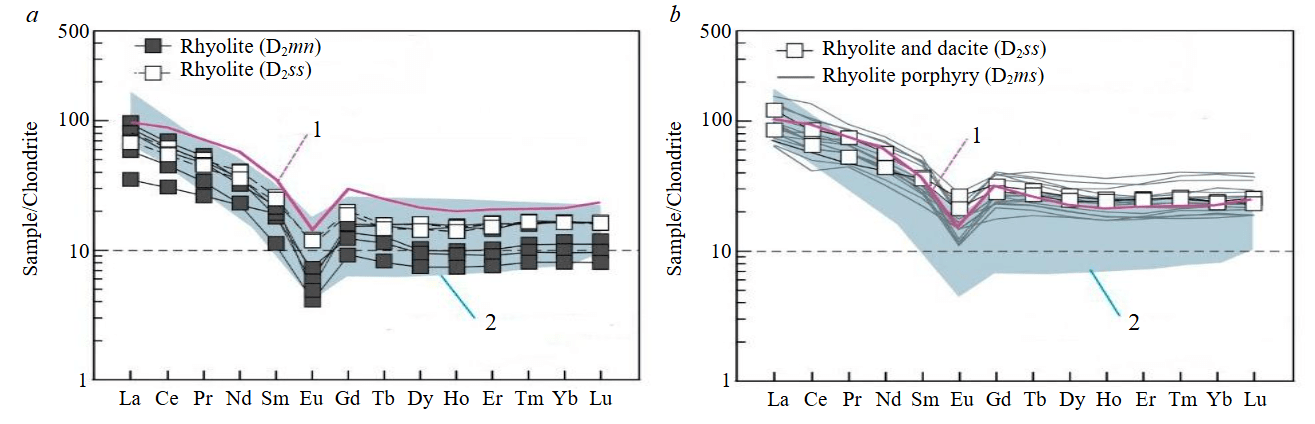
Fig.5. REE spectra normalized to chondrite [31] compared to hot-dry-reduced (1) and cold-wet-oxidized (2) New Zealand rhyolite [32, 33]
However, the chondrite-normalised REE spectra (Fig.5, a, b) [34] have a generally coherent pattern character, which allows their use for interpretation with a certain degree of caution. The analysis of non-mobile elements (see Fig.4, e) [4-6] shows that the compositional peaks are predominantly in the tholeiitic series with a trend towards the calc-alkaline series, as they have relatively low values of their indicator ratios (Zr/Y = 3-6.6, Zr < 350 ppm). Apparently, the geochemical types discussed were not peralkaline by nature, as indicated by the Nb/Y indicator ratios (< 0.52) and relatively low Nb concentrations (< 12 ppm; Fig.4, f) [29]. It is also unlikely that their parent magmas could be peraluminous in nature, since the compositions studied show a positive evolutionary trend in the distribution of Ga/Al values (Fig.4, g), which differs from that of highly fractionated S- and I-type felsic magmas [30]. The total concentrations of Nb, Y, Zr and Ce (< 347 ppm), together with low values of Ga/Al ratios (1.26-3.52) and Zn contents (9-187 ppm), indicate that the studied rocks belong to the I-S-type compositional range, close to the A2 compositional range. The contents of large ion lithophile elements (LILE: Rb, Ba, Cs, Sr) show more significant variations in the same type of strongly altered rocks, corresponding to their high mobility during hydrothermal processes [25]. For example, the Rb/Sr ratio varies from 0.02 to 1.2 in weakly altered rocks and from 0.4 to 6.0 in strongly altered samples. In most cases, the compositional field has a close affinity with the previously studied Melnychno-Sosnovsky subvolcanic rhyolites [20], which have more pronounced transitional geochemical characteristics between island-arc and intraplate magmatic formations.
The compositions of weakly altered Melnychnaya Suite lavas normalized to chondrites [34] are characterized by asymmetric REE spectra with a wide range of (La/Yb)n ratios (2.11-10.09), almost flat to positive shapes of HREE spectra (Gd/Yb)n = 0.96-1.29) and Eu anomaly (Eu/Eu* = 0.28-0.51; Eu* = Eun/(Smn*Gdn)½; Fig.5, a). Based on these geochemical characteristics, the studied rocks are closest to those of the ensialic island arc, which owe their petrogenesis to fluid-related conditions of partial melting of crustal substrates under the control of the dehydration regime of the subduction plate [32, 33]. The lavas of the Sosnovskaya Suite (lower section) are characterized by REE spectra close to those of the Melnychnaya Suite (La/Yb)n = 4.27-4.9, (Gd/Yb)n = 1.16-1.24), differing by a less pronounced Eu anomaly (Eu/Eu* = 0.5-0.54; Fig.5, b). In the upper section, these rocks have more enriched REE spectra (La/Yb)n = 2.96-5.18, (Gd/Yb)n = 1.21-1.33, Eu/Eu* = 0.65-0.75), corresponding to the Melnychno-Sosnovsky subvolcanic rhyolites [20]. In the latter case, the rocks resemble rhyolites [34] of bimodal associations from riftogenic settings behind island arcs, e.g. the Okinawa Trough [35-37], the Kuroko Rift [38-40], and the Taupo Rift [41, 42]. Together with relatively high contents of HREE (157-210 ppm), Y (48-54 ppm) and Zr (172-217 ppm), this suggests that the parental magmas of these rhyolites may have formed under more reduced partial melting conditions [32, 33] than the precursor magmas with more pronounced supra-subduction geochemical characteristics (HREE = 66-174, Y = 16-39, Zr = 76-179 ppm). In addition, it is empirically established that A-type felsic rocks have 2-3 times higher Zn contents than similarly composed S-, I- and M-type granitoids and closely related volcanic rocks (< 60 ppm [6]), which is explained by the high solubility of Zn at high temperatures in such magmatic systems. Indirectly, this suggests that the parent magmas of the studied rhyolites could be metal-bearing.
Analysis of ore-bearing formations
We analysed 13 rock samples from the Melnychno-Sosnovsky volcanic complex and three samples from sub-volcanic intrusions. The vertical distribution of ore components is shown in Fig.6. The studied rocks are characterised by high concentrations of Zn, Pb, Cu, Ba and contain As, Bi, Co, Ni and Cr. On average, the highest concentrations of Zn, Pb, Cu and Ba are restricted to volcanogenic and volcanogenic-sedimentary sequences. Dolerites with high concentrations of both Zn, Pb, Cu, Ba and Co, Ni, Cr are prominent among the subvolcanic intrusions. The occurrence of Co, Ni and Cr in the rocks of this intrusive formation is probably related to the later basaltic volcanism that occurred in the study area from the end of the Late Givetian to the beginning of the Frasnian [17].
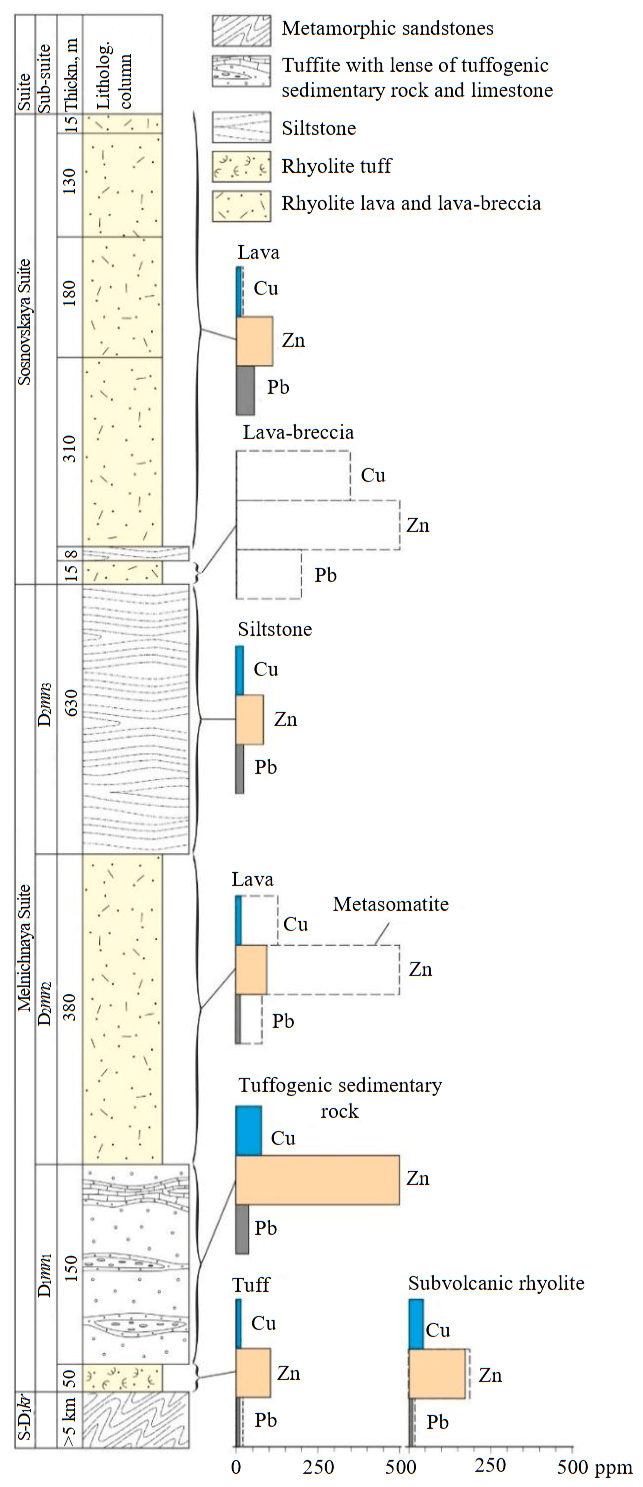
Fig.6. Distribution of ore components in the section of the Melnichno-Sosnovsky volcanic complex
The Melnychnaya Suite is characterized by minimum Zn, Pb, Cu concentrations (up to 1164; 78; 162 ppm) with maximum As concentrations (up to 52 ppm). In the Sosnovskaya Suite the opposite distribution of these components is observed (Zn up to 15,648; Pb up to 307; Cu up to 497; As up to 3 ppm). Probably higher As contents in the Melnychnaya Suite are related to early diagenetic processes in the sediment lithology, which is characteristic of a number of volcanogenic-hydrothermal deposits formed in seafloor environment [32]. On the contrary, the high contents of Zn, Pb and Cu in the Sosnovskaya Suite are consistent with the available data on their association with endogenous processes (magmatic activity) [17]. In general, the increase in Zn content in the Melnichnye Sopki cross-section indicates increasing activity of volcanism as a result of progressing riftogenic processes, since most volcanogenic strata have higher Zn contents (above 60 ppm), which is characteristic of riftogenic (A-type) felsic magmas of continental marginal settings [4-6].
Discussion
From the point of view of sedimentary formation analysis [12, 13] in most cases the occurrence of coarse clastic facies in the studied cross-section, as products of the destruction of growing mountain region, should indicate the manifestation of tectonic activation. On the other hand, coarse clastic facies can be considered as intraformational rocks associated with short-term destruction of volcanic structures during periods of volcanic quiescence. In our case, petrographic observations indicate a decrease in the granulometric composition of sedimentary rocks (from gravelites to siltstones) and an increase in the proportion of volcanic products, up to their complete predominance in the cross-section from the lower section of the Melnychnaya Suite to the Sosnovskaya Suite.
Formally, the decrease in the granulometric dimension of the sedimentary rocks from the bottom to the top of the cross-section, in the sequence of gravelites – sandstones-siltstones – siltstones at the Melnychnye Sopki site corresponds to the signs of marine basin transgression and tectonic subsidence of the region. In general, this does not contradict the described geological record of Rudny Altai, where Devonian magmatic activation was preceded by uplift of the region and formation of brachyform anticlinal folds of the pre-Devonian basement. At the boundary between the Middle and Late Devonian, an extension regime was clearly manifested with the formation of a rift zone in the rear part of the NW Rudny Altai [17]. At the same time, the mainland coast should have been relatively distant.
The sedimentary rocks have massive textures, there is no oblique layering in outcrops, indicating the relative layering of the coastal shallow-sea zone and the absence of intense wave activity. The gravelite clasts show no obvious mineralogical signs of the input of allogenic material from the continental part, which can be indicated by perthitic grains of feldspar grains, granite clasts and quartz grains with mosaic texture due to cataclasis during transportation.
Among other indirect signs, we note basal cement in the rocks, indicating a moderate degree of overwash of the primary sedimentary material. As mentioned above, no zircons were found in the volcanomic sandstones of the Melnychnaya Suite. The correlation between sedimentation style and paleontological data (faunal depth) also indicates a gradual transition from the coastal zone (inner shelf) to deeper sea zones (outer shelf). Thus, the set of geological features discussed above testifies to the submergence of the territory, which began in a shallow-marine basin environment, at a relative distance from the continent's coastline, but without obvious signs of active riftogenesis, since there is no evidence of avalanche sedimentation of coarse clastic material [17].
In terms of magmatic analyses [11-13], the Melnichnye Sopki cross-section lacks a continuous sequence from basalts to rhyolites, which is a classic feature of most subduction settings. Felsic pyroclastic rocks (rhyolite tuffs) are widespread and, except for rare interlayers of dacitic andesite tuffits, pyroclastic material of andesitic composition is absent.
In the study area, the Melnychnaya Suite and the Sosnovskaya Suite show different genesis peculiarities, which are expressed in different duration and intensity of eruptions. The Melnychnaya Suite consists mainly of rhyolitic lavas and lava-breccias and their tuffs. The Sosnovskaya Suite consists almost entirely of rhyolitic lavas and lava-breccias, i.e. felsic effusive products, which, due to their high viscosity, should have accumulated in the immediate distance of the eruption centres. Pyroclastic material is absent.
The lavas of the Melnychnaya Suite have mostly massive, rarely banded and fluidal textures indicating lava flow. The lavas of the Sosnovskaya Suite, on the other hand, show greater textural diversity – both massive, striated (fluidal), spotted and spheruloid textures are common. The spotted texture could be related to secondary alteration, while the formation of spheruloidal lavas is due to the fact that the preceding lava (with well-developed flow structures) contained large amounts of dissolved volatiles, according to [11]. This is consistent with our observations; in the Sosnovskaya Suite, spheruloid lavas are preceded by thin-banded lavas.
The comparable amount of erupted volcanic material in both formations, expressed in thickness, has a ratio of 4:6. In fact, the volcanic period of the Melnychnaya Suite can be characterized as depressed sporadic, with a strong predominance of pyroclastic eruptive products over lavas, alternating several times with short volcanic pauses and accumulation of intraformational coarse clastic sediments. In contrast, the formation of the Sosnovskaya Suite volcanism had a more intense and almost continuous character, expressed by lava eruptions in the absence of pyroclastic material, which occurred after the sediment accumulation. In studies [43], a similar eruption mechanism (in the absence of pyroclastic material) is explained by an increase in depth from 200 m and above, as a result of which the explosive activity of volcanoes decreases until its complete cessation. This suggests a direct relation to the high hydrostatic pressure of the seawater column, which causes only a slow rise of felsic magmas, followed by their extrusion to the seafloor surface and vent plugging.
Finally, if we include dolerite dikes, which we believe are not related to the formation, then we formally speak of a bimodal basalt-rhyolite (quartz-keratophyre) formation associated with shallow-sea environments [12]. The combination of the characteristics discussed, which the whole community of formations (volcanogenic, sedimentary and ore-bearing) possesses, is more in favour of a riftogenic setting. If we consider that lava eruptions to the surface are the result of increased permeability of the continental lithosphere and activation of deep penetrating fault zones, then the volcanic eruptions of the Melnychnaya Suite reflect the initial stage of this development, and those of the Sosnovskaya Suite a more prolonged stage of tectonic processes. If we correlate magmatic, sedimentary, and tectonic processes on the scale of the Devonian period from the Emsinian to the beginning of the Frasnian, when basic volcanism erupted in the NW Rudny Altai, then the Melnichno-Sosnovskaya volcanic formation can be interpreted as the initial one, corresponding to the beginning of crustal extension.
Conceptual geodynamic scenario
Despite contradictions in the interpretation of the geodynamic nature of Rudny Altai (reviewed in [20]), most authors agree on the sequence from initial riftogenesis (D1-2) to the formation of the island arc (D3-C1). However, from the point of view of the proposed geodynamic scenarios, it remains unexplained why the initial volcanism of Rudny Altai (Early-Middle Devonian) is represented by a bimodal association that developed in a riftogenic environment against the background of general subduction of a shallow-marine basin and without preceding island-arc formations, whereas in the Late Devonian an island arc with andesites was formed in region of the Rudny Altai riftogenic basin, according to formal features [14, 17].
It is well known that the development of bimodal volcanism is a common phenomenon in extension tectonic settings, whereas the development of andesites usually corresponds to compressional geodynamic settings. A current research based on the Extension Subduction Orogen model [44] suggests that the driving force for the formation of marginal back-arc basins is the geometry change and roll-back of the subduction plate. This is accompanied by the upwelling of the asthenospheric diapir, which leads to the migration of the volcanic front, the opening of the back-arc basin and, as a consequence, the interference of geochemical signatures of the basic magmatism [35-37]. However, by analogy with the evolution of the Japanese back-arc basin, the process is not unidirectional: alternating episodes of extension and compression are possible in the case of reciprocal migration of the subduction plate. Note that the opening of the back-arc basins on the Eastern Asian margin was accompanied by the formation of graben-like structures and pull-apart basins, as well as multidirectional rotation of continental blocks and lateral movements of tectonic blocks along the main shear zones and associated faults [45, 46].
The Rudny Altai block also has widespread tectonic macrostructures that are indicative of the modes of manifestation of volcanism, such as large shear zones and associated faults, pull-apart basins, geological and cartographic evidence of rotation of individual blocks marked by subvolcanic intrusions, and others. Taking into account the kinematic characteristics and the spatial position of the faults, the Devonian tectonic architecture of the Rudny Altai block can be considered as a negative flower (tulip) structure according to structural kinematic models and analogue modelling [47, 48]. Accordingly, our geodynamic interpretation, based on the continental-marginal lithospheric plate-slip scenario [49], suggests activation of the tectonic zone between the island-arc and the back-arc basin, similar to that at the Eastern Asian margin. This is consistent with the ideas of predecessors [14] who drew an analogy between the Rudny Altai sulfide-polymetallic belt and the Green Tuffs province in Japan (Kuroko type), which formed in the extension regime under submarine environment behind the island arc [38-40].
Conclusion
Reconstruction of the initial volcanogenic formations genetically related to the Early-Middle Devonian polymetallic deposits of the NW Rudny Altai allowed us to formulate the following conclusions:
- The formation of the volcanogenic formations occurred in the tectonic setting associated with the initial stage of riftogenesis.
- Petrogeochemical interpretations and analysis of the genetic type of the formation (magmatic, sedimentary, and ore-bearing) indicate their relation to the rifting settings. The U-Pb isotopic age of zircons from the initial tuffogenic sequences is ~ 390 Ma.
- The conceptual geodynamic scenario suggests the formation of Rudny Altai ore deposits in the transition zone between the island-arc and the back-arc basin, similar to the Eastern Asian margin settings.
References
- Vikentyev I.V., Belogub E.V., Novoselov K.A., Moloshag V.P. Metamorphism of volcanogenic massive sulphide deposits in the Urals. Ore geology. Ore Geology Reviews. 2017. Vol. 85, p. 30-63. DOI: 10.1016/j.oregeorev.2016.10.032
- Chekalin V.M., Dyachkov B.A. Rudny Altai Base-Metal Belt: Localization of Massive Sulfide Mineralization. Geology of Ore Deposits. 2013. Vol. 55. N 6, p. 438-454. DOI: 10.1134/S1075701513060020
- Chernyshev I.V., Vikentyev I.V., Chugaev A.V. et al. Sources of Metals for the Rudny Altai VMS Deposits: Results of High-Precision MC-ICP-MS Lead Isotope Study. Geochemistry International. 2023. Vol. 61. N 6, p. 539-561. DOI: 10.1134/S0016702923060022
- Galley A.G., Hannington M.D., Jonasson I.R. Volcanogenic Massive Sulphide Deposits. Mineral Deposits of Canada: A Synthesis of Major Deposit-Types, District Metallogeny, the Evolution of Geological Provinces, and Exploration Methods. Geological Association of Canada, Mineral Deposits Division, 2007. Special Publication N 5, p. 141-161.
- Brueckner S.M., Johnson G., Wafforn S. et al. Potential for Volcanogenic Massive Sulfide Mineralization at the A6 Anomaly, North-West British Columbia, Canada: Stratigraphy, Lithogeochemistry, and Alteration Mineralogy and Chemistry. Minerals. 2021. Vol. 11. Iss. 8. N 867. DOI: 10.3390/min11080867
- Piercey S.J., Hinchey J.G., Sparkes G.W. Volcanogenic massive sulfide (VMS) deposits of the Dunnage Zone of the Newfoundland Appalachians: setting, styles, key advances, and future research. Canadian Journal of Earth Sciences. 2023. Vol. 60. N 8, p. 1104-1142. DOI: 10.1139/cjes-2022-0148
- Kuznetsov V.V., Kudryavtseva N.G., Seravina T.V. et al. Basics of forecasting and prospecting for pyrite-polymetallic deposits of Rudny Altai. М.: Tsentralnyi nauchno-issledovatelskii geologorazvedochnyi institut tsvetnykh i blagorodnykh metallov, 2019, p. 208.
- Levashova E.V., Mamykina M.E., Skublov S.G. et al. Geochemistry (TE, REE, Oxygen) of Zircon from Leucogranites of the Belokurikhinsky Massif, Gorny Altai, as Indicator of Formation Conditions. Geochemistry International. 2023. Vol. 61. N 13, p. 1323-1339. DOI: 10.1134/S001670292311006X
- Levashova E.V., Skublov S.G., Hamdard N. et al. Geochemistry of Zircon from Pegmatite-bearing Leucogranites of the Laghman Complex, Nuristan Province, Afghanistan. Russian Journal of Earth Sciences. Vol. 24. N 2. N ES2011 (in Russian). DOI: 10.2205/2024es000916
- Skublov S.G., Levashova E.V., Mamykina M.E. et al. The polyphase Belokurikhinsky granite massif, Gorny Altai: isotope-geochemical study of zircon. Journal of Mining Institute. 2024. Vol. 268, p. 552-575.
- Luchitsky I.V. Fundamentals of paleovolcanology. In 2 vol. Vol. 2. Drevnie vulkany. Moscow: Nauka, 1971, p. 383.
- Kuznetsov Yu.A. Main types of magmatic formations. Moscow: Nedra, 1964, р. 387.
- Tseisler V.M. The study of geological formations in connection with the studies of composition, structure and evolution of the Earth’s crust. Proceedings of higher educational establishments. Geology and Exploration. 2009. N 2, p. 3-9 (in Russian).
- Lyubetskii Bolshoi Altai (geologiya i metallogeniya). Vol. 1. Geologicheskoe stroenie / Ed. by G.N.Shcherby. Almaty: Gylym, 1998, p. 304.
- Dobretsov N.L. Evolution of structures of the Urals, Kazakhstan, Tien Shan, and Altai-Sayan region within the Ural-Mongolian fold belt (Paleoasian Ocean). Russian Geology and Geophysics. 2003. Vol. 44. N 1-2, p. 3-26.
- Yarmolyuk V.V., Kuzmin M.I., Vorontsov A.A. West Pacific-type convergent boundaries and their role in the formation of the Central Asian Fold Belt. Russian Geology and Geophysics. 2013. Vol. 54. N 12, p. 1427-1441. DOI: 10.1016/j.rgg.2013.10.012
- Gosudarstvennaya geologicheskaya karta Rossiiskoi Federatsii. Masshtab 1:200,000. Seriya Altaiskaya. List M-44-XI (Zmeinogorsk). Obyasnitelnaya zapiska. St. Petersburg: Izd-vo Sankt-Peterburgskoi kartograficheskoi fabriki VSEGEI, 2001, p. 174.
- Gaskov I.V. Specific features of pyrite ore-magmatic systems development in the island arc environments of Rudny Altai and Southern Urals. Litosfera. 2015. N 2, p. 17-39 (in Russian).
- Maslennikov V.V., Maslennikova S.P., Tretyakov G.A. et al. Fahlores in paleozoic vent chimneys from the Urals and Rudny Altai volcanogenic massive sulfide deposits. Мineralogy. 2015. N 4, p. 53-78 (in Russian).
- Kuibida M.L., Murzin O.V., Kruk N.N. et al. Whole-rock geochemistry and U-Pb ages of Devonian bimodal-type rhyolites from the Rudny Altai, Russia: Petrogenesis and tectonic settings. Gondwana Research. 2020. Vol. 81, p. 312-338. DOI: 10.1016/j.gr.2019.12.002
- Nakamura H., Iwamori H., Nakagawa M. et al. Geochemical mapping of slab-derived fluid and source mantle along Japan arcs. Gondwana Research. 2019. Vol. 70, p. 36-49. DOI: 10.1016/j.gr.2019.01.007
- Seung Ryeol Lee. Physical conditions for basaltic volcanism beneath the Jeju volcanic field and the geodynamic implications. Geosciences Journal. 2024. Vol. 28. N 5, p. 789-798. DOI: 10.1007/s12303-024-0031-3
- Dey B., Shibata T., Yoshikawa M. LOMU Type Alkali Basalts in East Asia Sourced from Subduction Recycling of Multiple Ancient Crustal Components. Journal of Petrology. 2024. Vol. 65. Iss. 10. N egae104. DOI: 10.1093/petrology/egae104
- Dickinson W.R., Suczek C.A. Plate Tectonics and Sandstone Compositions. AAPG Bulletin. 1979. Vol. 63. Iss. 12, p. 2164-2182.
- Humphris S.E., Blusztajn J., Yuanfeng Cai. Rare Earth Element Mobility and Sr Isotope Systematics of Altered Volcanic Rocks from Seawater-Based and Magmatically Influenced Hydrothermal Systems: Brothers Volcano, Kermadec Arc (IODP Expedition 376). Economic Geology. 2023. Vol. 118. N 7, p. 1699-1717. DOI: 10.5382/econgeo.4961
- Middlemost E.A.K. Naming materials in the magma/igneous rock system. Earth-Science Reviews. 1994. Vol. 37. Iss. 3-4, p. 215-224. DOI: 10.1016/0012-8252(94)90029-9
- Peccerillo A., Taylor S.R. Geochemistry of Eocene Calc-Alkaline Volcanic Rocks from the Kastamonu Area, Northern Turkey. Contributions to Mineralogy and Petrology. 1976. Vol. 58. Iss. 1, p. 63-81. DOI: 10.1007/BF00384745
- Winchester J.A., Floyd P.A. Geochemical discrimination of different magma series and their differentiation products using immobile elements. Chemical Geology. 1977. Vol. 20, p. 325-343. DOI: 10.1016/0009-2541(77)90057-2
- Shellnutt J.G., Vaughan M.W., Hao-Yang Lee, Iizuka Y. Late Jurassic Leucogranites of Macau (SE China): A Record of Crustal Recycling During the Early Yanshanian Orogeny. Frontiers in Earth Science. 2020. Vol. 8. N 311. DOI: 10.3389/feart.2020.00311
- Fu Yuan Wu, Xiao Chi Liu, Wei Qiang Ji et al. Highly fractionated granites: Recognition and research. Science China Earth Sciences. 2017. Vol. 60. N 7, p. 1201-1219. DOI: 10.1007/s11430-016-5139-1
- Barrie C.T., Hannington M.D. Classification of Volcanic-Associated Massive Sulfide Deposits Based on Host-Rock Composition. Volcanic Associated Massive Sulfide Deposits: Processes and Examples in Modern and Ancient Settings. Society of Economic Geologists, 1999. Vol. 8, p. 1-11. DOI: 10.5382/Rev.08.01
- Bachmann O., Huber C. The Inner Workings of Crustal Distillation Columns; the Physical Mechanisms and Rates Controlling Phase Separation in Silicic Magma Reservoirs. Journal of Petrology. 2019. Vol. 60. Iss. 1, p. 3-18. DOI: 10.1093/petrology/egy103
- Deering C.D., Gravley D.M., Vogel T.A. et al. Origins of cold-wet-oxidizing to hot-dry-reducing rhyolite magma cycles and distribution in the Taupo Volcanic Zone, New Zealand. Contributions to Mineralogy and Petrology. 2010. Vol. 160. Iss. 4, p. 609-629. DOI: 10.1007/s00410-010-0496-0
- Sun S.-s., McDonough W.F. Chemical and isotopic systematics of oceanic basalts: implications for mantle composition and processes. Geological Society, London, Special Publications. 1989. Vol. 42, p. 313-345. DOI: 10.1144/GSL.SP.1989.042.01.1
- Xiaohui Li, Zhigang Zeng, Huixin Yang et al. Integrated major and trace element study of clinopyroxene in basic, intermediate and acidic volcanic rocks from the middle Okinawa Trough: Insights into petrogenesis and the influence of subduction component. Lithos. 2020. Vol. 352-353. N 105320. DOI: 10.1016/j.lithos.2019.105320
- Agangi A., Manalo P.C., Takahashi R. et al. Magmatic evolution and metal systematics of back-arc volcanic rocks of north-east Japan and implications for deposition of massive sulphide Kuroko ores. Contributions to Mineralogy and Petrology. 2022. Vol. 177. Iss. 12. N 115. DOI: 10.1007/s00410-022-01980-z
- Yagi M., Hasenaka T., Ohguchi T. et al. Transition of magmatic composition reflecting an evolution of rifting activity. Japanese Magazine of Mineralogical and Petrological Sciences. 2001. Vol. 30. Iss. 6, p. 265-287. DOI: 10.2465/gkk.30.265
- Shikazono N., Ogawa Y., Utada M. et al. Geochemical behavior of rare earth elements in hydrothermally altered rocks of the Kuroko mining area, Japan. Journal of Geochemical Exploration. 2008. Vol. 98. Iss. 3, p. 65-79. DOI: 10.1016/j.gexplo.2007.12.003
- Manga M., Mitchell S.J., Degruyter W., Carey R.J. Transition of eruptive style: Pumice raft to dome-forming eruption at the Havre submarine volcano, southwest Pacific Ocean. Geology. 2018. Vol. 46. N 12, p. 1075-1078. DOI: 10.1130/G45436.1
- Collins W.J. Nature of extensional accretionary orogens. Tectonics. 2002. Vol. 21. N 4, p. 6-1 – 6-12. DOI: 10.1029/2000TC001272
- Yuxiang Zhang, Zhigang Zeng, Xiaoyuan Wang et al. Factors controlling the geochemical differences between two types of rhyolites in the middle Okinawa Trough. Geosciences Journal. 2020. Vol. 24. N 1, p. 35-48. DOI: 10.1007/s12303-018-0084-2
- Zehua Guo, Zenghui Yu, Ke Wang et al. Origins of magmatism in the Okinawa Trough: Fe–Sr–Nd–Pb–Hf isotopic constraints. International Geology Review. 2024. Vol. 66. Iss. 8, p. 1590-1606. DOI: 10.1080/00206814.2023.2245864
- Hosoi J., Tanii Y., Okada M., Haneda Y. Rotated Transtensional Basins Formed During Back-Arc Spreading in Japan: Simultaneous Rapid Tectonic Rotation and Basin Subsidence. Tectonics. 2023. Vol. 42. Iss. 6. N e2022TC007642. DOI: 10.1029/2022TC007642
- Ganbat A., Pastor-Galán D., Hirano N. et al. Cretaceous to Miocene NW Pacific Plate kinematic constraints: Paleomagnetism and Ar-Ar geochronology in the Mineoka Ophiolite Melange (Japan). Journal of Geophysical Research: Solid Earth. 2021. Vol. 126. Iss. 5. N e2020JB021492. DOI: 10.1029/2020JB021492
- Kinoshita H., Yamaji A. Arc-parallel extension in preparation of the rotation of southwest Japan: Tectonostratigraphy and structures of the Lower Miocene Ichishi Group. Island Arc. 2021. Vol. 30. Iss. 1. N e12418. DOI: 10.1111/iar.12418
- Gürbüz A., Şaroğlu F. Chapter 7 – Right-Lateral Strike-Slip Faulting and Related Basin Formations in the Turkish–Iranian Plateau. Developments in Structural Geology and Tectonics. Elsevier, 2019. Vol. 3, p. 101-130. DOI: 10.1016/B978-0-12-815048-1.00007-X
- Bhattacharya A.R. Strike-Slip Faults. Structural Geology. Springer, 2022, p. 231-243. DOI: 10.1007/978-3-030-80795-5_12
- Zhu Mengjia, Wang Guangzeng, Li Sanzhong et al. An overview of structures associated with bends of strike-slip faults: Focus on analogue and numerical models. Marine and Petroleum Geology. 2024. Vol. 167. N 106983. DOI: 10.1016/j.marpetgeo.2024.106983
- Khanchuk A.I., Grebennikov A.V., Ivanov V.V. Albian–Cenomanian Orogenic Belt and Igneous Province of Pacific Asia. Russian Journal of Pacific Geology. 2019. Vol. 13. N 3, p. 187-219. DOI: 10.1134/S1819714019030035