

The cover shows an exhibit of the Mining Museum – a granular aggregate of platinum in dunite with chromite, Ural. The ore sample contains 300 grams of platinum per ton of rock. The mineral got its name from the Spanish word plata, meaning “silver”, for its silvery-white color, as platinum was mistakenly considered a form of silver.
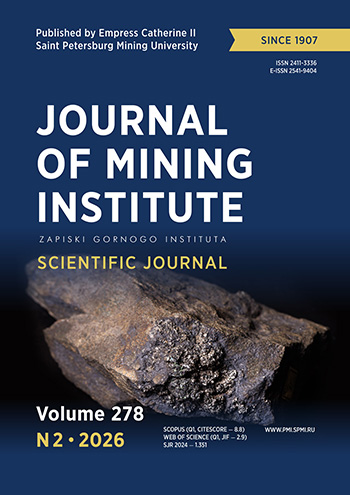
Vol 278
-
Date submitted2024-12-24
-
Date accepted2025-10-09
-
Online publication date2026-01-28
-
Date published2026-05-12
Three-dimensional modeling of stress-strain state and rock massif stability analysis during the construction of an underground research laboratory
The paper presents the results of modeling stress fields and analyzing the strength of the rock mass at the Yeniseiskiy site (Krasnoyarsk Region), selected for the construction of an underground research laboratory. Variants of boundary loading conditions along the model boundaries are substantiated, and the results of modeling the distribution of stress tensor components for four loading scenarios are presented, along with an assessment of rock mass stability using well-known strength criteria, including Hoek – Brown, Mohr – Coulomb, von Mises, and others. Regularities in the distribution of stress fields within the rock mass and differences associated with the tectonic conditions of the area are identified. It is established that the localization of zones of stress intensity concentration depends on the ratio of the principal stress components. Orientation of compression in the submeridional direction leads to an increase in stress intensity by 10-15 % relative to other modeling variants. Zones of anomalous stress intensity values are located within blocks as well as in the footwalls of tectonic faults. The models are characterized by high values of the potential energy of distortion in fault zones (as parts of the rock mass most susceptible to deformation) and at their intersections. Three-dimensional modeling makes it possible to identify effects that are weakly expressed in plane strain models. The results of geomechanical modeling are required for planning experiments in the underground research laboratory in order to refine the isolation properties of the rock mass during the disposal of high-level radioactive waste. Methodological approaches of three-dimensional modeling are applied by geomechanical and geotechnical services of industrial enterprises and other hazardous facilities (underground gas storage facilities, mineral deposits, etc.).
-
Date submitted2024-11-25
-
Date accepted2025-10-09
-
Online publication date2026-02-02
-
Date published2026-05-12
Geometric models of typical complex-structured bench blocks
More complete extraction of minerals from subsurface by reducing their losses even more actualizes tasks of improving mathematical models of mining objects. Purpose of this work is to create geometric models of typical complex-structured blocks (CSB), which could be extended to real CSB. They are based on mining and geological models of virtual (typical) complex-structured ore blocks of bench, consisting of discontinuous continuous (first type) and dispersed ore bodies (second type). These blocks key parameters are isolated continuous and dispersed ore bodies characteristic points coordinates, ore bodies with host rocks contact line segments length, and ore bodies areas in CSB sections. They determine these objects mining and geological characteristics (ore saturation, block geological and morphological structure complexity). These characteristics are analytically interconnected with disparate ore bodies geometric parameters and admixed rock or lost ore layer size. They are the basis for CSB geometric models numerical values calculation methodology and mining and geological characteristics of ore bodies and whole block. Computer program for automated determination of geometrical characteristics of CSB by given initial key parameters of complex-structured blocks has been created. Example of calculation of these characteristics for typical complex-structured blocks is considered, and significance of research results in CSB development is shown. Proposed methodology of calculation of key characteristics of geometrical models of CSB is an information basis for making decisions on economical and ecological development of CSB of benches. Results of research can be used in exploitation of real complex-structured deposits to significantly reduce loss and dilution of minerals.
-
Date submitted2025-02-20
-
Date accepted2025-12-09
-
Online publication date2026-02-04
-
Date published2026-05-12
Investigation of rock burst hazard formation features in tectonic discontinuity zones of the Khibiny deposits
- Authors:
- Ilya I. Bagautdinov
- Arkadii N. Shabarov
The hazard of rock bursts at the Khibiny deposits is largely due to their block structure and the natural gravitational-tectonic stress field in the rock mass. A detailed analysis of documented cases of rock bursts in the fields of the Kola Peninsula allowed to develop a classification of geodynamic events by the mechanism of their occurrence. During the analysis, it was found that in the period 1980-2024, 40 % of all rock bursts were associated with geological disturbances with high strength of the aggregate material. Such geodynamic events occur as a result of activation of a combined mechanism. The cause of the geodynamic event in this case is a combination of structural disturbances of the rock mass with a high level of tectonic stresses. An important criterion of rock burst hazard in the area of geological disturbances in highly stressed rock masses is their relative rigidity, and consequently, the degree of fracturing in relation to the natural conditions of the rock mass. The mechanism of this class of rock bursts can be described within the framework of the theory of rigid-platen theory. Based on the research results, the need to pay serious attention to the development of special measures to prevent or minimize the risk of geodynamic events when approaching tectonic disturbances with high strength of the aggregate material of the stoping and development workings is justified.
-
Date submitted2025-01-31
-
Date accepted2025-10-09
-
Online publication date2025-12-10
-
Date published2026-05-12
Reagent treatment of fluorin-containing wastewater from the processing industry
Fluorine‑containing wastewater is one of the main problems of the mining and processing industries. Mining, dressing, and sulphuric acid digestion of apatite concentrate – all these processes are accompanied by the generation of vast amounts of wastewater with elevated fluoride content, which pose a serious threat to the environment. Conventional methods do not always allow achieving the required discharge standards, which in turn necessitates the search for alternative reagents. The main objective of this work is to assess the possibility of using waste from the mining and smelting sector (phosphochalk, magnesia scrap, dust from gas cleaning units) as precipitating reagents for the first stage of fluoride ion removal, followed by tertiary treatment with complex titanium‑containing coagulants. We conducted experiments to select reagents and their dosages, the use of which will allow achieving the lowest residual fluoride concentrations in water. We found that using calcium/magnesium hydroxides does not allow meeting the standards for residual fluoride anion content. To achieve maximum precipitation efficiency, a 30 % excess of precipitating reagents is required. The study confirms that large‑volume mineral waste can serve as precipitating reagents for fluoride ion, with treatment efficiencies of 94 % for phosphochalk, 90 % for magnesia refractory scrap, and 99 % for gas cleaning units. We proved the effectiveness of complex titanium‑containing coagulants for water defluorination in comparison with conventional coagulants (aluminium oxychloride/aluminium sulphate). The use of a complex reagent not only significantly reduces coagulant consumption and minimizes residual fluoride anion content, but also substantially intensifies precipitation (by 1.5-1.75 times) and filtration of coagulation sludges (by 1.25-1.5 times). The developed conceptual diagram for wastewater defluorination using large‑volume waste and complex titanium‑containing reagents allows significantly reducing the level of negative environmental impact and taking a step towards implementing the circular economy concept.
-
Date submitted2024-11-01
-
Date accepted2025-12-09
-
Online publication date2026-03-11
-
Date published2026-05-12
Biogeochemical characterization and assessment of geoecological risks in the Daldyn kimberlite field
- Authors:
- Anna G. Gololobova
- Yana B. Legostaeva
The study was conducted on the territory of the Daldyn kimberlite field, within the industrial site of the Udachny Mining and Processing Plant (Yakutia, Russia). The objects of the study were permafrost soils and two types of shrubs – Betula middendorffii T. (Middendorff birch) and Duschekia fruticosa R. (shrubby alder). Soil and plant samples were analyzed using atomic absorption spectrometry for the presence of potentially toxic elements (Pb, Ni, Mn, Cd, Co, Cr, Zn, Cu and As). Bioaccumulation coefficient and potential environmental risk factor were calculated for each element. In the studied plants, the elements of interest were arranged in descending order of content: Mn > Zn > > Cr > Ni > Cu > Pb > As > > Co > Cd, according to the degree of bioaccumulation Betula middendorffii T. characterized by a number of Cr > Zn > Ni > Mn > Pb > Cu > Cd > Co, and Duschekia fruticosa R. – Cr > Zn > Ni > Pb > Cu > Mn > Cd > Co. The research revealed that Betula middendorffiii T. and Duschekia fruticosa R. are resistant to high concentrations of elements, coherent kimberlites – Cr, Ni, Co and dolerites – Cu, Mn and Zn. The consequence of the occurrence of kimberlite magmatism in soils and plants are concentrations of Ni, Cr and Mn that are excessive for plants, which are identified as potential environmental risk factors. Most of the territory of the Daldyn kimberlite field is characterized by low and moderate environmental risk. Impact zones of kimberlite pipe quarries and waste rock dumps are characterized by significant and high potential environmental risk.
-
Date submitted2025-06-10
-
Date accepted2025-12-09
-
Online publication date2026-03-19
-
Date published2026-05-12
The influence of seasonal changes in the physicochemical properties of fresh water on the rheological properties of hydraulic fracturing fluids (a case study of the Almetyevsk District, Republic of Tatarstan)
The work investigates the influence of seasonal changes in the composition of fresh water on the rheological properties of guar‑borate hydraulic fracturing fluids. Between October 2024 and August 2025, monthly samples were taken from three sources in the Republic of Tatarstan, with analysis of pH (7.3-7.9), alkalinity (73-275 mg/l HCO-3), total hardness (180-520 mg/l Ca2⁺+ Mg2⁺), chlorides (42-284 mg/l), sulphates (61-146 mg/l), and iron ions (0.1-0.3 mg/l). Fracturing fluids were prepared using these waters and tested on a Brookfield PVS high‑pressure rheometer at 32 °C in accordance with ISO 3219:1993. The target viscosity range was approximately 400-700 mPa·s. We found that in water with high salinity (source N 2, average hardness ~419 mg/l, Cl–>180 mg/l), gel viscosity decreased by 10-15 %, the time to recover to operating viscosity increased, and breakdown accelerated, which raised the risk of premature proppant settling. Correlation analysis showed strong positive correlations between hardness, chlorides, sulphates, and alkalinity (r = 0.53-0.90) for “soft” sources N 1 and 3, whereas in the mineralized water of source N 2 these correlations are weakened (r = 0.17-0.51). The results demonstrate that the seasonal increase in salinity (winter‑spring period) significantly impairs the rheological stability of hydraulic fracturing fluids and emphasize the need for mandatory monitoring of water composition and adaptation of formulations during periods of peak salinity.
-
Date submitted2025-01-21
-
Date accepted2025-12-09
-
Online publication date2026-03-24
-
Date published2026-05-12
Geological and geochemical characteristics of solid bitumen inclusions in volcanites of the pre-Jurassic complex of the Litvakovsky oil field
The investigation of bitumen occurrences confined to zones of hydrothermal alteration developed within volcanic rocks of the Late Permian-Early Triassic age, intersected by a well in the upper part of the pre-Jurassic basement section at the Litvakovskoye oil field, is of critical importance for predicting the petroleum potential of the West Siberian basement. The presence of bitumen in metasomatically altered basalts provides evidence of either a destroyed oil accumulation or the existence of hydrocarbon migration pathways within the pre-Jurassic complex. According to mineralogical and petrographic data, hydrocarbon emplacement occurred after the hydrothermal-metasomatic alteration of the volcanic rocks. Based on V.A.Uspensky’s classification, the studied bitumens are identified as pure asphaltites and transitional asphaltite – kerite varieties. Molecular composition and carbon isotope data suggest that the precursor source organic matter of the naphthides was formed under reducing conditions in a shallow basin with elevated water salinity and clay – carbonate sedimentation, which may have received humic material input. The level of thermocatalytic transformation of the bitumens corresponds to the early phase of the oil window. The naphthides have been variably affected by hypergenic and, possibly, migrational processes. In addition to the typical biodegradation markers – C28-C34 25-norhopanes – the bitumens reveal, for the first time, their lighter homologs: demethylated tricyclic C19 and tetracyclic C23 terpanes, as well as unusual tetracyclic hydrocarbons of the hopanoid type (secohopanes C27, C29, C30). These compounds, along with bicyclic terpanes C17-C24, may be considered a distinctive feature of the solid naphthides from the pre-Jurassic complex of the study area. The bitumens are characterized by low sterane content and exhibit specific compositional features similar to those of crude oils from the Kotyg'yeganskoye and Severo-Khokhryakovskoye oil fields. The distribution of tri- and tetracyclic terpanes indicates a similarity between the bitumens and both crude oils and bitumoids of the Tyumen Formation. The observed sterane and terpane signatures in the bitumens may be attributed to the contribution of humic material to the precursor source organic matter and suggest a possible genetic link between the naphthides and the deposits of the Tyumen Formation.
-
Date submitted2025-10-05
-
Date accepted2026-03-04
-
Online publication date2026-04-02
-
Date published2026-05-12
Stress-strain state modeling of a mine working face near gas-dynamic hazard zones
- Authors:
- Semen G. Gendler
- Nikita E. Moroz
The driving of mine workings in strong dolomites at the “Internatsionalny” mine using the drill-and-blast method is complicated by gas-dynamic phenomena, which manifest as rock and gas outbursts. The presence of fracture zones and significant rock pressure in rock strata at depths exceeding 1000 m has predetermined the occurrence of secondary rock failure from the face of opening workings. The paper presents the results of modeling the stress-strain state of the mine working face in areas hazardous for gas-dynamic phenomena, typical for the geomechanical conditions of the “Internatsionalnaya” kimberlite pipe deposit. The stress-strain state modeling was performed using the finite element method in the domestic software package CAE Fidesys. Eighteen geomechanical scenarios were considered for the position of the mine working face at distances of 2, 4, and 6 m from intensive fracturing zones with thicknesses of 2, 4, and 6 m, both with and without gas present. All computational models were constructed in a three-dimensional formulation at a depth of 1500 m, with vertical stresses equal to 40 MPa, which corresponds to Professor A.N.Dinnik’s theory. Horizontal stresses were applied to the side faces of the computational models via forced displacements under the condition of equicomponent compression, corresponding to a lateral earth pressure coefficient 1. The parameters of an equicomponent or near-equicomponent stress field at the deep horizons of the “Internatsionalnaya” kimberlite pipe are confirmed both by instrumental measurements and by global experience in mining operations at depths exceeding 1000 m. The research results indicate that a safe gas-dynamic state of the rock mass can be achieved by creating a non-reducible advance zone, the width of which is recommended to be determined based on the physical-mechanical and structural characteristics of the mine working drive section.
-
Date submitted2025-10-16
-
Date accepted2025-12-24
-
Online publication date2026-04-03
-
Date published2026-05-12
The problem of identifying lower crustal garnet-clinopyroxene granulites and mantle eclogites: a case study of xenoliths from the V.Grib pipe
The article presents a comprehensive analysis of the mineralogical and geochemical features of xenoliths from the V.Grib kimberlite pipe, represented by lower crustal garnet-clinopyroxene granulites and mantle eclogites. A comparative characterization of the two xenolith types is conducted, as clear criteria for their distinction are currently lacking. The study identifies several distinctive features that unequivocally characterize mantle eclogites: elevated Cr contents (in garnets >300 ppm, in clinopyroxenes >1500 ppm), high pyrope content in garnet (>34 mol.%), and evidence of early metasomatism manifested as metasomatic garnet, spongy clinopyroxene replaced by pargasite, and phlogopite rims at garnet-clinopyroxene contacts. Evaluation of the pressure-temperature parameters of the V.Grib pipe xenoliths confirmed the mantle origin of eclogitic xenoliths formed at T = 800-1200 °C and P = 30-50 kbar, and did not refute the initial assumption of a lower crustal origin for granulitic xenoliths characterized by T = 750-800 °C and P = 14-15 kbar. To definitively resolve the issue of identifying lower crustal garnet-clinopyroxene granulites and mantle eclogites, a comprehensive comparison of the isotope-geochemical characteristics of “eclogitic” and “granulitic” zircon is proposed for future research.
-
Date submitted2025-03-17
-
Date accepted2025-12-09
-
Online publication date2026-04-21
-
Date published2026-05-12
Experimental study of ground level atmospheric metal pollution during the development of the Ozernoye polymetallic deposit (Western Transbaikalia)
Wastes from mining and ore processing have a negative impact not only on surface- and groundwater, soils, but also on the state of the ground-level atmosphere. In highly permeable deposits of waste storage facilities, as a result of weathering of ores and rocks hosting mineralization, highly mineralized waters containing metals are formed. Under their influence, liquid aerosol flows are formed above the storage facilities. Their conditions of formation and chemical composition are still poorly studied. The objective of the work is to determine the qualitative and quantitative composition of toxic metals entering the ground‑level atmosphere as part of aerosols from the storage facility of oxidized ores and overburden rocks stockpiled during the development of the Ozernoye polymetallic deposit. The tasks set are to identify the mechanism of aerosol flow formation from the aeration zone of storage facilities, to develop a methodology for sampling aerosols by condensing them, and to collect the amount of condensate required for analysis. The collected condensate samples were analysed by inductively coupled plasma mass spectrometry using Agilent 7500ce quadrupole mass spectrometer according to a certified procedure. We found that the total mineralization of condensation waters reaches 110-130 mg/dm3. The content of toxic elements (mercury, lead, zinc, copper) is several times higher than the concentration in surface waters of the area. In the snow cover in the area adjacent to the Mining and Processing Plant, manganese, zinc, copper, and mercury were found in abnormally high concentrations exceeding the MPC for fishery purposes. Their input into the snow cover is associated with evaporation from the surface of stockpiled wastes and transport of pollutants by air currents. The work shows that liquid aerosols containing high concentrations of toxic chemical elements are released into the atmosphere from the stockpile of oxidized ores and overburden rocks. To protect the natural environment, the enterprise needs measures to isolate stockpiled mining wastes from weathering agents and prevent aerosol input into the atmosphere, as well as to use personal protective equipment for personnel working with mining and processing wastes.
-
Date submitted2024-09-20
-
Date accepted2026-03-04
-
Online publication date2026-04-21
-
Date published2026-05-12
Methane hydrate dissociation at reduced pressure in the presence of biosurfactants with subsequent injection of carbon dioxide
The global volume of natural gas trapped in hydrate deposits far exceeds the conventionally recoverable hydrocarbon reserves. However, the high costs associated with hydrate production, transportation, and storage currently hinder the large-scale implementation of hydrate-based technologies. A promising way to reduce these costs is through phase transition technology, which involves СН4 hydrate depressurization in the presence of biosurfactants, followed by СО2 formation. This approach also enables carbon dioxide sequestration, addressing the corresponding environmental concerns. Biosurfactants, which are naturally present in many hydrate reservoirs, enhance hydrate growth and accelerate СН4-СО2 exchange. The newly developed method of producing highly porous ice using biosurfactants, presented in this research, provides higher formation rates, substantially reducing the time required for the process. Most importantly, this technique eliminates the risk of mixed hydrate formation – a major limitation, which hindered the replacement efficiency. As a result, the proposed sequential phase transition method decreases the total time of CO2 hydrate synthesis by two to three orders of magnitude compared to direct СН4-СО2 replacement. The method is particularly effective for permafrost regions and offers a more environmentally friendly approach to developing gas hydrate deposits by minimizing methane emissions while enabling CO2 storage.
-
Date submitted2025-03-25
-
Date accepted2025-12-09
-
Online publication date2026-04-21
-
Date published2026-05-12
Abandoned copper pyrite mines: migration of chemical elements in the aquatic environment and bottom sediments (case study of the Levikhinskaya group of deposits, Middle Urals)
The work addresses the issues of hydrosphere pollution in the Middle Urals resulting from the impact of acid mine drainage from abandoned copper mines. The study examined the concentrations of macro‑ and trace components in water and bottom sediments in the area of the Levikhinsky copper‑pyrite mine, which was abandoned over 20 years ago, as well as changes in their concentrations along the following chain: mine water discharge (acidic environment) – neutralization (alkaline environment) – settling (acidic environment) – middle reach of a small river (slightly acidic environment) – mouth of a small river (neutral environment). Thermodynamic estimations showed that acidic mineralized waters are supersaturated with respect to minerals of the oxides and oxide-hydroxides groups. Strongly alkaline and slightly alkaline waters are supersaturated with respect to minerals of the oxides, oxide-hydroxides, hydroxides, and sulphates groups. Waters from all environments are close to equilibrium or undersaturated with respect to gypsum. The most intensive metal precipitation and sorption by bottom sediments occur in near‑neutral environments: the concentration ratio (CR) exceeds n·105 l/kg for Al, Fe, Cu, and Pb. The performed assessment of the degree of equilibrium of anthropogenically impacted waters with respect to minerals allowed us to determine secondary mineral formation, the forms of metal migration in water bodies, and their impact on the environment. The obtained data are essential for justifying measures aimed at improving the state of the hydrosphere.
-
Date submitted2024-10-14
-
Date accepted2025-12-24
-
Online publication date2026-04-27
-
Date published2026-05-12
Electromagnetic sounding of deep lithosphere of the Belomorian Block (Fennoscandian Shield): the experiment “Kovdor-2023”
The results of the “Kovdor-2023” experiment on deep electromagnetic sounding of the Earth’s crust within the Archean basement of the southwest of the Kola Region with natural (magnetotelluric sounding, MTS) and artificial (controlled source audio magnetotelluric sounding, CSAMT) sources are presented. The experiment was intended to study the electrical conductivity of the upper Earth’s crust in the area of the Belomorian Block of the Fennoscandian Shield in continuation of the work of 1995, as well as the “Kovdor-2015” experiment, which suggested that the presence of a heterogeneous conductive layer (DD layer) with longitudinal conductivity from tenths to units of siemens in the upper part of the Precambrian crystalline crust at depths of up to ten kilometers is an inherent regional characteristic of the Fennoscandian Shield. During the 2023 experiment, technologically improved versions of field generating and measuring equipment and the new data processing methods were used. The earlier studies have identified the need for the modified measuring equipment with the frequency range expanded towards high frequencies, as well as for better synchronization between the source and receiver. Thus, to carry out the experiment, a new generator group and a new electronic unit combining functions of the control unit for the generator and the source output recorder, as well as a technique for synchronous processing of time series of current in the source and the electromagnetic field component at the observation point, were developed. The “Kovdor-2023” experiment was carried out using a new generator and a new measuring system, which made it possible to obtain additional information about the upper part of the object studied. Synchronous processing of new data was carried out, taking into account the materials and experience of the previous experiment, including static distortions and displacement currents. MTS and CSAMT data were used to construct a geoelectric section using the MARE2DEM program.
-
Date submitted2025-03-11
-
Date accepted2025-12-09
-
Online publication date2026-03-06
-
Date published2026-05-12
Problems of monitoring stored mining waste in cold climatic zones: possibilities of using geophysical methods
The stored waste from mining, mainly represented by tailings dumps and landfills, needs constant monitoring. On the one hand, they often pose a danger to the environment and people, on the other, with the development of new technologies, they are considered as a source of recycling and extraction of valuable components. In cold climatic zones, waste storage, stable storage facilities, and the organization of a monitoring system have a number of special features. Negative temperatures, freezing and thawing cycles lead both to increased release of potentially toxic substances outside landfills and tailings dumps, and to a violation of the integrity of enclosing structures. The problem is compounded by global warming, which leads to greater mobility of the upper layers due to thawing of frozen ground. The problems of monitoring in cold zones are caused by the high cost of its implementation due to the remoteness of the territories and the difficulties of working during the winter period. In such conditions, geophysical observation methods become promising, since they do not violate the integrity of the studied objects and provide an autonomous energy-saving mode for a long time. The article discusses the possibilities and features of using geophysical technologies for monitoring stored mining waste in cold climatic zones. Examples of study in Russia, Canada, the Nordic countries of Europe and other countries with similar climatic conditions are used.

-
Date submitted2025-02-12
-
Date accepted2025-12-24
-
Online publication date2026-04-24
-
Date published2026-05-12
History, current state, and prospects for studying the Lower Cretaceous reservoirs in the Tersko-Sunzhenskaya oil and gas region
- Authors:
- Timur B. Ezirbaev
Cretaceous deposits represent one of the most important stratigraphic intervals characterized by the development of hydrocarbon reservoir rocks. Given the growing demand for energy resources and the depletion of proven reserves, further study into the Lower Cretaceous deposits of the Chechen Republic is a crucial task for the region and the entire country aiming to ensure its energy security. For the Chechen Republic, which has a significant number of historically explored oil fields, the synthesis and reinterpretation of logging data will open up new opportunities for the development of deep horizons. More than ten fields associated with the Lower Cretaceous deposits are discovered in the Tersko-Sunzhenskaya oil and gas region (TSOGR). The thick oil and gas bearing terrigenous sequence formed in the coastal zone of the marine basin in the East Caucasian foredeep is one of the most important areas for hydrocarbon production in the Chechen Republic. We provide a brief summary of the exploration status of the Lower Cretaceous rocks in the Eastern Ciscaucasia since the early period. We present information on the geological and geophysical exploration status and oil and gas potential of the Lower Cretaceous in the TSOGR. In addition, we generalized data on the distribution, formation, and development features of the Lower Cretaceous reservoir rocks and associated oil and gas reserves to improve understanding of the prospects for further development of the Lower Cretaceous deposits in the Chechen Republic – one of the oldest industrially developed Cretaceous deposits.