Submit an Article
Become a reviewer
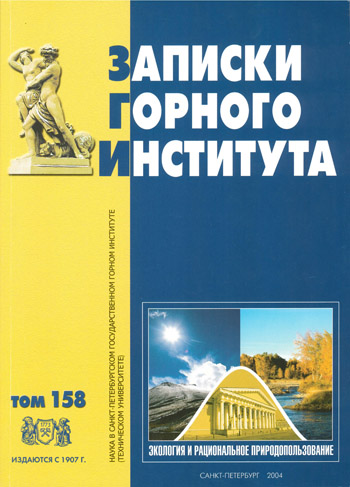
Vol 158
Pages:
166-168
Download volume:
RUS
Article

Physical and chemical basis for the creation of sorption technologies for the management of highly saline liquid radioactive waste (mathematical modeling)

Authors:
V. A. Avramenko
About authors
  • Far East Technological Center of the Ministry of Education of the Russian Federation
Date submitted:
2003-08-21
Date accepted:
2003-09-21
Date published:
2004-12-15

Abstract

By the example of sorption-reagent materials (SRM) based on inorganic hydroxides the factors influencing the efficiency of the strontium sorption process are considered. It is shown that formation of a poorly soluble sediment in the porous system of the sorbent matrix is possible either in the form of microcrystals in the pore volume or in the form of thin X-ray amorphous layers on the pore surface, which in turn affects the selectivity of strontium extraction. The peculiarities of strontium sorption dynamics by SRM are considered. Mathematical model of strontium sorption dynamics in sorption-reagent systems is presented which allows not only to predict sorption behavior of material, form content of all system components at any moment of time and at any point of a column, but also to explain distinctive features of the process.

Область исследования:
(Archived) Radioactive waste and irradiated nuclear fuel management
Funding:

None

Go to volume 158

Similar articles

Development of porous glass-crystalline material based on cenospheres of energy ashes for radioactive waste disposal
2004 A. G. Anshits
Development of a mobile unit for conversion of petrochemical waste into liquid fuel
2004 A. D. Zorin
Multipurpose use and reproduction of protective forest plantations in the central forest-steppe and southern Russia
2004 L. T. Sviridov
Improvement of the regional information and analytical system of social environmental monitoring and environmental safety
2004 A. V. Frolov
Analysis of the variability of the material composition and morphometric features of ores in order to predict the technological properties of minerals and reduce losses of useful components
2004 Yu. B. Marin, Yu. L. Gulbin, V. O. Ilichenko, D. A. Petrov, A. A. Savichev, V. V. Smolenskii
Landscape and environmental planning
2004 A. A. Selivanov