

Mineral raw materials resources in the strategy of progress of the Russian economy
- Ph.D.
Abstract
The importance and place in Russia's economy development strategy has been developed as a result of detailed analysis of the mineral - and - raw materials resources potential.
None
The sustainable development of the Russian economy in the coming years must be based on the systematic growth of its components and, above all, through its mineral resource potential. In this context, sustainable development as applied to mineral and raw material resources implies the guaranteed provision of the country’s economic security by establishing a reliable mineral resource base to meet the current and prospective needs of the Russian economy, taking into account environmental, social, demographic, defense, and other factors.
An analysis of global economic development shows that the economic growth of developed countries amounts to 2-3% per year and is typically achieved through the adoption of high technologies. Given this, the Russian economy should maintain an economic growth rate of 4-6%. It should be noted that such growth will help reduce Russia’s lag behind developed countries in terms of GDP per capita.
Economic growth should be no lower than the rates indicated above, and this can be ensured through the extraction, processing, and utilization of mineral and raw material resources.
An analysis of the economic potential of mineral and raw material resources, the state of fixed assets, and the technologies employed in the extractive sector will provide grounds for drawing certain conclusions regarding the significance and place of the mineral resource complex in the framework of the country’s economic development:
- Mineral and raw material resources represent a significant potential for the country’s economic development.
- Comprehensive support for the development of domestic processing industries based on the extractive sector is the primary reserve for transforming Russia in the relatively near future into a leading economic power with a high standard of living for the majority of its population.
- Analysis of economic processes taking place in the world necessitates comprehensive state support and the creation, on the basis of resource-extracting enterprises, of large cross-sectoral financial-industrial corporations capable of competing on equal terms with Western transnational corporations.
- The development of the extractive sector must be regulated by the state using purely market methods. At the same time, the state must facilitate in every way the development of processing industries based on the extractive complex.
- The state of fixed assets and the technologies employed in the extractive sector of a country with the richest reserves of natural resources is such that they cannot, in the coming years, provide significant additional financial inflows into the state budget for major public investments in its own processing industry.
- Due to the low share of labor in the cost of extracted raw materials and the relatively high cost of a workplace in extractive industries, raw material resources cannot serve as a reserve for raising the standard of living for the majority of the country’s population.
The Russian economy in the 21st century, at least in its first half, will apparently retain its raw material orientation. The potential value of Russia’s balance sheet reserves of mineral resources allows the mineral resource complex to be considered as the basis for the country’s sustainable development in the long term (Fig. 1). The presence of a major natural resource potential determines Russia’s special place among industrial nations. This resource potential, if used effectively, will become one of the most important prerequisites for Russia’s stable integration into the world economy.
The country’s endowment with natural resources is a crucial economic and political factor for the development of social production. The structure of natural resources, the size of their reserves, quality, degree of exploration, and directions of economic development directly influence economic potential. The presence of rich and efficient natural resources provides broad scope for the economic development of regions.
The economic development of Russia’s natural resources creates real opportunities for attracting large-scale investments, including foreign capital; a significant portion of foreign currency earnings is provided through the export of natural resources (Fig. 2).
Mineral resources occupy a central place among Russia’s natural resources, which is determined by the following circumstances:
- geographical position, which makes sustenance impossible without significant consumption of mineral resources;
- a predominantly raw-material economic structure oriented towards the extraction, processing, and conversion of mineral raw materials;
- the greatest attractiveness of subsurface resources for foreign investors;
- vast territories and the geological exploration work conducted on them in previous decades, which have made subsurface resources a highly significant element of national wealth.
The total value of Russia’s mineral resource base, based on explored and assessed reserves of all types of mineral resources, amounts to at least USD 28 trillion; however, the estimated value of their commercially viable portion is only USD 1.5 trillion.
The Russian Federation possesses significant reserves of mineral resources. The number of types of mineral raw materials explored within its territory is unique and has no parallel in the world. In terms of nickel and natural gas reserves (33% of world reserves), Russia ranks first in the world; in oil reserves it is second after Saudi Arabia; in coal − third after the USA and China; in gold − third after South Africa and the USA, etc. In addition to the direct availability of a wide range of the most important types of mineral raw materials, this sector of the economy possesses developed extraction and processing infrastructure and a powerful scientific and technical potential.
The Russian mineral resource complex plays an important role in all spheres of the state’s life:
- It ensures the stable supply of mineral resources to the sectors of the economy. It is precisely the developed state of the raw materials sector that contributes to the formation of a solid industrial base capable of meeting the necessary needs of both industry and agriculture.
- It makes a substantial contribution to the formation of the state budget’s revenue; its products continue to be the main source of foreign currency earnings. Enterprises comprising the mineral resource complex account for over 50% of the country’s gross domestic product. The volume of export revenues to the state budget, directly or indirectly provided by the development of the country’s mineral wealth, amounts to 70%.
- It constitutes the foundation of the country’s defense might. A developed raw material base is a necessary condition for improving the state’s military-industrial complex and creates the necessary strategic reserve and potential.
- It ensures social stability. In Russia, almost all major companies that are part of or linked to the mineral resource complex are city-forming enterprises. Thus, the development of this economic sector will ensure an increase in the population’s welfare and a reduction in social tensions.
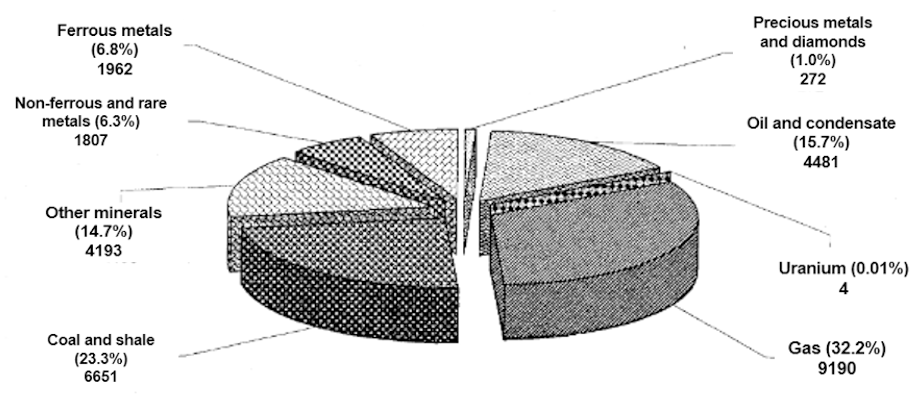
Fig.1. The total potential value of Russia’s mineral reserves is $28,560 billion.
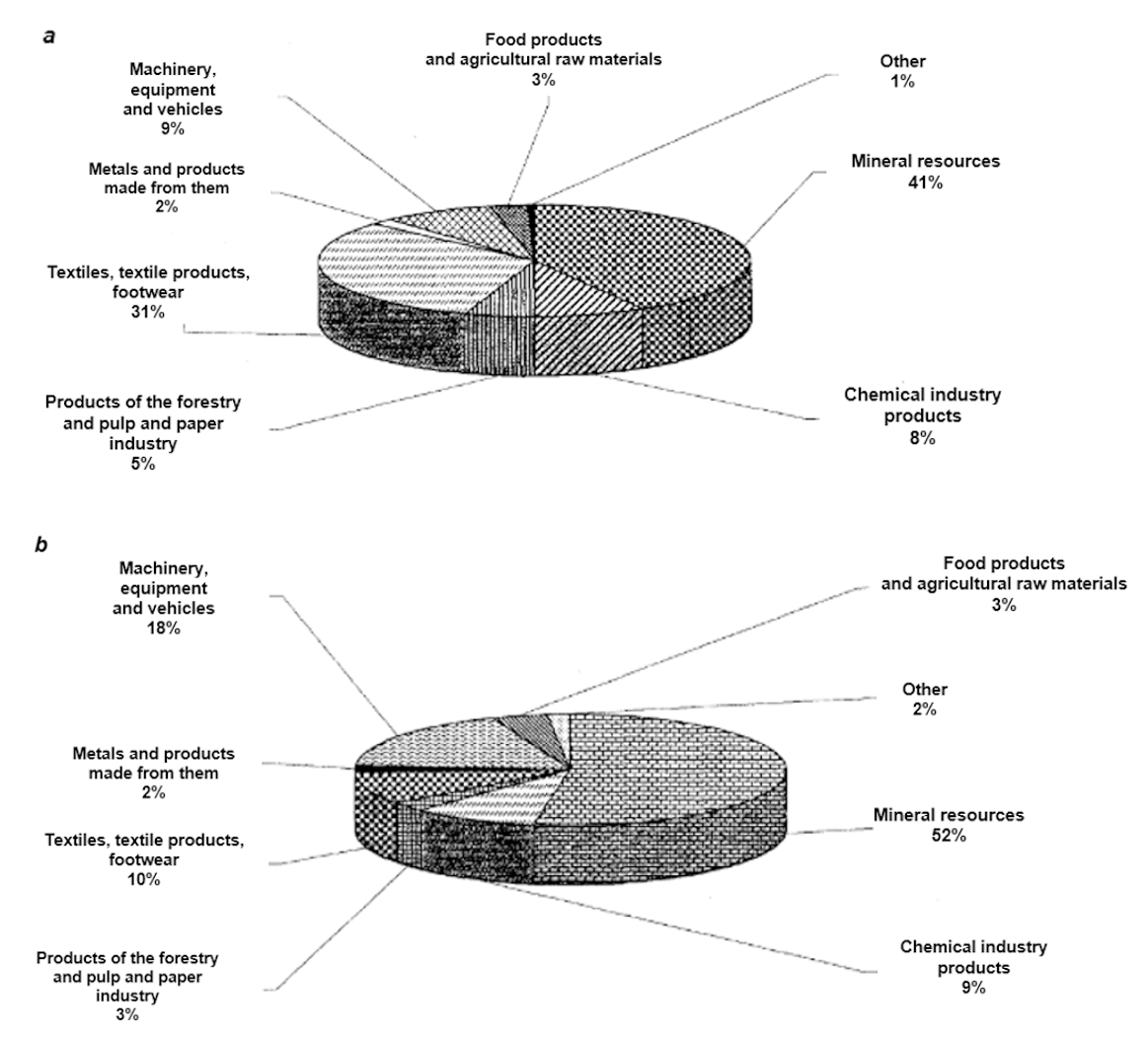
Fig. 2. Commodity composition of exports to non-CIS countries (a) and CIS countries (b)
A strategic factor for Russia’s economic growth in the near future must be the structural restructuring of the national economy based on the country’s available mineral and raw material resources with the aim of significantly increasing its efficiency. The particular complexity of this task lies in the need to restructure the sectoral and production frameworks that were formed under the conditions of a planned-distributive system in complete isolation from the world market. This circumstance determined the low efficiency of the manufacturing industry, the lack of competitiveness of most of its products on the world market, and, as a consequence, a decline in production volumes and the closure of many enterprises in this sector of economy.
Raw material and, in particular, extractive industries are unable to absorb the vast mass of labor released from the processing sectors of the economy. At the same time, most mining enterprises lack sufficient investment potential not only for expanded but even for simple reproduction of their fixed assets. For example, in the most prosperous sector of the Mineral Resource Complex (MRC) − the gas industry − over 60% of gas pipelines have been in operation for more than 20 years (with a standard service life of 33 years), while in the coal industry over two-thirds of fixed assets are beyond the point of physical depreciation.
In this regard, the process of structural restructuring of the national economy should aim at forming highly efficient and competitive companies in both domestic and global markets. Given Russia’s enormous mineral resource potential, the restoration of the domestic manufacturing industry should be carried out on the basis of its comprehensive integration with the extractive industries.
The most promising form of such integration should be the creation, with comprehensive state support, of large financial-industrial groups − cross-sectoral corporations capable of competing with Western transnational corporations.
The current financial state of enterprises in the extractive and processing industries, the use of non-competitive technologies in the production process, and the lack of funding for geological exploration − all this necessitates, with the support of state bodies, organizing financial-industrial groups capable of accumulating significant financial resources in domestic and global capital markets.
The main priorities of the state in creating cross-sectoral financial-industrial groups should include:
- sustainable provision of the country with mineral resources and their processed products;
- improving the efficiency of mineral and raw material resource utilization and creating the necessary conditions for transitioning the economy to a resource-saving development path;
- further development of the raw material base;
- maintaining and increasing the country’s export potential, changing its structure in favor of trading processed products and industrial goods;
- development of the manufacturing industry and its export potential, among others.
The emerging process in Russia of establishing industrial-financial groups based on individual sectors of the MRC (primarily gas, energy, oil, aluminum, etc.) signifies the formation of a new stage of development: the integration of multi-sectoral complexes with financial and commercial structures.
These complexes must determine the pace of transformation and recovery of the Russian economy as a stable source of budgetary and foreign currency revenues, a significant center of stability, including effective employment of the population; as a factor in forming breakthrough critical technologies; as a factor in the restructuring and modernization of the basic sectors of the MRC and industry; and, finally, as a factor of integration within Russia, the CIS, and the global community.
Regardless of who owns natural resources, particularly mineral resources, the state has the right to regulate the process of their development and use, acting in the interests of society as a whole and of individual owners whose interests conflict with each other, and for achieving a compromise, the assistance of state authorities is necessary.
In a centrally managed economy, environmental management existed outside the sphere of market relations. At the beginning of market reforms in Russia, the state temporarily relinquished strategic management of the natural resource complex. This resulted in stagnation of the national natural resource potential, the collapse of the geological sector formed over many decades, and a number of other negative consequences. But now, the market euphoria of the first years of economic reforms is gradually giving way to a more balanced approach, which admits the possibility and recognizes the necessity of state regulatory influence on economic processes in general and on environmental management in particular. The practice of countries with developed market economies provides us with many examples of effective state intervention in long-term natural resource development projects.
A modern strategy for rational resource consumption cannot be based solely on the possibilities of the market as such. This is even more true for transitional stages of economic development, and therefore, for the Russian national economy. Practice clearly demonstrates this: even our innovative enterprises often do not use resource-saving technologies.
The market mechanism, even in developed countries, does not ensure the solution of strategic tasks in environmental management, nature conservation, and sustainable economic security, as clearly evidenced by the outcomes of the 1992 United Nations Conference on Environment and Development (largely reflected in the governmental concept for the transition of the Russian Federation to sustainable development, approved by Presidential Decree No. 440 of April 1, 1996).
In Russia, therefore, it is necessary to implement a principle of rational environmental management that involves the organic combination of market self-regulation mechanisms and support for rational resource consumption and resource conservation. The system of state regulation and support for the latter should include, at a minimum, the following subsystems: a) legal support, b) financial and credit support, c) infrastructure and information support, d) insurance against emergencies and natural disasters. One can also distinguish subsystems for scientific support, environmental and economic education, professional development, etc. Rational resource consumption and conservation is a complex and multifaceted problem. Alongside socio-economic and environmental aspects, researchers identify technical and technological aspects. The improvement and radical renewal of technologies must be placed at the forefront of entrepreneurial activity deployment. According to a number of serious foreign and domestic studies in the field of technological macro-dynamics, Russia remains (and given the current ill-conceived strategy of market reform, will long remain) multi-structured not only in terms of forms of ownership but also in terms of so-called technological paradigms. Here, the dominant paradigm is the “third (resource-intensive) paradigm,” which developed countries had already moved beyond by the end of the 1970s, while the “fourth technological paradigm,” associated with the transition to resource-saving innovative technologies, is represented only in a few of military-industrial complex (MIC) production facilities.
Potential conditions for transitioning to new paradigms exist in Russia in a number of areas, but to implement these opportunities it is necessary to ensure the dissemination of advanced technologies from the MIC to civilian industries and economic sectors, utilize the still-preserved groundwork of relevant domestic developments, and stimulate our scientists to intensify new research. Through the development and implementation of new paradigm technologies, it will be necessary first and foremost to ensure efficient resource consumption by entrepreneurial structures in the fuel and energy complex, the agro-industrial complex, and in the industries and spheres of production, social, and market infrastructure.
To rationalize resource consumption, appropriate organizational and economic conditions must be created. The market mechanism, as already noted, is not in itself capable of solving the entire complex of problems under consideration; a number of contradictions are resolved through scientifically grounded state regulation. This involves countering the monopolistic behavior of large corporate structures, which in some cases hinder innovation and violate environmental management norms; ensuring the purity of biosystems; blocking tendencies toward environmental pollution, etc. In all developed states, environmental management is regulated to the greatest extent (though far from always effectively) − regardless of existing forms of land and subsoil ownership or forms of economic activity.
The most important goal of natural resource policy is to ensure the rational and efficient use of Russia’s natural resource potential to meet the current and prospective needs of the country’s economy and for export. It must ensure the implementation of fundamental structural transformations that eliminate inefficient, resource-wasteful environmental management; the creation of economic mechanisms for the comprehensive solution of tasks related to the rational use, protection, and reproduction of natural resources, including state support for new methods and techniques for studying, forecasting, and monitoring the state of the environment; and the improvement of interconnected cadaster systems based on digital geoinformation systems.
In this context, the strategic goal of state policy in the sphere of replenishment (restoration), use, and protection of natural resources for the coming decade is to achieve optimal levels of reproduction, non-depleting, rational, and balanced consumption and protection of the entire complex of natural wealth. This is aimed at enhancing the country’s socio-economic potential, the population’s quality of life, implementing the rights of present and future generations to utilize the natural resource potential and a favorable living environment, intensified conservation of raw materials, materials, and energy at all stages of production and consumption, creating the basis for transitioning to sustainable development, exercising high responsibility when making various domestic and foreign policy decisions aimed at implementing geopolitical interests and safeguarding Russia’s national security.
At the same time, the main strategic tasks for the natural resource sector are: completing the transition to a rational combination of administrative and economic methods of state regulation in the field of environmental management; forming an effective system of state management bodies in the sphere of environmental management, with clear coordination and demarcation of their areas of responsibility; developing the legal framework to stimulate innovation and investment processes in the field of environmental management; optimizing the volume and expanding the diversification of investment sources for the reproduction, consumption, and protection of natural resources; developing state regulation of export-import operations concerning natural resources; implementing state support for scientific research as the most crucial initial part of the technological cycle in the study, reproduction, use, and protection of natural resources; creating conditions for balanced environmental management as a fundamental factor for the country’s sustainable development; ensuring the demarcation of functions and powers between federal bodies and subjects of the Russian Federation in the sphere of environmental management; and accounting for regional specifics and needs of environmental management while improving the structure of the Russian economy as a whole.
In the first stage, the state’s efforts should be directed toward solving the following problems: improving natural resource legislation, including strengthening administrative and criminal liability for its violation; deepening and refining the economic mechanism of environmental management; clarifying and adjusting the system of licensing and regulation of environmental management regimes; developing an audit mechanism in the field of environmental management; expanding the list of types of natural resources used on a fee basis; creating an effective mechanism for the financial support of programs and measures for the reproduction and protection of natural resources; formulating criteria and requirements for the demarcation of state and other forms of ownership over natural resources; and establishing a federal fund of reserve mineral deposits and other types of natural wealth, among others.
In the future, the main efforts should be focused on completing the creation of a unified system of regulatory and legal support; implementing state policy in the field of environmental management; transitioning to the management and regulation of environmental management based on the demarcation of state ownership of natural resources between the center and the constituent entities; developing (reforming) the taxation system in the sphere of environmental management with the primary replacement of excise taxes by royalty payments; introducing systems of insurance and audit into environmental management practice; implementing territorial comprehensive cadasters of natural resources; creating a unified, standardized information-analytical and statistical accounting system for natural resources, and a number of other areas.
In the future, the main efforts should be focused on completing the creation of a unified system of regulatory and legal support; implementing state policy in the field of environmental management; transitioning to the management and regulation of environmental management based on the demarcation of state ownership of natural resources between the center and the constituent entities; developing (reforming) the taxation system in the sphere of environmental management with the primary replacement of excise taxes by royalty payments; introducing systems of insurance and audit into environmental management practice; implementing territorial comprehensive cadasters of natural resources; creating a unified, standardized information-analytical and statistical accounting system for natural resources, and a number of other areas.
In this regard, it is necessary to develop and begin implementing a concept for state natural resource policy, encompassing problems of regulatory, legal, economic, and statistical accounting support for rational environmental management; to complete the preparation of the regulatory and legal framework for introducing fees for the use of all types of natural resources involved in economic circulation; to continue improving the system of payments for the right to use subsoil resources, including the possibility for subsoil users to receive benefits for resource depletion or for processing low-quality ores containing scarce minerals. Subsequently, it is necessary to foresee a reduction in the number of taxes and a transition primarily to royalty payments, to increase the effectiveness of state management of environmental management, to strengthen the economic foundations of federalism in the sphere of property relations over natural resources, to strengthen administrative and criminal liability for violations of natural resource legislation, and to ensure the protection of national interests when attracting foreign investment.
For implementing state policy in the use, protection, and reproduction of mineral resources, the following primary key measures should be envisaged: preventing the depletion of the exploration backlog from previous years by intensifying geological surveys and exploration work; eliminating acute shortages in the country of specific types of mineral raw materials (manganese, chromium, uranium, etc.); halting the lag in reserve growth behind production volumes; developing the mineral resource base at the regional level through the identification, evaluation, and industrial development of small deposits of coal, peat, and agrochemical raw materials, primarily in remote areas of Russia that lack alternative sources of solid fuel and mineral fertilizers; increasing the comprehensive use of mineral raw materials; developing measures to modernize geological exploration work, introducing new machinery for drilling and geophysical operations adapted to the geological and natural conditions of specific oil, gas, and ore regions of Russia; expanding the scope of studying and utilizing the resources of the continental shelf and the World Ocean.
As a final overall conclusion, it should be noted that the established socio-economic prerequisites, as well as the strategy for Russia’s emergence from deep crisis and the regaining of its former power on a qualitatively new basis, indicate that the state of the country’s mineral resource complex remains the most important factor in the state’s development for the near future. The speed of overcoming crisis phenomena in the country, the creation of a material and technical base for the production of high-tech and knowledge-intensive products, including durable goods; the solution of the food problem, including ensuring Russia’s state security in the area of food supply; changing the structure of foreign trade to correspond to the commodity turnover of developed world countries; the solution of many social problems and a whole range of factors determining the future of the Russian Federation overwhelmingly depend on the level of rationality, considered responsibility, and the scale of utilizing the potential of natural wealth.