

Nimba iron ore deposit in Guinea
Abstract
The Nimba deposit is located in the extreme southeastern part of Guinea and extends into neighboring Liberia, where iron ore production of approximately 9 million tons per year is taking place.The iron ores of the deposit are confined to the upper part of the Precambrian crystalline rocks ...
None
The Nimba deposit is located in the extreme southeastern part of Guinea and continues on the territory of neighboring Liberia (Fig.1), where iron ore is mined in the amount of approximately 9 million tons per year [2].
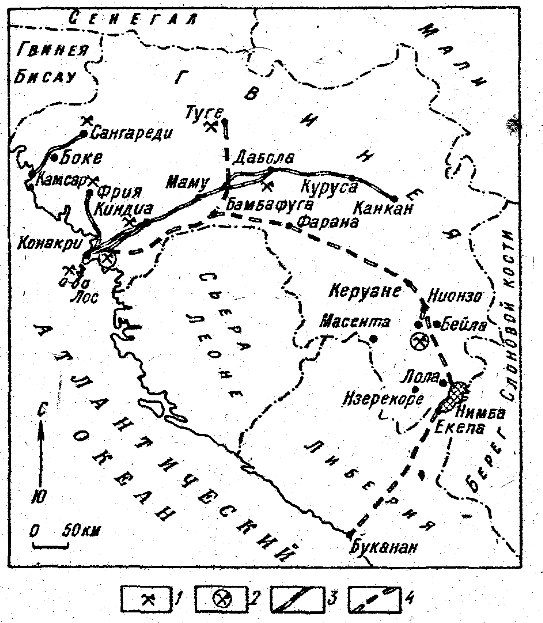
Fig. 1. The arragement of the iron ores of Nimbus in Guinea
1 - bauxite deposits; 2 - iron deposits; 3 - railway; 4 - railway project.
The iron ores of the deposit are associated with the upper part of the Precambrian crystalline rock sequence (Fig. 2). The thickness of the iron-bearing sequences is 200 m or more. The productive sequence is folded, as a result of which the ore bodies often have steep, sometimes vertical bedding. The following sequence of geological formations has been established in the deposit area (from bottom to top): 1) Lower Precambrian (Archean?) granite-gneisses; 2) the Birrimian Series, represented by various quartzites, schists, and iron ores of the Middle Precambrian. The rocks of the Nimba Range are known as the Simandou Series. Among them, the following are distinguished: 1) Quartzites – massive, grey-blue, monomineralic rocks with rare inclusions of chloritized sericite flakes; 2) Schists – intensely foliated dark grey rocks; along foliation surfaces, localized granitization is sometimes observed; the main minerals are quartz and biotite; 3) Itabirites – banded ores characterized by alternating very thin interlayers of microgranular quartz and iron oxides; biotite is observed along the boundary between layers.
The Nimba Series lies unconformably on the granite-gneisses. However, a fault zone, accompanied by cataclysm of the rocks, may be developed along their contact.
The formations of Mount Nimba are of primary sedimentary origin. The quartzites have an aleuro-psammitic composition, the schists – an aleuro-pelitic composition.
The metamorphism of these rocks reaches the biotite facies. Considering that the ore constitutes the upper part of the stratigraphic column and the quartzites its lower part, it can be concluded that the Nimba rocks were formed as a result of a transgression.
Four types of ores are distinguished in the deposit [3]: so-called “blue” ores, platy ores, itabirites, and Tanga ores.
The “blue” ores are composed predominantly of hematite, magnetite, and limonite. Magnetite is almost completely absent in some parts of the ore and reaches up to 10% of its total volume. The distribution of magnetite grains is very uneven.
Hematite, which predominates in the “blue” ores, occurs in two forms: proper crystallographic (as flakes among non-ore minerals) and as a product of magnetite replacement (martite). Two stages of magnetite replacement by hematite can be traced – from penetration along cleavage cracks or the formation of a “rind” around magnetite grains to its complete replacement.
Limonite (hydrogoethite) is observed as isolated grains or their aggregates, replacing magnetite and hematite.
Non-metallic minerals are represented by isolated quartz grains or a finely dispersed mixture of silica and limonite.
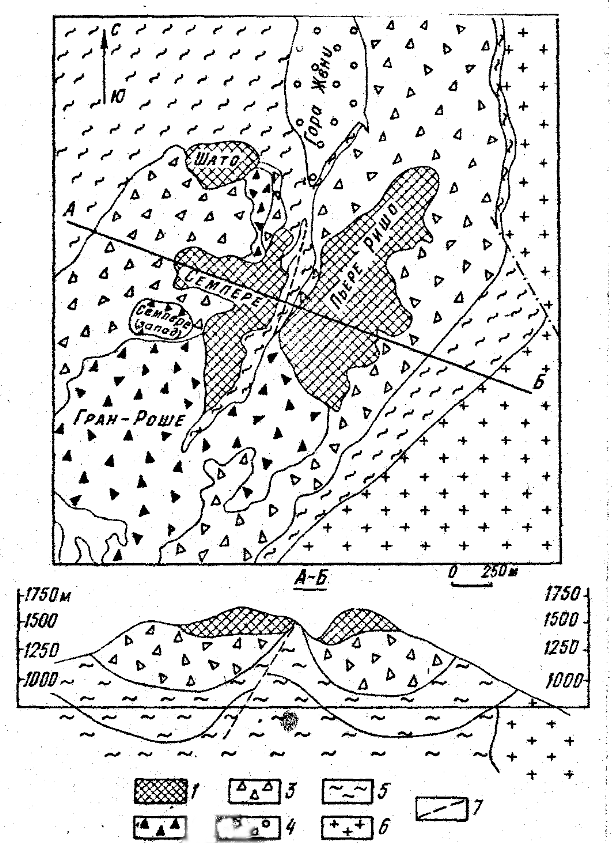
Fig. 2. Geological map of the ore deposit of the Nimba ridge
1 - rich iron ores (more than 60% Fe); 2 - ordinary iron ores (50-60% Fe); 3 - itaberites (less than 50% Fe); 4 - quartzites; 5 - crystalline schists; 6- granite gneiss; 7 - fractures.
The average chemical composition of the ore is: 68.9% Fe; 0.6% SiO₂; 0.6% Al₂O₃; 0.06% P; 0.04% S; 0.02% Ti.
Plate ores are distinguished by the presence of a large amount of non-ore minerals. The iron content in them decreases to 60-54%.
Itabirites (ferruginous quartzites) are characterized by alternating siliceous and iron-rich layers; their iron content is relatively high – 40-50%. In the future, itabirites may be considered as an industrial ore type.
Tanga represents ore colluvium with a high iron content (60-64%). This is an industrial ore type.
For all ore types, the following sequence of mineral formation is established: magnetite and hematite formed first in the form of plates; then the process of martitization occurred, and finally, limonitization.
Itabirites have a primary sedimentary genesis. The rich platy and “blue” ores were formed in the ancient weathering crust of itabirites.
Within the Guinean part of Nimba, four ore sectors are known: Grand Roche, Pierre Richaud, Sempéré, and Château (see Fig. 2). Reserves of “blue” and platy ores (see table) have been calculated by American geologists.
Ore reserves at the Pierre Richaud site
|
Inventory history |
Average Fe content in ore, % |
Ore reserves, million tons |
|
Guaranteed Probable Possible |
65 62 60 |
250 50 20-50 |
The total reserves of these types of ores in the Guinean part of the Nimba deposit can be estimated at 1 billion tons. In addition, itabyrite reserves can be estimated at 500 million tons.
References
- Mikhailov B.I. Geology and Mineral Resources of the Liberna Shield. - Tr. VseGEI, nov, series, 1969, v. 167, 180 p.
- Bere J.W., Johansson K., Jak J. - Econ. Geol., 1977, v.72. pp. 582-607.
- Rapport Tractionnel, 1972, № 3. Mlfergul-Nimba Conakry.